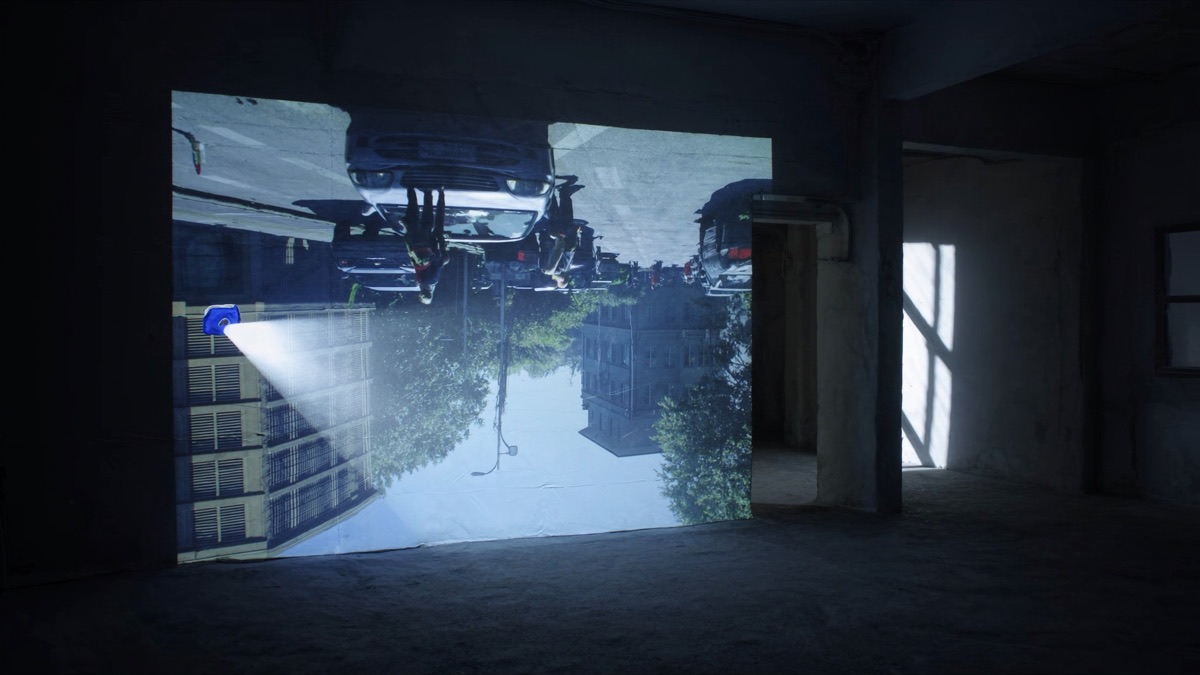
A camera obscura is simply a darkened space with one small hole in an otherwise light-blocking wall, and light rays passing through that single small opening naturally project an inverted, surprisingly detailed image of whatever scene lies outside directly onto the opposite interior wall, with no lens, no glass, and no mechanical components whatsoever required. This effect works because the tiny hole physically restricts light entering the darkened room to only one narrow ray path from each specific point in the outside scene, so light from the top of an object outside is naturally forced to land near the bottom of the projected image, and light from the bottom naturally lands near the top.
Why a Tiny Hole Alone Can Project a Complete, Detailed Image
Without a restricting small opening, light from every single point in the outside scene would simply scatter and overlap chaotically across the entire interior wall, illuminating it with a uniform undifferentiated wash of light rather than forming any recognizable, coherent image whatsoever.
The small hole's specific size represents a genuine physical tradeoff: a larger opening lets in considerably more overall light, producing a noticeably brighter image, but that same larger opening also allows more overlapping light rays through simultaneously, which meaningfully blurs the fine detail and overall sharpness of the projected result.
How Pinhole Size Directly Trades Off Image Brightness Against Sharpness
An extremely small pinhole restricts incoming light to an almost single, precisely defined ray path per outside scene point, producing a genuinely sharp, well-focused projected image, though one that is also correspondingly quite dim because comparatively little total light manages to pass through such a tiny restrictive opening.
There exists a specific mathematically optimal pinhole diameter for any given camera obscura chamber depth, one that meaningfully balances acceptable image sharpness against acceptable image brightness, and this specific optimal diameter can actually be calculated in advance using established formulas that account for both the physical wavelength of visible light and the particular chamber's internal depth.
Why the Projected Image Appears Upside Down and Also Left-Right Reversed
Light traveling in a perfectly straight line from the top of an outside object must physically pass downward through the small pinhole opening to reach the lower portion of the interior projection surface, which is precisely why the resulting projected image appears fully inverted vertically compared to the actual outside scene.
This exact same straight-line geometric principle applies equally to the horizontal direction as well, meaning light from the left side of the outside scene crosses through the pinhole to land on the right side of the projected interior image, and vice versa, producing a complete image inversion along both the vertical and horizontal axes simultaneously.
How Ancient Philosophers First Documented and Investigated This Optical Effect
The ancient Chinese philosopher Mozi documented and specifically described this precise pinhole imaging phenomenon as early as the fifth century BCE, correctly identifying and explaining that light travels in perfectly straight lines and specifically noting that this simple geometric fact alone explains why the resulting projected image consistently appears inverted.
The ancient Greek philosopher Aristotle separately observed a naturally occurring version of this identical phenomenon, specifically noting that sunlight passing through small irregular gaps between overlapping tree leaves projects a series of small circular images of the sun itself onto the ground below, even when those particular gaps themselves are not perfectly circular in shape.
Why Ibn al-Haytham's Systematic Experiments Advanced Understanding Considerably
The medieval Arab scientist Ibn al-Haytham, working in the early eleventh century, conducted considerably more rigorous and systematic experiments specifically using darkened chambers with small controlled apertures, and he correctly connected the observed pinhole imaging effect directly to his broader, more comprehensive theories concerning exactly how light and human vision itself actually work.
His methodical, carefully documented experimental approach to studying this specific optical phenomenon is widely regarded by historians of science as an important early meaningful contribution to the broader development of empirical, evidence-based scientific methodology, considerably predating the systematic Scientific Revolution figures more commonly credited in later Western scientific history.
How Adding a Simple Lens Transformed the Basic Camera Obscura Device
Later Renaissance-era camera obscura designs incorporated a simple convex glass lens fitted directly into the aperture opening instead of relying on a plain, unmodified small hole, and this comparatively simple modification allowed considerably more overall light to pass through the opening while simultaneously actually improving rather than degrading the sharpness and clarity of the final projected image.
This meaningful lens-based improvement specifically worked because a properly shaped convex lens can actively focus multiple genuinely divergent light rays from each individual outside scene point back together into one single sharply defined image point, entirely unlike a simple pinhole opening which can only naturally pass through one comparatively narrow single ray path per scene point.
Why Artists Widely Used Camera Obscura Devices as a Genuine Drawing Aid
Renaissance and later Baroque-era painters commonly used portable camera obscura devices specifically to project a real scene directly onto their drawing surface or canvas, then simply and directly traced the resulting projected outlines to achieve genuinely accurate proportions and correct perspective far more easily and reliably than could be reasonably achieved through freehand observational drawing alone.
Considerable art historical debate continues today regarding precisely which specific historical artists actually used camera obscura devices for this specific purpose, with the celebrated Dutch painter Johannes Vermeer frequently cited as a particularly likely genuine user based on certain distinctive optical qualities and characteristics observed in his finished paintings, though definitive, universally conclusive historical proof of this specific claim genuinely remains actively disputed among art historians.
How the Camera Obscura Principle Directly Led to Photography's Later Invention
Early pioneering photography inventors directly adapted the well-established camera obscura's existing image-projection principle, then specifically added a light-sensitive chemical coating applied to a surface positioned precisely where the projected image itself naturally formed, allowing that fleeting projected image to be permanently captured and fixed rather than merely observed temporarily and then lost.
This direct historical connection is precisely why the word "camera" itself, now universally used to mean a photographic device, actually derives directly from "camera obscura," the original Latin phrase which literally translates to "dark chamber" or "dark room" in English.
Why Room-Sized Camera Obscura Installations Remain Popular Tourist Attractions Today
Several historic and modern room-sized camera obscura installations still operate today specifically as public tourist attractions, commonly using a rotating external mirror mounted on the building's roof combined with an internal lens system to project a live, continuously moving image of the surrounding outside cityscape or landscape onto a large curved viewing table positioned inside a completely darkened room.
These specific larger installations demonstrate the exact same core underlying optical principle as a simple pinhole camera obscura but at a dramatically larger physical scale, and the additional rotating mirror component specifically allows visitors to view different outside directions without needing to physically move or reposition the entire fixed structure itself.
How a Modern Pinhole Camera Directly Applies This Same Ancient Optical Principle
A modern pinhole photographic camera is functionally just a small, portable, and genuinely light-tight version of the classic camera obscura, using a precisely sized tiny aperture instead of any conventional glass lens system, with light-sensitive photographic film or a digital image sensor positioned exactly where the resulting projected image forms inside the sealed camera body.
Because pinhole cameras genuinely lack any focusing lens element whatsoever, they naturally produce an inherently infinite depth of field, meaning both extremely close nearby objects and very distant far-off objects both appear simultaneously and equally in sharp focus within the exact same single photographic exposure.
Why Camera Obscura Exposure Times Are Inherently Much Longer Than Lens-Based Photography
Because a small pinhole opening physically admits substantially less total light than an equivalent conventional glass camera lens with a comparably wide aperture setting, achieving a properly and fully exposed photographic image through a pinhole opening genuinely requires a considerably longer overall exposure time, frequently ranging anywhere from several full seconds up to multiple continuous minutes depending on the specific ambient lighting conditions present.
This inherently longer required exposure time means any moving subjects present within a pinhole photograph's frame will typically appear significantly blurred or occasionally may disappear from the final image entirely, which is precisely why pinhole photography as an artistic medium is particularly well-suited to genuinely still, static subjects like architecture, landscapes, or long-exposure light trail photography.
How Chamber Depth Interacts With Aperture Size to Determine Magnification
The overall physical distance between a camera obscura's small aperture opening and its interior projection surface directly determines the final image's magnification level, with a proportionally deeper interior chamber producing a correspondingly larger projected image while a shallower, more compact chamber produces a correspondingly smaller one from the exact same identical outside scene.
This direct, predictable geometric relationship follows the exact same straightforward similar-triangles mathematical principle used throughout all of optics more broadly, where the resulting image size scales proportionally and predictably with chamber depth in a way that can be precisely calculated in advance using simple, well-established geometric formulas.
Why the Human Eye Itself Actually Works on a Remarkably Similar Optical Principle
The human eye functions somewhat like a considerably more biologically sophisticated version of a lens-equipped camera obscura, with the eye's cornea and internal crystalline lens together focusing incoming light rays onto the light-sensitive retina positioned at the rear interior of the eyeball, producing a naturally inverted image there in essentially the same fundamental optical manner as a projection-based camera obscura.
The human brain then automatically and unconsciously processes and effectively "flips" this naturally inverted retinal image back into the coherent, correctly right-side-up visual perception people consciously experience, a remarkable neurological correction process that happens so completely automatically and unconsciously that most people never actually realize their own eyes are physically capturing a genuinely upside-down image in the very first place.
How Astronomers Used Camera Obscura Devices to Safely Observe the Sun
Historical astronomers commonly used camera obscura devices specifically to safely observe solar eclipses and directly track sunspot activity over time without ever needing to look directly at the sun's dangerously intense direct light, since the projected solar image itself could instead be viewed comfortably and safely on an interior surface.
This particular safe indirect solar-viewing application remains genuinely relevant and actively used today, since directly viewing the sun without appropriately certified specialized eye protection can cause immediate and permanently irreversible eye damage, while a simple pinhole projector allows perfectly safe indirect solar eclipse viewing using nothing more than ordinary household materials.
Why Multiple Overlapping Pinholes Genuinely Degrade Rather Than Improve an Image
Adding a second additional pinhole opening to a camera obscura does not simply produce one single, correspondingly brighter combined image as one might initially reasonably expect; instead, it actually produces two entirely separate, distinctly overlapping projected images side by side, since each individual pinhole opening independently projects its own separate complete image of the identical outside scene.
This specific overlapping multiple-image effect becomes clearly and directly visible during a partial solar eclipse, when the small irregular gaps naturally occurring between overlapping tree leaves each project their own individual crescent-shaped sliver image of the partially eclipsed sun rather than one single simple round dot of light as they normally would during an ordinary non-eclipse day.
How Digital Pinhole Photography Combines Genuinely Ancient Optics With Modern Sensors
Contemporary digital pinhole photography enthusiasts commonly remove a conventional lens entirely from an otherwise standard digital camera body and replace it with a specialized precisely sized pinhole aperture cap, directly combining the exact same ancient optical projection principle first documented many centuries ago with genuinely modern digital image sensor technology.
This particular contemporary hybrid combined approach allows photographers to immediately preview their captured results instantly rather than waiting through the traditional chemical film development process, while still fully preserving the pinhole photography medium's genuinely distinctive characteristic soft focus, unusually wide depth of field, and considerably longer required exposure times.
Why Camera Obscura Devices Continue to Hold Genuine Modern Educational Value
Science museums and educational institutions worldwide commonly build and maintain functional working camera obscura exhibits specifically because the device so effectively and intuitively demonstrates fundamental core optical principles, including light's naturally straight-line travel, focal length relationships, and basic image formation, using nothing more than simple, easily understandable physical components with essentially no mathematical background required to grasp the underlying concept.
This genuine hands-on visual and tangible demonstration approach makes fundamentally abstract optical physics concepts considerably more immediately intuitive and accessible for students than an equivalent purely textbook-based mathematical explanation alone could ever realistically achieve, particularly for younger students or beginning learners with limited prior formal optics background.
How Camera Obscura Rooms Are Deliberately Constructed to Maximize Image Quality
Properly built camera obscura installations require genuinely complete and absolute darkness inside the interior viewing chamber itself, since even small amounts of unwanted stray light leaking in from other sources would otherwise wash out and significantly reduce the contrast of the comparatively faint naturally projected image on the interior wall or table.
The specific interior projection surface itself is often deliberately painted a plain flat white or otherwise neutral matte color specifically to maximize how much of the incoming projected light is diffusely reflected back toward waiting viewers' eyes, while the projection chamber's remaining interior walls are typically instead painted matte black specifically to minimize any unwanted secondary internal light reflections that could otherwise degrade overall image contrast and clarity.
Sources
- Encyclopaedia Britannica — Camera Obscura
- The Metropolitan Museum of Art — Camera Obscura
- Smithsonian Institution — History of Photography
FAQ
How can a simple hole with no lens project a real image?
The hole restricts light to one narrow ray path per outside point, so light naturally lands in a consistent inverted position rather than scattering chaotically across the wall.
Why does a smaller pinhole produce a sharper but dimmer image?
A smaller opening restricts light to an almost single ray path per point, producing sharp focus, but lets through much less total light, making the image dim.
Why does a camera obscura image appear upside down?
Light from the top of an object must travel downward through the pinhole to reach the lower part of the projection surface, inverting both vertically and horizontally.
Who first documented the pinhole imaging effect?
The Chinese philosopher Mozi described it as early as the fifth century BCE, correctly explaining that light travels in straight lines and that this causes the inversion.
How did Ibn al-Haytham advance understanding of this phenomenon?
In the eleventh century he conducted rigorous systematic experiments with controlled apertures, connecting the effect to his broader theories of light and vision.
Why did adding a lens improve rather than degrade the projected image?
A convex lens can focus multiple divergent light rays from one scene point back into a single sharp image point, unlike a pinhole which passes only one narrow ray.
Did famous painters actually use camera obscura devices?
Many Renaissance and Baroque artists likely did to trace accurate proportions, with Johannes Vermeer frequently cited as a probable user, though definitive proof remains disputed.
Why is the word "camera" derived from camera obscura?
"Camera obscura" is Latin for "dark chamber," and early photography inventors directly adapted its image-projection principle, carrying the name into the word "camera."
How do room-sized camera obscura tourist attractions work?
They typically use a rotating roof-mounted mirror and internal lens to project a live moving image of the surrounding cityscape onto a curved table in a darkened room.
Why does a pinhole camera have infinite depth of field?
Lacking any focusing lens element, it produces the same sharp focus for near and far objects simultaneously within a single exposure, unlike lens-based cameras.
Why do pinhole photographs need such long exposure times?
A pinhole admits far less light than a conventional wide-aperture lens, requiring exposures from several seconds to multiple minutes to properly expose the image.
How does chamber depth affect the projected image size?
A deeper chamber produces a proportionally larger projected image, following the same similar-triangles geometric principle used throughout optics generally.
Does the human eye actually work like a camera obscura?
Yes; the cornea and lens focus light onto the retina, forming a naturally inverted image that the brain automatically flips into the upright perception people experience.
Why did astronomers historically use camera obscura to observe the sun?
It let them safely view a projected image of solar eclipses and sunspots without ever looking directly at the sun's dangerously intense light.
What happens if you add a second pinhole to a camera obscura?
It produces two separate overlapping projected images side by side rather than one brighter combined image, since each hole projects its own complete image independently.
How does digital pinhole photography combine old and new technology?
Photographers remove a conventional lens and replace it with a pinhole aperture cap, combining ancient optical projection with a modern digital image sensor.
Why do science museums still build working camera obscura exhibits?
The device intuitively demonstrates fundamental optical principles like straight-line light travel and image formation using simple components with no math required.
About the Author
We reference Wikipedia and other authoritative sources to explain the background and current understanding of this topic.
Loved This Article?
Share it on WhatsApp → Share it on WhatsApp
Get more guides in your inbox — Subscribe to our newsletter for weekly surprising stories from Egypt, Saudi Arabia, Dubai, and beyond.