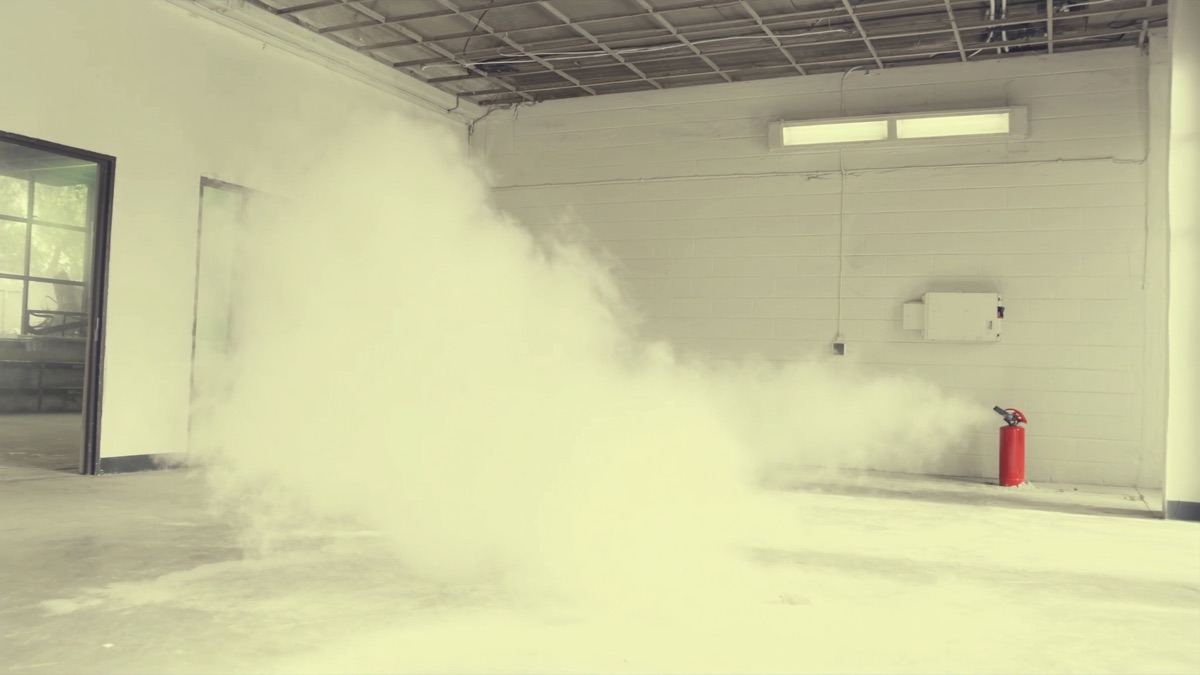
A fire needs three things at once to keep burning — fuel, oxygen, and enough heat to sustain the chemical reaction — and every fire extinguisher works by knocking out one or more of those three legs rather than simply dousing flames with liquid. Because different fuels burn in fundamentally different ways, the agent that safely smothers a wood fire can turn a grease fire into an explosive fireball, which is exactly why extinguishers are labeled by fire class and why picking the wrong one is one of the most dangerous mistakes an untrained person can make in an emergency.
The Fire Triangle: Why Fuel, Oxygen, and Heat Must All Be Present
Combustion is a self-sustaining chemical reaction that only continues while three conditions hold simultaneously: a fuel source, an oxidizer (almost always atmospheric oxygen), and enough heat to keep vaporizing the fuel into a reactive gas. Firefighters call this relationship the fire triangle, and removing any single side collapses the reaction entirely, which is the founding principle behind every extinguishing method ever devised.
Modern fire science actually extends this into a fire tetrahedron by adding a fourth element, the uninterrupted chemical chain reaction that propagates the flame itself, which explains why some agents work not by removing fuel, oxygen, or heat but by directly interrupting that chain reaction at a molecular level, a distinction that matters enormously for extinguisher design.
Class A: Why Water and Foam Work on Ordinary Combustibles
Class A fires involve ordinary solid combustibles like wood, paper, cloth, and most plastics, materials that leave glowing embers capable of reigniting long after visible flames disappear. Water is extremely effective here because it absorbs enormous amounts of heat as it vaporizes, cooling the fuel below its ignition temperature while also physically soaking into porous materials to prevent smoldering embers from flaring back up.
Foam extinguishers add a second mechanism on top of water's cooling effect: they form a blanket over the fuel surface that also limits oxygen contact, which is useful on class A fires but becomes essential rather than optional for the flammable liquid fires covered next. Multipurpose dry chemical extinguishers rated for class A work differently, coating the fuel in a chemical residue that also insulates against reignition.
Class B: Why You Must Never Use Water on a Flammable Liquid Fire
Class B fires involve flammable liquids and gases such as gasoline, oil, paint solvents, and propane, and using water on them is actively dangerous rather than merely ineffective. Because most flammable liquids are less dense than water and do not dissolve in it, a jet of water sinks beneath the burning liquid and displaces it outward, spreading burning fuel across a wider area instead of extinguishing it.
Foam, dry chemical, and carbon dioxide extinguishers instead work by cutting off oxygen at the liquid's surface or interrupting the chemical chain reaction directly, without introducing anything that spreads the fuel. Aqueous film-forming foam, developed originally for aircraft carrier fires, is especially effective because it spreads a thin water film beneath the foam layer that continues suppressing vapor release even after the visible foam blanket breaks down.
Class C: Why Electrical Fires Demand a Non-Conductive Agent
Class C fires involve energized electrical equipment, and the defining danger is not the flame chemistry itself but electrocution risk: any conductive agent, including plain water, can carry current back up the stream into the person holding the extinguisher. Once equipment is confirmed de-energized, an electrical fire technically reverts to whatever class A or B material is actually burning.
Carbon dioxide and dry chemical extinguishers are rated for class C specifically because their discharge is electrically non-conductive, letting a responder fight an energized fire without becoming part of the circuit. Carbon dioxide is often preferred around sensitive electronics and server equipment because it leaves no residue at all, evaporating completely and avoiding the corrosive chemical film that dry powder leaves on delicate components.
Class D: The Specialized Powders That Fight Burning Metal
Class D fires involve combustible metals like magnesium, titanium, sodium, and lithium, which burn at extremely high temperatures and react violently, sometimes explosively, with water because the intense heat splits water molecules into hydrogen and oxygen gas that then combusts itself. These fires are rare in ordinary settings but common in machine shops, laboratories, and battery manufacturing.
Class D extinguishers use specialized dry powders, typically based on sodium chloride or graphite, that form a heat-absorbing crust over the burning metal, smothering it and blocking oxygen without any chemical reaction with the metal itself. These agents are never interchangeable with standard dry chemical powders, and a workplace handling reactive metals must stock class D extinguishers specifically rather than relying on general-purpose equipment.
Class K: Why Kitchen Grease Fires Need a Chemical Reaction, Not Smothering
Class K fires involve cooking oils and fats heated to temperatures far above the boiling point of water, which is why splashing water on a grease fire causes the water to instantly flash into steam and violently eject burning oil in every direction, a phenomenon that has caused serious burns and structural fires. Even foam and standard dry chemical extinguishers struggle here because hot oil can reignite from residual heat within seconds.
Class K extinguishers use a wet chemical agent, typically a potassium-based solution, that triggers saponification, a chemical reaction with the hot fat that converts the oil's surface into a soapy, foam-like layer. That layer both smothers the fire and cools it enough to prevent reignition, which is why commercial kitchens are required by fire code to mount class K extinguishers specifically near deep fryers and grills rather than relying on general kitchen fire suppression alone.
How Multipurpose ABC Dry Chemical Extinguishers Cover Several Classes
The dry chemical extinguisher found in most homes, offices, and vehicles is usually rated ABC, meaning a single agent, most commonly monoammonium phosphate powder, is formulated to handle ordinary combustibles, flammable liquids, and electrical fires all at once. On class A fires the powder melts and forms a sticky coating that smothers embers, while on class B and C fires it interrupts the chemical chain reaction and blankets the surface.
This versatility makes ABC extinguishers the default recommendation for general-purpose fire safety, but it comes with a real tradeoff: the powder is mildly corrosive, extremely messy, and can permanently damage sensitive electronics, which is why server rooms and archives often specify clean-agent or carbon dioxide extinguishers instead despite ABC units being cheaper and more widely available.
How Carbon Dioxide Extinguishers Smother Fire Without Residue
A carbon dioxide extinguisher stores CO2 under high pressure as a liquid, and when discharged it expands rapidly into a dense gas cloud along with dry ice snow that rapidly cools the immediate area. Because CO2 is roughly one and a half times denser than air, it settles over the fuel surface and physically displaces the oxygen needed for combustion, effectively smothering the flame without leaving any chemical residue behind.
This clean, residue-free discharge makes CO2 extinguishers the preferred choice for fires near computers, electrical panels, and laboratory equipment, but the same properties that make them useful also make them dangerous in confined spaces: discharging enough CO2 to smother a fire in a small enclosed room can also displace enough breathable oxygen to pose a suffocation risk to people inside.
How Wet Chemical Extinguishers Cool Grease Through Saponification
Inside a class K wet chemical extinguisher, an alkaline solution, usually a potassium acetate, potassium carbonate, or potassium citrate mixture, is discharged as a fine mist rather than a direct jet, which reduces the risk of splashing burning oil. When the mist contacts the hot fat, it triggers saponification almost instantly, converting the oil's outer layer into a thick, foam-like soap crust.
That crust does two things simultaneously: it seals the fuel surface off from oxygen, and it absorbs a large amount of heat as the water in the mist evaporates, cooling the oil below its autoignition temperature. The fine mist application pattern is deliberately designed to minimize agitation of the burning liquid, since a forceful jet on hot grease would risk the exact splashing hazard the wet chemical formula is meant to avoid.
The PASS Technique: How to Actually Operate an Extinguisher Under Pressure
Fire safety trainers teach a simple four-step sequence, remembered by the acronym PASS, to operate almost any handheld extinguisher correctly under stress: Pull the safety pin that prevents accidental discharge, Aim the nozzle low at the base of the fire rather than at the visible flames, Squeeze the handle slowly and evenly to release the agent, and Sweep the nozzle side to side across the base of the fire.
Aiming at the base rather than the flame tips is the single most common mistake untrained people make, since flames are simply the visible byproduct of combustion happening at the fuel surface below; spraying agent into the flame itself wastes the extinguisher's limited discharge time, typically only eight to fifteen seconds for a home-sized unit, without actually extinguishing anything.
How Extinguisher Pressure Gauges Actually Indicate Readiness
Most modern extinguishers carry a small pressure gauge on the front with a colored zone, usually green in the middle flanked by red on either side, that indicates whether the unit is pressurized correctly to discharge effectively. The gauge measures the pressure of an inert propellant gas, typically nitrogen, stored alongside the extinguishing agent rather than measuring how much agent remains inside.
A needle sitting in the red zone on the low side means the extinguisher has lost pressure through a slow seal leak and will not discharge with enough force to reach the fire, while a needle in the red zone on the high side signals overpressurization, both conditions that require professional servicing rather than simply shaking the canister, which does nothing to restore lost propellant gas.
Why Extinguishers Require Regular Inspection and Hydrostatic Testing
Fire codes typically require a visual monthly check of the pressure gauge, pin, and hose condition, plus a more thorough annual inspection by a certified technician who checks the agent for caking or clumping and confirms the cylinder shows no corrosion or damage. Dry chemical powder can settle and compact over years of storage, which is why some annual services include inverting and tapping the extinguisher to keep the powder loose.
Every extinguisher cylinder also requires periodic hydrostatic testing, typically every five to twelve years depending on the cylinder material, where the empty cylinder is filled with water and pressurized well beyond its rated capacity to confirm the metal has not weakened from corrosion or fatigue. A cylinder that fails this test is condemned and destroyed rather than refilled, since a ruptured extinguisher canister under pressure can become a dangerous projectile.
How Automatic Sprinkler Systems Differ From Portable Extinguishers
A building sprinkler system and a handheld extinguisher solve different problems: sprinklers are designed for unattended, automatic response using heat-activated glass bulbs or fusible links that trigger individual heads only in the specific area where heat has actually risen, containing a fire and buying time until firefighters arrive rather than fully extinguishing large blazes.
A portable extinguisher, by contrast, is meant for a trained person to actively fight a small, incipient fire in its earliest seconds, before it grows beyond what a single handheld unit's eight-to-fifteen-second discharge can handle. Fire safety guidance is consistent on this point: if a fire is larger than a small trash can or has already spread beyond its point of origin, the correct action is to evacuate and let sprinklers and firefighters handle it rather than attempt to fight it with a portable unit.
How Clean Agent Extinguishers Protect Sensitive Equipment
Clean agent extinguishers use halocarbon compounds, chemically engineered gases that interrupt the fire's chemical chain reaction at a molecular level without leaving any residue, without conducting electricity, and without the intense cold shock of carbon dioxide discharge, which can thermally stress delicate electronic components.
These agents largely replaced older halon extinguishers, which worked through the same chain-reaction interruption but were phased out internationally under the Montreal Protocol because halon depletes stratospheric ozone; modern clean agents like HFC-based formulations achieve similar firefighting performance with a far smaller environmental footprint, making them standard equipment in data centers, museums, and aircraft.
How Aircraft Cabin Extinguishers Are Specially Designed for Confined Spaces
Extinguishers carried aboard commercial aircraft face a unique constraint: standard carbon dioxide units, effective as they are, can displace enough oxygen to endanger passengers in a pressurized cabin's confined volume, so aviation authorities require specially formulated agents, historically halon and now increasingly clean agents, that suppress fire effectively at much lower discharge volumes.
Cabin crew are trained to fight fires, particularly the lithium battery fires that have become an increasing concern with personal electronics, using a specific technique that involves cooling the device with water or a non-alcoholic beverage after the initial extinguisher discharge, since lithium battery fires can reignite from stored chemical energy even after flames are initially suppressed.
How Industrial Fire Suppression Scales Beyond Portable Units
Large industrial facilities, refineries, and warehouses often rely on fixed suppression systems rather than portable extinguishers as the primary defense, including deluge sprinkler systems that flood an entire zone simultaneously, foam-water systems for flammable liquid storage tanks, and gaseous clean-agent flood systems for enclosed rooms housing critical equipment.
These systems are engineered around the specific hazard class present at each location, calculated using the same fire triangle principles as portable extinguishers but scaled to suppress fires across entire rooms or tank farms within seconds of detection, with fire marshals and insurance underwriters typically dictating exactly which system type a given occupancy class must install.
Why Using the Wrong Extinguisher Class Can Make a Fire Worse
Fire safety incident reports repeatedly document the same dangerous mistakes: water sprayed on a grease fire causing a violent steam explosion, water used on an energized electrical panel causing electrocution, and CO2 discharged in a small closed room causing an oxygen deficiency hazard for occupants. Each of these outcomes stems from applying an agent whose extinguishing mechanism is fundamentally incompatible with the fuel or hazard present.
This is precisely why fire safety training emphasizes identifying the fire class before reaching for any extinguisher at all, and why multipurpose ABC units, despite covering the most common household and office scenarios, still carry explicit labeling warning against use on class D metal fires or class K grease fires where a wet chemical or specialized powder agent is required instead.
How Extinguisher Placement and Selection Requirements Are Regulated
Fire codes such as the NFPA 10 standard in the United States specify not just which extinguisher class a building must have, but exact placement rules: maximum travel distance to reach an extinguisher, mounting height, minimum quantity per square footage based on hazard classification, and visibility requirements so an extinguisher is never obstructed behind stored materials during an emergency.
These regulations exist because studies of real fire incidents consistently show that the first ninety seconds determine whether a small fire stays small or grows beyond what any portable extinguisher can handle, so code requirements are calibrated around ensuring a properly rated extinguisher is always within a short, unobstructed reach of anyone who might need to respond immediately.
How Firefighters Decide Between Extinguishers and Full Structural Attack
Professional firefighters carry portable extinguishers for the same reason civilians do, quickly knocking down a small, contained fire, but their primary firefighting relies on hose lines delivering vastly larger water volumes because a structural fire has almost always grown well beyond the eight-to-fifteen-second capacity of any handheld unit by the time crews arrive on scene.
Incident commanders make a rapid size-up assessment on arrival, deciding between offensive interior attack, defensive exterior attack, or a combination, a decision built on the same underlying fire triangle and fire class principles that govern which extinguisher a homeowner should reach for, just applied at an entirely different scale with vastly more suppression capacity available.
Why Home Fire Safety Experts Recommend Multiple Extinguisher Types
Fire safety organizations generally recommend that homes stock at least one multipurpose ABC extinguisher per floor, plus a dedicated class K unit near the kitchen stove in households that do significant deep frying or cook with a large volume of oil, since a single general-purpose extinguisher is not optimally suited to every hazard a kitchen presents.
Beyond selecting the right classes, experts emphasize that an extinguisher is only useful if household members actually know where it is stored, how to operate it using the PASS technique, and crucially when not to attempt fighting a fire at all, since the single most important piece of fire safety advice remains that no possession is worth risking personal safety to save.
Sources
- Wikipedia — fire extinguisher classes and agents
- National Fire Protection Association — fire code standards including NFPA 10
- Wikipedia — the fire triangle and tetrahedron combustion model
FAQ
Why can't you use water on a grease fire?
Hot oil is far above water's boiling point, so water flash-vaporizes into steam and violently ejects burning oil outward instead of extinguishing it, which is why class K wet chemical agents are used instead.
What does the PASS technique stand for?
Pull the pin, Aim low at the base of the fire, Squeeze the handle, and Sweep side to side — the standard sequence for operating a handheld extinguisher.
Are ABC extinguishers safe on all fire types?
No; they cover ordinary combustibles, flammable liquids, and electrical fires, but not class D metal fires or class K grease fires, which need specialized powder or wet chemical agents instead.
Why is carbon dioxide preferred around electronics?
CO2 leaves no residue and is electrically non-conductive, unlike dry chemical powder, which can corrode and damage sensitive circuit boards even after the fire is out.
How often should a home extinguisher be inspected?
Check the pressure gauge, pin, and hose monthly, and have a certified technician perform a thorough annual inspection to check the agent condition and cylinder integrity.
What is hydrostatic testing?
A periodic pressure test, typically every five to twelve years, where an extinguisher's empty cylinder is filled with water and pressurized well beyond rated capacity to confirm the metal hasn't weakened.
Why do class D extinguishers exist separately?
Burning metals like magnesium and lithium react violently with water and standard agents, so class D uses specialized powders that form a heat-absorbing crust without reacting with the metal.
What is the fire triangle?
The three elements — fuel, oxygen, and heat — that must all be present simultaneously to sustain combustion; removing any one collapses the fire.
Can water conduct electricity back through an extinguisher stream?
Yes; water is conductive, so using it on energized electrical equipment risks sending current back through the stream to the person holding the extinguisher.
How long does a handheld extinguisher discharge last?
Typically only eight to fifteen seconds for a standard home-sized unit, which is why proper aim and technique matter so much in the moment.
Why were halon extinguishers phased out?
Halon effectively interrupted the fire's chemical chain reaction but was found to deplete stratospheric ozone, leading to its international phase-out under the Montreal Protocol in favor of modern clean agents.
When should you not try to fight a fire yourself?
If it's larger than a small trash can, has already spread beyond its origin, produces heavy smoke, or blocks your escape route, evacuate immediately rather than attempt to extinguish it.
What triggers saponification in a class K extinguisher?
The alkaline wet chemical mist reacts with hot cooking fat, chemically converting its surface into a thick, foam-like soap crust that seals off oxygen and cools the oil.
Why is aiming at the flames a common mistake?
Flames are just the visible byproduct of combustion happening at the fuel surface below; spraying into them wastes the extinguisher's limited discharge time without reaching the actual burning material.
Why do data centers avoid dry chemical extinguishers?
Dry chemical powder is mildly corrosive and leaves a residue that can permanently damage sensitive circuit boards, so data centers typically use clean-agent or CO2 systems instead.
What does a fixed sprinkler system do differently from a portable extinguisher?
Sprinklers respond automatically via heat-activated triggers to contain a fire and buy time until firefighters arrive, while a portable extinguisher requires a trained person to actively fight a small, early-stage fire.
About the Author
We reference Wikipedia and other authoritative sources to explain the background and current understanding of this topic.
Loved This Article?
Share it on WhatsApp → Share it on WhatsApp
Get more guides in your inbox — Subscribe to our newsletter for weekly surprising stories from Egypt, Saudi Arabia, Dubai, and beyond.