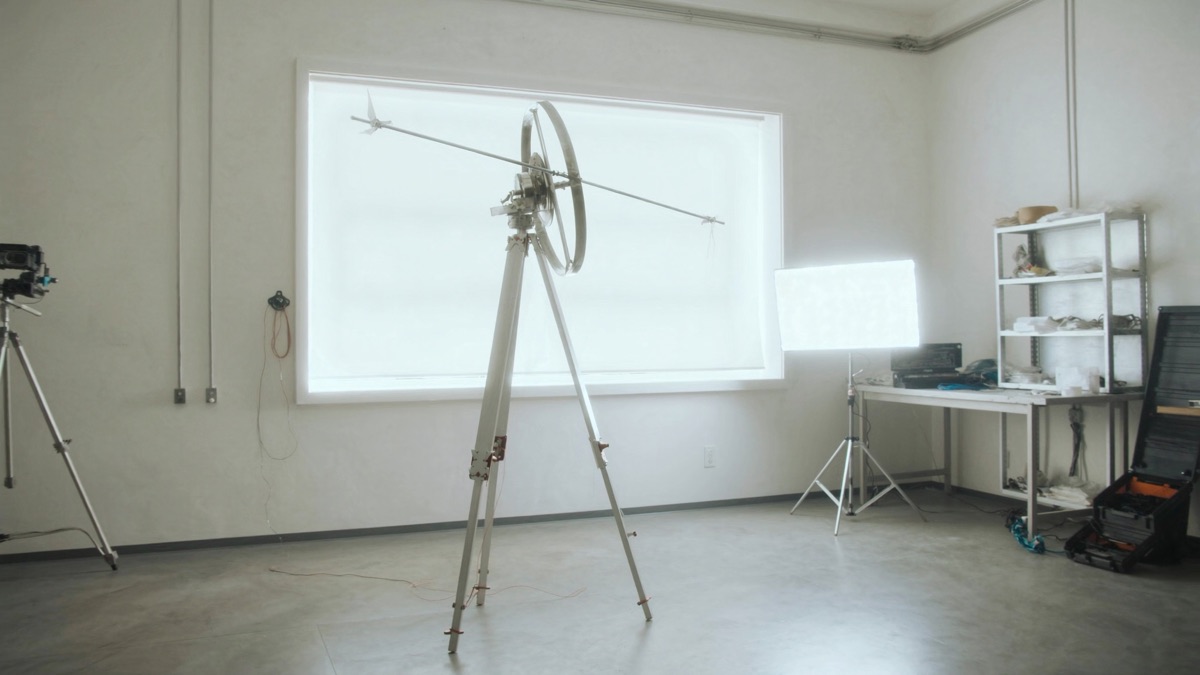
A spinning gyroscope seems to defy gravity, balancing at odd angles a stationary object never could. The real explanation is angular momentum, a physical property of spinning mass that makes a fast-spinning object actively resist any force trying to change the direction its spin axis points, producing the strange tilted balancing act and the sideways wobble called precession.
What Angular Momentum Actually Is
Angular momentum is a measure of how much rotational motion a spinning object has, determined by how the object’s mass is distributed around its spin axis and how fast it is actually spinning, and it behaves according to the same basic conservation principle that governs a spinning ice skater pulling in their arms to spin faster.
A spinning gyroscope wheel stores a genuinely large amount of angular momentum concentrated along a single axis, and that stored angular momentum is what physically resists any outside force attempting to tilt or redirect that axis, not some mysterious anti-gravity effect.
Why a Force on a Spinning Wheel Produces a Sideways Result
When you push down on one side of a stationary wheel, it simply tips over in the direction of the push, but pushing down on the same spot of a fast-spinning wheel produces a very different, counterintuitive result: the wheel tilts sideways, perpendicular to the direction you pushed.
This effect, called gyroscopic precession, happens because angular momentum is a directional quantity, and an applied force changes that direction according to rotational physics rather than simply pushing the object in the direction the force itself points.
Why a Spinning Top Balances on Such a Small Point
A spinning top balanced on a tiny point should, by ordinary intuition, immediately tip over from gravity’s pull, but its spin generates enough angular momentum that gravity’s tipping force instead produces a slow, circular precession of the top’s axis rather than an outright fall.
As friction and air resistance gradually slow the top’s spin, its angular momentum decreases, and the precession visibly widens and speeds up until the spin can no longer generate enough resistance to counteract gravity, at which point the top finally topples over.
How This Principle Stabilizes Real Vehicles
Bicycle wheels demonstrate a real-world version of this same effect: a moving bicycle is measurably easier to balance than a stationary one, partly because its spinning wheels generate angular momentum that resists tipping sideways, alongside separate steering-geometry effects that also contribute to a moving bike’s natural stability.
Motorcycles rely on the same underlying physics even more heavily at speed, and engineers specifically account for gyroscopic effects from spinning wheels and engine components when designing motorcycle handling characteristics.
Gyroscopes as Navigation Instruments
Because a spinning gyroscope’s axis resists being redirected, it naturally tends to keep pointing in the same fixed direction in space even as the vehicle or aircraft carrying it turns, a property that made mechanical gyroscopes genuinely essential navigation instruments long before satellite-based GPS existed.
A gyrocompass exploits this same resistance-to-redirection property, combined with Earth’s own rotation, to continuously find and point toward true geographic north rather than magnetic north, making it immune to the local magnetic interference that affects a traditional magnetic compass.
How a Smartphone Detects Rotation Without a Spinning Wheel
Modern smartphones and gaming controllers contain something called a MEMS gyroscope, a microscopic vibrating structure etched onto a silicon chip rather than an actual physically spinning wheel, that detects rotation by measuring how the device’s own rotation subtly distorts that vibration pattern.
This MEMS gyroscope is what lets a phone accurately detect when it has been rotated from portrait to landscape orientation, and it works alongside a separate accelerometer chip, which measures linear movement and tilt rather than rotation, to build a complete picture of the device’s orientation in space.
Gyroscopic Stabilization in Spacecraft and Satellites
Spacecraft and satellites use devices called reaction wheels, essentially precision-controlled internal gyroscopes, to change or hold their orientation in the vacuum of space without needing to fire fuel-consuming thrusters for every small adjustment.
By spinning an internal reaction wheel faster or slower in a controlled way, a spacecraft can rotate its own body in the opposite direction through simple conservation of angular momentum, an elegant and fuel-efficient method of orientation control that would be impossible without gyroscopic physics.
Why a Faster Spin Makes a Gyroscope More Stable
Since angular momentum increases directly with spin speed for a given mass distribution, a faster-spinning gyroscope generates proportionally more resistance to any outside force trying to redirect its axis, which is why toy gyroscopes and tops are typically spun as fast as possible right before use.
This relationship also explains why a gyroscope’s stabilizing effect noticeably weakens as friction slows its spin over time, a gradual, predictable decay rather than a sudden failure, right up until the spin becomes too slow to meaningfully resist gravity’s tipping force any longer.
Gyroscopic Precession: The Counterintuitive Part
The single most confusing part of gyroscope behavior for most people is precession: when you push on the spinning axis of a gyroscope, it doesn't tip in the direction you pushed, it instead moves at roughly a 90-degree angle to that push, seemingly defying ordinary intuition about how forces work.
This happens because angular momentum is a vector quantity, and an applied torque changes that vector in a direction determined by the mathematics of rotational motion rather than simple linear motion, producing a slow, steady circling of the spin axis called precession instead of a direct tip in the pushed direction.
A tabletop toy gyroscope demonstrates this vividly: pressing down gently on one end of its spinning axis doesn't make that end fall, it instead makes the whole axis slowly trace a cone shape in the air, circling around rather than collapsing, precisely because of this 90-degree torque response.
Bicycles, Motorcycles, and the Gyroscope Debate
For decades, popular explanations credited gyroscopic effect from spinning wheels as the primary reason a moving bicycle stays upright, but more recent engineering research using specially built bicycles with counter-rotating wheels, which cancel out gyroscopic effect entirely, showed those bicycles still balance normally when ridden.
Researchers now generally attribute bicycle self-stability mostly to geometric factors like trail, the distance between where the front wheel's steering axis meets the ground and where the tire actually touches down, and to a rider's own active steering corrections, with gyroscopic effect playing a real but much smaller supporting role than once assumed.
Motorcycles at higher speed do rely more heavily on genuine gyroscopic forces from their heavier, faster-spinning wheels, which is part of why countersteering, pushing the handlebar in the opposite direction of the intended turn to initiate a lean, becomes an essential riding technique at speed.
Gyroscopes Inside Ships and Submarines
Large ships have historically used massive gyroscopic stabilizers, giant spinning wheels mounted below deck, to counteract rolling motion caused by waves, actively resisting the tipping forces of the sea in much the same way a spinning top resists gravity.
Submarines rely on gyroscopic compasses rather than magnetic ones for accurate heading information underwater, since a magnetic compass can be thrown off by the steel hull itself and doesn't work reliably near the magnetic poles, while a gyrocompass finds true north mechanically using Earth's own rotation rather than magnetic fields.
The Gyroscope's Role in Modern Camera Stabilization
Professional camera gimbals and in-body image stabilization systems in smartphones both rely on tiny MEMS gyroscopes to detect unwanted shake many times per second, feeding that motion data to motors or software that counteract the movement in real time, keeping footage smooth even when the person holding the camera is walking or running.
This same sensing principle extends to drones, where multiple gyroscopes combined with accelerometers let the flight controller detect and correct tiny orientation changes dozens of times per second, a feedback loop far faster than any human pilot could manage manually and the reason modern camera drones can hover so precisely in a breeze.
How Engineers Test and Calibrate Gyroscopes
Before a MEMS gyroscope ships inside a phone or drone, manufacturers place it on a precision rotating table that spins at exactly known rates, comparing the chip's own reported rotation values against that known ground truth to calculate and store a calibration correction factor for each individual unit.
Because MEMS gyroscopes can still drift slightly over time due to temperature changes and manufacturing tolerances, many devices also perform periodic self-calibration while sitting still, quietly comparing readings against a known zero-rotation baseline to correct for accumulated drift before it becomes noticeable to the user.
Gyroscopes in Missile Guidance and Early Inertial Navigation
Before satellite positioning existed, ballistic missiles and long-range aircraft relied on inertial navigation systems built around extremely precise mechanical gyroscopes that could track a vehicle's exact orientation and acceleration continuously from a known starting point, integrating that motion data mathematically to calculate current position without any external reference signal.
These early gyroscopic inertial systems were remarkably accurate for their era but suffered from slow, unavoidable drift over long flights, since tiny mechanical imperfections and friction accumulated into meaningful position error over hours, a limitation that satellite-based GPS eventually solved by providing a continuous outside correction signal, though inertial gyroscopes remain a critical backup when satellite signals are jammed or unavailable.
Why a Gyroscope Feels Heavier Than It Looks When Spinning
A common experience with a spinning bicycle wheel or gyroscope toy is that trying to tilt its axis by hand feels dramatically harder than the object's actual weight would suggest, an effect entirely caused by the object's resistance to changing its angular momentum rather than any change in gravitational weight.
This resistance is strongest exactly along the axis perpendicular to the spin direction, which is why a person holding a spinning bicycle wheel by its axle and trying to turn it sideways feels a strong, almost springy pushback specifically in that twisting direction while the wheel itself remains just as easy to lift straight up.
Building a Simple Gyroscope Demonstration at Home
A basic gyroscope demonstration only requires a bicycle wheel with handles attached to its axle, or a simple toy gyroscope purchased inexpensively, spun up to a reasonably fast speed by hand or with a pull-string before being handed to a seated volunteer holding it by the handles.
When that volunteer then tries to tilt the spinning wheel's axis to one side, the wheel visibly resists and instead swings sideways in the perpendicular direction due to precession, sometimes even rotating the volunteer's own chair if they're seated on something that spins, a dramatic and safe classroom demonstration of angular momentum conservation that science teachers have used for generations.
Why Earth Itself Behaves Like a Giant Gyroscope
Earth's own rotation gives the planet significant angular momentum, and this planetary-scale gyroscopic effect is part of why Earth's rotational axis stays remarkably stable in its general orientation relative to the stars over human timescales, resisting the small gravitational tugs from the Sun and Moon that would otherwise tip it more noticeably.
Those same gravitational tugs do still produce a slow, genuine precession of Earth's axis, called axial precession, completing one full 26,000-year cycle that gradually shifts which star appears as the North Star over millennia, a real-world astronomical example of exactly the same physics that makes a tabletop toy gyroscope circle instead of tip.
Gyroscopes in Virtual Reality and Augmented Reality Headsets
VR and AR headsets rely on tiny MEMS gyroscopes updating dozens of times per second to track exactly how a user's head is rotating, feeding that data into rendering software fast enough that the virtual scene appears to stay perfectly fixed in space as the wearer looks around, an illusion that breaks down uncomfortably if there's any noticeable lag between real head motion and the displayed image.
Engineers combine gyroscope data with accelerometer and sometimes camera-based tracking specifically because a gyroscope alone tends to drift slightly over time, so blending multiple sensor types through what's called sensor fusion produces a far more stable and accurate sense of orientation than any single sensor could achieve on its own.
Sources
- Wikipedia — overview of gyroscope physics, angular momentum, and precession
- Wikipedia — background on MEMS gyroscopes used in smartphones and consumer electronics
- NASA Glenn Research Center — official explainer on gyroscopic principles and angular momentum
FAQ
Does a spinning gyroscope actually defy gravity?
No; gravity still acts on it exactly as normal, but the angular momentum from spinning converts gravity’s tipping force into a slow, circular precession instead of an immediate fall.
Why does pushing a spinning wheel tilt it sideways instead of tipping it over?
This is gyroscopic precession, a result of angular momentum being a directional quantity, so an applied force changes that direction rather than simply pushing the wheel over in the direction pushed.
Do modern smartphones contain an actual spinning wheel gyroscope?
No; they use a MEMS gyroscope, a microscopic vibrating structure on a silicon chip that detects rotation by how it distorts the vibration, not a physically spinning wheel.
Why do spacecraft use reaction wheels instead of thrusters for small turns?
Spinning an internal reaction wheel lets a spacecraft rotate its own body through conservation of angular momentum without consuming fuel, unlike firing a thruster for every small orientation change.
Why does a spinning top eventually fall over?
Friction and air resistance gradually slow its spin, reducing its angular momentum until it can no longer generate enough resistance to counteract gravity’s tipping force.
How did gyroscopes help with navigation before GPS existed?
A spinning gyroscope’s axis resists being redirected, letting it keep pointing in a fixed direction even as a vehicle turns, a property gyrocompasses used to reliably find true north.
Does gyroscopic effect actually keep a bicycle upright?
Only partially; modern research shows bicycle stability comes mostly from frame geometry and a rider's active steering corrections, with gyroscopic effect playing a smaller supporting role than long assumed.
Why does a spinning bicycle wheel feel hard to tilt by hand?
The resistance you feel is the wheel's angular momentum resisting a change in its spin axis direction, an effect entirely separate from the wheel's actual weight.
Do VR headsets use the same kind of gyroscope as smartphones?
Yes; VR and AR headsets use the same type of tiny MEMS gyroscope found in phones, typically combined with accelerometers and sometimes cameras through sensor fusion for more accurate head tracking.
Why does Earth's axis slowly shift which star is the North Star?
Gravitational tugs from the Sun and Moon cause a slow 26,000-year precession cycle in Earth's rotational axis, the same physics that makes a tabletop gyroscope circle instead of falling straight over.
About the Author
We reference Wikipedia and other authoritative sources to explain the background and current understanding of this topic.
Loved This Article?
Share it on WhatsApp → Share it on WhatsApp
Get more guides in your inbox — Subscribe to our newsletter for weekly surprising stories from Egypt, Saudi Arabia, Dubai, and beyond.