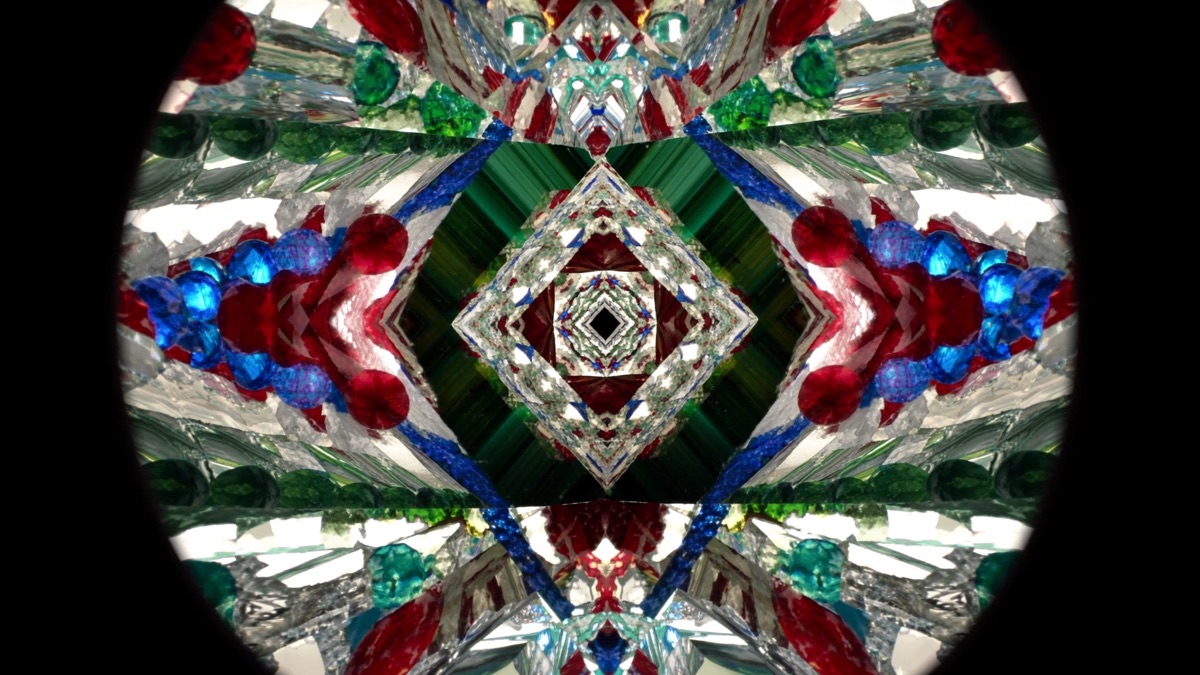
A kaleidoscope's tube typically holds no more than a few dozen small beads, sequins, or fragments of colored glass rattling loosely in a small chamber at one end, and yet no matter how many times you turn it, the pattern staring back never seems to repeat in quite the same way twice. The real engine behind that effect isn't the loose objects themselves but the two or three long mirrors running the length of the tube, angled precisely enough to reflect the same small handful of beads back and forth into each other over and over, multiplying one messy, asymmetrical glimpse into a perfectly symmetrical, seemingly infinite pattern.
Why Mirror Angle, Not Bead Count, Determines the Pattern
The single most important design choice in any kaleidoscope is the angle between its mirrors, because that angle directly determines how many times the original image gets reflected before the reflections overlap and close into a complete circle, and therefore how many repeated segments make up the final symmetrical pattern.
A pair of mirrors set at exactly sixty degrees produces six repeating segments arranged around a point, while mirrors at forty-five degrees produce eight segments, and this relationship follows a precise mathematical rule: dividing three hundred sixty degrees by the mirror angle tells you exactly how many wedge-shaped reflections will tile together to complete the circular pattern.
How Two Mirrors Create a Wheel of Repeating Reflections
In the classic two-mirror design, the mirrors run down the length of the tube meeting at a shared edge nearest the viewer's eye, forming a narrow V-shaped trough, and light from the object chamber at the far end bounces between these two reflective surfaces before reaching the eye.
Because each mirror reflects not only the original object chamber but also the reflection already produced by the other mirror, the light bounces back and forth a limited number of times depending on the angle, building up a full circular wheel of symmetrical wedges radiating outward from that shared edge, with each wedge a mirror-flipped copy of its neighbors.
Why Three Mirrors Produce a Seamless, Edgeless Tiling Pattern
A three-mirror arrangement, typically forming an equilateral or isosceles triangle in cross-section, works differently from the two-mirror V-shape: instead of a wheel of wedges radiating from a single point, it produces a pattern that tiles seamlessly across the entire visible field, with no obvious center point where the segments converge.
This triangular arrangement mathematically guarantees that reflections meet each other at consistent angles across the whole viewing area rather than just around one hub, which is why three-mirror kaleidoscopes are prized by pattern designers for producing wallpaper-like, edge-to-edge tessellations rather than the more common flower-like radial bursts.
How the Loose Object Chamber Guarantees No Two Views Repeat
At the far end of the tube sits a small chamber, often made from two panes of glass or clear plastic sandwiching a shallow gap, containing the loose beads, glass chips, or sequins that actually get reflected, and this chamber is typically designed to rotate independently of the mirror housing.
Because the objects inside are unattached and free to tumble under gravity every time the chamber turns, even a tiny rotation reshuffles their exact positions relative to each other in a way that is, for all practical purposes, never exactly repeated, which is the real reason a kaleidoscope feels like it generates truly infinite patterns rather than cycling through a fixed set.
Why the Pattern Always Looks Symmetrical Even Though the Beads Aren't
The loose beads themselves are scattered completely at random with no symmetry whatsoever, yet the moment light bounces through the mirror system, that randomness gets forced into perfect radial or tiled symmetry, because every mirror reflection is by definition a precise geometric mirror-image of whatever came before it.
This is the core optical trick: the eye is never actually looking at a symmetrical arrangement of objects, only at multiple mathematically identical reflections of one asymmetrical arrangement, layered together so convincingly that the brain perceives a single, deliberately designed symmetrical composition rather than the chaotic jumble of beads that is the true, unreflected reality.
How Sir David Brewster Invented the Kaleidoscope While Studying Light Polarization
The kaleidoscope was patented in 1817 by Scottish physicist Sir David Brewster, who stumbled onto the effect not while trying to build a toy but while conducting serious experiments on light polarization, noticing that arranging loose fragments between angled mirrors produced strikingly ordered, symmetrical patterns from otherwise random material.
Brewster coined the name from the Greek words kalos, meaning beautiful, eidos, meaning form or shape, and skopein, meaning to look at or examine, and despite the device's scientific origins, its patent famously failed to prevent widespread commercial copying, so Brewster himself profited comparatively little from what became one of the most widely manufactured optical toys in history.
Why Cheap Copies Spread Faster Than Brewster Could Enforce His Patent
Within roughly a year of Brewster's patent, an estimated tens of thousands of kaleidoscopes had already been manufactured and sold across Britain and beyond, driven by the device's simple, cheap construction: a tube, a couple of strips of reflective material, and a handful of scrap glass or beads was all that was needed.
Because the underlying mirror geometry was straightforward to copy once demonstrated, and patent enforcement across scattered small manufacturers proved practically impossible in the early nineteenth century, the kaleidoscope became one of history's earliest examples of a scientifically sophisticated invention becoming an instant, uncontrollable mass-market fad almost immediately after its public unveiling.
How Mirror Quality and Flatness Affect Image Sharpness
Not every kaleidoscope produces an equally crisp pattern, because the sharpness of the final image depends heavily on how perfectly flat and optically true the internal mirrors are, since even microscopic waviness or curvature in a cheap mirror surface distorts each successive reflection slightly, and those small distortions compound with every bounce.
High-end kaleidoscopes typically use front-surface mirrors, where the reflective coating sits on top of the glass rather than behind it, eliminating the faint double-image ghosting caused by light reflecting off both the coating and the front glass surface in ordinary household mirrors, producing a noticeably cleaner, more precisely symmetrical final pattern.
Why Rotating the Object Chamber Slowly Produces a Smoother Visual Transition
Turning the object chamber quickly causes the beads to tumble chaotically, producing a rapid, almost jarring succession of unrelated patterns, while turning it very slowly allows gravity to shift only a few beads at a time, so consecutive patterns share enough common elements to blend smoothly from one symmetrical arrangement into the next.
This is why experienced kaleidoscope users, and the mechanically geared "parlor" kaleidoscopes historically built for slow, controlled rotation, favor a gentle, gradual turn: it transforms the experience from a jumpy slideshow of disconnected images into something closer to a continuously evolving, hypnotic animation.
How Teleidoscopes Replace Loose Beads with a Clear Lens for Real-World Views
A variant called a teleidoscope removes the enclosed object chamber entirely and replaces it with a clear glass ball lens or open aperture at the far end, so instead of reflecting a fixed set of internal beads, the mirror system reflects and multiplies whatever real-world scene the tube happens to be pointed at.
This turns any ordinary view, a patch of grass, a friend's face, city traffic, into the same kind of radially symmetrical pattern a traditional kaleidoscope produces from beads, effectively applying the identical mirror-geometry trick to unlimited, ever-changing real-world subject matter rather than a fixed handful of enclosed objects.
Why Some Kaleidoscopes Use a Wheel Instead of a Tumbling Chamber
A different design replaces the loose, gravity-tumbled bead chamber with a fixed, rotating glass wheel embedded with permanently arranged colored glass pieces, oils, or liquid-filled compartments, allowing the viewer to precisely control the exact sequence of patterns by turning the wheel at a chosen speed rather than relying on random tumbling.
Wheel-based kaleidoscopes trade the pure unpredictability of a tumbling chamber for repeatable, controllable pattern sequences, making them popular in kaleidoscope art shows and performances where the artist wants to deliberately compose and reliably reproduce a specific visual sequence rather than leave every viewing to chance.
How Kaleidoscope Geometry Connects to Crystallography and Molecular Symmetry
The same mirror-reflection mathematics that generates a kaleidoscope's pattern also describes how repeating unit cells combine to form the larger symmetrical structures seen in crystals and certain molecules, which is why kaleidoscope-style diagrams occasionally appear in crystallography textbooks as an intuitive way to visualize how a small asymmetrical unit can tile into a large, highly ordered structure.
This connection isn't merely decorative: point-group symmetry, the formal mathematical classification system used to describe how a crystal or molecule looks the same after certain rotations or reflections, draws on essentially the same geometric principles that determine how many segments a kaleidoscope's mirror angle produces.
Why Kaleidoscopes Became a Standard Tool for Teaching Optics and Symmetry
Because a kaleidoscope makes an otherwise abstract optical principle, the law of reflection, and an abstract mathematical one, rotational symmetry, immediately and vividly visible without requiring any equations, physics and mathematics educators have long used it as an accessible hands-on demonstration for students encountering these concepts for the first time.
Students can directly observe how changing the mirror angle changes the number of repeated segments, turning what would otherwise be a purely theoretical relationship between angle and symmetry order into something they can verify by simply building and adjusting a simple mirror rig themselves.
How Digital Kaleidoscope Apps Simulate the Same Mirror Mathematics in Software
Modern kaleidoscope apps and screensavers recreate the same effect entirely in software, applying the identical mathematical reflection and rotation rules a physical mirror system would enforce to a live camera feed, an uploaded photo, or generated graphics, without any actual glass or physical mirrors involved at all.
Because software can apply the mirror-angle math with perfect, frictionless precision and instantly recompute the entire pattern at any resolution, digital kaleidoscope tools can produce far sharper, more elaborately layered effects than any physical device, while still relying on the exact same underlying geometric principle Brewster described two centuries earlier.
Why the Kaleidoscope Remains a Symbol for Constant, Beautiful Change
Beyond its optics, the kaleidoscope has become a widely used cultural metaphor precisely because of the mechanism described throughout this article: a small, fixed set of underlying elements that, through a simple structural rule, produces what feels like limitless variety, a pattern people readily map onto everything from cultural diversity to shifting personal circumstances.
That metaphor only works because the underlying science genuinely delivers on the promise, since every turn of a real kaleidoscope tube produces an authentically new, mathematically guaranteed-symmetrical arrangement from the exact same handful of loose objects, which is part of why a two-hundred-year-old optical toy still feels genuinely surprising on every single turn.
How Victorian Parlor Kaleidoscopes Grew into Elaborate Mechanical Instruments
During the Victorian era, kaleidoscopes evolved well beyond Brewster's simple handheld tube into large, elaborately crafted parlor instruments mounted on stands, sometimes fitted with geared cranks that rotated the object chamber at a slow, perfectly controlled speed, and occasionally combined with multiple interchangeable object wheels so an owner could swap in different sets of glass fragments or liquid-filled cells.
Wealthy households displayed these instruments as both entertainment devices and conversation pieces, and specialist manufacturers competed on the quality of their brass fittings, the precision of their mirror alignment, and the richness of the colored glass supplied with each unit, turning what began as a scientific curiosity into a genuine decorative art form in its own right.
Why Artists Still Build Custom Kaleidoscopes as a Fine-Art Medium Today
A dedicated community of contemporary artists and craftspeople still designs and builds kaleidoscopes by hand, treating the mirror geometry as a creative medium in its own right, experimenting with unusual mirror counts, non-standard angles that produce irregular rather than perfectly repeating tilings, and object chambers filled with anything from dichroic glass to found natural objects.
These custom instruments are sold and exhibited much like sculpture or glass art, with collectors valuing precision optics, unusual materials, and inventive mechanical designs, and dedicated societies and conventions exist specifically to showcase new kaleidoscope craftsmanship, keeping a two-hundred-year-old optical principle alive as an actively evolving contemporary art form rather than a purely historical curiosity.
Sources
- Wikipedia — kaleidoscope history, invention, and mirror geometry
- Wikipedia — Sir David Brewster's optics work and 1817 patent
- Britannica — kaleidoscope optics and design overview
FAQ
What actually determines how many segments a kaleidoscope shows?
The angle between the mirrors. Dividing 360 degrees by that angle gives the number of repeating symmetrical segments in the final pattern.
Why does the pattern never seem to repeat exactly?
The loose beads inside tumble freely under gravity with every turn, so their exact positions almost never match a previous arrangement precisely.
Who invented the kaleidoscope?
Scottish physicist Sir David Brewster, who patented it in 1817 while conducting experiments on light polarization.
What's the difference between two-mirror and three-mirror kaleidoscopes?
Two mirrors produce a wheel of wedges radiating from one point; three mirrors produce a seamless pattern that tiles edge-to-edge with no single center.
What is a teleidoscope?
A kaleidoscope variant that replaces the enclosed bead chamber with a clear lens, so it reflects and multiplies real-world scenes instead of fixed objects.
Why do cheap kaleidoscopes look blurrier than expensive ones?
Lower-quality mirrors with microscopic waviness distort each reflection slightly, and those distortions compound over multiple bounces, blurring the final pattern.
What are front-surface mirrors and why do they matter here?
Mirrors with the reflective coating on top of the glass rather than behind it, eliminating faint double-image ghosting for a sharper pattern.
Does turning speed change how a kaleidoscope looks?
Yes; slow turning shifts only a few beads at a time, blending consecutive patterns smoothly, while fast turning jumps abruptly between unrelated arrangements.
How does a wheel-based kaleidoscope differ from a tumbling one?
It uses a fixed, rotating glass wheel with permanently arranged pieces instead of loose tumbling beads, giving controllable, repeatable pattern sequences.
Is kaleidoscope symmetry connected to crystal structure?
Yes; the same mirror-reflection mathematics describing kaleidoscope segments also underlies point-group symmetry used to classify crystal and molecular structures.
Why do teachers use kaleidoscopes in science classes?
They make abstract concepts like the law of reflection and rotational symmetry immediately visible without requiring equations, giving students a hands-on demonstration.
Do digital kaleidoscope apps use the same math as physical ones?
Yes; software applies the identical mirror-angle reflection and rotation rules to a camera feed or image, just without any actual glass involved.
Could Brewster stop people from copying his invention?
No; the mirror design was simple enough to copy once seen, and within about a year tens of thousands were manufactured across Britain despite his patent.
Why does the eye perceive symmetry when the beads are scattered randomly?
The eye never sees the random beads directly, only multiple mathematically identical mirror reflections of them layered together into forced symmetry.
What does the word kaleidoscope actually mean?
It comes from Greek: kalos (beautiful), eidos (form), and skopein (to look at) — literally, an instrument for observing beautiful forms.
Were Victorian kaleidoscopes different from modern handheld ones?
Yes; wealthy Victorian households owned large, elaborately mounted parlor instruments with geared cranks for slow rotation and interchangeable object wheels, far more elaborate than a typical modern handheld toy.
Do people still hand-craft kaleidoscopes as art today?
Yes; a dedicated community of contemporary artists builds custom kaleidoscopes as a fine-art medium, sold and exhibited like sculpture or glass art, with dedicated societies and conventions supporting the craft.
Can a kaleidoscope have an irregular, non-repeating pattern on purpose?
Yes; some contemporary custom-built kaleidoscopes deliberately use non-standard mirror angles or counts to produce irregular tilings rather than the classic perfectly repeating radial pattern.
What materials go inside a typical object chamber?
Small fragments of colored glass, plastic beads, sequins, or occasionally oil-filled cells are the most common fillings, chosen for how they catch and scatter light when reflected.
Does the length of the tube affect the pattern at all?
A longer tube mainly changes how much of the object chamber's contents the mirrors capture and how magnified the final segments appear, while the mirror angle still governs the segment count.
Why do some kaleidoscopes cost far more than others despite looking similar from the outside?
Price differences usually come down to mirror quality (front-surface versus ordinary glass), the precision of the angle alignment during assembly, and the richness and craftsmanship of the object chamber's contents, all of which affect image sharpness and color even when two tubes look nearly identical on the outside.
Is it possible to calculate a kaleidoscope's segment count without measuring the mirror angle directly?
Yes; if you already know how many segments a given kaleidoscope produces, you can work backward using the same 360-degrees-divided-by-segments relationship to infer the mirror angle, which is exactly how designers plan a build before cutting any glass.
Can a kaleidoscope work with only one mirror?
A single flat mirror only produces one simple reflection with no repeating symmetry; the characteristic radiating or tiling pattern requires at least two mirrors set at an angle to each other.
Is a kaleidoscope's pattern truly infinite, or just very large in number?
Technically the number of possible bead arrangements is enormous but finite, not infinite in the strict mathematical sense; in practice it is so large that a lifetime of viewing would never repeat one exactly.
About the Author
We reference Wikipedia and other authoritative sources to explain the background and current understanding of this topic.
Loved This Article?
Share it on WhatsApp → Share it on WhatsApp
Get more guides in your inbox — Subscribe to our newsletter for weekly surprising stories from Egypt, Saudi Arabia, Dubai, and beyond.