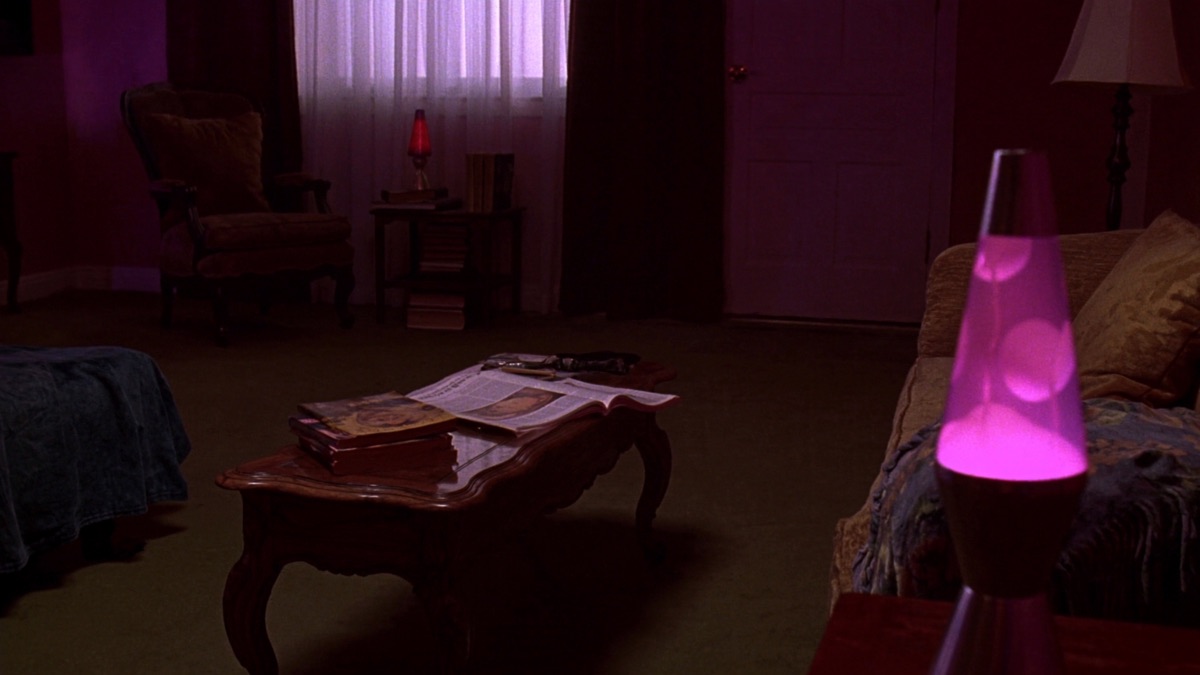
A lava lamp’s slow-moving blobs are not the result of a chemical reaction happening inside the glass. They come from two immiscible liquids of very precisely matched density that continuously swap places as a heat source at the base warms the bottom layer and cools slightly as it rises, a purely physical process engineered to run in an endless, hypnotic loop.
Two Liquids That Refuse to Mix
A lava lamp contains two immiscible liquids, typically a wax-based compound and a water-based solution, that do not dissolve into one another the way alcohol dissolves in water, instead remaining as visually distinct layers or blobs no matter how much they are stirred or heated.
This immiscibility is a deliberate formulation choice, since a lamp using two liquids that could actually mix together would eventually blend into a single uniform, cloudy liquid instead of maintaining the distinct floating blob effect the lamp is designed to produce.
Why Density, Not Just Temperature, Is the Real Key
The wax compound and the water-based liquid are formulated to have almost, but not quite, identical density at room temperature, meaning the wax normally sits as a solid mass at the very bottom of the lamp rather than floating or actively moving.
A light bulb built into the base of the lamp heats this bottom layer of wax, and as it warms, the wax expands and becomes very slightly less dense than the surrounding liquid, just enough for it to break apart and rise as blobs rather than remaining a single solid mass.
The Rise-and-Fall Convection Cycle
As a warmed wax blob rises away from the heat source at the base, it gradually cools in the cooler liquid higher up in the lamp, and as it cools it becomes very slightly denser again than the surrounding liquid, eventually causing it to slow down, stop rising, and sink back toward the bottom.
This continuous rise-cool-sink-reheat cycle is a textbook example of convection, the same basic physical process that drives weather patterns and ocean currents at a vastly larger scale, here deliberately engineered into a small, contained, endlessly repeating decorative loop.
Why Blobs Merge, Split, and Change Shape
Individual wax blobs merge together when they collide and their combined mass and density happen to favor staying together at that moment, and they split apart when internal convection currents or minor density differences within a single blob pull it in different directions faster than surface tension can hold it together.
Surface tension between the two liquids is what gives each blob its characteristic rounded, blob-like shape rather than an irregular splatter, the same physical force that makes a water droplet on a countertop pull itself into a rounded bead rather than spreading out completely flat.
Why the Coil at the Bottom of the Lamp Matters
Many lava lamps include a thin coiled wire at the very bottom of the glass, whose job is to provide a nucleation point that breaks the surface tension of the solid wax mass just enough to help it separate into rising blobs rather than staying stubbornly fused as one large unmoving piece.
Without this coil, or an equivalent design feature, a cold lamp’s wax can sometimes stay stuck together as a single unresponsive mass even once heated, which is part of why manufacturers specifically warn against tilting or shaking a lava lamp while it is actively warming up.
Why It Takes So Long to Warm Up
A typical lava lamp needs somewhere between one and three hours of continuous heating before its wax fully melts and begins producing the characteristic rising and falling blob motion, since the heat has to gradually transfer from the base bulb through a genuinely large, dense volume of liquid.
Running the lamp for too long once the blobs are flowing well, generally beyond eight to ten hours at a stretch, can actually overheat the liquids and cause the wax to become cloudy or fail to properly separate back into distinct blobs once the lamp cools down again.
The Chemistry Behind the Colors
The vivid, often glowing colors associated with lava lamps come from dye dissolved specifically into the clear water-based liquid layer, not the wax itself, which is why a lamp’s wax blobs typically appear as a single consistent color against a differently tinted, often clear or lightly colored surrounding liquid.
Manufacturers carefully select dyes that remain chemically stable and resist fading even after years of repeated heating and cooling cycles, since a dye that degraded quickly under sustained heat would visibly discolor the lamp’s liquid within a relatively short period of regular use.
How the Original Astro Lamp Was Invented
The lava lamp was invented in England in the early 1960s by Edward Craven Walker, who reportedly developed the concept after seeing a homemade egg-timer device that used a similarly heated liquid mixture, and he subsequently founded a company to manufacture and sell the design commercially under the name Astro Lamp.
The lamp became closely associated with psychedelic 1960s counterculture aesthetics almost immediately after its introduction, an association that has persisted in popular imagination even as the product itself became a mainstream decorative item sold widely across many decades since.
Why Lava Lamps Are Technically Misnamed
The term "lava" is a poetic marketing choice rather than a scientific description, since the wax blobs inside the lamp are not molten rock at all but a carefully engineered blend of paraffin wax, mineral oil, and other additives that happen to melt at a temperature close to that produced by the lamp's own incandescent bulb.
Real volcanic lava reaches temperatures well over a thousand degrees Celsius and behaves according to entirely different fluid dynamics driven by dissolved gases and silicate mineral content, so the resemblance between the two is purely visual, based on the slow-moving, blob-like way both substances flow rather than on any shared physical or chemical process.
The Role of Surfactants in Keeping Blobs Cohesive
Manufacturers add small amounts of surfactant compounds to the wax mixture to control how readily it breaks apart and re-forms as it rises and falls, since without the right surface tension the wax would either shatter into a fine mist of droplets or clump into one solid, unmoving mass that never separates properly.
Getting this balance right required extensive experimentation during the lamp's original development, and it remains one of the more closely guarded aspects of lava lamp manufacturing today, since a poorly balanced surfactant ratio is the most common reason a cheaply made lamp fails to produce the smooth, undulating blobs associated with the genuine product.
How Glass Shape Changes the Visual Effect
The tapered, hourglass-like shape used in most classic lava lamps is not purely decorative, since the narrowing midsection concentrates rising wax into a slower, more deliberate column before it widens again near the top, producing the elongated, dramatic blob shapes that became the product's signature look.
Novelty variants built with straight cylindrical glass or unusually wide globes tend to produce blobs that separate and merge more chaotically, which is part of why collectors and enthusiasts still seek out the original bottle-necked silhouette over modern reinterpretations that prioritize a different aesthetic.
Safety Considerations and Why Overheating Matters
Because the internal liquid must reach and sustain a fairly specific temperature range to keep flowing correctly, lava lamps are designed to run for limited stretches at a time, and manufacturers generally recommend switching them off after eight to ten hours of continuous use to prevent the glass and internal components from overheating.
A cracked or overheated lamp can leak its liquid contents, which are typically non-toxic but can stain fabric and damage surfaces, and a small number of lamp designs from past decades have been subject to safety recalls after reports of glass globes shattering under prolonged heat stress, which is why modern lamps include a thermal cutoff or a design that limits maximum internal temperature.
Why Bulb Wattage Has to Match the Lamp Exactly
Every lava lamp is calibrated to a specific bulb wattage during manufacturing, because the bulb is not just a light source but the lamp's entire heating mechanism, and using a bulb with the wrong wattage is one of the most common reasons a lamp either never starts flowing or overheats and behaves erratically.
A bulb that is too weak fails to raise the wax above its melting point at all, leaving it permanently settled at the bottom, while a bulb that is too strong can push the liquid past its intended operating temperature, causing the wax to over-thin into a cloudy, poorly defined mass instead of forming distinct blobs.
The Global Manufacturing and Collector Market
Although the original Astro Lamp company changed hands and names multiple times over the decades, production of the classic design continues today under licensed manufacturers, and the product has developed a dedicated collector market for vintage units, rare color combinations, and limited-edition novelty shapes released to mark anniversaries or pop-culture tie-ins.
Some vintage lamps from the 1960s and 1970s now sell for hundreds of dollars among collectors specifically because their original wax and liquid formulations, glass shapes, and base designs differ subtly from modern reproductions, making an authenticated original considerably more valuable than a contemporary equivalent.
Classroom and Science-Communication Uses
Because the lamp makes density-driven convection visually obvious in a way few other everyday objects can, science educators frequently use it as a teaching aid when introducing concepts like buoyancy, thermal expansion, and fluid density to students who would otherwise only encounter these ideas as abstract equations.
Some physics demonstrations go further by placing a small working lava lamp model under a document camera so an entire classroom can watch the rise-and-fall cycle in real time, pairing the observation directly with a discussion of how temperature changes a liquid's density and therefore its buoyancy relative to a neighboring liquid of different composition.
Common Reasons a Lava Lamp Stops Working Properly
Over years of repeated heating and cooling, the wax and liquid inside a lamp can gradually oxidize or absorb trace amounts of contamination from the glass and metal coil, which shows up as cloudiness, a change in blob texture, or a failure to fully separate into distinct globs even after a normal warm-up period.
Because the glass globe in most commercially sold lamps is permanently sealed, a lamp exhibiting these symptoms generally cannot be refilled or repaired at home, and enthusiasts typically treat a degraded lamp as reaching the natural end of its working life rather than something to be serviced.
Why Some Lamps Use Metallic Glitter Instead of a Second Liquid
A related but mechanically different novelty product suspends metallic flakes or glitter in a single clear liquid rather than using two immiscible substances, relying purely on convection currents to stir the particles into slow, drifting patterns instead of forming the coherent rising-and-falling blobs a true lava lamp produces.
These glitter-style lamps are sometimes marketed under similar branding, which has led to some consumer confusion, but they operate on a simpler principle involving suspended solid particles rather than the density-driven separation and merging of two distinct liquid phases that defines a genuine lava lamp's behavior.
How Room Temperature Affects Startup Time
A lava lamp placed in a cold room takes noticeably longer to begin flowing than one started at typical indoor room temperature, because the bulb has to first raise the ambient wax from a lower starting point before it even approaches its melting threshold, sometimes extending the usual forty-five to ninety minute warm-up period considerably.
Enthusiasts sometimes recommend avoiding placement near air conditioning vents, drafty windows, or unheated rooms for exactly this reason, since inconsistent ambient temperature can also cause a lamp that had been flowing normally to suddenly slow down or partially resettle if the surrounding air cools significantly.
The Lamp's Place in Design and Pop Culture History
Beyond its association with 1960s counterculture, the lava lamp has repeatedly resurfaced as a design icon in later decades, appearing in retro-revival home décor trends, film and television set design meant to signal a particular era or mood, and as a recurring visual shorthand for relaxed, offbeat creativity in advertising.
Its continued commercial success across more than six decades is unusual for a decorative object with no practical function beyond ambiance, and design historians often cite it as a rare example of a mid-century novelty item that never fully went out of production or fell out of cultural relevance.
Cleaning and Caring for a Working Lamp
Because the sealed glass globe cannot be opened without permanently ruining the internal mixture, proper care is limited to keeping the exterior glass clean with a soft, dry cloth once the lamp has fully cooled, avoiding harsh chemical cleaners that could degrade the base's electrical components or the glass-to-metal seal that keeps the liquid contained.
Manufacturers also generally advise against moving or tilting a lamp while it is warm and actively flowing, since sudden movement can cause the wax to break apart into many small droplets that take considerably longer to recombine into the smooth, large blobs the lamp is designed to produce once it settles back down.
Sources
- Wikipedia — history, design, and physical operating principles of the lava lamp
- Wikipedia — background on the convection process driving the lamp’s rising and sinking motion
- Encyclopedia Britannica — history and design of the lava lamp
FAQ
Does a lava lamp use a chemical reaction to move its blobs?
No; it uses two immiscible liquids whose relative density changes slightly with temperature, causing them to rise when heated and sink when cooled, a purely physical convection process.
Why does the wax sit at the bottom of a cold lava lamp?
At room temperature the wax compound is slightly denser than the surrounding liquid, so it settles as a solid mass at the bottom until the base heater warms and expands it enough to rise.
What is the coiled wire at the bottom of the lamp for?
It acts as a nucleation point that helps break the surface tension of the solid wax mass, helping it separate into rising blobs instead of staying fused together as one piece.
How long does a lava lamp take to start flowing properly?
Typically one to three hours of continuous heating, since heat has to gradually transfer from the base bulb through a large, dense volume of liquid before the wax fully melts.
Where does a lava lamp’s color actually come from?
From dye dissolved into the clear water-based liquid layer, not the wax itself, which is why the blobs usually appear one consistent color against a differently tinted surrounding liquid.
Who invented the original lava lamp?
Edward Craven Walker invented it in England in the early 1960s, reportedly inspired by a homemade heated-liquid egg timer, and marketed it commercially as the Astro Lamp.
About the Author
We reference Wikipedia and other authoritative sources to explain the background and current understanding of this topic.
Loved This Article?
Share it on WhatsApp → Share it on WhatsApp
Get more guides in your inbox — Subscribe to our newsletter for weekly surprising stories from Egypt, Saudi Arabia, Dubai, and beyond.