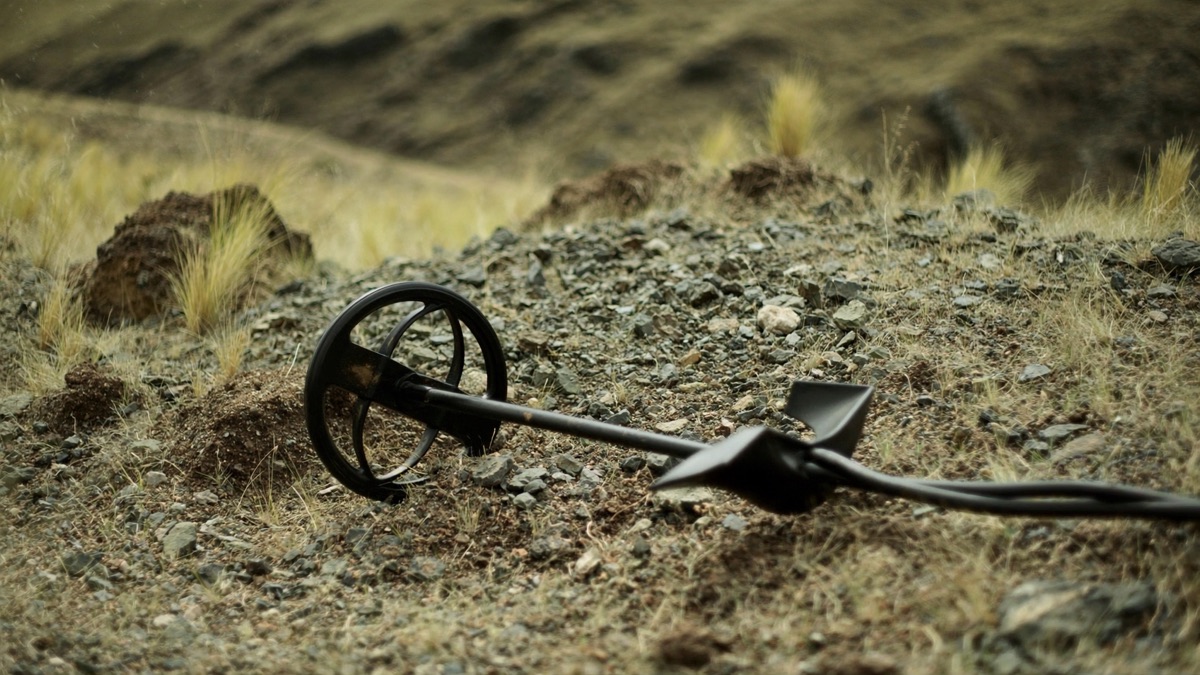
A metal detector does not sense metal directly; it generates its own alternating magnetic field through a transmitter coil, and when that field passes through a piece of metal, it induces small electrical currents inside the metal itself, which in turn create a second, secondary magnetic field that a separate receiver coil in the detector can pick up as a distinct disturbance. Detecting metal is fundamentally detecting this induced secondary field rather than sensing the metal object directly, which is why detectors respond very differently to different metals based on how strongly each one supports these induced currents.
Why a Metal Detector Relies on Disturbing Its Own Magnetic Field
This physical principle is called electromagnetic induction, the same underlying phenomenon that powers electric generators and transformers, applied here in reverse to detect the presence of a conductive object rather than to generate or transfer usable electrical power.
Because the strength of the induced secondary field depends heavily on both the metal's electrical conductivity and its physical size and shape, a metal detector's response signal genuinely does carry usable information about what kind of object it has actually found, not just a simple binary yes-or-no metal signal.
How a Very Low Frequency Detector Analyzes Both Signal Strength and Phase
Very low frequency, or VLF, detectors, the most common consumer detector design, transmit a continuous alternating current signal and analyze not just how strong the returning induced signal is but also its phase shift, meaning how much the returning signal's timing has shifted relative to the original transmitted signal.
Different metals produce measurably different characteristic phase shifts because their electrical conductivity and magnetic permeability differ, which is the specific physical property that lets a VLF detector distinguish between, for example, a piece of aluminum foil and a gold ring even when both produce a similarly strong overall signal.
Why Target Identification Discrimination Relies on This Same Phase Data
Modern detectors use the phase shift information to assign each detected object a discrimination value, commonly displayed on a numeric or graphical scale, that estimates what broad category of metal was likely found, letting an operator set the detector to visually or audibly flag likely valuable targets while suppressing signals from common unwanted metal trash.
This discrimination is never perfectly reliable because some genuinely different metal objects happen to produce very similar phase signatures, which is exactly why experienced detectorists still commonly dig up flagged signals manually to visually confirm a target's identity rather than trusting the discrimination display as an infallible verdict.
How Pulse Induction Detectors Take a Fundamentally Different Approach
Pulse induction, or PI, detectors send short, powerful bursts of current through the transmitter coil rather than a continuous alternating signal, and after each individual pulse ends, they briefly listen for a decaying secondary current, called an eddy current, that any nearby metal object continues to generate for a short moment afterward.
Because this pulse-and-listen cycle repeats extremely rapidly, often hundreds of times per second, a pulse induction detector can effectively average out the confusing electromagnetic interference that highly mineralized soil produces, which is exactly why PI detectors are strongly preferred for beach and saltwater detecting where VLF technology struggles significantly.
Why Highly Mineralized Ground Interferes With VLF Detector Performance
Soil containing significant iron mineral content, commonly found near volcanic areas, in heavily oxidized red soil, or in wet salt-laden beach sand, produces its own weak but persistent background electromagnetic response that a VLF detector's continuous signal analysis has genuine difficulty distinguishing from an actual buried metal target.
This interference, commonly called ground mineralization or ground noise, is exactly why serious detectorists working in mineralized soil either switch to pulse induction technology, which is naturally less susceptible to this particular interference, or rely on a VLF detector's built-in ground balance feature specifically designed to filter it out.
How Ground Balance Circuitry Actively Filters Out Soil Interference
Ground balance is a calibration process, either performed manually by the operator sweeping over bare, target-free ground or handled automatically by onboard circuitry, that measures the specific mineral background signal at the current search location and then electronically subtracts that consistent baseline from all subsequent readings.
Properly calibrated ground balance allows a VLF detector to remain sensitive to genuine metal targets even in moderately mineralized soil, though extremely high mineralization levels can still overwhelm even a well-calibrated system, which is exactly the scenario where pulse induction technology's fundamentally different detection approach becomes genuinely necessary rather than merely helpful.
Why Search Coil Size and Shape Directly Affect Detection Depth and Precision
A larger search coil generates a proportionally larger and deeper electromagnetic field, letting it detect buried targets at meaningfully greater depth, but that same larger field also covers a wider physical area at once, making it comparatively harder to pinpoint a target's exact location once a signal is detected.
Smaller search coils sacrifice some maximum detection depth in exchange for much finer target pinpointing precision and better overall performance in trash-dense search areas, which is exactly why many experienced detectorists carry multiple interchangeable coil sizes for different specific search conditions rather than relying on one single all-purpose coil.
How Concentric and Double-D Coil Designs Shape the Detection Field Differently
A concentric coil design uses two circular windings, an outer transmitter loop and a smaller inner receiver loop, producing a cone-shaped detection field that offers precise target pinpointing but a comparatively narrow, cone-like search pattern with certain limitations near the coil's outer edge.
A double-D coil design instead uses two overlapping D-shaped windings, producing a wider, more evenly distributed blade-shaped detection field with generally better sensitivity across the coil's entire physical width and improved ground balancing performance, making it the design most commonly preferred for mineralized or trash-heavy search environments.
Why Operating Frequency Involves a Direct Tradeoff Between Metal Types
Lower operating frequencies generally perform better at detecting larger, highly conductive targets like silver coins or bulk conductive objects at meaningful depth, while higher operating frequencies respond more strongly to smaller or lower-conductivity targets, like fine gold jewelry, gold nuggets, or thin gold flakes.
Because no single frequency performs optimally across every possible target type and conductivity, detector manufacturers offer specific models tuned toward particular target categories, and higher-end multi-frequency detectors attempt to address this fundamental tradeoff by transmitting and analyzing several distinct frequencies essentially simultaneously.
How Multi-Frequency and Simultaneous Multi-Frequency Detectors Improve Versatility
A multi-frequency detector transmits multiple distinct frequencies either in rapid alternating sequence or genuinely simultaneously, then combines the resulting response data across all those frequencies to build a more complete overall picture of a detected target's likely composition than any single fixed frequency alone could realistically provide.
This approach meaningfully reduces the traditional need to choose one single frequency optimized narrowly for one specific target type, letting a single detector unit perform reasonably well across a genuinely broader range of target sizes, conductivities, and search conditions than older single-frequency designs ever could.
Why Airport Security Metal Detectors Work on a Related but Distinct Principle
Walk-through airport security metal detectors use the same fundamental electromagnetic induction principle as handheld treasure-hunting detectors, but they are specifically calibrated and shaped to scan an entire human body passing through a fixed archway rather than searching unknown buried targets across open ground.
These security-focused units are deliberately tuned toward high sensitivity for the specific conductivity and mass ranges typical of weapons and knives, sometimes at the meaningful cost of triggering more false-positive alerts on comparatively harmless personal metal items like belt buckles, jewelry, or certain shoe components.
How Handheld Wand Detectors Complement Walk-Through Archway Screening
A handheld wand detector uses a single, more tightly focused coil design specifically to pinpoint the exact location of metal on a person's body after a walk-through archway detector has already triggered a general alert, letting security personnel confirm precisely where on the body the flagged metal object is actually located.
This complementary two-stage detection approach, general archway screening followed by precise handheld pinpointing, balances the practical need for efficient rapid mass throughput at a checkpoint against the separate need for genuinely precise individual target confirmation once an initial general alert has already occurred.
Why Military and Humanitarian Demining Detectors Require Extreme Sensitivity
Landmine detection presents a uniquely demanding technical challenge because many modern landmines are deliberately constructed with minimal metal content specifically to evade detection, meaning demining detectors must reliably sense extremely small metal components, like a tiny firing pin or a small metal spring, that would be completely irrelevant to a typical hobbyist treasure detector.
This extreme sensitivity requirement unfortunately also produces a substantially higher false-positive rate on ordinary harmless metal debris like spent shell casings, bottle caps, or rusted scrap metal, meaning humanitarian demining teams must painstakingly investigate every single detected signal by hand regardless of how likely it seems to be an actual harmless false alarm.
How Industrial Metal Detectors Protect Food and Manufacturing Quality Control
Industrial food processing facilities commonly run every single product past a large stationary metal detector on a conveyor belt system specifically to catch accidental metal contamination, like a broken piece of processing machinery or a stray fragment, before that contaminated product ever reaches a retail shelf.
These industrial detection systems must be precisely calibrated to reliably detect even very small metal fragments while simultaneously never triggering a false rejection on a product's own naturally occurring mineral content, a genuinely difficult balance that requires careful frequency selection and calibration specifically matched to each individual product type being scanned.
Why Underwater Metal Detectors Need Specialized Waterproof Engineering
Underwater metal detectors require fully waterproof electronic housings rated for the specific pressure depths they are designed to operate at, along with search coil designs specifically engineered to resist the electromagnetic interference commonly generated by saltwater's naturally high electrical conductivity.
Because saltwater itself conducts electricity significantly, underwater detectors commonly rely heavily on pulse induction technology for exactly the same fundamental noise-resistance reasons that make PI detectors so strongly preferred for dry saltwater beach sand detecting compared to conventional VLF technology.
How Archaeological Metal Detecting Differs Meaningfully From Casual Treasure Hunting
Professional archaeological metal detecting survey work is typically conducted using a carefully planned systematic grid pattern with precise GPS location logging for every single detected find, specifically to preserve valuable contextual information about exactly where and how deep each individual artifact was actually located within the overall site.
This careful methodology stands in sharp contrast to casual hobbyist detecting, where an artifact's precise findspot location is often not documented with the same archaeological rigor, a difference that matters enormously to professional archaeologists because an artifact's exact original context frequently provides far more genuine historical information value than the isolated physical object recovered by itself.
Why Detector Signal Audio Tones Carry Meaningfully Encoded Information
Most detectors translate a detected target's discrimination value into a specific distinct audio tone pitch, with different tone pitches conventionally representing different broad likely metal categories, letting an experienced operator learn to distinguish probable target types by careful, trained ear alone without needing to constantly look down at a visual display screen.
Experienced detectorists frequently develop a genuinely refined ability to recognize subtle variations within these tone categories, sometimes distinguishing a promising, likely-valuable signal from a probable trash signal well before actually digging, purely from learned, practiced familiarity with these characteristic audio tone patterns.
How Detector Depth Capability Is Fundamentally Limited by Physics, Not Just Engineering
A metal detector's induced secondary electromagnetic field naturally weakens rapidly with increasing distance from the search coil itself, following a predictable and unavoidable physical relationship, meaning there exists a genuine hard physical limit to detection depth that no amount of clever engineering can ever fully overcome regardless of manufacturing sophistication.
Larger buried targets do genuinely produce a proportionally stronger induced signal that can be reliably detected at somewhat greater depth than smaller targets, which is precisely why a large buried metal container is realistically detectable far deeper underground than a comparatively tiny individual coin ever could be at the exact same buried depth.
Why Legal Regulations Around Metal Detecting Vary Dramatically by Location
Metal detecting regulations differ enormously between different countries and even between different jurisdictions within the same country, ranging from genuinely permissive hobbyist-friendly rules in some regions to strict blanket prohibitions on detecting at any designated archaeological or protected historical site in others.
Some countries specifically require any significant historical find to be formally reported to designated cultural heritage authorities regardless of exactly where it was originally discovered, reflecting a broader and increasingly common legal recognition that culturally or historically significant artifacts genuinely belong to a shared collective heritage rather than solely to whoever happens to have physically found them first.
Sources
- Encyclopaedia Britannica — Metal Detector
- USAID — Humanitarian Demining
- Archaeological Institute of America
FAQ
How does a metal detector actually sense metal without touching it?
It generates a magnetic field that induces small currents in nearby metal, and those currents create a secondary field the detector's receiver coil picks up as a disturbance.
How does a VLF detector tell different metals apart?
It analyzes the phase shift of the returning signal relative to the transmitted one, since different metals produce measurably different characteristic phase shifts based on conductivity.
Why do detectorists still dig up flagged trash signals sometimes?
Discrimination based on phase data is never perfectly reliable, since different metals can occasionally produce very similar signatures, so digging confirms identity visually.
How does pulse induction detection differ from VLF detection?
PI detectors send short powerful current bursts and listen for a decaying eddy current afterward, rather than continuously analyzing an alternating signal's phase shift.
Why do pulse induction detectors work better on saltwater beaches?
Their rapid pulse-and-listen cycle effectively averages out the electromagnetic interference from mineralized soil or saltwater that confuses continuous-signal VLF detectors.
What does ground balance actually do?
It measures the mineral background signal at a search location and electronically subtracts that consistent baseline from subsequent readings, letting the detector stay sensitive to real targets.
Why do larger search coils detect deeper but pinpoint less precisely?
A larger coil generates a proportionally larger and deeper field, but that same wider field covers more area at once, making exact target location harder to pinpoint.
What is the difference between a concentric coil and a double-D coil?
Concentric coils produce a cone-shaped field good for pinpointing, while double-D coils produce a wider, more evenly distributed blade-shaped field better for mineralized ground.
Why does operating frequency involve a tradeoff between metal types?
Lower frequencies detect large conductive targets like silver coins deeper, while higher frequencies respond better to small low-conductivity targets like fine gold jewelry.
How do multi-frequency detectors improve on single-frequency designs?
They transmit and analyze several frequencies simultaneously, combining the data to build a more complete picture of a target than any single fixed frequency could provide alone.
How do airport walk-through metal detectors differ from treasure detectors?
They use the same electromagnetic induction principle but are calibrated for high sensitivity to weapon-typical conductivity and mass, sometimes triggering false alerts on harmless items.
Why do demining detectors need extreme sensitivity?
Many modern landmines are built with minimal metal content to evade detection, so detectors must sense tiny components like a small firing pin, which also increases false positives.
How do industrial metal detectors protect food safety?
They scan every product on a conveyor belt to catch accidental metal contamination before it reaches shelves, calibrated to avoid false rejections from a product's natural minerals.
Why do underwater metal detectors rely heavily on pulse induction?
Saltwater conducts electricity significantly, and pulse induction's noise resistance handles that interference far better than continuous-signal VLF technology can.
How does archaeological metal detecting differ from casual hobbyist detecting?
It uses a systematic grid pattern with precise GPS logging for every find to preserve context, since an artifact's original location often carries more historical value than the object alone.
Why do detectors use different audio tones for different signals?
They translate a target's discrimination value into a distinct tone pitch representing likely metal categories, letting an experienced operator judge probable targets by ear alone.
Is there a hard physical limit to how deep a metal detector can detect?
Yes; the induced secondary field weakens rapidly with distance following unavoidable physics, though larger buried objects can be detected somewhat deeper than smaller ones.
About the Author
We reference Wikipedia and other authoritative sources to explain the background and current understanding of this topic.
Loved This Article?
Share it on WhatsApp → Share it on WhatsApp
Get more guides in your inbox — Subscribe to our newsletter for weekly surprising stories from Egypt, Saudi Arabia, Dubai, and beyond.