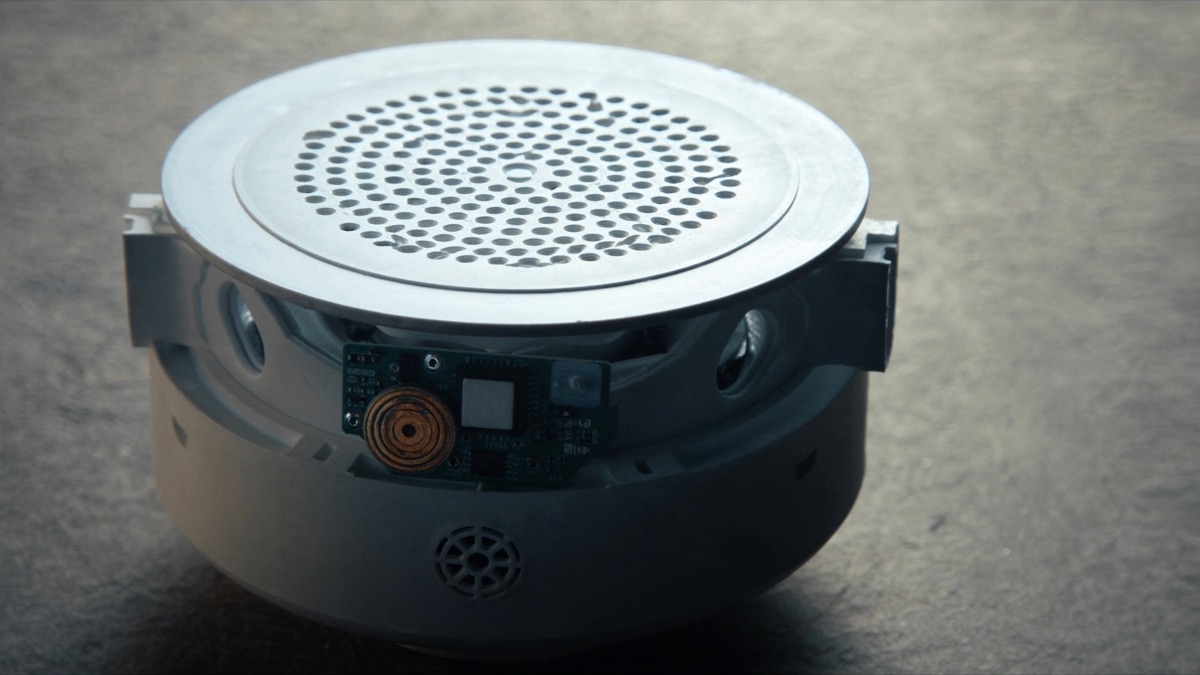
A smoke detector never actually smells anything; instead it constantly monitors a small internal sensing chamber for a physical disturbance, either scattered light or disrupted electrical current, that only occurs when smoke particles enter that chamber. The two dominant technologies, ionization and photoelectric, detect genuinely different kinds of fire at genuinely different speeds, which is why fire safety authorities increasingly recommend combining both rather than treating either one as a complete solution on its own.
How an Ionization Smoke Detector Actually Senses Fire
An ionization smoke detector contains a tiny amount of a radioactive isotope, typically americium-241, positioned between two electrically charged plates inside a small sensing chamber. The isotope continuously emits alpha particles that strip electrons from oxygen and nitrogen molecules in the air, creating a steady stream of charged ions that flow between the plates, producing a small, constant electrical current.
When smoke particles drift into the chamber, they are large and heavy compared to individual air molecules, and they attach to the ions, effectively neutralizing them and disrupting that steady current flow. The detector's circuit continuously monitors this current, and once it drops below a calibrated threshold, indicating enough ions have been captured by smoke particles, the alarm triggers.
How a Photoelectric Smoke Detector Uses Light Scattering Instead
A photoelectric smoke detector uses an entirely different mechanism: a small light-emitting diode shines a beam across a dark sensing chamber at an angle deliberately positioned so the beam normally misses a light sensor positioned off to one side, meaning clean air produces no signal at all.
When smoke particles enter the chamber, they scatter the light beam in many directions, and some of that scattered light strikes the sensor, which the circuit interprets as smoke and triggers the alarm once the scattered light exceeds a calibrated threshold. This geometry, called light scattering detection, means the sensor is specifically listening for light that should not normally be there rather than measuring a baseline that gets disrupted.
Why Ionization Detectors React Faster to Flaming Fires
Fast-flaming fires, like burning paper or a grease fire that ignites suddenly, produce very small combustion particles, often too fine to scatter light effectively but perfectly sized to attach to and neutralize ions. This physical property means ionization detectors typically respond to flaming fires several minutes faster than photoelectric units in controlled testing.
This speed advantage matters most in scenarios where flames spread rapidly with relatively little smoke buildup beforehand, such as a fire starting in flammable liquids or dry paper, situations where every additional minute of warning meaningfully increases the time available to escape before conditions become untenable.
Why Photoelectric Detectors React Faster to Smoldering Fires
Smoldering fires, like a cigarette left on upholstery or an electrical short slowly overheating insulation, produce large volumes of dense smoke well before any visible flame appears, and these larger particles scatter light extremely effectively. Photoelectric detectors typically catch smoldering fires significantly faster than ionization units, sometimes tens of minutes faster in real-world testing.
This matters enormously because smoldering fires are statistically the more common cause of nighttime house fire deaths, since they can produce lethal levels of toxic smoke and carbon monoxide for a long period while occupants sleep, unaware, before flames finally break out, making early smoke detection more critical than early flame detection in these scenarios.
Why Fire Safety Authorities Now Recommend Dual-Sensor Detectors
Because each technology has a genuine blind spot relative to the other, national fire safety organizations, including the National Fire Protection Association, now recommend installing both ionization and photoelectric detectors, or a single dual-sensor unit that combines both technologies in one housing, rather than relying on either type alone.
A dual-sensor detector runs both detection circuits simultaneously and triggers an alarm if either one crosses its threshold, giving households fast response to both flaming and smoldering fire scenarios without needing to install and maintain two entirely separate devices in every room, a design that has become increasingly standard in newer residential construction and retrofits.
Why Ionization Detectors Are More Prone to Cooking Nuisance Alarms
Ionization detectors are notoriously more sensitive to the fine combustion particles produced by ordinary cooking, particularly frying, broiling, and toasting, which frequently triggers nuisance alarms far from any real fire hazard. This sensitivity is a direct consequence of the same particle-size physics that makes them fast at detecting flaming fires.
Repeated nuisance alarms are a genuine safety concern beyond mere annoyance, because households that experience frequent false alarms near the kitchen often respond by disabling or removing the detector entirely, or relocating it so far from the kitchen that its detection speed suffers, both of which defeat the purpose of having a working smoke alarm in the first place.
Why the Radioactive Source in an Ionization Detector Is Considered Safe
The americium-241 inside an ionization detector emits alpha particles, a form of radiation that cannot penetrate even a sheet of paper or the outer layer of human skin, and the total quantity used, typically less than one microcurie, is extremely small. Regulatory agencies in most countries classify these devices as safe for unrestricted household use without special disposal precautions during normal operation.
The genuine safety consideration arises only at end of life: because the source is sealed inside the unit and the isotope has a long half-life of over four hundred years, expired detectors should be disposed of through manufacturer take-back programs or household hazardous waste collection rather than simply thrown in regular household trash, to prevent long-term accumulation in landfills.
How a Smoke Alarm's Piezoelectric Horn Actually Makes That Loud Sound
The distinctive, piercing alarm sound comes from a piezoelectric buzzer, a thin ceramic disc that rapidly deforms and vibrates when an alternating electrical current is applied to it, and that vibration pushes air to create sound waves at a frequency, typically around three to four kilohertz, deliberately chosen because human ears are most sensitive to it.
Modern smoke alarms are required to reach at least eighty-five decibels at ten feet, loud enough to wake a sleeping adult through a closed bedroom door, and many now use a specific temporal pattern, three beeps, a pause, then three beeps again, standardized so the sound is instantly recognizable as a fire alarm rather than a carbon monoxide alarm or another warning tone.
Why Smoke Detectors Should Be Replaced Every Ten Years
Both ionization and photoelectric sensing chambers gradually accumulate dust and degrade in sensitivity over years of continuous operation, and manufacturers and fire safety authorities uniformly recommend replacing an entire smoke detector, not just its battery, every ten years regardless of whether it still appears to function during a manual test button press.
The manual test button only confirms that the alarm circuit, speaker, and battery connection work; it does not verify that the sensing chamber itself can still accurately detect real smoke particles at the correct threshold, which is why a unit that passes every monthly test button check can nonetheless have degraded past its reliable service life.
Why Smoke Detectors Should Never Be Installed Too Close to Kitchens or Bathrooms
Fire codes specify minimum distances between smoke detectors and cooking appliances or shower steam sources, typically at least ten feet from a stove, because both cooking particulates and water vapor can trigger nuisance alarms in either detector type, steam because water droplets scatter light similarly to smoke particles in a photoelectric chamber.
Placement guidance also generally avoids dead air spaces, such as the peak of a pitched ceiling corner or directly beside an air conditioning vent, since stagnant air pockets can prevent smoke from reaching the sensor promptly, while strong airflow near a vent can dilute smoke concentration below the detection threshold before it reaches the chamber.
How Interconnected Smoke Alarms Warn an Entire House at Once
Modern residential fire codes increasingly require interconnected smoke alarms, where every unit in a house is wired or wirelessly linked so that a single detector sensing smoke triggers every alarm in the building simultaneously, rather than only sounding in the room where the fire actually started.
This matters enormously because a fire starting in a basement or garage might otherwise take several minutes to produce enough smoke to trigger a detector on a distant upper floor, precious time during which sleeping occupants elsewhere in the house would otherwise remain completely unaware, and interconnection can be achieved with either hardwired systems in new construction or radio-frequency linked battery units in retrofits.
How Smart Smoke Detectors Add Connectivity Without Changing the Sensing Physics
Smart smoke detectors use the same underlying ionization, photoelectric, or dual-sensor detection chambers as conventional units; the added intelligence comes entirely from a Wi-Fi or Bluetooth radio and companion smartphone app layered on top, sending push notifications, identifying which room triggered the alarm, and sometimes silencing false cooking alarms directly from a phone.
Some smart models also add a carbon monoxide sensor, typically an electrochemical cell that measures gas concentration through a chemical reaction rather than optical or ionization smoke detection, combining two entirely different sensing technologies inside one housing, which is why a combination unit's specifications sheet lists separate detection methods for each hazard.
Why Carbon Monoxide Detection Uses an Entirely Different Sensor
Carbon monoxide is an odorless, invisible gas produced by incomplete combustion in furnaces, water heaters, and vehicle exhaust, and because it is not smoke at all, neither ionization nor photoelectric technology can detect it; instead, dedicated carbon monoxide detectors use an electrochemical sensor that generates a small electrical current proportional to the gas concentration reacting at an electrode.
Some jurisdictions require combination smoke and carbon monoxide alarms specifically because the two hazards often arise from different sources at different times, and a household relying solely on a smoke detector would have no warning at all of a slow, deadly carbon monoxide leak from a malfunctioning furnace with no accompanying smoke or flame.
Why Low-Battery Chirps Happen at the Worst Possible Times
Most smoke detectors emit a distinct, single low-battery chirp roughly every thirty to sixty seconds when internal circuitry detects the battery voltage has dropped below a safe operating threshold, deliberately spaced apart and irregular in timing partly because it tends to draw more sustained attention than a continuous tone would.
The chirp often seems to happen disproportionately at night specifically because temperature drops slightly overnight in most homes, and battery voltage output naturally dips with lower temperature, pushing an already-marginal battery below the detection threshold at the exact moment it would otherwise have lasted until daytime, a well-documented and widely reported phenomenon rather than mere coincidence.
The Early History of Smoke Detection From Bulky Systems to Household Devices
Early smoke detection technology emerged in the mid-twentieth century as large, expensive systems installed almost exclusively in commercial and industrial buildings, connected to centralized alarm panels and far too costly and bulky for residential use, with ionization technology in particular originating from Swiss physicist Walter Jaeger's accidental discovery while researching gas detection.
It took until the 1970s for battery-powered, self-contained ionization detectors to become affordable and compact enough for mass residential adoption, a shift that coincided with a dramatic, measurable decline in house fire fatality rates across countries that mandated residential smoke detector installation, demonstrating one of public health's clearest examples of a simple technology producing large-scale lifesaving impact.
Why Large Buildings Combine Detectors With Duct and Beam Systems
Commercial buildings often supplement point-type ionization and photoelectric detectors with specialized designs suited to large open spaces: duct smoke detectors sample air directly from HVAC ductwork to shut down air handlers and prevent smoke from spreading through a building's ventilation system, while beam detectors project an infrared beam across an open atrium or warehouse.
A beam detector works on the same light-scattering and light-obscuration principle as a photoelectric unit but scaled up dramatically, monitoring for smoke anywhere along a beam path that can span over a hundred meters, making it far more practical than installing hundreds of individual point detectors across a large open ceiling space like an aircraft hangar or sports arena.
How Very Early Smoke Detection Systems Spot a Fire Before Visible Smoke
Very early smoke detection, or VESDA-type aspirating systems, use a network of small sampling pipes that continuously draw air from a protected space into a highly sensitive laser-based particle counter, capable of detecting combustion particles at concentrations thousands of times more dilute than what a standard point detector requires to trigger an alarm.
These systems are typically installed in environments where fire must be caught in its earliest overheating stages, before any visible smoke or flame, such as data centers protecting irreplaceable servers, clean rooms in semiconductor manufacturing, and museum archives storing priceless artifacts, since the value of what could be lost justifies the far higher cost of aspirating detection technology.
Why Correct Placement Matters as Much as Detector Technology
Fire safety codes specify smoke detectors on every level of a home and inside or immediately outside every sleeping area, because smoke naturally rises and spreads outward, and a detector positioned too far from bedrooms can leave occupants without adequate warning time during the critical minutes while they are asleep and least able to notice a fire on their own.
Beyond code minimums, safety experts emphasize that the best available detector technology cannot compensate for poor placement: a unit installed in a dead air pocket, blocked by furniture, or too close to a bathroom or kitchen generating frequent nuisance triggers that lead a household to disable it, ultimately provides less real-world protection than a correctly placed basic model.
Sources
- Wikipedia — ionization and photoelectric detection technology
- National Fire Protection Association — smoke alarm placement and dual-sensor guidance
- Wikipedia — electrochemical carbon monoxide sensing
FAQ
Which type of detector reacts faster to flaming fires?
Ionization detectors typically react faster to fast-flaming fires because their fine combustion particles readily attach to and neutralize ions inside the sensing chamber.
Which type of detector reacts faster to smoldering fires?
Photoelectric detectors typically react significantly faster to smoldering fires because the large, dense smoke particles they produce scatter light very effectively.
Is the radioactive material in an ionization detector dangerous?
No; the americium-241 emits alpha particles that cannot penetrate paper or skin, and the total quantity is extremely small, making it safe for normal household use.
Why do smoke detectors need to be replaced every ten years?
Sensing chambers accumulate dust and gradually lose sensitivity over years of operation, and the test button only confirms the alarm circuit works, not the sensor's actual accuracy.
Why do smoke detectors often go off while cooking?
Ionization detectors in particular are highly sensitive to the fine particles produced by frying, broiling, and toasting, triggering nuisance alarms unrelated to real fire risk.
What is a dual-sensor smoke detector?
A single unit combining both ionization and photoelectric detection circuits, triggering an alarm if either technology crosses its threshold, giving fast response to both flaming and smoldering fires.
Can a smoke detector detect carbon monoxide?
No, not on its own; carbon monoxide requires a separate electrochemical sensor, which is why combination smoke and CO alarms use two entirely different detection technologies.
Why do low-battery chirps often happen at night?
Battery voltage naturally dips with the slight overnight temperature drop in most homes, pushing an already-marginal battery below the detection threshold at that moment.
What is an interconnected smoke alarm system?
A setup where every alarm in a house is wired or wirelessly linked so that one unit detecting smoke triggers all alarms simultaneously, not just the one nearest the fire.
What does a beam detector do differently from a point detector?
It projects an infrared beam across an open space, sometimes over a hundred meters, and detects smoke anywhere along that path, rather than sampling air at a single fixed point.
What is a VESDA-type aspirating smoke detection system?
A system that continuously draws air through sampling pipes into a highly sensitive laser particle counter, able to detect combustion particles far earlier than a standard point detector.
Why shouldn't a smoke detector be placed near a bathroom?
Water droplets from shower steam scatter light similarly to smoke particles in a photoelectric chamber, which can trigger frequent nuisance alarms unrelated to any actual fire.
How does a smart smoke detector differ technically from a regular one?
It uses the same underlying ionization or photoelectric sensing chamber, with the added intelligence coming entirely from a Wi-Fi or Bluetooth radio and companion app layered on top.
Who invented ionization smoke detection technology?
Swiss physicist Walter Jaeger accidentally discovered the ionization detection principle while researching gas detection in the mid-twentieth century.
Why do commercial buildings use duct smoke detectors?
They sample air directly from HVAC ductwork to shut down air handlers and stop smoke from spreading through a building's ventilation system during a fire.
Does the piezoelectric alarm sound have a specific pattern?
Yes; standard fire alarms use three beeps, a pause, then three beeps again, a pattern chosen so the sound is instantly distinguishable from a carbon monoxide alarm.
About the Author
We reference Wikipedia and other authoritative sources to explain the background and current understanding of this topic.
Loved This Article?
Share it on WhatsApp → Share it on WhatsApp
Get more guides in your inbox — Subscribe to our newsletter for weekly surprising stories from Egypt, Saudi Arabia, Dubai, and beyond.