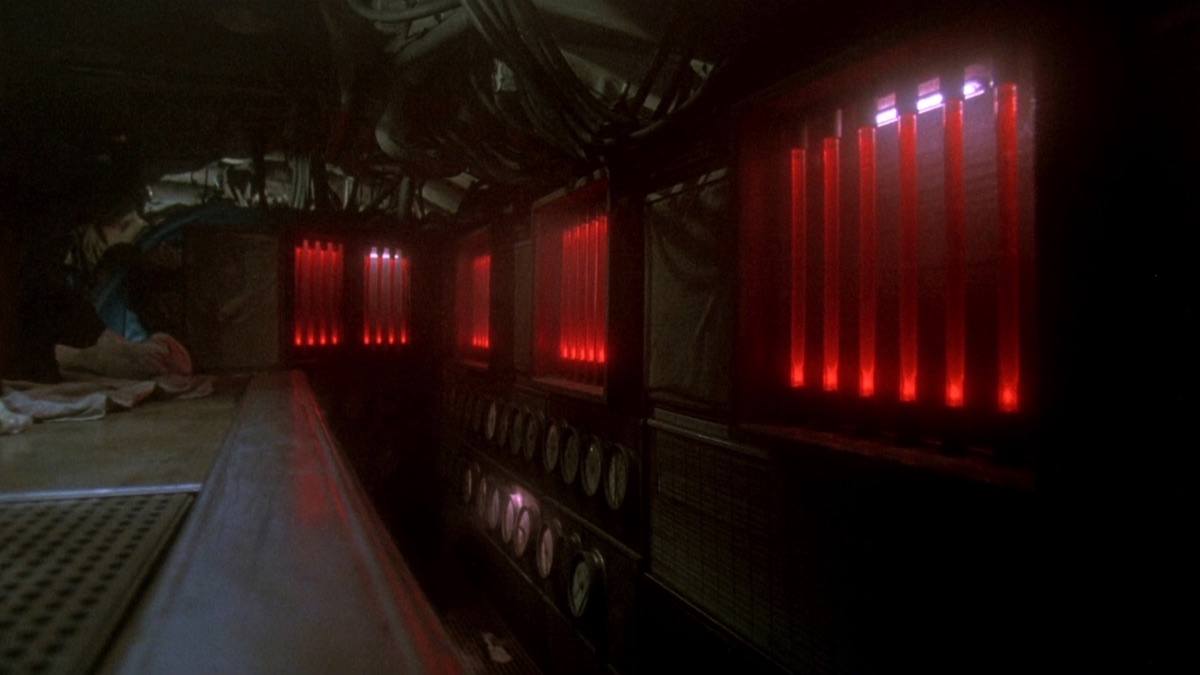
A submarine doesn't fight gravity to stay underwater — it simply makes itself weigh exactly as much as the water it pushes aside, a state called neutral buoyancy, then fine-tunes that balance to rise, sink, or hover perfectly still at any depth. It achieves this by flooding or emptying large ballast tanks with seawater, deliberately changing its own overall weight while its physical size and shape, and therefore the volume of water it displaces, stays essentially constant.
What Buoyancy Actually Means for a Submarine
Buoyancy is governed by Archimedes' principle: any object submerged in water experiences an upward force equal to the weight of the water it displaces. If an object weighs less than the water it displaces, it floats; if it weighs more, it sinks; if the two weights are exactly equal, the object neither rises nor sinks, a state called neutral buoyancy.
A submarine's hull has a fixed volume, so the weight of water it would displace at any given moment is essentially constant. This means the only variable a submarine can actually control to change its behavior in the water is its own total weight, which it adjusts deliberately by taking on or expelling seawater as ballast.
How Ballast Tanks Actually Let a Submarine Sink
A submarine at the surface floats with its ballast tanks filled mostly with air, keeping its overall weight less than the water it displaces. To dive, crew members open vents at the top of the ballast tanks, letting trapped air escape upward while seawater rushes in through openings at the bottom to fill the space.
As seawater fills the tanks, the submarine's total weight steadily increases while its displaced water volume stays essentially unchanged, until the two weights become equal and the vessel achieves neutral buoyancy, or the crew allows slightly more water in to make it briefly negatively buoyant so it begins descending under gravity.
How Compressed Air Actually Blows Water Out to Surface
To surface, the submarine reverses the process: high-pressure compressed air, stored in dedicated tanks specifically for this purpose, is forced into the top of the ballast tanks, pushing seawater back out through the bottom openings against the surrounding sea pressure, exactly like blowing air into an upside-down cup underwater to push the water out.
As water is expelled, the submarine's overall weight decreases while displaced volume stays constant, eventually making the vessel lighter than the water it displaces, generating a net upward force that carries it to the surface. Emergency surfacing systems can perform this entire process rapidly using high-pressure air bottles for a fast ascent if needed.
Why Neutral Buoyancy Alone Isn't Enough to Hover
Achieving exact neutral buoyancy at a specific depth is inherently unstable without correction, because seawater density itself varies with depth, temperature, and salinity — colder, saltier water is denser and provides more buoyant force, so a submarine perfectly balanced at one depth would tend to drift toward denser or less dense water layers.
To hold a precise, stable depth, submarines continuously use smaller trim tanks along with their diving planes, fin-like control surfaces that generate lift or downward force as the vessel moves forward through the water, similar to how an aircraft's wings and elevators control altitude, providing active correction beyond passive buoyancy balance alone.
How Trim Tanks Actually Fine-Tune the Balance
Beyond the main ballast tanks that control the overall dive-or-surface decision, submarines carry smaller trim tanks distributed at the bow and stern specifically to fine-tune the vessel's precise weight distribution, correcting for factors like fuel consumption, crew movement, or changes in cargo that would otherwise shift the boat's balance point over time.
Water is pumped between forward and aft trim tanks to keep the submarine level rather than tilted nose-up or nose-down, and between port and starboard trim tanks to prevent unwanted rolling, a continuous, largely automated balancing act that keeps the vessel level and stable regardless of what else is happening inside it.
Why Diving Planes Work Like Underwater Airplane Wings
Diving planes are movable, wing-shaped control surfaces mounted on the submarine's sail and stern, angled to generate lift or downward force as water flows past them while the vessel moves forward, exactly the same aerodynamic principle that lets an airplane wing generate lift by deflecting air.
Tilting the bow planes upward angles the entire submarine to climb even while remaining neutrally buoyant, and tilting them downward forces a controlled descent, giving the crew fast, responsive depth control that doesn't require waiting for the slower process of adjusting ballast water, especially useful for rapid depth changes during maneuvering.
How Depth Affects Water Pressure on the Hull
Water pressure increases roughly one atmosphere for every ten meters of depth, meaning a submarine several hundred meters down experiences dozens of times the pressure at the surface, squeezing the hull inward with immense force from every direction simultaneously, a fundamentally different structural challenge than an aircraft, which experiences relatively low pressure differences.
A submarine's pressure hull is engineered as a thick-walled cylinder, generally the strongest practical shape for resisting uniform external pressure, and every design has a specific maximum safe operating depth beyond which the hull risks structural failure, with a substantial safety margin built in below the theoretical crush depth.
Why Submarines Carry Emergency Blow Systems
An emergency blow system releases a very large volume of high-pressure air into the main ballast tanks almost instantaneously, far faster than the normal, controlled surfacing procedure, specifically designed for emergencies like flooding or loss of propulsion where the crew needs the fastest possible ascent to the surface.
This system is deliberately kept simple and mechanically robust, often operable even if the submarine's main electrical systems fail, because in a genuine emergency the crew cannot rely on complex automated systems working correctly — it must function as a nearly foolproof, last-resort mechanism precisely when everything else may be going wrong.
How Submarines Manage Weight Changes From Fuel and Supplies
As a submarine consumes fuel, food, and other consumables over a long patrol, or as crew and equipment shift position, its overall weight and center of gravity gradually change, which would slowly throw off a perfectly calibrated buoyancy balance if left uncorrected over weeks or months at sea.
Crews continuously compensate by adjusting trim tank water levels to match these gradual weight losses and shifts, essentially replacing consumed mass with an equivalent mass of seawater in the appropriate location, so the vessel's overall buoyancy and balance remain correct throughout a mission regardless of how much has been consumed.
Why Nuclear Submarines Can Stay Submerged Far Longer Than Diesel Ones
Diesel-electric submarines must periodically surface or come near the surface to run air-breathing diesel engines, either to recharge batteries or use a snorkel that draws in outside air, because the diesel combustion process itself requires oxygen unavailable underwater without external air access.
Nuclear submarines instead use a reactor to generate heat that produces steam driving a turbine, requiring no atmospheric oxygen at all for propulsion, and they generate their own oxygen for the crew to breathe by splitting seawater through electrolysis, meaning their underwater endurance is limited mainly by crew food supplies rather than fuel or air.
How the Periscope and Sensors Let Crews See Without Surfacing
A periscope uses a series of mirrors or prisms inside a long, narrow, retractable tube to let a crew member view the surface from below while the rest of the submarine remains fully submerged, exposing only the thin periscope tip above the waterline, which is far harder to spot than the entire vessel.
Modern submarines increasingly rely on electronic photonics masts instead of traditional optical periscopes, which use digital cameras and sensors at the mast's top feeding video to screens throughout the control room, eliminating the need for a direct optical path down through the hull and allowing the imagery to be viewed and recorded simultaneously by multiple crew members.
Why Submerged Submarines Rely on Sonar Instead of Vision
Light penetrates only a limited distance through even the clearest seawater before scattering and absorption render it useless for navigation, so a submerged submarine relies almost entirely on sonar, which sends out sound waves and listens for their echoes off surrounding objects, since sound travels through water far more efficiently than light does.
Passive sonar simply listens for sounds generated by other vessels without transmitting anything, keeping the submarine covert, while active sonar deliberately pings out a sound pulse and measures the echo's return time to calculate distance, at the cost of revealing the submarine's own position to anyone else listening.
How Ballast Systems Actually Differ Between Military and Research Submersibles
Small deep-sea research submersibles, designed for short scientific dives to extreme depths rather than sustained military patrols, often use simpler ballast systems, sometimes even dropping solid weights like iron pellets or shot to descend and releasing them to ascend, rather than the complex pumped water systems large military submarines use.
These smaller vessels also frequently carry syntactic foam, a rigid, buoyant composite material that provides stable buoyancy without being compressed by extreme deep-sea pressure the way an air-filled tank would, since at extreme ocean depths the pressure is far too great for a simple air-filled ballast approach to remain practical or safe.
Why a Submarine's Center of Gravity Must Stay Below Its Center of Buoyancy
For a submarine to remain stably upright rather than capsizing, its center of gravity, the average point where its weight is concentrated, must sit below its center of buoyancy, the average point where the buoyant force effectively acts, creating a righting effect that naturally corrects any small unwanted roll or tilt back toward level.
Engineers achieve this by deliberately placing heavy components like the reactor, batteries, and keel ballast low in the hull, while lighter equipment sits higher, ensuring that if the vessel is ever nudged off level by waves, currents, or maneuvering, gravity and buoyancy work together to restore it to a stable, upright orientation automatically.
How Depth Charges Historically Exploited Submarine Buoyancy Limits
A depth charge is designed to detonate at a preset depth near a submerged submarine, and its destructive effect comes primarily from the shockwave transmitted through water, which is far denser than air and transmits pressure waves much more efficiently, capable of rupturing a pressure hull from a distance without a direct hit.
If a depth charge damages ballast tanks or the pressure hull itself, a submarine can lose its ability to control buoyancy precisely, either becoming trapped unable to surface if it loses buoyant capacity, or uncontrollably rising if damaged ballast tanks flood with air instead of water, historically making depth charge attacks a critical vulnerability for early submarines.
Sources
- U.S. Navy Fact File — Official U.S. Navy overview of submarine systems.
- Smithsonian Institution — Smithsonian explainer on submarine history and technology.
- NOAA Ocean Exploration — NOAA reference on submersible and submarine technology.
FAQ
Can a submarine get permanently stuck at a certain depth?
In principle yes if buoyancy control systems fail entirely, which is precisely why submarines carry redundant emergency blow systems and, in dire emergencies, can jettison heavy equipment or fuel to reduce weight and force an ascent even without normal ballast control.
How deep can a typical submarine actually dive?
Most military submarines have a publicly stated safe operating depth of a few hundred meters, though actual maximum depths are typically classified; specialized deep-sea research submersibles can descend to several thousand meters or even to the ocean's deepest trenches.
Does a submarine use more energy to stay at a fixed depth than to move forward?
Maintaining neutral buoyancy itself requires very little ongoing energy once achieved, since it's a passive physical balance; most of a submarine's propulsion energy actually goes toward forward movement and running onboard systems, not toward simply holding depth.
Why do submarines sometimes appear to bob at the surface before diving?
At the surface, a submarine behaves somewhat like a surface ship, riding on waves with partially filled ballast tanks, and this visible bobbing is simply normal wave action on a partially buoyant vessel before the crew begins the deliberate, controlled flooding sequence to submerge.
What happens to buoyancy if a submarine springs a leak?
Uncontrolled flooding adds unplanned weight exactly like ballast water would, pushing the vessel toward negative buoyancy and an unintended descent, which is why submarines are divided into watertight compartments that can be sealed off to contain flooding to one section and limit the weight gain.
Why can't a submarine simply use propellers to force itself down instead of ballast?
Propellers combined with diving planes can angle a moving submarine downward, but this only works while the vessel has forward speed; ballast-controlled buoyancy lets a submarine hover motionless at a stable depth indefinitely, which thrust-based diving alone cannot achieve.
How do submarine crews know their exact depth without looking outside?
Pressure sensors mounted on the hull continuously measure surrounding water pressure, which increases predictably and precisely with depth, and onboard instruments convert that pressure reading directly into an accurate depth display in the control room at all times.
Do submarines need different ballast amounts in saltwater versus freshwater?
Yes; saltwater is denser than freshwater and therefore provides more buoyant force for the same volume, so a submarine moving between the two, such as into a river estuary, must adjust its ballast to compensate for the density change or its buoyancy balance will shift.
Why don't submarines simply sink to the ocean floor and rest there?
Most submarines are not structurally designed to rest on the seabed, and ocean depths in open water far exceed any submarine's safe crush depth, so resting on the bottom is only possible in relatively shallow water and is avoided operationally except in specific emergency or specialized scenarios.
How quickly can a modern submarine change depth?
Routine depth changes using diving planes happen at a controlled, moderate rate for crew safety and structural comfort, while emergency ascent using the emergency blow system can bring a submarine to the surface dramatically faster, though still limited by pressure change effects on the crew and hull.
Why is submarine design so much more complex than a simple submersible toy?
A real submarine must sustain human life for months, withstand enormous and highly variable pressure at operational depths, maintain precise stability and stealth, and integrate propulsion, life support, and weapons or sensor systems — requirements far beyond a simple toy that only needs to sink and rise once in shallow water.
Can water temperature alone cause a submarine to rise or sink unexpectedly?
Yes, to a small but real degree; crossing into a layer of significantly warmer or colder water changes the local water density and therefore the buoyant force acting on the hull, which is why crews continuously monitor and adjust trim as the submarine moves through different water layers.
How do submarines avoid collisions with the seafloor or other vessels while submerged?
Crews rely on sonar to detect nearby objects and the seafloor, combined with detailed nautical charts showing known depth contours and hazards, and maintain a safety margin below their keel at all times, using both active listening and passive charts to avoid unseen obstacles.
Why do submarine hulls have a rounded, cigar-like shape?
A rounded cylindrical hull distributes external water pressure evenly across its surface, minimizing structural stress points, while also reducing hydrodynamic drag as the vessel moves through water, combining structural strength against pressure with efficient underwater movement in a single shape.
Do all parts of a submarine flood equally when it dives?
No; only the ballast tanks, which sit outside or separate from the pressurized crew compartments, are deliberately flooded with seawater — the inner pressure hull housing the crew and equipment remains completely dry and sealed against the surrounding water at all times.
Who first designed a practical, working submarine?
Early working submersibles date to the early 1600s, but the first submarine widely credited with practical underwater combat use was the hand-cranked Turtle, built in 1775, followed by rapid nineteenth and twentieth century advances in propulsion, hull design, and ballast systems that produced the modern submarine.
Why do submarine crews train extensively for flooding emergencies?
Because uncontrolled flooding directly threatens buoyancy and can quickly overwhelm a vessel if not contained within seconds to minutes, crews drill repeatedly on sealing watertight compartments, operating emergency pumps, and executing emergency ascent procedures so the response becomes automatic rather than something worked out under pressure.
Does a submarine's buoyancy behave differently near the equator versus the poles?
Yes, slightly; water temperature and salinity vary by region and season, changing local seawater density, so crews operating in different ocean regions account for these regional differences when calibrating ballast and trim rather than assuming identical conditions everywhere.
How do research submersibles differ from crewed navy submarines in mission length?
Research submersibles are typically designed for dives lasting hours, carrying enough life support for a short, focused scientific mission, while nuclear-powered navy submarines are built to sustain crews for months at a time, reflecting entirely different mission profiles and life-support engineering priorities.
Why is precise buoyancy control especially critical near the ocean surface?
Near the surface, wave action and shallower water leave far less margin for error, and a submarine that broaches unintentionally risks detection or collision with surface traffic, so crews exercise extra caution and finer ballast adjustments during the critical transition zone near periscope depth.
About the Author
We reference Wikipedia and other authoritative sources to explain the background and current understanding of this topic.
Loved This Article?
Share it on WhatsApp → Share it on WhatsApp
Get more guides in your inbox — Subscribe to our newsletter for weekly surprising stories from Egypt, Saudi Arabia, Dubai, and beyond.