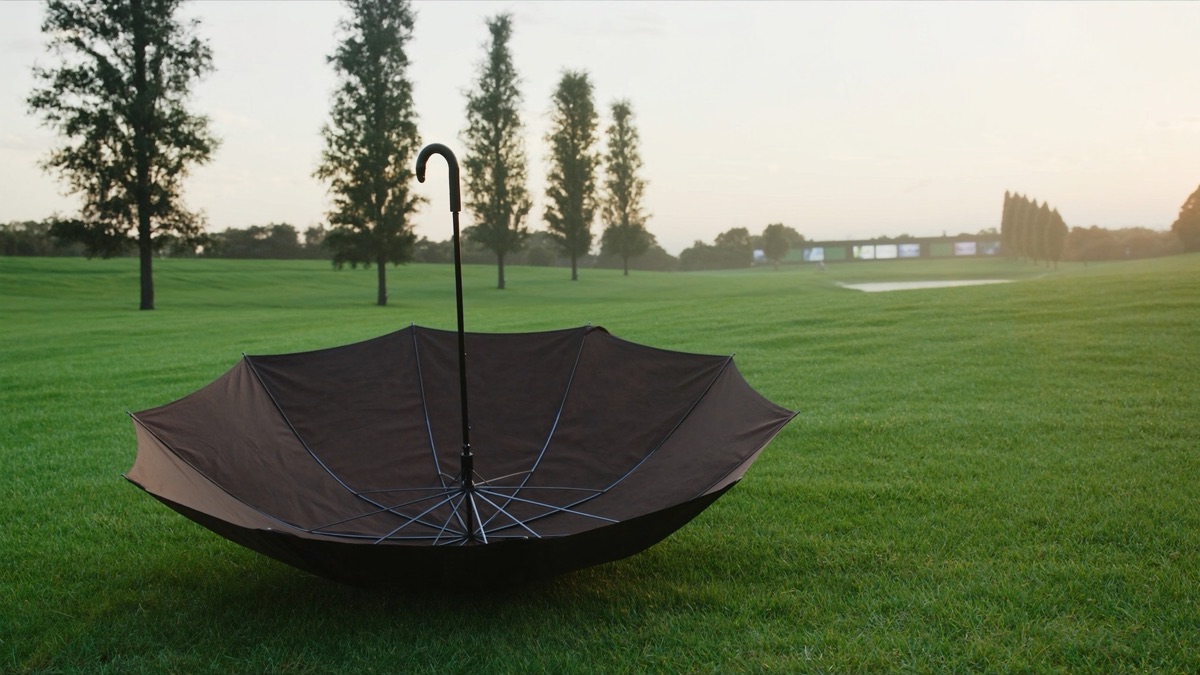
An Umbrella Is Really a Tent Frame in Miniature
Strip away the fabric and an umbrella is a small tensioned structure remarkably similar to a tent: a central pole acts as the rigid spine, a set of ribs radiate outward like tent poles, and a stretched canopy is the only thing standing between the frame and the sky.
The entire design challenge is the same one tent engineers face at a much larger scale — how to hold a lightweight covering taut against unpredictable wind loads using the smallest, lightest possible frame that still won't collapse or invert under pressure.
Wind Doesn't Push an Umbrella — It Lifts It
The dangerous force acting on an open umbrella in a storm isn't a simple horizontal shove but an upward lift, generated the same way an airplane wing generates lift: air moving faster over the canopy's curved top surface creates lower pressure there than underneath.
That pressure difference tries to suck the canopy upward and, past a certain wind speed, flip it violently inside out — which is why umbrella failure almost always looks like sudden inversion rather than the umbrella simply being blown sideways out of a person's hand.
The Ribs Are Deliberately the Weakest Link
Every umbrella rib is designed to be the first component to give way under excessive force, not out of poor engineering but by careful intent — a rib that bends or briefly folds absorbs and dissipates gust energy that would otherwise transfer directly into the central shaft or the canopy fabric itself.
This sacrificial design philosophy mirrors how modern buildings are engineered to sway rather than stay perfectly rigid during an earthquake: some flex is the mechanism that prevents catastrophic failure elsewhere in the structure.
Vented Canopies Let Air Pass Through Instead of Fighting It
Many storm-rated umbrellas include a small vented panel or double-canopy gap near the top, deliberately breaking the sealed dome shape that would otherwise trap a gust of wind underneath the fabric with nowhere to escape.
That trapped air pocket is exactly what generates the catastrophic upward force during a strong gust, so a vent that lets a portion of that air bleed through the top of the canopy dramatically reduces the pressure differential driving inversion, even though it looks like a design flaw rather than a safety feature.
Fiberglass Ribs Bend Because Metal Ones Snap
Older umbrella designs relied on stiff steel ribs, which held their shape well in light wind but had a critical flaw: steel deforms permanently once bent past its elastic limit, meaning a single strong gust could snap or permanently warp the frame beyond repair.
Fiberglass ribs, now standard in most quality umbrellas, can flex dramatically — sometimes bending nearly in half — and then spring back to their original shape once the gust passes, because fiberglass composites have a far higher elastic limit relative to their stiffness than metal does.
The Runner and Stretcher System Turns a Push Into a Lock
Opening an umbrella works through a sliding component called the runner, which travels up the central shaft and pushes a set of secondary rods called stretchers outward, which in turn force the main ribs to swing open and tension the fabric across them.
Once the runner reaches the top and clicks into a locking notch, the geometry of the stretcher-to-rib connection creates a mechanically stable triangle at each rib, meaning the open position resists collapsing inward under normal load without needing continuous force to hold it there.
Canopy Fabric Is Chosen for How It Sheds Wind, Not Just Rain
Modern umbrella canopies are usually woven from tightly spun polyester rather than the cotton or oiled silk of earlier centuries, chosen partly for water resistance but just as much for its relatively low aerodynamic drag and ability to flex without permanently stretching or tearing under gust loads.
A canopy with too much give will billow excessively and place uneven strain on individual ribs, while one that's too rigid transmits the full force of any gust directly into the frame — fabric selection is really a compromise between these two failure modes.
The Central Shaft Handles Compression, Not Bending
The umbrella's central pole is engineered primarily to resist compression — the downward force of someone's grip pushing against the upward resistance of the open canopy — rather than to resist significant sideways bending, which is instead distributed outward through the rib and stretcher system.
This division of structural labor is why a shaft can be relatively thin and light without failing under normal use: it isn't meant to single-handedly resist wind, only to hold the geometry of the rib system in place while that system does the actual work of absorbing gust force.
Double-Canopy Designs Add a Second Layer of Escape Routes
Some high-performance storm umbrellas use two separate fabric layers with a gap between them near the crown, functioning much like the vent design but more aggressively — wind that would build pressure under a single canopy instead passes between the two layers and exits through the sides.
This two-layer approach costs more in materials and manufacturing complexity but noticeably raises the wind speed an umbrella can survive without inverting, which is why most umbrellas explicitly marketed as wind-resistant use some variation of this dual-layer principle.
Angling an Umbrella Into the Wind Changes Its Physics Entirely
Holding an umbrella flat overhead in gusty conditions maximizes the surface area exposed to lift-generating airflow, while tilting the canopy forward into the oncoming wind changes the airflow pattern so gusts largely deflect off the fabric's angled surface instead of curling underneath it.
This is why the common advice to tilt an umbrella into strong wind isn't just folk wisdom — it fundamentally alters which forces dominate, shifting the load from dangerous lift toward more manageable drag that the frame is better equipped to handle.
Umbrella Frames Borrow Directly From Parachute Rigging Logic
The network of ribs and stretchers distributing tension evenly across an umbrella canopy is structurally analogous to the suspension lines of a parachute, which likewise spread the force of air resistance across dozens of load-bearing lines rather than concentrating it on any single point.
In both systems, failure at one point should ideally not cascade catastrophically — an umbrella with one bent rib can often still function adequately, just as a parachute with a few damaged lines can usually still provide enough resistance to be functional, because the load simply redistributes across the remaining structure.
Compact Folding Umbrellas Trade Rib Length for More Joints
Telescoping umbrellas achieve their collapsibility by breaking the central shaft and ribs into multiple sliding or hinged segments rather than one continuous piece, which inevitably introduces more joints — and every joint is a potential weak point where flex, wear, or misalignment can occur.
Manufacturers compensate for this added fragility by using more ribs overall in compact designs, distributing wind load across a greater number of thinner segments rather than fewer thick ones, which is part of why quality compact umbrellas often cost more than full-size ones despite using less total material.
Golf Umbrellas Are Oversized on Purpose, Not by Accident
The unusually large canopy diameter of a golf umbrella isn't simply about covering more ground — a bigger canopy also means the wind load per unit of rib length is actually lower relative to the umbrella's overall size, since larger canopies typically use proportionally thicker, sturdier ribs designed from the outset for outdoor, exposed-field use.
This is also why golf umbrellas frequently use a double-canopy vent system as standard rather than an optional feature, since their large surface area would otherwise be especially prone to catching and trapping gusts of wind.
The Snap of an Inverting Umbrella Is a Structural Warning, Not Random Noise
When an umbrella suddenly inverts, the sharp cracking sound often comes from a rib's fiberglass fibers reaching and briefly exceeding their elastic limit before either recovering or beginning to delaminate internally, a warning sign that the material has been pushed close to genuine failure even if it visually springs back afterward.
Repeated inversions weaken fiberglass ribs cumulatively through microscopic fiber damage that doesn't show externally, which is why an umbrella that has inverted several times tends to fail at progressively lower wind speeds even though each individual incident looked identical from the outside.
Automatic Open Mechanisms Use Stored Spring Tension
Push-button automatic umbrellas store mechanical energy in a compressed spring inside the shaft when the umbrella is closed, and pressing the button releases that stored energy in a controlled burst that drives the runner upward along the shaft to open the canopy in roughly a second.
This stored-energy system adds no strength advantage against wind once the umbrella is open — the spring's only job is opening the canopy quickly, after which the same rib-and-stretcher geometry as a manual umbrella takes over entirely for structural support.
Why Umbrellas Perform Worse in Sudden Gusts Than Steady Wind
A steady, constant wind allows the ribs and canopy to settle into a stable flex pattern that distributes load predictably across the whole frame, but a sudden, sharp gust arrives faster than the fabric and ribs can smoothly redistribute that force, concentrating stress momentarily on whichever ribs happen to be least angled to deflect it.
This is the same reason a bridge is often more vulnerable to sudden wind shear than to sustained high wind of the same average speed — rapid changes in load are harder for any flexible structure to absorb gracefully than gradual ones, even when the peak force involved is identical.
The Handle and Grip Transmit Force Back Into the Human Arm
In genuinely severe gusts, the umbrella frame itself may survive intact while the real failure point becomes the person holding it, since the same forces the ribs are designed to absorb ultimately transmit back down the shaft into the wrist and forearm if the canopy can't fully dissipate them structurally.
This is part of why ergonomic handle designs matter beyond simple comfort: a handle shape that lets the wrist rotate slightly under load acts as one more small shock absorber in the overall chain, reducing the jarring impact a sudden gust otherwise delivers directly to the hand.
Materials Science Has Quietly Doubled Practical Wind Ratings
Umbrellas from several decades ago were rarely rated to survive winds much above 30 kilometers per hour before frame failure became likely, while modern fiberglass-and-vented designs routinely claim resistance up to 60 or even 100 kilometers per hour under controlled testing conditions.
That improvement comes almost entirely from materials and geometry rather than sheer added bulk — today's storm umbrellas are often lighter than older rigid designs while surviving substantially higher wind loads, a direct result of engineering for controlled flex rather than for raw stiffness.
Why No Umbrella Is Truly Windproof
Every design choice described here — venting, flexible ribs, angled deflection, distributed tension — raises the wind speed threshold at which failure occurs, but none of them eliminates the underlying aerodynamic lift problem entirely, since a canopy of any size still presents a surface for pressure differentials to act on.
Manufacturers market umbrellas as wind-resistant rather than windproof for exactly this reason: past some sufficiently extreme wind speed, the physics of lift generation on a curved surface will always eventually overwhelm whatever mechanical compromises the frame has been engineered to make.
Sources
- Wikipedia: Umbrella — History and mechanical design of umbrella canopy and frame systems.
- Wikipedia: Drag (physics) — Aerodynamic force principles relevant to wind loading on curved surfaces.
- Britannica: Umbrella — Encyclopedia entry on umbrella history and construction.
FAQ
Why do umbrellas turn inside out in wind?
Wind moving over the curved canopy top creates lower pressure there than underneath, generating an upward lift force similar to an airplane wing that flips the canopy past a certain wind speed.
Why do umbrella ribs bend instead of staying rigid?
Ribs are designed as the sacrificial weak point that flexes to absorb and dissipate gust energy, preventing that force from transferring destructively into the central shaft or canopy fabric.
What does the vent on top of an umbrella actually do?
It lets a portion of trapped air escape through the top of the canopy, reducing the pressure difference underneath that would otherwise drive violent inversion during a strong gust.
Why are fiberglass ribs better than metal ones?
Fiberglass has a much higher elastic limit relative to its stiffness, letting it bend dramatically and spring back to shape, while metal deforms permanently once bent past its elastic limit.
Does tilting an umbrella into the wind actually help?
Yes; tilting changes the airflow so gusts deflect off the angled fabric surface instead of curling underneath it, shifting the dominant force from dangerous lift to more manageable drag.
Why do double-canopy umbrellas resist wind better?
A gap between two fabric layers lets wind that would build pressure under a single canopy pass through and exit the sides instead, reducing the buildup that drives inversion.
Why are golf umbrellas so much bigger than regular ones?
Their larger canopies use proportionally thicker, sturdier ribs designed for exposed outdoor use, and they almost always include vent systems as standard given their greater wind-catching surface area.
Does an umbrella get weaker after it inverts once?
Yes; repeated inversions cause microscopic fiber damage in fiberglass ribs that doesn't show externally, making the umbrella fail at progressively lower wind speeds over time.
How does an automatic push-button umbrella open itself?
A compressed spring inside the shaft stores mechanical energy while closed, and pressing the button releases it in a controlled burst that drives the canopy open in about a second.
Why are sudden gusts worse for umbrellas than steady wind?
Steady wind lets the frame settle into a stable, evenly distributed flex pattern, while a sudden gust arrives faster than the structure can redistribute force, concentrating stress on the least-angled ribs.
Can a bent umbrella rib still be used safely?
Often yes, since the umbrella's rib-and-stretcher system distributes load like a parachute's suspension lines, allowing the remaining ribs to compensate for one damaged one without total structural failure.
Why do compact folding umbrellas often use more ribs?
Breaking the frame into sliding, telescoping segments adds joints that are potential weak points, so manufacturers add extra ribs to distribute wind load across more, thinner segments.
Is there really such a thing as a windproof umbrella?
No; every design improvement raises the wind speed threshold for failure, but the underlying aerodynamic lift problem on any curved canopy surface can never be fully eliminated at extreme wind speeds.
Why does the umbrella handle matter for wind resistance?
In severe gusts the frame may hold while force transmits down into the user's wrist and forearm, so an ergonomic handle that allows slight wrist rotation acts as an added shock absorber.
How much stronger are modern umbrellas than older designs?
Older designs rarely survived winds above 30 km/h before failing, while modern fiberglass-and-vented designs often claim resistance up to 60-100 km/h under controlled testing, mainly from materials and geometry improvements.
About the Author
We reference Wikipedia and other authoritative sources to explain the background and current understanding of this topic.
Loved This Article?
Share it on WhatsApp → Share it on WhatsApp
Get more guides in your inbox — Subscribe to our newsletter for weekly surprising stories from Egypt, Saudi Arabia, Dubai, and beyond.