A Tooth Isn't Cemented to Bone — It's Suspended in It
Every tooth sits inside its socket held by the periodontal ligament, a thin layer of collagen fibers stretching between the tooth's root and the surrounding jawbone, which means the tooth is never rigidly fused to bone but rather suspended in a slightly flexible sling.
This ligament is the entire reason orthodontic movement is possible at all: it senses pressure, transmits that pressure into biological signals, and recruits the cells that will eventually relocate the bone socket itself rather than simply bending the tooth in place.
Light, Constant Force Beats Heavy, Short Bursts
Orthodontists deliberately apply light continuous force, typically in the range of 50 to 150 grams per tooth, because forces in this narrow band compress the ligament just enough to restrict blood flow on the pressure side without crushing the tissue outright.
Push much harder and the ligament's blood supply is cut off entirely, causing tissue death that actually stalls movement and risks root damage — which is why a bent, springy archwire that delivers gentle sustained pull moves teeth faster over months than any single hard push ever could.
The Pressure Side of the Tooth Literally Dissolves
On the side of the root where the ligament gets compressed, the reduced blood flow and mechanical strain trigger the release of chemical signals that recruit osteoclasts — specialized cells whose entire job is to dissolve bone mineral and clear it away.
Over roughly one to two weeks, this localized bone resorption carves out just enough space in the socket wall for the tooth to physically drift a fraction of a millimeter in the direction the force is pulling it.
The Opposite Side Rebuilds New Bone to Fill the Gap
On the tension side of the root, where the ligament fibers stretch rather than compress, a different set of signals recruits osteoblasts — the bone-building counterpart to osteoclasts — which lay down fresh bone matrix to fill the widening gap left behind.
This dual process, resorption on one side and deposition on the other, effectively lets the entire tooth socket migrate through the jaw over time, carrying the tooth with it while keeping the root anchored in living bone the whole way.
Why the First Few Days After an Adjustment Hurt
The soreness patients feel two to four days after an orthodontist tightens a wire isn't the bone remodeling itself, which is painless, but rather the initial inflammatory response — swelling and chemical mediators like prostaglandins released as the ligament first registers the new pressure.
That inflammation typically peaks around day three and fades within a week as the tissue adapts to the new force level, which is also roughly the point at which resorption and deposition are running at full pace and real movement resumes.
Archwires Are Chosen for How They Bend, Not How Strong They Are
Modern archwires are usually made from nickel-titanium alloys prized for superelasticity — the ability to bend into a tight curve and then slowly return toward their original shape over weeks, delivering a steady low force without the orthodontist needing to retighten anything.
Later in treatment, orthodontists often switch to stiffer stainless steel wires for fine positioning and torque control, once the bulk of the tooth movement is done and only small precise adjustments to angle and rotation remain.
Elastic Bands Solve a Problem Wires Alone Cannot
Rubber bands stretched between upper and lower brackets apply force in a direction wires can't easily deliver — pulling the entire upper or lower arch forward or backward relative to the other, which is essential for correcting overbites and underbites rather than just straightening individual teeth.
Because elastics are removable and patient-controlled, their effectiveness depends heavily on how consistently they're worn; orthodontists typically ask for 20 to 22 hours a day, since gaps of even a few hours let the ligament partially relax and slow the correction.
Self-Ligating Brackets Trade Force for Friction, Not the Other Way Around
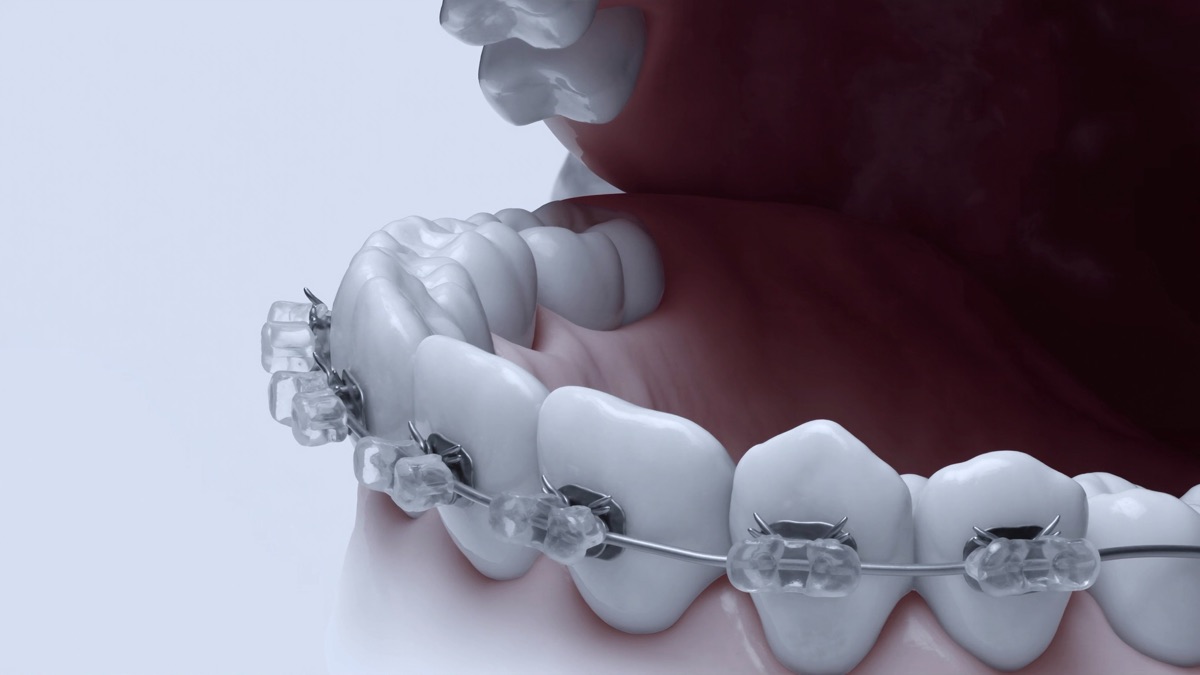
Traditional brackets hold the wire in place with small elastic or metal ties, which press the wire against the bracket slot and create friction that resists the wire's natural sliding motion as teeth move.
Self-ligating brackets use a built-in sliding clip instead of ties, reducing that friction so the archwire can slide more freely through the bracket — proponents argue this allows lighter forces to still produce movement, though clinical studies show the total treatment time difference versus traditional brackets is often smaller than marketing suggests.
Clear Aligners Move Teeth in Small, Pre-Planned Steps
Instead of one continuously adjusted wire, clear aligner systems use a sequence of rigid plastic trays, each shaped slightly differently from the last, with each tray designed to move a tooth about 0.25 to 0.33 millimeters before the patient switches to the next one in the series.
A 3D-printed or milled model of the entire planned tooth path is generated before treatment starts, meaning the full sequence of small movements is mapped out digitally in advance rather than adjusted reactively at each office visit the way wire-based treatment usually is.
Some Tooth Movements Are Far Easier Than Others
Tipping a tooth — tilting its crown sideways while the root stays relatively put — requires the least force and happens fastest, since it only needs resorption and deposition concentrated near the top of the root rather than along its entire length.
Bodily movement, sliding the whole tooth including its root in one direction while keeping it upright, and rotation around the tooth's long axis are both mechanically harder, requiring more sustained force over a wider area of the root and taking proportionally longer to complete.
Root Resorption Is the Real Risk of Moving Too Fast
If force levels are pushed too high or applied for too long without rest periods, the resorption process meant to clear space in the bone socket can begin eating into the root's own surface — a condition called root resorption that is irreversible once it occurs.
This is one reason orthodontists resist patient requests to speed up treatment by tightening wires more aggressively: the biological remodeling rate has a practical ceiling, and forcing movement faster than the bone can safely dissolve and rebuild raises resorption risk without proportionally shortening total treatment time.
Palatal Expanders Widen the Jaw Itself, Not Just the Teeth
In growing children and young teens, a palatal expander applies steady outward pressure across the roof of the mouth, gradually separating the midpalatal suture — a seam of connective tissue between the two halves of the upper jaw that hasn't yet fully fused.
As the suture widens, new bone fills the gap, permanently increasing the width of the upper jaw itself rather than just tilting individual teeth outward, which is why expanders are used early: once the suture fuses completely in adulthood, achieving the same skeletal widening requires surgery.
Retainers Exist Because the Ligament Fibers Remember
Even after a tooth has fully moved into its new position and the surrounding bone has remodeled around it, the stretched gingival and periodontal fibers retain some elastic memory of the tooth's original position for months afterward, quietly pulling it back if given the chance.
Retainers counteract this by holding teeth firmly in place long enough for those fibers to fully reorganize and stabilize, which is why orthodontists prescribe nightly retainer wear indefinitely rather than for just a few months — relapse can happen years later if retention is abandoned too early.
Adult Orthodontics Works the Same Way, Just Slower
The biological mechanism of resorption and deposition doesn't change with age, but adult bone tends to be denser and remodels more slowly than a teenager's actively growing jaw, which is the main reason adult treatment plans typically run longer than adolescent ones for a comparable amount of correction.
Adults are also more likely to have existing gum recession or bone loss from periodontal disease, both of which can limit how much movement is safe and require closer monitoring throughout treatment than a healthy teenage patient would need.
Why Some Cases Require Extractions First
When the jaw doesn't have enough physical space to accommodate all the teeth in straight alignment, orthodontists sometimes remove one or more premolars first, creating room that the remaining teeth can then be guided into using the same resorption-deposition process.
Modern orthodontics extracts far less often than it did decades ago, since better skeletal expansion techniques and more sophisticated force planning can create space non-surgically in many cases that would once have automatically called for extraction.
Headgear Redirects Growth, It Doesn't Just Move Teeth
Headgear, worn outside the mouth and anchored to bands on the back molars, applies force that's transmitted not just to individual teeth but to the growth pattern of the jawbone itself, useful for correcting skeletal discrepancies like a severely protruding upper jaw in a still-growing child.
Because it relies on the jaw still being in an active growth phase to redirect that growth, headgear is far more effective when used in childhood or early adolescence than as a treatment option for adults, whose skeletal growth has already finished.
Digital Scanning Replaced Guesswork With Millimeter Precision
Where orthodontists once relied on messy physical impressions and hand-measured plaster models to plan treatment, intraoral scanners now capture a full 3D digital map of a patient's teeth in minutes, accurate to a fraction of a millimeter.
This digital model feeds directly into software that simulates the entire tooth-movement plan before treatment even begins, letting orthodontists preview how each planned adjustment will reshape the bite months in advance rather than reacting to the mouth's response visit by visit.
Lingual and Ceramic Brackets Change Appearance, Not Mechanics
Lingual braces, mounted on the back of the teeth facing the tongue rather than the front, and ceramic brackets, colored to blend with tooth enamel, both use exactly the same resorption-and-deposition force mechanics as traditional metal brackets — the difference is purely cosmetic.
Lingual brackets do require more customization since the back surfaces of teeth vary in shape more than the front, which typically makes them costlier and can take slightly longer for patients to adjust their speech around during the first few weeks.
Treatment Duration Depends on Biology as Much as Severity
Two patients with visually similar misalignment can finish treatment months apart, because the underlying rate of osteoclast and osteoblast activity varies by individual — some people's bone simply remodels faster than others, independent of how crowded or crooked their teeth started out.
Patient compliance compounds this biological variability directly: missed elastic-wearing time, skipped aligner-tray hours, or delayed adjustment appointments all extend total treatment time regardless of how favorable a person's underlying bone biology happens to be.
The Bite Classification System Guides the Whole Treatment Plan
Orthodontists classify misalignment using a system dating back to Edward Angle's early 20th-century work, which sorts bites into classes based on how the upper and lower first molars align relative to each other, from a neutral Class I bite to the more severe overbite or underbite patterns of Class II and Class III.
This classification isn't just descriptive — it determines which combination of force, direction, and appliance type an orthodontist chooses, since correcting a molar relationship problem requires fundamentally different mechanics than simply straightening individual crowded teeth within an otherwise normal bite.
Chewing Gum and Ice Don't Speed Up or Sabotage the Process
A persistent myth holds that chewing gum can help move teeth faster by stimulating the ligament, but the forces generated by normal chewing are far too brief and randomly directed to produce the kind of sustained, one-directional pressure that drives real bone remodeling.
The bigger practical risk from hard foods and ice isn't interfering with tooth movement biology at all, but simply breaking a bracket or bending a wire, which sets treatment back not because the biology changes but because the applied force is temporarily lost until the appliance is repaired.
Sources
- Wikipedia: Orthodontics — Overview of tooth movement mechanics and appliance types.
- Wikipedia: Bone remodeling — Osteoclast/osteoblast cycle that relocates teeth through bone.
- ADA MouthHealthy: Braces — American Dental Association patient guidance on orthodontic braces.
FAQ
Do braces push teeth through bone?
No; braces apply light pressure that triggers living bone cells to dissolve bone on one side of the tooth and rebuild it on the other, letting the tooth's socket itself migrate rather than forcing the tooth through solid material.
Why does light force work better than strong force?
Heavy force cuts off blood flow to the periodontal ligament entirely, killing tissue and stalling movement, while light sustained force in the 50-150 gram range keeps the ligament alive and actively signaling for bone remodeling.
Why do teeth hurt for a few days after tightening?
The pain comes from an initial inflammatory response as the ligament registers new pressure, not from the bone remodeling itself, and typically peaks around day three before fading within a week.
How do clear aligners move teeth without wires?
Each tray in a series is shaped slightly differently, moving a tooth about 0.25-0.33 millimeters before the patient switches to the next tray, with the full movement path planned digitally in advance.
Can moving teeth too fast damage them?
Yes; pushing force levels too high or too long can cause the resorption process to eat into the root's own surface, a condition called root resorption that is permanent once it happens.
Why do orthodontists use rubber bands as well as wires?
Elastics pull the entire upper or lower dental arch relative to the other, correcting overbites and underbites, which individual tooth movement from wires alone cannot achieve.
Do self-ligating brackets really work faster than traditional ones?
They reduce friction between the wire and bracket, allowing lighter forces to still produce movement, but clinical studies show the real-world treatment time difference is often smaller than marketed.
Why do adults need braces longer than teenagers?
Adult bone is denser and remodels more slowly than an actively growing teenager's jaw, and adults are also more likely to have existing gum or bone conditions that require more cautious force levels.
What does a palatal expander actually do?
It applies steady pressure that separates the midpalatal suture in a growing child's upper jaw, letting new bone fill the gap and permanently widen the jaw itself, not just tilt teeth.
Why do people need to wear retainers forever?
Stretched ligament fibers retain elastic memory of a tooth's original position for months after treatment, so retainers hold teeth in place long enough for those fibers to fully reorganize and prevent relapse.
Does chewing gum help teeth move faster?
No; the forces from normal chewing are too brief and randomly directed to produce the sustained one-directional pressure needed for real bone remodeling.
Why are some teeth extracted before braces?
When the jaw lacks enough space for all teeth to align straight, removing a premolar creates room the remaining teeth can be guided into using the same resorption-deposition process.
What's the difference between lingual and traditional braces?
Lingual braces are mounted behind the teeth facing the tongue instead of the front, using identical force mechanics to traditional brackets — the difference is purely cosmetic, though customization costs more.
Why does headgear only work well in children?
Headgear redirects the growth pattern of the jawbone itself, which requires the jaw to still be in an active growth phase — a mechanism unavailable once skeletal growth finishes in adulthood.
Why do two people with similar crooked teeth finish treatment at different times?
The underlying rate of bone remodeling varies by individual biology independent of how crowded the teeth started, and patient compliance with elastics or aligner wear time compounds that variability further.
About the Author
We reference Wikipedia and other authoritative sources to explain the background and current understanding of this topic.
Loved This Article?
Share it on WhatsApp → Share it on WhatsApp
Get more guides in your inbox — Subscribe to our newsletter for weekly surprising stories from Egypt, Saudi Arabia, Dubai, and beyond.