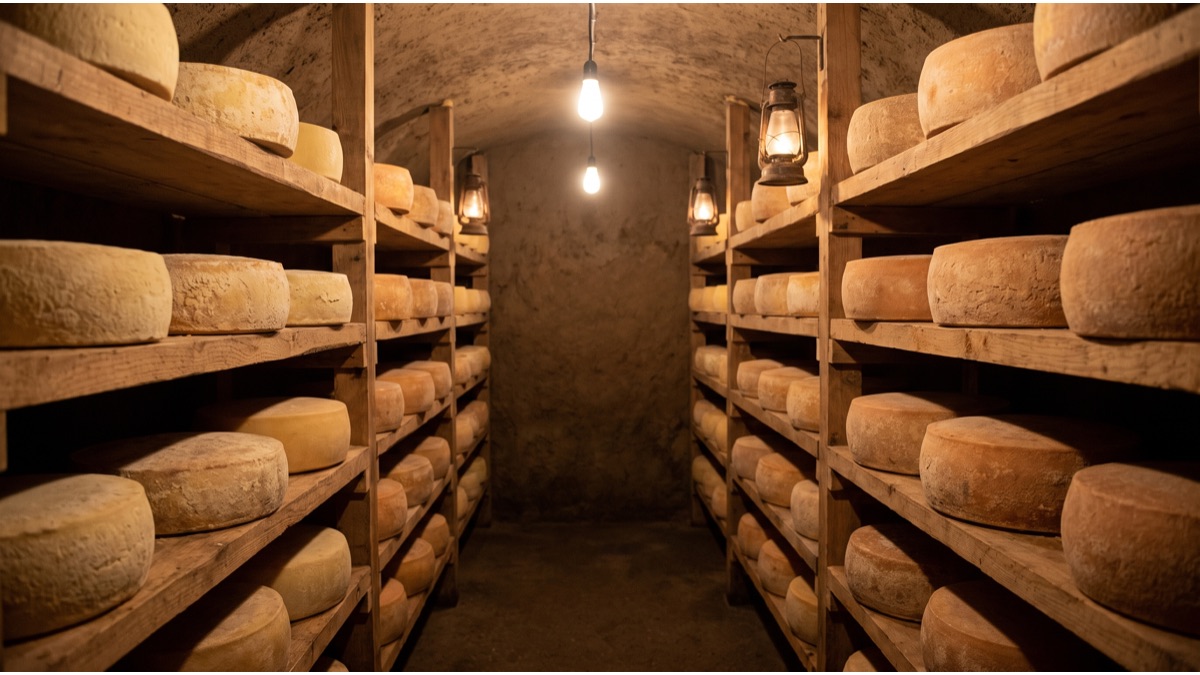
A wheel of mild, springy young cheddar and a hunk of sharp, crumbly three-year-old cheddar start life as the exact same curd, and the only thing separating one from the other is time managed with remarkable precision. Aging, known formally as affinage, is not passive storage in a cold room; it is an active biochemical transformation in which living microbes, natural enzymes, and carefully controlled humidity and temperature slowly dismantle mild curd and rebuild it into something sharper, denser, and vastly more complex.
Every flavor compound that eventually makes an aged cheese taste nutty, tangy, savory, or intensely sharp did not exist in the fresh curd at all; it was created gradually inside the wheel through ongoing chemical reactions that continue for months or, for the hardest and most prized cheeses, for years after the cheese was first formed and salted.
Understanding affinage means following several processes happening simultaneously inside a single wheel: enzymes and microorganisms breaking down proteins and fats into smaller flavor-active molecules, moisture gradually escaping and concentrating whatever flavor remains behind, and a rind slowly forming that protects and, in many cases, actively participates in shaping the final flavor of the cheese underneath it.
It also explains why aging is genuinely risky and skilled work rather than simple patience, since the same warm, moist conditions that build flavor can just as easily support harmful spoilage organisms if humidity, temperature, and airflow are not managed correctly throughout the entire aging period.
What Aging, or Affinage, Actually Does to Fresh Curd
Fresh curd immediately after cheesemaking is mild, rubbery, and relatively bland because none of the deep flavor compounds found in aged cheese have had time to form yet; the milk sugars, proteins, and fats are still largely intact in their original molecular form, waiting to be broken down.
Affinage is the French term cheesemakers use for the deliberate process of aging cheese under controlled conditions, and a skilled affineur actively manages humidity, temperature, airflow, and sometimes physical handling like turning, brushing, or washing each wheel on a specific schedule tailored to that particular cheese variety.
During this period, enzymes already present in the milk or added during cheesemaking, along with bacteria and molds either naturally occurring or deliberately introduced, slowly convert bland curd into a wheel packed with the amino acids, fatty acids, and aromatic compounds that give aged cheese its distinctive character.
The Enzymes That Actually Drive Cheese Ripening
Enzymes are the molecular machinery doing much of the actual chemical work during aging, and cheese contains several different types simultaneously active: rennet enzymes left over from the original curdling process, enzymes naturally present in raw milk, and enzymes produced continuously by the living bacterial cultures inside the cheese.
Each enzyme type targets a specific kind of molecule; some enzymes specifically break down proteins into shorter chains and eventually individual amino acids, while entirely different enzymes target milk fat, splitting it into free fatty acids that carry much of the pungent, sharp character associated with well-aged cheese varieties.
The specific balance and concentration of these enzymes, which varies considerably by milk type, starter culture, and cheesemaking method, is precisely why two cheeses aged for an identical length of time under seemingly similar conditions can still develop noticeably different flavor profiles from one another.
The Bacteria and Molds Behind Distinct Aged Flavors
Beyond enzymes acting alone, entire living microbial communities work throughout the aging process, and different cheese styles are deliberately built around completely different organisms chosen specifically for the particular flavors and textures they produce over time.
Surface-ripened cheeses rely on molds or bacteria that grow directly on the rind and slowly work their way inward, softening the paste from the outside in, while blue cheeses are deliberately inoculated internally with Penicillium mold spores that grow along fissures cut into the wheel, producing the sharp, tangy veins characteristic of that entire family of cheese.
Hard, long-aged cheeses like aged gouda or parmesan-style wheels rely more heavily on internal bacterial cultures working slowly and steadily throughout the entire interior of the cheese over an extended period, producing the dense, crystalline, intensely savory character that defines cheeses aged well beyond a year.
Why Moisture Loss Actually Concentrates Flavor Over Time
Cheese loses moisture continuously throughout the aging process, evaporating slowly through the rind or cut surface, and this steady moisture loss is one of the single biggest reasons aged cheese tastes noticeably more concentrated and intense than the same cheese would have tasted fresh.
As water content drops, the remaining flavor compounds, salts, proteins, and fats become proportionally more concentrated within a smaller overall mass, meaning the same absolute quantity of flavor-active molecules is now packed into considerably less volume, which the tongue perceives directly as heightened sharpness and intensity.
This moisture loss also explains the textural transformation that accompanies long aging: a young cheese's springy, moist paste gradually becomes firmer, denser, and eventually genuinely crumbly or granular in extremely aged examples, since less water remains to hold the protein and fat structure together in its original elastic form.
Proteolysis: How Breaking Down Protein Creates Umami
Proteolysis, the enzymatic breakdown of milk protein into progressively smaller fragments, is arguably the single most important chemical process behind aged cheese flavor, since it gradually converts relatively flavorless casein protein into shorter peptides and eventually free amino acids that carry powerful, distinctive taste on their own.
Glutamic acid, one specific amino acid released in significant quantities during extended proteolysis, is directly responsible for much of the intense savory umami character found in heavily aged cheeses like parmesan, explaining why such cheeses are often described as tasting almost meaty or brothy despite containing no meat whatsoever.
Proteolysis also fundamentally changes cheese texture over time, since breaking down the protein matrix that originally gave curd its springy, rubbery structure is precisely what allows aged cheese to become progressively softer and creamier in some styles, or firmer and more crumbly in others, depending on exactly which proteins break down and how the resulting fragments interact.
Lipolysis: How Breaking Down Fat Builds Sharpness
Lipolysis, the enzymatic breakdown of milk fat into free fatty acids and other smaller aromatic compounds, runs alongside proteolysis throughout aging and is largely responsible for the pungent, sometimes sharply peppery character found in strongly flavored aged cheeses.
Certain specific fatty acids released during lipolysis, including butyric and caproic acid, carry distinctly strong, sharp aromas on their own, and their gradual accumulation over months or years of aging is a major reason why an aged blue cheese or a well-aged sharp cheddar smells and tastes so much more intense than its mild, young counterpart.
The degree of lipolysis a cheesemaker allows or actively encourages varies deliberately by style; some cheese varieties are crafted specifically to limit fat breakdown for a cleaner, milder profile even after considerable aging time, while others are intentionally encouraged toward extensive lipolysis specifically to develop that recognizable sharp, pungent character prized in certain aged styles.
Why Some Cheeses Are Actually Aged in Caves
Natural limestone caves provide remarkably stable humidity and temperature year-round, typically holding within a narrow band that happens to closely match the precise conditions many traditional cheese varieties need for slow, even ripening over extended periods without artificial climate control.
Cave walls themselves also host their own naturally occurring populations of beneficial molds and bacteria that can meaningfully influence a cheese's developing rind and flavor over time, which is precisely why cheeses aged in specific, historically significant caves are sometimes considered to develop a genuinely distinctive character difficult to reliably reproduce in a purpose-built modern aging facility.
Many modern cheesemakers now recreate cave-like conditions inside specially engineered aging rooms with precise humidity and temperature control, though several historic cheese varieties, most famously certain French blue cheeses, are still legally required by regional protected-name rules to be aged in the specific original caves associated with their traditional production region.
The Crunchy Crystals Found in Well-Aged Cheese
The small, gritty white crystals frequently found scattered throughout extremely aged hard cheeses like well-aged gouda or parmesan are largely composed of tyrosine, an amino acid released during extensive proteolysis that becomes concentrated enough over long aging periods to precipitate out as visible, tangible solid crystals.
These crystals add a distinct textural pop that many cheese enthusiasts specifically seek out and value, and their presence is generally considered a reliable, genuine indicator of extended aging time rather than any kind of flaw or defect, since crystal formation simply cannot happen quickly regardless of how aggressively humidity or temperature are manipulated.
Some crystals found in aged cheese are instead formed from calcium lactate rather than tyrosine, particularly in cheddar varieties, and while both crystal types are completely harmless and simply mark genuine chemical maturity within the cheese, tyrosine crystals in particular tend to correlate with the very longest, most intensively aged wheels available.
Rind Types: Washed, Natural, and Waxed Explained
A cheese's rind is far more than simple packaging; it actively regulates moisture loss, controls which microorganisms can reach the interior paste, and in many styles directly participates in flavor development by hosting its own distinct community of surface bacteria or mold that gradually works inward from the outside.
Washed rinds are periodically wiped or bathed in a brine, beer, or spirit solution during aging, encouraging specific bacteria that produce the deeply pungent aroma and orange-tinted surface characteristic of washed-rind styles, while natural rinds develop organically from whatever bacteria and mold happen to colonize the cheese's exposed surface during aging.
Waxed or wrapped rinds, by contrast, are deliberately sealed to block outside microorganisms almost entirely, slowing moisture loss and producing a cleaner, more uniform interior flavor, which is precisely why many young or mild-aged cheeses use wax coating specifically to preserve consistency rather than encourage the more dramatic flavor development a natural or washed rind allows.
How Aging Time Actually Shapes Price and Sharpness
Longer aging periods generally command meaningfully higher prices, and this reflects genuine underlying costs rather than simple marketing, since a wheel aged for two or three years occupies valuable temperature-controlled storage space for far longer, requires ongoing labor for turning and monitoring, and loses considerable saleable weight through moisture evaporation the entire time.
Flavor sharpness does not increase in a perfectly straight line with aging time, however; the relationship follows a curve that eventually flattens, meaning the flavor difference between a six-month and a twelve-month cheddar tends to be considerably more dramatic than the difference between a four-year and a five-year wheel of the same variety.
Producers therefore calibrate aging duration deliberately around where a particular variety's flavor development curve delivers the most meaningful improvement for the additional storage cost incurred, which is part of why specific age-labeled tiers, such as mild, sharp, and extra sharp, tend to cluster around particular time windows rather than being spaced perfectly evenly apart.
Food Safety Considerations During Long Aging
Aging cheese safely for months or years requires carefully controlling the exact same environmental conditions that support beneficial ripening, since warm, moist conditions favorable to desirable bacteria and mold can just as easily support harmful pathogens if hygiene, salt content, and acidity are not properly managed from the very start of the process.
Salt plays a genuinely dual role during aging, both contributing directly to flavor and actively suppressing the growth of many unwanted microorganisms by drawing out moisture and creating an environment inhospitable to most harmful bacteria, which is precisely why salting technique and timing are treated as such a critical early step in the entire cheesemaking and aging process.
Regulatory bodies in many countries require raw-milk cheeses specifically to be aged for a legally mandated minimum period, commonly around sixty days, based on research showing that sufficiently long aging under proper conditions meaningfully reduces the risk of harmful pathogens surviving in the finished product.
Why Young and Aged Versions of One Cheese Taste So Different
A single cheese variety can taste dramatically different depending purely on how long it aged, since young and aged versions of the same cheese, made from the same milk using the same original recipe, undergo genuinely different amounts of proteolysis, lipolysis, and moisture loss before being sold.
Young gouda, for example, is mild, springy, and only lightly nutty, while gouda aged for several years becomes hard, deeply caramel-toned, and intensely savory, illustrating just how much transformation a single recipe can undergo purely through time and careful environmental management rather than any change to the original ingredients at all.
This is precisely why cheese producers frequently sell the exact same base recipe at multiple distinct age points, deliberately marketing each stage as a genuinely different product aimed at a different flavor preference, even though every version began as literally the identical curd on the very same production day.
How Affineurs Actually Judge When a Wheel Is Ready
Professional affineurs rely on a combination of trained senses and objective measurement to judge readiness, regularly tapping a wheel to listen for subtle changes in internal density, smelling the developing rind for specific aromatic cues, and periodically extracting a small core sample to directly taste and examine texture without damaging the wheel as a whole.
Experienced affineurs also track measurable indicators like moisture content and pH over time, since these values shift predictably as aging progresses and can flag a wheel developing ahead of or behind its expected schedule long before the difference would be obvious just from external appearance alone.
Ultimately, deciding exactly when a wheel has reached its ideal flavor point is part science and part genuinely earned craft judgment, since the same recipe aged in a slightly different cave, cellar, or climate-controlled room can mature at a meaningfully different pace, meaning rigid calendar dates alone are never fully sufficient on their own.
Sources
- Wikipedia — overview of cheese ripening, affinage, and the biochemical processes involved
- U.S. Food and Drug Administration — regulatory guidance on raw-milk cheese aging requirements and food safety
- USDA Economic Research Service — background on dairy and cheese production practices in the United States
- Cheese Science Toolkit — technical reference on cheesemaking chemistry, proteolysis, and lipolysis
FAQ
Why does aged cheese taste sharper than fresh cheese?
Aging concentrates flavor through moisture loss while enzymes and microbes break proteins and fats down into smaller, intensely flavored compounds like free amino acids and fatty acids, none of which are present in significant amounts in fresh, unaged curd.
What causes the crunchy white crystals in aged cheese?
Most crystals are tyrosine, an amino acid released by extended protein breakdown that becomes concentrated enough to precipitate as visible solid crystals, generally a reliable sign of genuinely long aging rather than any defect in the cheese.
Why are some cheeses aged in caves?
Natural caves offer remarkably stable humidity and temperature year-round and can host their own beneficial mold and bacteria populations, conditions historically difficult to replicate without a cave, though many modern producers now recreate similar conditions mechanically.
Is it safe to eat cheese that has been aged for years?
Yes, when produced and aged under properly controlled sanitary conditions; salt content, acidity, and controlled humidity all work together to suppress harmful organisms, and long-aged hard cheeses have an extensive, well-documented safety record.
Does longer aging always mean a sharper, better cheese?
Not necessarily; flavor development eventually flattens out on a curve, so the jump between six and twelve months is often more dramatic than between four and five years, and some cheeses are deliberately made to peak at a specific, relatively short age.
What is the difference between a washed rind and a natural rind?
A washed rind is periodically wiped with brine, beer, or spirits to encourage specific pungent-aroma bacteria, while a natural rind simply develops from whatever mold and bacteria colonize the surface on their own during aging, typically producing a milder result.
About the Author
We reference Wikipedia and other authoritative sources to explain the background and current understanding of this topic.
Loved This Article?
Share it on WhatsApp → Share it on WhatsApp
Get more guides in your inbox — Subscribe to our newsletter for weekly surprising stories from Egypt, Saudi Arabia, Dubai, and beyond.