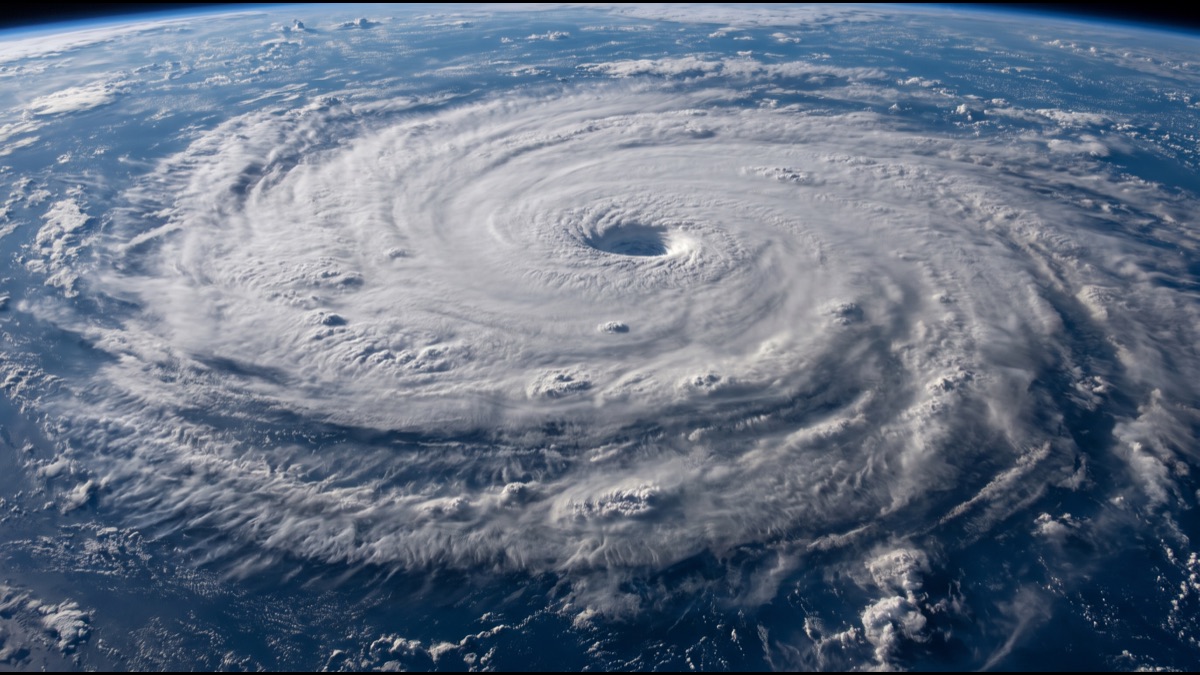
A hurricane starts as a cluster of ordinary thunderstorms drifting over tropical ocean water that stays at least about 26.5°C (80°F) down to a depth of roughly 50 meters. That warmth evaporates huge volumes of moisture, and as the rising water vapor condenses into clouds, it releases heat that fuels even stronger updrafts.
None of that spins into a storm on its own. The system also needs Earth's rotation, through something called the Coriolis effect, to nudge the rising air into a rotating pattern — which is why hurricanes essentially never form right on the equator, where that effect all but disappears.
Warm Water and a Spinning Push
Categories, the Eyewall, and the Calm Eye
As thunderstorms cluster around a shared center of low pressure, air rushes in to replace the rising warm air, spirals inward and upward, and the whole system organizes into distinct rainbands circling a core. Meteorologists reclassify the storm as winds strengthen: a tropical depression becomes a tropical storm at sustained winds of 63 km/h (39 mph), and a hurricane once winds pass 119 km/h (74 mph).
At the center sits the eye, a region of sinking, relatively calm air roughly 30 to 65 kilometers across, ringed by the eyewall — home to the most violent thunderstorms and strongest winds in the entire system. Air sinking in the eye warms and dries as it descends, which is why the sky overhead can look eerily clear even while a wall of destructive weather spins just kilometers away.
Sources
- Wikipedia — overview of tropical cyclone formation and structure
- NOAA — explanation of the conditions hurricanes need to form
- National Geographic — hurricane formation and classification explained
FAQ
Why don't hurricanes form right at the equator?
The Coriolis effect, which makes rising air spiral instead of rushing straight into a low-pressure zone, is close to zero at the equator and only becomes strong enough a few degrees of latitude away from it.
What is the difference between a hurricane, a typhoon, and a cyclone?
They are the same storm system under different regional names — hurricane in the Atlantic and eastern Pacific, typhoon in the western Pacific, and cyclone in the South Pacific and Indian Ocean.
Can a hurricane form or stay strong over land?
No — hurricanes draw their energy from warm ocean water, so they weaken quickly once they make landfall and lose that fuel source.
About the Author
We reference Wikipedia, NOAA, and National Geographic to explain the background and current understanding of this topic.
Loved This Article?
Share it on WhatsApp → Share it on WhatsApp
Get more guides in your inbox — Subscribe to our newsletter for weekly surprising stories from Egypt, Saudi Arabia, Dubai, and beyond.