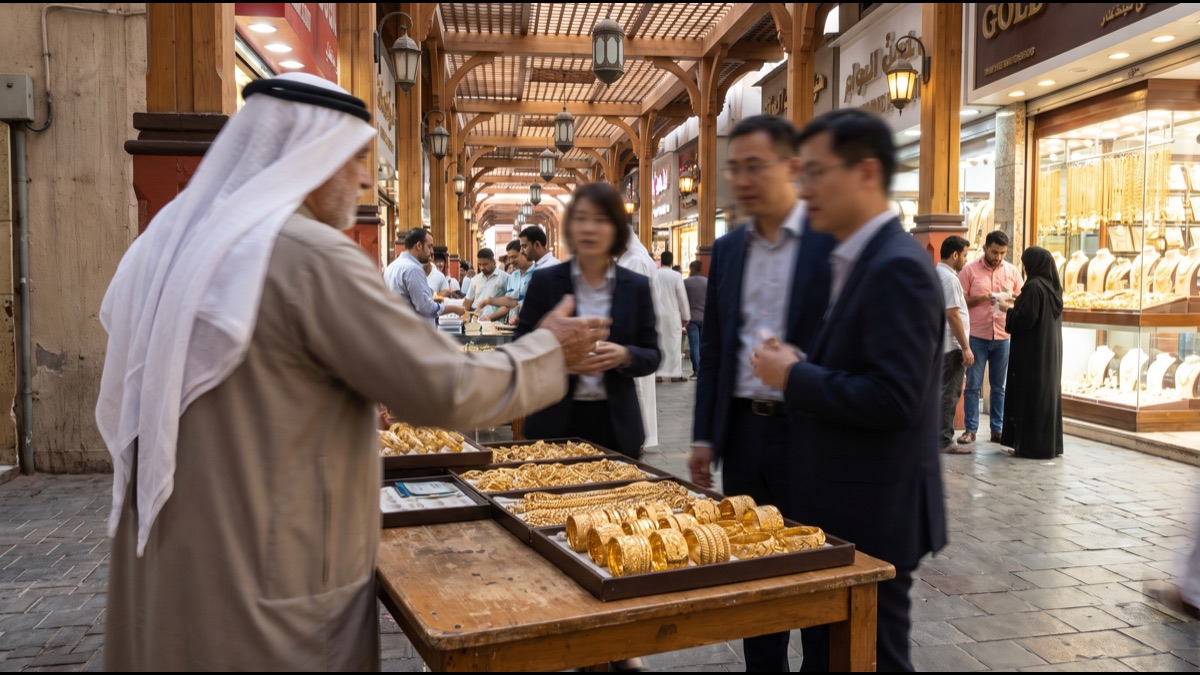
A market in Deira lined with wooden-lattice roofing and hundreds of shopfronts glittering with gold jewelry handles trading volumes that would be respectable for a modern financial exchange. Dubai's Gold Souk is not simply a tourist attraction, though it is genuinely that too; it is one of the reasons Dubai became known internationally as a gold trading hub decades before it became known for skyscrapers, museums, or man-made islands.
Understanding how a single traditional market in the older, unglamorous part of the city genuinely grew into a serious node in the global gold trade requires looking past the glittering window displays to the specific regulatory, geographic, and economic conditions that made Dubai an unusually attractive place to buy, sell, and move physical gold across a large stretch of the twentieth century.
What the Gold Souk Actually Is
The Gold Souk occupies a compact covered market area in Deira, one of Dubai's oldest commercial districts, home to several hundred individual jewelry shops packed closely together along narrow lanes, each displaying gold jewelry ranging from mass-produced everyday pieces to elaborate, heavily bejeweled statement items catering to South Asian, Middle Eastern, and international tastes alike.
The market's traditional wooden-lattice roofing provides shade and natural ventilation in a design predating modern air conditioning, and the sheer visual density of gold on display, illuminated under bright shop lighting along nearly every storefront, has made the souk a genuine visual spectacle as well as a functioning commercial market that residents actually rely on for jewelry purchases.
Many of the shops operating today trace back to family businesses established generations ago, some dating to the mid-twentieth century when Dubai's trading economy was built substantially around its port and the movement of goods including gold, pearls, and textiles between the Indian subcontinent, Iran, and the wider Gulf, long before oil revenue or modern construction transformed the emirate's economy.
Why Dubai's Free-Port Status Mattered So Much
Dubai's emergence as a gold trading center traces back to a specific, deliberate policy choice made decades before the emirate's oil wealth or later construction boom: establishing itself as a free port with minimal or no import duty on gold, in sharp contrast to neighboring countries, particularly India, which historically imposed substantial import duties on gold entering the country.
This duty-free status meant gold could be imported into Dubai, traded, and re-exported at a meaningfully lower cost than in markets where heavy import taxation applied, creating a genuine price advantage that attracted traders, jewelers, and eventually ordinary buyers from across the wider region who found it cheaper to purchase or acquire gold through Dubai than through their own domestic markets.
Dubai's rulers actively cultivated this trading role well before oil was discovered in commercial quantities in the emirate, recognizing early that a strategic port city positioned along established maritime trade routes between South Asia, East Africa, and the wider Gulf could build genuine prosperity around facilitating trade rather than solely producing goods domestically, a strategic bet that proved durable long after the specific gold-trading advantages that first established it evolved considerably.
How the Souk Actually Prices Gold
Gold jewelry in the souk is priced using a formula rather than arbitrary negotiation from scratch: the item's weight in grams is multiplied by the officially posted daily gold rate, itself derived from the global gold spot price, with the resulting figure representing the base metal value of the piece before any additional charge for craftsmanship is added.
This pricing transparency, with gold rates typically displayed prominently in shops and updated daily to track global market movements, means buyers can reasonably verify they are being charged a fair metal value, a level of price transparency genuinely uncommon in jewelry retail in many other parts of the world where metal content and markup are rarely disclosed so explicitly.
What a Making Charge Actually Covers
Beyond the gold's metal value, shops add a separate making charge covering the labor, craftsmanship, and design complexity involved in producing the specific piece, which varies considerably between simple, mass-produced items and intricate, heavily detailed designs requiring substantially more skilled labor to produce.
Unlike the metal value, which is essentially fixed by the daily gold rate across the market, making charges are genuinely negotiable and vary meaningfully between shops, giving knowledgeable buyers real room to negotiate a better overall price by comparing making charges across several shops before committing to a purchase, a practice locals and experienced visitors alike routinely engage in.
How Gold Smuggling Actually Shaped Dubai's Trade
For much of the latter twentieth century, the price gap between Dubai's low-duty gold market and countries imposing steep import restrictions, India being the most significant example, created substantial financial incentive for informal and often illegal movement of gold across borders, with Dubai serving as a major source point for gold that eventually entered India's domestic market through unofficial channels.
While this smuggling activity was never officially endorsed by Dubai's government and existed in a legal gray area that periodically drew international scrutiny, it is a documented and historically significant part of how Dubai's gold trading volumes grew far beyond what its own domestic jewelry demand could explain, effectively subsidizing the scale and sophistication of the wider trading infrastructure that developed around the souk.
As India gradually liberalized its own gold import policy over subsequent decades, reducing duties and easing restrictions, the specific arbitrage incentive that drove much of this informal trade diminished considerably, though by that point Dubai's gold market had already accumulated enough scale, infrastructure, and international reputation to sustain itself on legitimate trading volume alone rather than depending on the original smuggling-driven demand that helped establish it.
Why Hundreds of Competing Shops Kept Prices Honest
The sheer density of competing jewelry retailers concentrated within the same small market area created intense, continuous price competition that a single dominant retailer or a handful of shops spread across a wider city could never replicate, since any shop attempting to charge an excessive making charge would quickly lose customers to a competitor located literally a few doors away.
This competitive pressure, sustained over decades, is frequently cited as a major reason the souk maintained a reputation for comparatively fair pricing relative to many other jewelry markets worldwide, reinforcing Dubai's broader reputation as a place where gold could be bought at genuinely competitive rates rather than at inflated tourist-market prices.
How the Souk's Physical Design Actually Works
The market's layout, with narrow covered lanes lined densely with shopfronts on both sides, was never formally master-planned in the way a modern shopping mall would be, having evolved organically over decades as the trading district expanded to accommodate growing demand, giving it an authentically historic character that purpose-built retail developments elsewhere in Dubai deliberately try to evoke but rarely replicate convincingly.
This organic density also serves a practical function beyond atmosphere, concentrating enough shops within easy walking distance of one another that a buyer can realistically visit a dozen or more stores comparing designs and making charges within a single short visit, a level of comparison shopping that a more spread-out retail layout would make considerably less convenient.
How Dubai's Gold Trade Grew Beyond the Souk Itself
As Dubai's ambitions expanded beyond retail jewelry trading, the emirate developed more formal wholesale gold trading infrastructure and eventually established the Dubai Gold and Commodities Exchange, providing a regulated, exchange-based venue for gold and other commodity trading that operates on a scale and sophistication well beyond what the traditional souk itself could offer.
This layering of formal commodities exchange infrastructure on top of the souk's traditional retail trade reflects a broader pattern seen elsewhere in Dubai's economic development, where an organic, historically rooted commercial activity eventually gets complemented by modern regulated financial infrastructure built specifically to formalize and scale what began as informal trade.
The Dubai Multi Commodities Centre free zone, established specifically to serve commodities trading businesses including gold and diamonds, further institutionalized this shift, providing dedicated licensing, storage, and regulatory infrastructure for wholesale traders operating at a scale far beyond individual retail jewelry transactions, effectively building a modern commodities trading ecosystem directly alongside the centuries-old retail tradition of the souk itself.
What VAT Actually Changed for Gold Buyers
The introduction of value-added tax in the UAE brought new complexity to gold pricing, with investment-grade gold bullion generally receiving different tax treatment intended to preserve its function as a genuine investment asset, distinct from jewelry purchases made primarily for personal adornment rather than investment purposes.
Tourists purchasing jewelry in the souk can typically reclaim VAT paid through the UAE's tax refund scheme when departing the country through participating exit points, a mechanism that has helped preserve much of the souk's price competitiveness for international visitors even after VAT's introduction added a layer of tax complexity that did not previously exist.
How Tourists Actually Shop There Today
For visitors, the souk functions as both a genuine shopping destination and an experience in its own right, with many tourists arriving primarily to see the sheer visual spectacle of the market rather than necessarily intending to make a significant purchase, though the two motivations frequently end up combined once visitors are actually walking the lanes surrounded by shop windows.
Tour guides and travel content commonly advise visitors unfamiliar with the negotiation norms to research daily gold rates before visiting, compare making charges across multiple shops rather than purchasing from the first store entered, and treat the initially quoted price as a starting point for negotiation rather than a fixed retail price, reflecting norms genuinely different from fixed-price retail common in shopping malls elsewhere in the city.
Why Record-Setting Displays Became Part of the Marketing
Over the years, the souk and individual jewelers associated with it have periodically created record-setting gold items, including exceptionally large rings and other pieces, deliberately designed to attract media attention and reinforce the market's association with gold on a spectacular scale, a marketing approach consistent with Dubai's broader pattern of using record-breaking attractions to build international attention.
These displays function less as genuinely marketable jewelry pieces than as symbolic anchors reinforcing the souk's identity, drawing photographers, journalists, and curious visitors who might not otherwise prioritize visiting a traditional jewelry market, generating exactly the kind of viral, shareable content that sustains tourist interest in an attraction that predates modern social media by decades. Guinness World Records certification for some of these pieces has additionally given local media and tourism authorities an official, independently verified benchmark to reference in international coverage, lending a layer of documented credibility to what might otherwise read as pure marketing hyperbole.
How the Souk Has Adapted to Online Gold Trading
The rise of online gold trading platforms and digital investment products has genuinely changed how sophisticated investors access gold exposure, reducing reliance on physical jewelry or bullion purchases from any specific location, a shift that could have threatened a physical marketplace built around in-person retail transactions.
The souk has largely adapted by leaning further into what digital platforms cannot replicate: the tactile, visual experience of examining physical jewelry in person, the cultural and social significance gold jewelry holds in many of its core customer communities for weddings and major life events, and the genuine expertise of individual jewelers in crafting custom pieces, rather than competing directly with digital platforms on pure investment-grade trading. Some shops have also embraced hybrid approaches, maintaining an online presence for browsing and price comparison while still requiring an in-person visit to finalize significant purchases, particularly for custom or bespoke pieces where seeing the finished item before payment remains genuinely important to most buyers.
Why It Remains a Genuine Trading Hub, Not Just a Tourist Stop
Despite decades of change in global gold markets, the rise of e-commerce, and Dubai's own transformation into a city dominated by skyscrapers and shopping malls, the Gold Souk has retained a genuine functional role in the city's gold trade rather than becoming a purely nostalgic tourist attraction preserved for its historic charm alone.
That durability reflects the underlying economic logic that built the souk in the first place: transparent, competitive, duty-advantaged gold trading concentrated in one accessible location remains genuinely valuable to buyers regardless of how much broader financial infrastructure has grown up around it, which is exactly why a centuries-old market format continues thriving in a city otherwise defined by relentless modernization. Few other attractions in Dubai manage to function simultaneously as a working commercial market for locals, a genuine bargain-hunting destination for savvy international shoppers, and a photogenic tourist landmark, and it is that rare triple identity that keeps the Gold Souk relevant well beyond nostalgia alone.