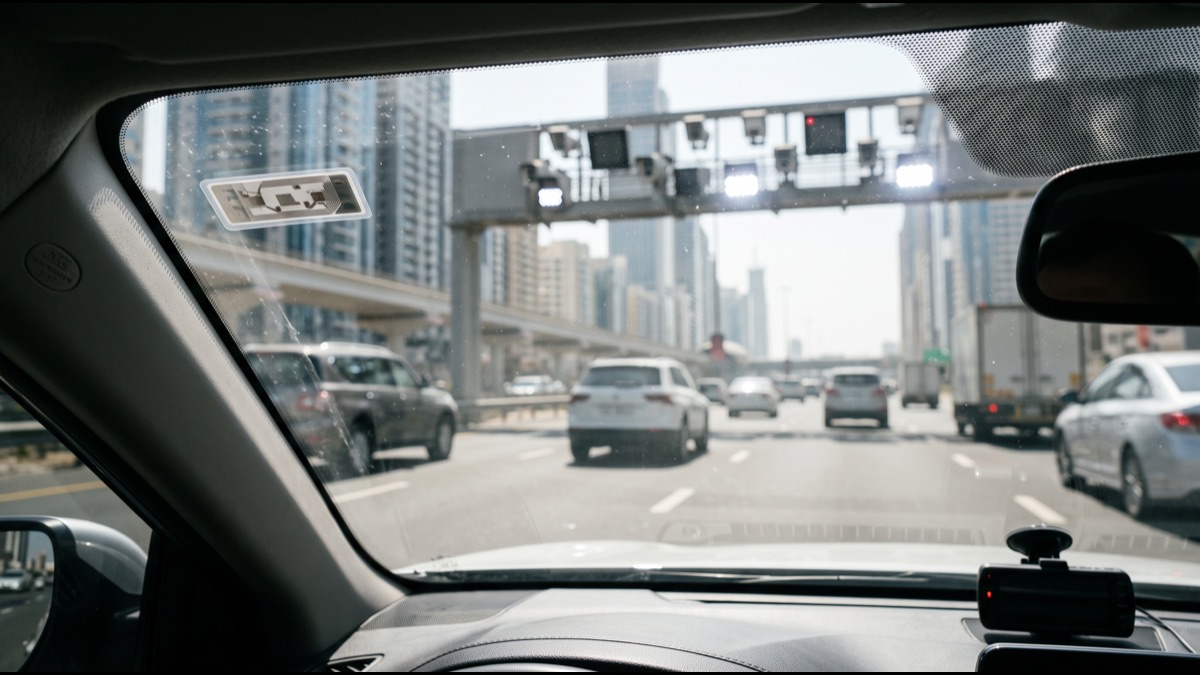
A car can cross a Salik toll point on Sheikh Zayed Road at well over 100 kilometres an hour, in the middle of dense traffic, and still get billed the exact correct toll within moments, without ever slowing down or seeing a single barrier arm. There is no gate, no ticket, and no window to roll down, and yet the system reliably identifies that specific vehicle and charges its account automatically.
This kind of free-flow tolling, as the underlying technology is known worldwide, depends on solving a genuinely tricky engineering problem: accurately identifying a specific fast-moving vehicle from among many others travelling at similar speed in adjacent lanes, without ever requiring it to stop, slow down, or interact with any physical toll booth at all.
Understanding how Dubai's Roads and Transport Authority actually pulls this off means looking at the small radio tag stuck to a car's windshield, the overhead gantry structure that reads it, and the backend billing system tying it all together into a single automatic transaction that most drivers barely think about.
It also explains why the system occasionally does need a backup camera-based method for vehicles without a tag, and why toll pricing itself changes depending on the specific gate location and time of day rather than charging a single flat rate everywhere.
The Small Tag That Makes the Whole System Work
Every vehicle enrolled in Salik carries a small electronic tag, mounted on the inside of the windshield, containing a radio frequency identification chip programmed with a unique identifier linked to that specific vehicle's account in the system's central database.
This tag is passive rather than battery-powered in most implementations, meaning it does not actively transmit a signal on its own but instead reflects and modulates a radio signal beamed at it from overhead equipment, a low-cost, low-maintenance design choice that keeps the tag itself simple, cheap to manufacture, and essentially maintenance-free for years.
Because the tag only needs to respond when specifically queried by the overhead reading equipment, rather than continuously broadcasting its location, it also avoids raising the kind of ongoing location-tracking privacy concerns a constantly transmitting device might otherwise create.
What Actually Happens Overhead as a Car Passes Through
Suspended above the roadway at each toll point sits a gantry structure equipped with radio frequency readers, cameras, and sensors, positioned to detect and interact with every vehicle passing beneath it across every lane simultaneously, regardless of how many lanes of traffic exist at that particular location.
As a tagged vehicle passes underneath, the overhead reader emits a radio signal that activates the passive tag, which responds by reflecting back its unique identifier, a process completing in a small fraction of a second, fast enough to reliably capture even vehicles travelling at full highway speed without requiring any reduction in speed at all.
Because multiple vehicles in adjacent lanes can pass through the gantry within the same brief window, the system uses precise timing and lane-specific sensor zones to correctly associate each captured tag identifier with the specific vehicle that triggered it, preventing the kind of cross-lane confusion that could otherwise result in charging the wrong vehicle.
How the System Handles Vehicles Without a Working Tag
For vehicles without an enrolled tag, or in cases where a tag fails to respond correctly for any reason, the same overhead gantry equipment includes cameras specifically positioned to capture a clear image of the vehicle's license plate as a fallback identification method.
This camera-based backup relies on automatic license plate recognition software to read the plate and match it against vehicle registration records, allowing the system to identify the vehicle and its associated owner even without a functioning radio tag, though this fallback process typically takes somewhat longer to process than the near-instant tag-based method.
Vehicles without either a valid tag or a recognizable plate match, including certain visiting vehicles from outside the country, are generally handled through a separate registration or payment process specifically designed for occasional or first-time users who have not yet enrolled a tag in the standard system.
Why Toll Pricing Varies by Location and Time
Unlike a simple flat-rate toll system, Salik pricing is deliberately structured to vary based on the specific gate location and, at some gates, the time of day, reflecting a traffic management goal that goes beyond simply generating toll revenue: using price itself as a tool to influence when and where drivers choose to travel.
Gates positioned at particularly congestion-prone points on the road network are specifically intended to encourage some drivers to consider alternate routes or shift their travel timing to less congested periods, a traffic demand management strategy used by toll systems in major cities worldwide, not unique to Dubai specifically.
This pricing structure means the same vehicle can be charged different toll amounts on different days or at different times purely based on when and where it travels, a deliberate design choice rather than any inconsistency or error in the underlying billing system itself.
How the Backend Billing System Actually Processes Everything
Every toll transaction captured at a gantry, whether identified through the radio tag or the camera fallback, feeds into a centralized backend system that matches the captured vehicle identifier against a prepaid account balance or a linked payment method associated with that specific vehicle.
For prepaid account holders, the toll amount is deducted automatically and near-instantly from the account's existing balance, with the system typically sending a low-balance notification well before the account actually runs out, specifically to avoid a situation where a driver's tag stops registering successfully due to insufficient funds.
This automated backend processing is what allows the entire system to function without requiring any human toll booth operator at all, processing what amounts to millions of individual toll transactions across the city's road network every single day with minimal direct human involvement in each individual transaction.
Why Free-Flow Tolling Replaced Traditional Toll Booths
Traditional toll booths, requiring vehicles to slow down or stop to pay, create exactly the kind of bottleneck and induced congestion that a well-designed toll system is often specifically trying to avoid, particularly on a high-volume urban highway where even a brief slowdown at a toll point can cascade into significant traffic backup during peak hours.
Free-flow tolling systems like Salik eliminate this specific problem entirely by allowing vehicles to maintain full highway speed through the toll point, moving the actual complexity of identification and billing into the electronic and software systems described above rather than into any physical infrastructure that would otherwise require vehicles to slow down.
This shift toward free-flow tolling reflects a broader global pattern in urban toll road design over the past two decades, with major cities worldwide progressively replacing traditional stop-and-pay toll booths with similar radio tag and camera-based free-flow systems for largely the same underlying traffic-flow reasons.
What Happens When the System Cannot Identify a Vehicle at All
In rare cases where neither the radio tag nor the camera-based license plate recognition successfully identifies a passing vehicle, whether due to a damaged or obscured plate, a malfunctioning tag, or an unusual vehicle configuration the system was not designed to handle well, that specific toll transaction can go uncollected at the time it actually occurred.
Road authorities operating these systems typically build in periodic system audits and manual review processes specifically to catch and investigate these edge cases, since a system processing enormous transaction volumes daily will inevitably encounter some small percentage of genuinely difficult-to-identify vehicles regardless of how well the underlying technology performs on average.
This built-in tolerance for occasional edge-case failures reflects a deliberate design tradeoff common to essentially all large-scale automated systems: engineering for near-total reliability across the overwhelming majority of transactions while accepting that achieving literally perfect identification across every single edge case would require a level of system complexity and cost that is simply not proportional to the marginal benefit gained.
How Toll Revenue Actually Gets Used
Revenue collected through toll systems like Salik is typically allocated toward road infrastructure maintenance, expansion, and broader transportation network investment, functioning as a dedicated funding mechanism tied specifically to the road network generating that revenue rather than simply flowing into undifferentiated general government revenue.
This direct link between toll revenue and road infrastructure investment is a common design principle across toll systems globally, intended partly to build public acceptance of tolling itself by making the connection between paying a toll and receiving continued road quality and capacity improvements more visible and direct to the paying public.
Beyond direct infrastructure funding, toll revenue data itself also provides valuable traffic pattern information that transportation planners use to inform future road expansion priorities, identifying which specific corridors experience the heaviest sustained demand and might therefore justify additional capacity investment.
Why Some Drivers Try to Avoid Toll Gates Entirely
Because toll gate locations are fixed and publicly known, some drivers deliberately plan routes specifically to avoid passing through toll points, using alternate roads even when those alternate routes take meaningfully longer, a behavioral response transportation planners specifically anticipate and factor into overall road network capacity planning.
This toll-avoidance behavior can sometimes shift traffic congestion onto alternate, non-tolled roads not originally designed to handle that additional volume, an unintended side effect that road planners monitor and occasionally address through additional toll gates or road capacity adjustments on those alternate routes.
Transportation economists generally view this behavioral response as an expected and, within reasonable limits, actually desirable feature of toll pricing rather than a flaw, since drivers genuinely willing to accept a longer route specifically to avoid a toll are, in effect, revealing that the toll price exceeds what they personally value the time savings of the tolled route at.
How This Technology Compares to Toll Systems Elsewhere
The fundamental radio tag and camera combination used in Salik closely mirrors free-flow tolling technology deployed in major toll systems across the United States, Europe, and other parts of Asia, reflecting a broadly converged global engineering approach to solving essentially the same core identification and billing problem.
Interoperability between different regional or national tolling systems, allowing a single vehicle tag to work seamlessly across toll systems in different jurisdictions, remains a genuinely significant ongoing engineering and administrative challenge worldwide, since different regions have historically adopted somewhat different radio frequencies, tag formats, and backend billing architectures.
Dubai's specific system reflects design choices suited to its own particular traffic patterns and urban road network layout, illustrating how the same broadly shared underlying free-flow tolling technology gets adapted somewhat differently depending on the specific city or region actually deploying it.
What Drivers Actually Need to Do to Stay Compliant
Enrolling in the system typically requires registering a vehicle, obtaining and correctly mounting the physical tag, and linking a payment method or maintaining a prepaid balance, a one-time setup process after which the toll charging itself happens entirely automatically without requiring any further ongoing action from the driver.
Drivers are generally responsible for ensuring their tag remains correctly mounted, undamaged, and linked to a payment method with sufficient balance, since a tag that fails to register correctly can result in the vehicle being charged instead through the slower camera-based fallback process or, in some cases, an unpaid toll violation that later needs to be resolved.
This shared responsibility model, automated technology handling the actual charging process while the vehicle owner handles basic tag maintenance and account funding, reflects how most modern free-flow toll systems worldwide are designed to minimize ongoing friction for the overwhelming majority of routine, correctly functioning transactions.
Why This System Represents a Genuine Engineering Achievement
Reliably identifying and billing a specific fast-moving vehicle among many others, without requiring it to slow down at all, combines several genuinely difficult engineering problems, precise radio frequency identification, high-speed camera-based backup recognition, lane-specific sensor accuracy, and enormous-scale automated backend billing, into a single system that most drivers experience as something almost invisibly simple.
This apparent simplicity from the driver's perspective is itself a sign of good systems engineering: a genuinely well-designed piece of everyday infrastructure is one whose underlying complexity remains almost entirely hidden from the people using it, doing its job so smoothly that its complete absence of visible friction feels perfectly ordinary rather than remarkable.
The broader shift toward this kind of invisible, automated infrastructure, tolling, parking payment, and public transit fare collection increasingly following similar free-flow, automated-billing principles, reflects a genuinely significant, if largely unnoticed, engineering transformation quietly reshaping how cities manage road and infrastructure usage worldwide.
How Salik Has Evolved Since Its Original Launch
Salik launched in 2007 with just two gates on Sheikh Zayed Road, at a time when free-flow tolling technology was still relatively new globally, not only regionally, making Dubai one of the earlier cities to adopt this approach across an entire city road network rather than just a single bridge or tunnel crossing.
The system expanded gradually over subsequent years to include a considerably larger number of gates spread across the city's major road network, alongside multiple updates to both the pricing structure and the underlying technology itself in response to changing traffic patterns and a significant increase in the volume of registered vehicles as the city itself continued growing.
This gradual rollout reflects a cautious, deliberate approach cities often take when deploying major new digital infrastructure: launching a limited-scope initial version, then expanding based on real-world performance data rather than attempting to deploy a fully scaled system all at once from day one.
Sources
- Wikipedia — overview of the Salik toll system, gate locations, and pricing structure
- Dubai Roads and Transport Authority — official background on Salik tag registration, pricing, and account management
- International Bridge, Tunnel and Turnpike Association — background on free-flow tolling technology and global toll system design
- IEEE Spectrum — engineering reporting on radio frequency identification and automated tolling systems
FAQ
How does a Salik toll gate identify a car without it stopping?
An overhead gantry beams a radio signal at the passive tag mounted on the windshield, which reflects back a unique identifier within a fraction of a second, fast enough to reliably capture vehicles at full highway speed.
What happens if a car does not have a Salik tag?
Cameras on the same overhead gantry capture the license plate using automatic recognition software, matching it against vehicle registration records as a fallback identification method, though this typically takes longer than the tag-based process.
Why does the toll amount differ between gates or times of day?
Pricing is deliberately structured to vary by location and, at some gates, time of day, using price as a traffic management tool to encourage some drivers to shift routes or travel timing away from the most congested periods.
What happens if a Salik account runs out of balance?
The system typically sends a low-balance notification before the account is depleted, but if the balance is insufficient when a tag is read, the vehicle may be charged through the slower camera-based fallback or incur an unpaid toll requiring later resolution.
Is Salik’s technology unique to Dubai?
No, the underlying radio tag and camera combination closely mirrors free-flow tolling technology used in major toll systems across the United States, Europe, and other parts of Asia, though the specific design is adapted to Dubai’s road network.
Why do some drivers deliberately avoid toll gates?
Because gate locations are fixed and publicly known, some drivers choose longer alternate routes specifically to avoid tolls, a behavior transportation planners anticipate and factor into overall road network capacity planning.
About the Author
We reference Wikipedia and other authoritative sources to explain the background and current understanding of this topic.
Loved This Article?
Share it on WhatsApp → Share it on WhatsApp
Get more guides in your inbox — Subscribe to our newsletter for weekly surprising stories from Egypt, Saudi Arabia, Dubai, and beyond.