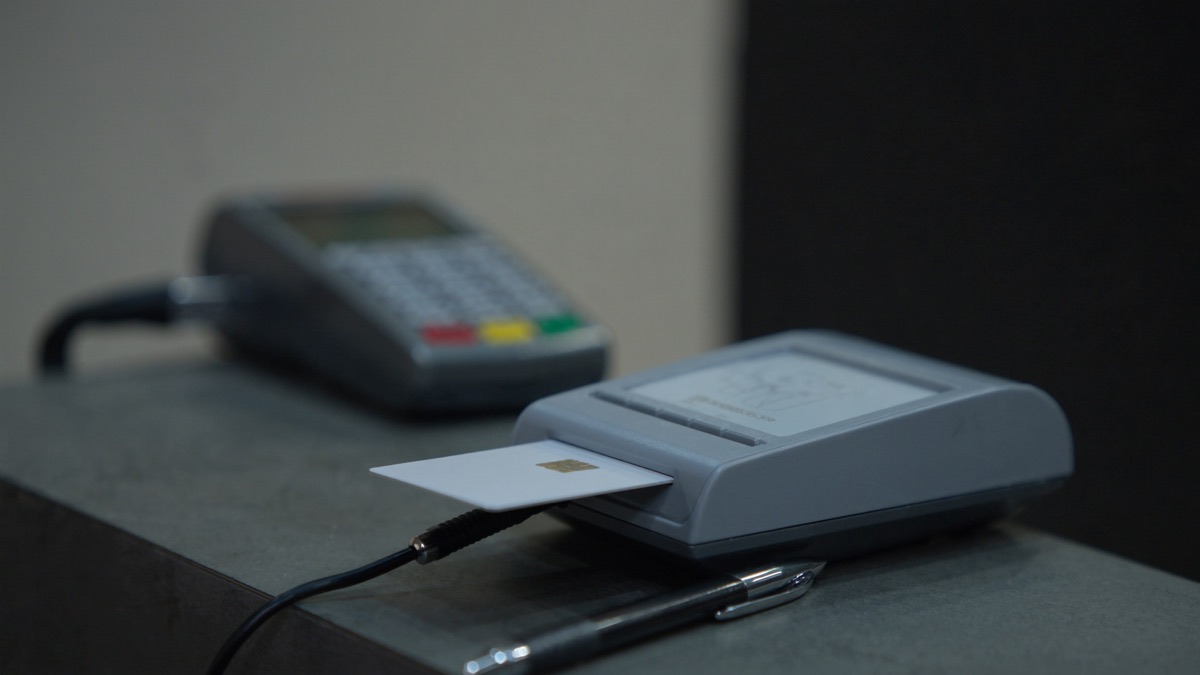
An EMV chip card generates a brand-new, one-time cryptographic code for every single transaction, which is the single biggest reason chip payments are so much harder to counterfeit than the old magnetic stripe they replaced. The name EMV comes from Europay, Mastercard, and Visa, the three payment networks that jointly created the standard in the 1990s after magnetic stripe fraud losses became too large to ignore.
What Actually Makes an EMV Chip Card Different
A magnetic stripe stores the exact same static data every time it is swiped — the card number, expiration date, and a few other fields encoded as a fixed pattern of magnetized particles that any inexpensive skimmer can copy in seconds and clone onto a blank card.
The embedded microchip instead contains a tiny computer capable of running cryptographic calculations, so instead of transmitting the same unchanging data on every purchase, it computes a unique authentication code specific to that one transaction, that one merchant terminal, and that one moment in time.
How the Chip Generates a Unique Code Every Time
When a chip card is inserted into a terminal, the chip and terminal exchange a series of encrypted messages, during which the chip uses a secret cryptographic key stored securely inside it, combined with transaction-specific data like the amount and a random number, to produce a cryptogram unique to that purchase.
That cryptogram is sent to the card issuer for verification, and because it depends on data that changes with every transaction, a criminal who intercepts one cryptogram gains nothing usable for the next purchase — unlike a stolen magnetic stripe number, which stays valid until the account is closed.
Why the Secret Key Never Actually Leaves the Chip
The cryptographic key used to generate each transaction cryptogram is generated during card manufacturing and stored inside a tamper-resistant secure element on the chip that is specifically engineered to resist physical probing, so even a stolen physical card cannot easily have its key extracted and copied.
This is the core security property that eliminates most cloning: counterfeiting a magnetic stripe only requires copying visible data, but counterfeiting a chip would require physically extracting a securely embedded secret key from tamper-resistant silicon, which is vastly more difficult and expensive than criminals find worthwhile at scale.
Chip-and-PIN Versus Chip-and-Signature
Chip-and-PIN requires the cardholder to enter a personal identification number to authorize each transaction, verified either by the chip itself or by the issuing bank, adding a second authentication factor beyond simply possessing the physical card.
Chip-and-signature, more common historically in the United States, instead relies on a handwritten signature that merchants rarely verify carefully, which is why chip-and-PIN is considered meaningfully more secure against a stolen card being used by someone other than its owner.
Contact Versus Contactless Chip Transactions
A contact chip transaction requires physically inserting the card into a terminal slot so the chip's metal contacts touch corresponding pins inside the reader, allowing several seconds of back-and-forth cryptographic exchange before the payment completes.
A contactless transaction uses a separate antenna embedded in the card to communicate wirelessly over near-field communication when tapped within a few centimeters of a compatible terminal, using the same underlying cryptographic principles but completing the exchange in under a second.
How EMV Reduced Counterfeit Card Fraud
Countries that fully migrated to EMV chip cards, including the United Kingdom, Australia, and much of Europe well before the United States, saw counterfeit card fraud at point-of-sale terminals drop dramatically within a few years of widespread adoption, since cloned magnetic stripes simply stopped working at chip-enforcing terminals.
The United States migrated later and more gradually starting around 2015, and during the transition period counterfeit fraud actually shifted disproportionately toward the smaller share of merchants and transactions still relying on magnetic stripe fallback, illustrating how quickly criminals redirect toward the weakest remaining link.
The Liability Shift That Forced Merchant Adoption
Rather than mandating chip terminals by law, payment networks used a financial incentive called the liability shift: after a set deadline, whichever party — the merchant or the issuing bank — had the less capable technology became financially responsible for counterfeit fraud losses on that transaction.
A merchant still using an old magnetic stripe terminal after the deadline would absorb fraud losses that previously fell on the card issuer, which is why merchants across nearly every industry upgraded terminals within a relatively short window once the shift took effect.
Why Chip Cards Do Not Stop Online Fraud
EMV chip technology specifically protects in-person transactions where a physical card and terminal interact directly; it does nothing to protect a card-not-present transaction like an online purchase, where only the printed card number, expiration date, and security code are entered.
This is precisely why card-not-present fraud rose sharply in countries that adopted EMV chips, as criminals who could no longer profitably clone physical cards shifted their stolen card-number fraud toward online checkout pages instead, a pattern regulators now address with separate online verification standards.
Tokenization for Mobile Wallets
Mobile wallet payments like Apple Pay and Google Pay do not transmit the actual card number to a merchant at all; instead, the wallet provider issues a substitute number called a token that is tied to a specific device, and the real card number is stored encrypted on secure payment servers.
Even if a merchant's systems are breached and stolen tokens leak, those tokens are worthless for fraud elsewhere because each one only works from the specific paired device and cannot be used to derive the underlying real card number.
How Terminals Verify a Genuine Chip
During a chip transaction, the terminal and the card also run offline or online data authentication, checking a digital certificate embedded in the chip against a public key infrastructure the payment network maintains, confirming the chip itself was legitimately issued by a real bank rather than fabricated.
This certificate check happens in addition to, not instead of, the unique per-transaction cryptogram, meaning a would-be counterfeiter would need to forge both a valid certificate chain and correctly derive transaction-specific cryptograms without ever possessing the actual secret key.
The EMVCo Standards Body
EMVCo, the organization that maintains and evolves the EMV specification, is jointly owned by the major global payment networks — Visa, Mastercard, American Express, Discover, JCB, and UnionPay — ensuring one interoperable technical standard rather than competing incompatible chip formats across networks.
This shared ownership is why a chip card issued by any participating bank works at chip terminals worldwide regardless of which specific network processes the transaction, a level of interoperability that would be far harder to achieve if each network built its own proprietary chip technology.
Why Some Countries Adopted EMV Faster Than Others
European countries adopted chip cards earlier partly because their telecommunications infrastructure historically made real-time online transaction verification more expensive, so an offline-capable chip that could verify a PIN locally without a network round-trip suited their existing payment infrastructure better than the always-online American system.
The United States, by contrast, already had cheap, reliable, always-online authorization for magnetic stripe transactions, which reduced the immediate incentive to migrate until counterfeit fraud losses eventually made the switch financially unavoidable for the industry as a whole.
The Small Metal Contacts and What They Actually Do
The gold or silver-colored metal pad visible on a chip card is not solid metal but a set of distinct electrical contact points, each corresponding to a specific function defined by the ISO/IEC 7816 standard, including power supply, a clock signal, a reset line, and a data input-output channel.
This standardized contact layout is why chip cards from completely different banks and countries all fit and communicate correctly with the same terminal hardware, since the physical and electrical interface is standardized independently of which bank or network issued the underlying card.
What Happens Inside the Chip During a Failed Attempt
If a PIN is entered incorrectly, the chip itself — not just the bank's server — tracks the failed attempt count and can lock the card after a set number of consecutive failures, a safeguard that works even in offline environments where the terminal has no live connection to the issuing bank.
This onboard counter is stored in the chip's protected memory and resets only after a correct PIN entry, providing a layer of brute-force protection that exists independently of whatever fraud monitoring the bank's central systems perform after the fact.
Why Chip Transactions Take Longer at the Terminal
The multi-step cryptographic handshake between chip and terminal — generating a random number, computing a cryptogram, checking certificates, and sometimes verifying a PIN — genuinely requires more processing time than simply reading a fixed magnetic stripe pattern, which is why early chip transactions felt noticeably slower to consumers.
Processing speed has improved substantially as chip technology and terminal hardware matured, and contactless chip transactions in particular now complete in roughly the same time as a stripe swipe, largely closing the speed gap that once frustrated both merchants and customers during peak checkout periods.
Dynamic Data Authentication and Its Predecessors
Early EMV implementations used static data authentication, where the chip presented a digital signature that never changed between transactions — more secure than a magnetic stripe, but theoretically still copyable if that static signature were somehow extracted and replayed.
Modern EMV cards instead use dynamic data authentication, generating a fresh digital signature using a private key for every single transaction, closing that theoretical gap and making even a perfect data capture of one transaction completely useless for authorizing a different one.
How Fallback Transactions Create a Security Gap
When a chip fails to read — due to physical damage, dirt on the contacts, or terminal malfunction — most terminals allow a fallback to magnetic stripe as a convenience measure so the customer is not stranded without a working payment method.
Criminals have specifically exploited this fallback path by damaging the chips on stolen cards to force a stripe fallback, which is why some banks and terminal operators have begun restricting or eliminating fallback transactions entirely as fraud losses increasingly concentrate there.
The Cost of Migrating an Entire Payment Industry
The United States EMV migration required replacing tens of millions of point-of-sale terminals across virtually every retail business in the country, plus reissuing hundreds of millions of cards, an infrastructure cost estimated in the tens of billions of dollars borne jointly by banks, card networks, and merchants.
Despite that enormous upfront cost, the payment industry judged the long-term fraud reduction and reduced liability exposure worth the expense, and the migration is now considered a settled, permanent shift rather than a temporary security measure that might later be reversed.
What Comes After the Physical Chip Card
Biometric payment cards that verify a fingerprint directly on the card before authorizing a transaction, and fully virtual cards that exist only inside a mobile wallet with no physical plastic at all, are already being piloted as evolutions of the same core cryptographic principles EMV established.
Whatever form future payment credentials take, the fundamental idea EMV introduced — never transmitting a static, reusable secret, and instead proving legitimacy freshly for every single transaction — is expected to remain the underlying security foundation regardless of the physical form factor that eventually replaces the plastic card.
Sources
- EMVCo — official EMV specification and technical documentation
- Wikipedia — overview of EMV chip card technology and history
- Visa — chip technology and liability shift guidance
FAQ
Why is a chip card harder to clone than a magnetic stripe card?
The chip generates a unique cryptographic code for every transaction using a secret key locked inside tamper-resistant silicon, so intercepting one transaction reveals nothing usable for the next — unlike a magnetic stripe, which repeats the same static, copyable data every time.
Does a chip card stop online fraud too?
No; EMV chip technology only protects in-person transactions where a physical card and terminal interact. Online purchases rely solely on the printed card number and security code, which is why online fraud rose in countries that adopted chip cards.
What is the difference between chip-and-PIN and chip-and-signature?
Chip-and-PIN requires entering a personal identification number as a second authentication factor beyond the physical card; chip-and-signature relies on a handwritten signature that merchants rarely verify closely, making PIN meaningfully more secure.
Why do contactless chip payments feel faster than inserting a chip?
Contactless payments use a wireless antenna to complete the same cryptographic exchange over near-field communication in under a second, while an inserted chip transaction requires several seconds of back-and-forth communication through physical contacts.
Can the secret key inside a chip actually be extracted?
It is extremely difficult; the key is stored in a tamper-resistant secure element specifically engineered to resist physical probing, making extraction far more costly and technically demanding than criminals find worthwhile at scale.
Why did the United States adopt EMV chips later than Europe?
The US already had cheap, reliable, always-online authorization for magnetic stripe transactions, reducing the immediate incentive to migrate, while Europe's costlier telecom infrastructure favored an offline-capable chip that could verify a PIN locally.
What is the liability shift that pushed merchants to upgrade terminals?
After a set deadline, whichever party — merchant or bank — had the less capable technology became financially responsible for counterfeit fraud losses on that transaction, giving merchants a strong financial reason to upgrade quickly.
How does a mobile wallet like Apple Pay protect card data?
It substitutes the real card number with a device-specific token; even if a merchant's systems are breached, the stolen token is worthless elsewhere because it only works from the one paired device.
Why do some chip transactions still fall back to a magnetic stripe swipe?
If a chip fails to read due to damage or dirt on the contacts, many terminals allow a stripe fallback as a convenience measure, a path criminals have exploited by damaging chips on stolen cards to force it.
What is dynamic data authentication?
It is a method where the chip generates a fresh digital signature using a private key for every transaction, closing a theoretical gap in earlier static data authentication where a captured signature could potentially be replayed.
Does the chip itself track failed PIN attempts?
Yes; the chip's own protected memory counts consecutive failed attempts and can lock the card after a set number, a safeguard that works even offline without a live connection to the issuing bank.
Why do all chip cards fit every chip terminal regardless of bank?
The physical and electrical contact layout is standardized under ISO/IEC 7816, so cards from any issuing bank or country use the same interface, independent of which network or bank issued the card.
What organization maintains the EMV standard?
EMVCo, jointly owned by Visa, Mastercard, American Express, Discover, JCB, and UnionPay, maintains one interoperable technical standard so chip cards work at compatible terminals worldwide regardless of network.
How much did the US EMV migration cost the payment industry?
Replacing tens of millions of terminals and reissuing hundreds of millions of cards was estimated to cost tens of billions of dollars, borne jointly by banks, card networks, and merchants.
What might eventually replace the physical chip card?
Biometric cards that verify a fingerprint directly on the card, and fully virtual cards existing only in a mobile wallet, are already being piloted as evolutions of the same cryptographic principles EMV established.
About the Author
We reference Wikipedia and other authoritative sources to explain the background and current understanding of this topic.
Loved This Article?
Share it on WhatsApp → Share it on WhatsApp
Get more guides in your inbox — Subscribe to our newsletter for weekly surprising stories from Egypt, Saudi Arabia, Dubai, and beyond.