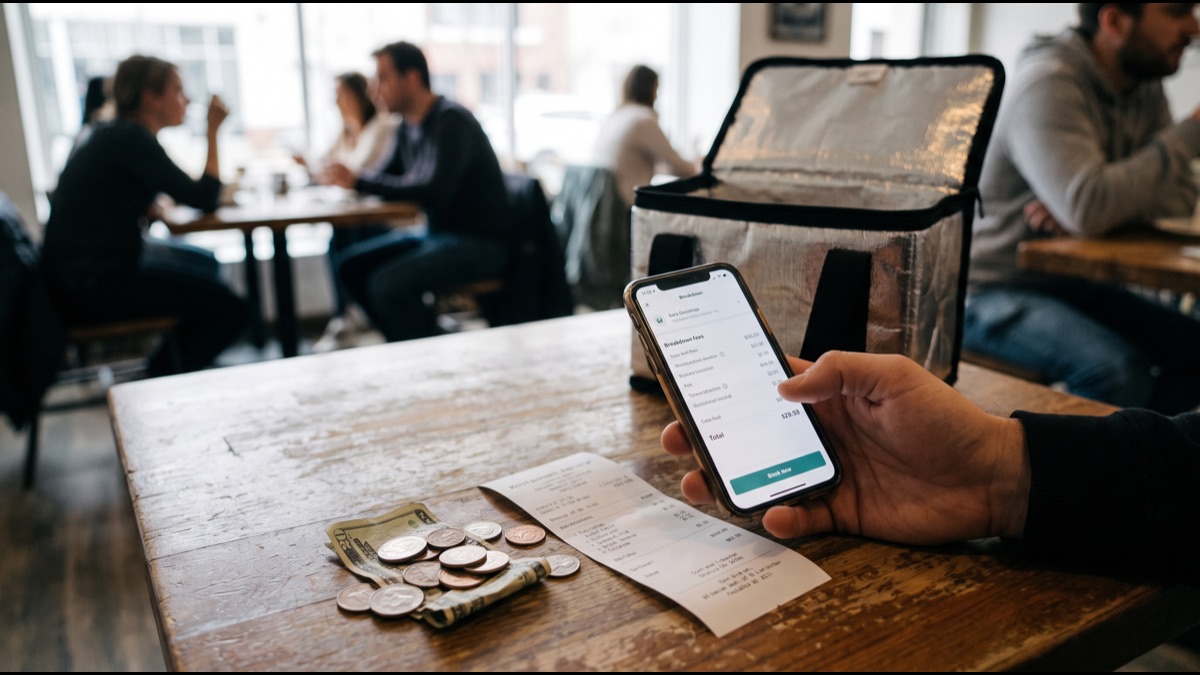
The total at checkout on a food delivery app is almost never the sum of the menu prices alone. Between the moment a dish is selected and the moment payment is confirmed, several layers of fees, some visible, some quietly baked into the food price itself, get added by the platform, the restaurant, and sometimes a dynamic pricing algorithm reacting to demand in real time.
Understanding how that final number actually gets built explains why the same meal can cost noticeably different amounts depending on the app used, the time of day, and even the specific address selected for delivery, and why restaurants and delivery platforms alike have strong, sometimes conflicting, incentives shaping exactly what appears on a customer's screen.
This is also one of the clearest modern examples of a three-sided marketplace, restaurant, rider, and customer, all pulling pricing in different directions, and tracing how each of those layers actually works shows why delivery has remained a genuinely difficult business to make profitable despite its explosive popularity.
Why the Menu Price Is Rarely the Real Price
A dish's listed price on a delivery app frequently differs from the price the same restaurant charges a customer walking in and ordering directly, a gap that exists specifically because the restaurant needs to recover part of the commission it pays the platform without simply absorbing that cost as a loss on every delivery order.
This markup is rarely disclosed explicitly to the customer, which is why comparing the in-app price of a specific dish to its dine-in menu price at the same restaurant can reveal a meaningful difference that has nothing to do with delivery distance or timing at all, but purely with how the restaurant chooses to pass along platform costs.
The Commission Restaurants Actually Pay
Delivery platforms typically charge participating restaurants a commission calculated as a percentage of each order's value, a rate that has historically ranged widely depending on the platform, the market, and whether the restaurant also uses the platform's own delivery riders versus handling delivery with its own staff.
This commission is the platform's primary revenue source from the restaurant side of the marketplace, and because it applies to every single order regardless of profitability for that specific transaction, restaurants with thin existing margins have to plan menu pricing carefully around this recurring cost rather than treating it as an occasional expense.
Why Menu Prices on Apps Often Differ From In-Store
Beyond a flat percentage markup, some restaurants adjust specific menu items differently on delivery apps based on which dishes travel well versus which ones lose quality during transit, sometimes pricing more delivery-resilient items more competitively to encourage orders for dishes the restaurant is more confident will arrive in good condition.
This selective pricing strategy also lets restaurants quietly protect margins on items that are more expensive to prepare or package for delivery, spreading the platform commission unevenly across the menu rather than applying a single uniform markup to every single dish regardless of its actual cost structure.
How Delivery Fees Are Actually Calculated
The delivery fee a customer sees is generally calculated from a combination of factors including distance between the restaurant and delivery address, current rider availability in that specific area, and sometimes a base fee that applies regardless of distance, all computed by an algorithm rather than set as a single fixed number across an entire city.
This is why the same customer ordering from the same restaurant at different times of day, or from a slightly different delivery address, can see a noticeably different delivery fee, since the underlying calculation is re-run for each individual order based on real-time conditions rather than pulled from a static, unchanging fee table.
What Surge or Dynamic Pricing Actually Responds To
During periods of unusually high demand, bad weather, or a shortage of available riders in a given area, delivery platforms frequently apply a temporary increase to delivery fees, a mechanism functionally similar to ride-hailing surge pricing, designed specifically to encourage more available riders to accept orders in that area when they might otherwise be scarce.
This dynamic pricing is genuinely responsive to real-time supply and demand rather than an arbitrary markup, since the platform's core operational challenge during a surge period is having enough riders willing to work in that specific area at that specific moment, and a higher fee is the primary lever available to attract them quickly.
Where the Service Fee Line Item Actually Goes
A separate service fee, distinct from the delivery fee itself, frequently appears at checkout and generally represents additional platform revenue covering costs like payment processing, customer support infrastructure, and the technology platform itself, rather than being passed through directly to either the restaurant or the delivery rider.
Because this fee is usually calculated as a small percentage of the order subtotal or a small flat amount, it tends to attract less customer attention than the more visible delivery fee, even though across a platform's entire order volume it can represent a genuinely significant and highly predictable revenue stream for the company operating the app.
How Driver Pay Connects to What You See at Checkout
Rider compensation models vary considerably between platforms and regions, ranging from a guaranteed base payment per delivery to more complex formulas incorporating distance, estimated time, and demand-based bonuses, but in most models a meaningful share of what a customer pays as a delivery fee does flow through, at least in part, to the rider actually making the trip.
Tipping functionality built directly into most delivery apps supplements this base pay significantly for many riders, and platforms have faced ongoing public scrutiny and, in several markets, regulatory attention over exactly how transparently rider earnings are calculated and disclosed relative to what customers actually pay in delivery and service fees combined.
Why Small Orders Cost Disproportionately More
Because a rider's trip costs the platform roughly the same amount whether the order is small or large, delivery platforms frequently apply a minimum order value threshold or an additional small-order fee for orders below a certain amount, since a tiny order otherwise risks costing the platform and rider more in time and fuel than the commission revenue it generates.
This is why ordering a single inexpensive item for delivery often feels proportionally far more expensive once fees are included compared to a larger combined order, encouraging customers, whether deliberately by platform design or simply as a natural side effect of the fee structure, to order more per delivery trip to make the fees feel proportionally smaller.
The Subscription Model and What It Changes
Many major delivery platforms now offer a paid monthly or annual subscription that waives delivery fees, or reduces them substantially, on qualifying orders, a model that shifts a portion of platform revenue from a per-order fee to a predictable recurring subscription payment collected regardless of how often the customer actually orders in a given period.
This subscription model tends to measurably increase how frequently subscribed customers order, since the marginal cost of placing one more order feels lower once the delivery fee is already waived, which is precisely the behavioral shift subscription programs are designed to encourage, benefiting the platform through higher overall order volume even at a lower per-order fee.
How Restaurants Try to Protect Their Margins
Beyond adjusting menu prices, many restaurants actively manage which delivery platforms they participate in, sometimes limiting availability to lower-commission periods or platforms, or creating delivery-specific menu items and portion sizes deliberately engineered to preserve acceptable margins after the commission is deducted from the order total.
Some restaurants have also pushed customers toward ordering directly through the restaurant's own website or app rather than a third-party platform specifically to avoid commission fees entirely, offering direct-order discounts as an incentive, a strategy that has grown more common as restaurant owners have become more sophisticated about the real cost of third-party delivery platform participation.
Why Gulf Delivery Apps Price Differently Than Elsewhere
UAE and Saudi delivery platforms operate in a market shaped by extremely high smartphone penetration, intense summer heat that pushes even short-distance orders toward delivery rather than walking or driving personally, and a competitive landscape with several major regional and international platforms competing directly for the same customer base.
This competitive intensity has kept promotional discounting and delivery-fee waivers unusually aggressive in the region compared to some other markets, with platforms frequently absorbing a larger short-term cost on individual orders specifically to win and retain market share in a fast-growing, high-value delivery market across major Gulf cities.
What Discounts and Promo Codes Actually Cost the App
Promotional discounts and referral codes are generally funded directly by the platform itself rather than by the restaurant, representing a deliberate customer acquisition and retention cost the platform accepts in exchange for building order frequency and brand loyalty among price-sensitive customers who might otherwise switch between competing apps based purely on which one currently has the better deal.
Platforms track exactly how much promotional spending it takes to acquire and retain a customer against how much that customer is expected to spend over time, a calculation that directly shapes how aggressively and how frequently promotional codes get issued in any given market at any given point in a platform's competitive cycle.
Why Profitability Took So Long for This Industry
Food delivery platforms globally spent years operating at a loss on a per-order basis, subsidizing delivery fees and promotional discounts heavily to build market share and order volume, a strategy funded by substantial venture capital investment betting that scale would eventually allow fees to rise and costs to fall enough to reach genuine profitability.
Many platforms have only reached sustainable profitability relatively recently, achieved through some combination of raising fees, growing subscription program adoption, improving delivery route efficiency through better routing algorithms, and consolidating a fragmented, heavily competitive market into a smaller number of larger, more efficient operators in most regions.
How Ghost Kitchens Changed the Cost Equation
Delivery-only kitchens, commonly called ghost or cloud kitchens, that operate without any dine-in space at all have emerged specifically to reduce the fixed cost side of the equation for restaurant operators, letting a single physical kitchen produce food for several different delivery-only brands simultaneously without the overhead of prime retail rent and a full dining room staff.
This structural cost advantage lets ghost kitchen operators sometimes absorb platform commission fees more comfortably than a traditional full-service restaurant, since they were never paying for expensive street-facing retail space in the first place, which is part of why delivery platforms have actively courted and in some cases directly invested in ghost kitchen infrastructure.
Why Cash-on-Delivery Still Matters in Some Markets
In markets including parts of the Gulf and wider region where card and digital payment adoption, while growing quickly, has not yet reached full saturation across every customer segment, cash-on-delivery remains a meaningful payment option that platforms have to support operationally, adding rider-side cash handling and reconciliation costs that a pure digital-payment market does not need to manage.
Platforms generally price this operational complexity into their overall cost structure rather than charging cash-paying customers a separate explicit fee, though the underlying handling cost is real and factors into how platforms think about broader efforts to encourage digital payment adoption across their customer base over time.
What Happens When an Order Actually Goes Wrong
Missing items, incorrect orders, and quality issues that arise during delivery trigger a refund or credit process that platforms generally fund out of their own margin rather than automatically billing the restaurant, at least for a first-time or occasional issue, since maintaining customer trust in the platform overall is treated as more valuable than recovering every individual error's cost from the restaurant.
Restaurants with unusually high complaint or error rates do typically face consequences over time, ranging from reduced visibility in the app's search and recommendation algorithm to, in persistent cases, removal from the platform entirely, since a pattern of consistently poor order accuracy from one restaurant reflects badly on the platform's overall reliability in the eyes of customers.
How Platforms Use Data to Predict What You Will Order
Order history, browsing behavior, and even the specific time of day a customer typically opens the app feed directly into recommendation algorithms that platforms use to surface specific restaurants and dishes likely to convert into an actual order, a data-driven merchandising approach conceptually similar to how e-commerce platforms personalize product recommendations.
This same data also informs which restaurants get offered promotional placement deals and how aggressively a given customer segment receives discount codes, since a platform with detailed visibility into individual ordering patterns can target promotional spending far more precisely than a blanket discount offered to every user regardless of their actual likelihood to order without one.
Why Exclusivity Deals Between Apps and Restaurants Happen
Some popular restaurant chains sign exclusivity agreements limiting their delivery availability to a single platform in a given market, trading away the reach of competing apps in exchange for reduced commission rates, prominent in-app promotional placement, or a marketing partnership the platform funds directly to help launch a new location or menu item.
These exclusivity deals reflect genuine negotiating leverage on both sides: a platform benefits from being the only place customers can order a genuinely popular brand, driving app downloads and engagement, while the restaurant trades some potential order volume from competing platforms for better economics and marketing support on the one platform it does choose to work with.
What to Actually Check Before Confirming an Order
Because the final checkout total on a delivery app is built from several independently calculated components, the menu price itself, a possible restaurant markup, the delivery fee, a service fee, and an optional tip, a customer genuinely comparing value across apps or against ordering directly benefits from actually reviewing that itemized breakdown rather than judging cost by the menu price alone.
Comparing the same order across two or three competing apps before confirming, and occasionally checking whether the restaurant offers a lower price for direct ordering, remains one of the most reliable ways to actually capture savings in a pricing system built from several independently moving parts rather than a single transparent number.
Sources
- Wikipedia — overview of online food ordering platforms and delivery marketplace economics
- Harvard Business Review — analysis of delivery platform business models and profitability challenges
- Talabat — background on a major Gulf regional food delivery platform
- Statista — market data on online food delivery growth and regional trends
FAQ
Why is the price of a dish higher on a delivery app than in the restaurant?
Restaurants frequently mark up menu prices on delivery apps to help recover part of the commission fee charged by the platform, so the same dish can cost noticeably more through an app than ordering directly in person.
Why does the delivery fee change throughout the day?
Delivery fees are typically calculated in real time based on distance, current rider availability, and demand conditions, so the same order from the same restaurant can show a different fee depending on when and where it is placed.
Does a subscription that waives delivery fees actually save money?
It can for frequent orderers, since the fixed subscription cost replaces per-order delivery fees, though occasional users may find the subscription fee itself exceeds what they would have paid in individual delivery fees over the same period.
Why do small orders often feel disproportionately expensive to deliver?
A rider trip costs roughly the same regardless of order size, so platforms often apply minimum order thresholds or small-order fees, making a small single-item order feel proportionally more expensive once fees are included.
Who actually pays for promotional discounts and promo codes?
These are generally funded by the delivery platform itself rather than the restaurant, treated as a customer acquisition and retention cost the platform accepts to build order frequency and loyalty among price-sensitive users.
About the Author
We reference Wikipedia and other authoritative sources to explain the background and current understanding of this topic.
Loved This Article?
Share it on WhatsApp → Share it on WhatsApp
Get more guides in your inbox — Subscribe to our newsletter for weekly surprising stories from Egypt, Saudi Arabia, Dubai, and beyond.