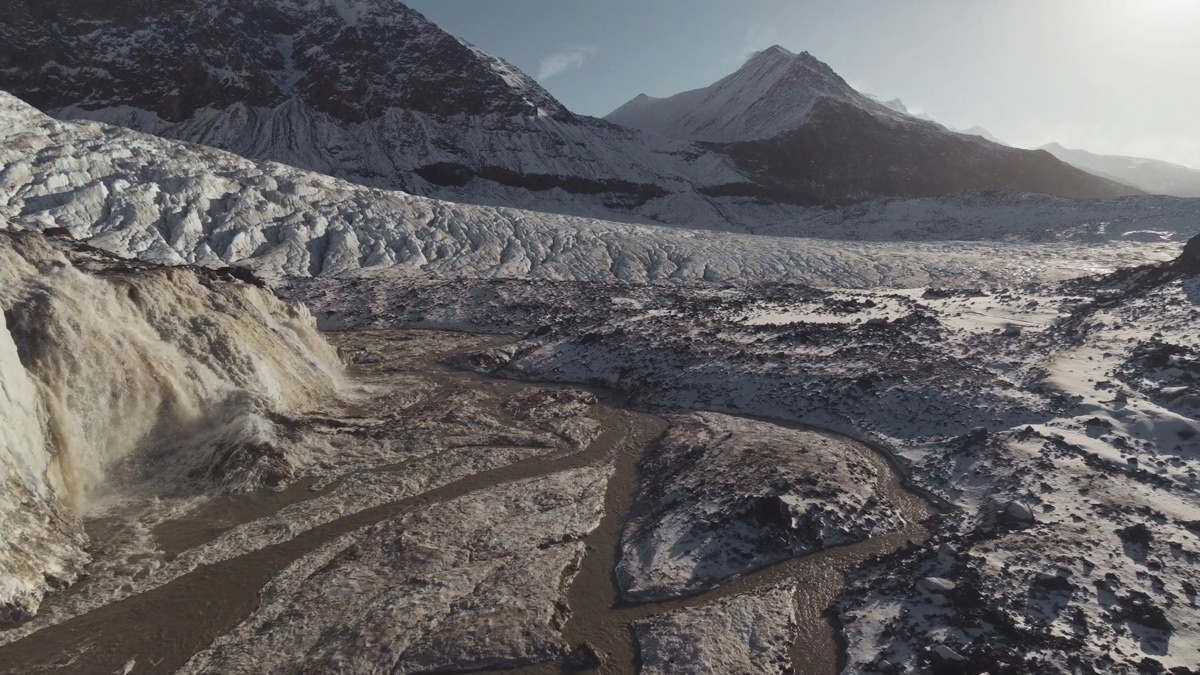
Glaciers move downhill because ice under enough weight and pressure behaves like an extremely slow-flowing fluid, deforming internally and sliding at its base while simultaneously grinding, plucking, and carrying away the rock beneath and around it. A glacier thick enough to matter — often hundreds of meters of compacted, recrystallized snow — exerts so much pressure at its base that individual ice crystals slip past each other and the whole mass creeps forward at anywhere from a few centimeters to several meters per day, slow enough to be invisible to a casual observer but fast enough to reshape entire mountain ranges over geological time.
How Snow Actually Becomes Glacial Ice Over Years
Fresh snow is mostly trapped air between loose, delicate ice crystals, and it takes years of repeated melting, refreezing, and compaction under the weight of new snow layers above for it to transform into dense, compact firn and eventually true glacial ice with almost all the air squeezed out. This transformation typically takes anywhere from a few years in wet, temperate climates to several decades in cold, dry polar regions.
Glacial ice is denser and far more crystalline than ordinary frozen water, having recrystallized under sustained pressure into large, interlocking grains that can be centimeters across near a glacier's base — a structure fundamentally different from the ice cubes in a freezer, and one that behaves far more like a slow-moving solid than a static, brittle block.
Why Ice Deforms Like a Fluid Under Its Own Weight
Ice crystals have a layered molecular structure that lets individual layers slide past each other under sustained stress, a process called internal deformation or creep, similar in principle to how a deck of cards can be sheared sideways even though each individual card stays rigid. This microscopic slipping, multiplied across billions of crystals throughout a glacier's thickness, adds up to macroscopic, visible flow.
The rate of this internal deformation increases sharply with both ice thickness and temperature — thicker ice experiences more pressure at depth, and warmer ice (closer to its melting point even while still solid) deforms more easily than very cold ice, which is why temperate glaciers in relatively mild climates often flow faster than similarly sized polar glaciers frozen solid to their base.
How Basal Sliding Adds a Second Kind of Motion
Beyond internal deformation, many glaciers also slide as a whole mass over the bedrock beneath them, a process called basal sliding that depends on a thin film of meltwater lubricating the interface between ice and rock. This meltwater forms from pressure melting at the base — the immense weight of overlying ice lowers the melting point of the ice in contact with rock, allowing liquid water to exist even at sub-freezing surface temperatures.
Basal sliding can account for the majority of a glacier's total forward motion in warmer, wetter conditions, while glaciers frozen solid to bedrock in extremely cold climates may move almost entirely through internal deformation alone, with essentially zero basal sliding — a distinction that dramatically affects how fast and how erosively different glaciers behave even at similar sizes.
Why Glaciers Carve U-Shaped Valleys, Not V-Shaped Ones
Rivers carve narrow, V-shaped valleys because flowing water is confined to a channel and erodes primarily downward at the streambed. Glaciers, by contrast, are wide masses of ice that fill an entire valley from wall to wall, so they erode both the floor and the sides simultaneously, widening and deepening the valley into the broad, rounded U-shaped cross-section that is the single most recognizable signature of past glacial activity.
Geologists can identify a valley that was carved by ancient glaciers thousands of years after the ice retreated purely from this characteristic U-shaped cross-section, distinguishing it immediately from river-cut V-shaped valleys even when no ice remains anywhere nearby — Yosemite Valley in California is one of the most famous examples of this glacially widened, flat-floored, steep-walled shape.
How Plucking Tears Whole Chunks of Bedrock Away
Plucking, one of a glacier's two main erosional tools, occurs when meltwater seeps into cracks in the bedrock beneath or ahead of the ice, then refreezes and bonds tightly to the glacier's underside. As the ice continues moving forward, it physically tears entire fractured blocks of rock loose from the bedrock and carries them away embedded in its base.
Plucking works especially effectively on the downstream side of bedrock bumps and hills, where ice pressure momentarily drops after passing over a high point, allowing meltwater to refreeze in the resulting cracks before the ice above pulls those loosened blocks free — this asymmetric process is why glacially plucked hills often have a smooth, gently sloped upstream face and a jagged, steep, quarried-looking downstream face.
How Abrasion Grinds Rock Into Fine Rock Flour
Abrasion, the glacier's second main erosional tool, happens when rock fragments already embedded in the ice's base — picked up through earlier plucking — get dragged across the bedrock surface like sandpaper, scratching, polishing, and grinding it down under the immense weight of ice pressing from above. This process produces the long, parallel scratches called striations that mark bedrock surfaces glaciers have passed over.
Continuous abrasion also pulverizes rock into an extremely fine sediment called rock flour or glacial flour, particles so small they remain suspended in glacial meltwater streams and lakes, giving them a distinctive milky, turquoise, or gray-blue color that comes purely from countless microscopic mineral particles scattering light rather than from any dissolved substance in the water itself.
Why Moraines Mark Exactly Where a Glacier Has Been
A glacier carries enormous quantities of rock debris of every size, from fine rock flour to house-sized boulders, both embedded within the ice and riding along its surface and edges after falling from surrounding cliffs. When a glacier eventually melts back or retreats, all this transported debris gets deposited in place, forming ridges called moraines that trace the glacier's former extent and edges with remarkable precision.
Different moraine types mark different features: lateral moraines run along a glacier's former side edges, terminal moraines mark the farthest point a glacier's snout ever reached before retreating, and medial moraines form down the center where two merging glaciers' lateral moraines combine — geologists read these deposits like a map to reconstruct exactly how large and how far a glacier extended thousands of years in the past.
How Crevasses Form From Stress the Ice Can't Absorb
While the deep interior of a glacier deforms plastically like a very slow fluid, the upper 30 to 50 meters or so remains brittle enough to crack under stress rather than flow, because pressure there is too low to allow the same crystal-slipping deformation that happens deeper down. When a glacier flows over uneven bedrock, speeds up, or stretches around a bend, this brittle surface layer fractures into deep, often hidden crevasses.
Crevasses can extend tens of meters deep and are frequently disguised by a thin, unstable snow bridge that forms when wind-blown snow accumulates over the gap, making them one of the most serious hazards for anyone traveling on glacier surfaces — experienced mountaineers rope together and probe ahead specifically because a snow bridge that looks solid can collapse without warning under a person's weight.
Why Glacier Speed Varies Dramatically Across Its Own Length
A glacier doesn't move at a uniform speed throughout its length — ice near the center and surface of a valley glacier typically flows fastest, since it's farthest from the friction of the valley walls and bed, while ice along the edges and at the very base moves slower, dragged back by contact with rock. This creates a velocity profile similar to water flowing through a pipe, fastest in the middle and slowest at the boundaries.
Seasonal and even daily speed changes occur too, since increased summer meltwater production adds more lubricating water at the glacier's base, temporarily boosting basal sliding speed — some glaciers measurably speed up during warm afternoons and slow again overnight, a rhythm directly tied to the daily melt-freeze cycle at the ice-rock interface.
How Glacial Lakes and Fjords Reveal Ice's Past Reach
When a retreating glacier's meltwater fills the depression it has just carved, often dammed by its own terminal moraine, it forms a glacial lake — many of the world's deepest, most scenic mountain lakes, including much of the North American Great Lakes basin, originated this way. Fjords form through the same basic carving process but at coastlines, where glaciers scoured valleys below sea level that later flooded with seawater as the ice retreated.
The extreme depth of many fjords, some plunging over a thousand meters just a short distance from open ocean, reflects how much more erosive power a large glacier has compared to any river system, since glacial ice can grind straight through bedrock at elevations well below current sea level in a way flowing water alone, constrained by hydraulic gradient, simply cannot achieve.
Why Glaciers Advance and Retreat Over Decades and Centuries
A glacier's front position depends on the balance between accumulation — new snow and ice added in its upper reaches — and ablation — ice lost to melting, evaporation, and calving at its lower end. When accumulation exceeds ablation over a sustained period, the entire glacier thickens and its front edge advances forward; when ablation wins out, the glacier thins and its front retreats even though the ice itself is still flowing forward internally the whole time.
This distinction matters because a retreating glacier's front position moving backward doesn't mean the ice has stopped moving or reversed direction — the ice is still flowing downhill exactly as always, just melting away faster at the terminus than fresh ice arrives from upstream, which is why scientists track mass balance (the net gain or loss of ice volume) rather than front position alone to assess a glacier's true health.
How Glacial Erratics Reveal Ice's Immense Carrying Power
A glacial erratic is a boulder, sometimes weighing hundreds of tons, that a glacier picked up in one location and deposited somewhere entirely different, often on top of bedrock of a completely different rock type, revealing at a glance that ice — not local weathering — placed it there. Some famous erratics have been traced, through matching their exact mineral composition, back to source outcrops hundreds of kilometers from where they now rest.
These displaced boulders serve as some of the most direct physical evidence geologists have for reconstructing past ice ages and mapping how far and in what direction now-vanished ice sheets once extended, since an erratic's resting place combined with its known origin traces an arrow pointing along the exact path the ice that carried it once flowed.
Why Ice Sheets Behave Differently From Mountain Glaciers
Continental ice sheets, like those covering Antarctica and Greenland, are vastly larger than mountain valley glaciers and flow outward from a central dome under their own weight in every direction rather than being channeled downhill through a single confined valley, spreading like extremely slow-moving pancake batter poured onto a surface.
Ice sheets can be kilometers thick at their center, generating pressures at the base high enough to keep large areas at the pressure-melting point even in the coldest climates on Earth, and they often terminate not on land but by flowing directly into the ocean as floating ice shelves, which then lose mass primarily through calving — breaking off as icebergs — rather than surface melting alone.
How Scientists Actually Measure a Glacier's Speed Today
Modern glaciologists track ice movement using GPS units drilled directly into the glacier's surface that record position changes over days, weeks, or years, combined with satellite radar interferometry that can detect surface displacement of just millimeters between successive satellite passes over the same location without anyone needing to physically visit the ice.
These measurements feed directly into models predicting how glaciers will respond to continued climate warming, since precisely tracking both flow speed and mass balance over time — rather than relying on occasional visual inspection of a glacier's front position — is what allows scientists to distinguish a temporarily stable glacier from one already losing mass rapidly beneath a deceptively unchanged surface appearance.
Sources
- National Snow and Ice Data Center — Glacier dynamics and monitoring research
- United States Geological Survey — Glacial geology and erosion processes
- Glaciology research — Ice flow physics and mass balance studies
FAQ
Do glaciers actually move, or do they just sit still?
They genuinely move — flowing under their own weight through internal deformation and, often, basal sliding, at speeds ranging from centimeters to several meters per day depending on thickness and temperature.
Why do glacier-carved valleys look different from river valleys?
Glaciers fill an entire valley and erode both floor and walls at once, producing a broad U-shaped cross-section, while rivers erode a narrow channel downward, producing a V-shaped valley.
What is basal sliding and why doesn't every glacier do it?
Basal sliding is a glacier moving as a whole mass over meltwater-lubricated bedrock; glaciers frozen solid to their bed in extremely cold climates may lack this meltwater and move almost entirely through internal ice deformation instead.
What's the difference between plucking and abrasion?
Plucking tears whole fractured rock blocks loose after meltwater refreezes and bonds them to the ice; abrasion grinds rock into fine powder using fragments already embedded in the ice's base, like sandpaper.
What causes the milky, turquoise color of glacial meltwater?
Extremely fine rock flour — microscopic mineral particles ground by glacial abrasion — stays suspended in the water and scatters light, producing the distinctive color, not any dissolved substance.
What are moraines and what do they tell scientists?
Moraines are ridges of rock debris deposited where a glacier's ice melted away, tracing the glacier's former size and edges precisely enough for geologists to reconstruct its past extent.
Why are crevasses so dangerous even when they look covered?
Wind-blown snow can form a thin, unstable bridge over a deep crevasse that looks solid but can collapse without warning under a person's weight, which is why mountaineers rope together and probe ahead.
Does a retreating glacier mean the ice has stopped flowing?
No; the ice keeps flowing downhill as always — a retreating front just means it's melting away faster at the end than fresh ice arrives from upstream, a matter of mass balance, not motion direction.
What is a glacial erratic and how does it prove ice was there?
A glacial erratic is a boulder deposited far from its source rock type, often hundreds of kilometers away — its mismatched mineral composition proves ice, not local weathering, carried and dropped it.
How are ice sheets different from mountain glaciers?
Ice sheets are far larger and flow outward from a central dome in every direction like spreading batter, rather than being channeled downhill through a single confined valley like a mountain glacier.
Why do fjords go so much deeper than nearby ocean water?
Glacial ice can grind bedrock straight through to elevations well below current sea level, an erosive power flowing water alone cannot match, which is why many fjords plunge far deeper than the adjacent open ocean.
How do scientists measure how fast a glacier is moving today?
GPS units drilled into the ice track position changes over time, combined with satellite radar interferometry that can detect surface displacement of just millimeters between passes, without needing to visit the ice in person.
Why does ice thickness affect how fast a glacier flows?
Thicker ice experiences more pressure at depth, which increases the rate of internal crystal-slipping deformation, so thicker glaciers generally flow faster than thin ones at similar temperatures.
Why do glaciers speed up in warm afternoons and slow at night?
Increased daytime meltwater production adds more lubricating water at the glacier's base, temporarily boosting basal sliding speed, a rhythm tied directly to the daily melt-freeze cycle.
How long does it take fresh snow to become true glacial ice?
Anywhere from a few years in wet, temperate climates to several decades in cold, dry polar regions, as repeated melting, refreezing, and compaction squeeze out nearly all the trapped air.
Why does ice speed vary across a single glacier's own cross-section?
Ice near the center and surface flows fastest since it's farthest from wall and bed friction, while ice at the edges and base drags slower, creating a velocity profile like water flowing through a pipe.
Is glacial ice the same as ordinary frozen water?
No; it recrystallizes under sustained pressure into large, interlocking crystal grains centimeters across near the base, giving it a structure and flow behavior nothing like an ordinary ice cube.
About the Author
We reference Wikipedia and other authoritative sources to explain the background and current understanding of this topic.
Loved This Article?
Share it on WhatsApp → Share it on WhatsApp
Get more guides in your inbox — Subscribe to our newsletter for weekly surprising stories from Egypt, Saudi Arabia, Dubai, and beyond.