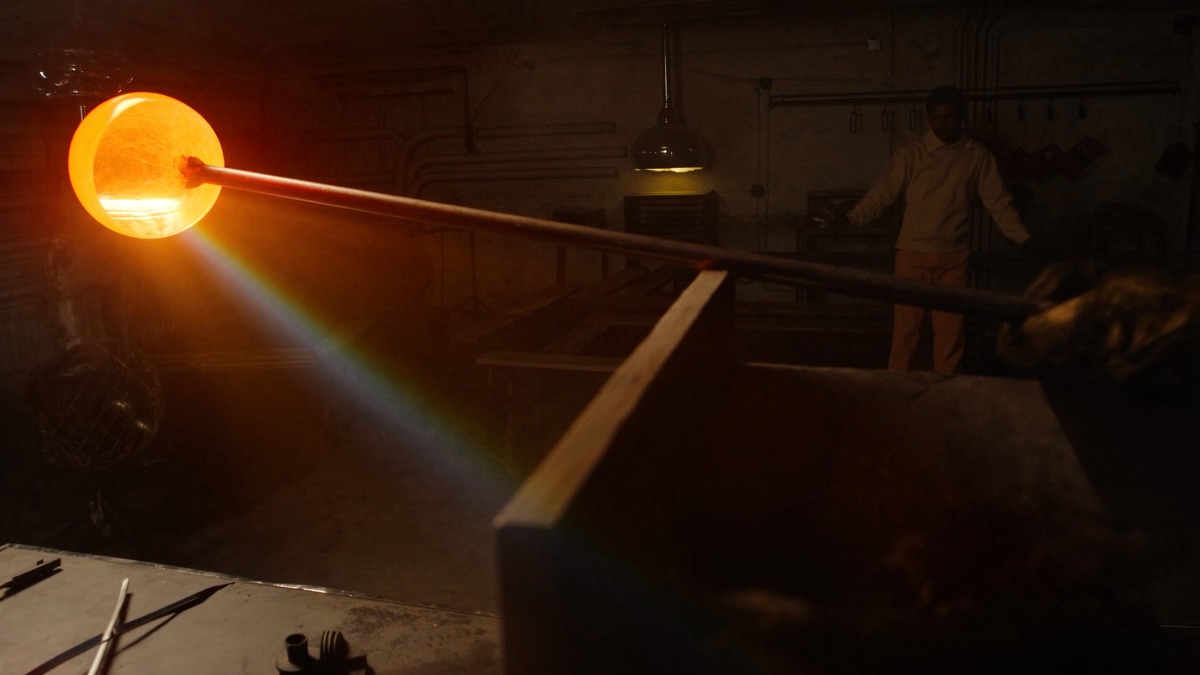
Glassblowing works because molten glass passes through a wide temperature range where it behaves like thick, stretchy honey rather than a solid or a thin liquid, allowing a skilled artisan to inflate a gathered blob of it into a hollow shape using nothing more than a long metal tube and their own breath. At the right temperature, glass is soft enough to stretch and expand under gentle air pressure but structured enough to hold that expanded shape as it cools, a narrow working window that gives glassblowers only a limited time to shape each piece.
Why Glass Can Be Shaped by Blowing Air Into It
Unlike water, which shifts abruptly from solid ice to liquid at a single fixed temperature, glass gradually softens over a wide temperature range as it is heated, passing through a workable, taffy-like consistency long before it becomes runny enough to pour freely.
This gradual softening is why glass can be blown, pulled, and shaped with hand tools at all: a material that flipped instantly between solid and liquid, the way ice and water do, would give an artisan no usable window in which to actually work it by hand.
How a Glassblower Actually Gathers Molten Glass Onto a Pipe
The process begins by dipping the end of a long hollow metal pipe, called a blowpipe, into a furnace holding molten glass kept at a temperature typically above 1,000 degrees Celsius, then rotating the pipe to collect a glowing, honey-like blob called a gather onto its tip.
Continuous rotation during this gathering step is essential, since gravity would otherwise pull the soft molten glass into an uneven, lopsided lump; spinning the pipe keeps the gather centered and roughly symmetrical from the very first moment it leaves the furnace.
Why Glassblowers Must Constantly Rotate Their Pipes
Glassblowers rotate their blowpipes almost continuously throughout the entire shaping process, not just during the initial gather, because molten glass remains soft enough to sag under gravity for much of the working time, and constant rotation is what keeps a piece round instead of drooping into an irregular shape.
This is why glassblowing is typically described as a full-body, constantly moving craft rather than a static one; the artisan is essentially fighting gravity in slow motion for as long as the glass remains workable, using rotation speed itself as a shaping tool.
How Blowing Air Into the Pipe Actually Inflates the Glass
Once a gather has been shaped into a rough bubble using hand tools and gentle initial puffs of air, the glassblower can blow more forcefully through the hollow pipe to expand that bubble further, using controlled breath pressure the same way a person inflates a balloon, except through molten material rather than rubber.
The wall thickness of the final piece depends heavily on how much the glass is stretched relative to how much material was originally gathered, meaning a skilled artisan has to plan the size of the initial gather with the intended final dimensions of the piece already in mind.
Why Reheating in the Glory Hole Is a Constant, Repeated Step
As glass is worked outside the furnace, it continuously loses heat to the surrounding air and cools toward a temperature where it becomes too stiff to shape further, so glassblowers repeatedly return the piece to a smaller secondary furnace called a glory hole to reheat and soften it again mid-process.
A single piece might be reheated a dozen or more times during its creation, and managing this heat cycle skillfully, keeping different parts of the piece at appropriately different temperatures for different shaping steps, is one of the most difficult aspects of the craft to master.
How Glassblowers Use Tools Like Jacks and Paddles to Shape Details
Beyond blowing and rotating, glassblowers use specialized hand tools like jacks, a scissor-like tool used to pinch and shape narrower sections such as a vase's neck, and wooden paddles, used to flatten a base or create straight surfaces on an otherwise round form.
Wooden tools are frequently soaked in water before use, since the moisture creates a thin protective steam layer between the tool and the roughly 1,000-degree glass, letting the tool touch and shape the glass surface without the wood immediately scorching or sticking.
Why the Punty Rod Solves the Problem of the Open End
A piece being blown remains attached to the blowpipe throughout most of its shaping, but that pipe occupies exactly where the opening of a vase or the base of a bowl eventually needs to be, so glassblowers attach a second rod called a punty to the opposite end before cutting the piece free from the original blowpipe.
This punty transfer lets the artisan then shape and finish the end that was previously attached to the blowpipe, including flaring open a vase's mouth or smoothing a bowl's rim, work that would be physically impossible to do while that end was still fixed to the pipe.
How Color Is Actually Introduced Into Blown Glass
Color in glass typically comes from adding specific metal oxide compounds to the molten glass batch itself, with different metals producing distinct, well-established colors: cobalt for blue, copper or gold for shades of red, and various other oxides for greens, yellows, and purples.
Colored glass can either be melted as the base material from the start or applied as a separate colored layer picked up from a container of colored glass frit or rods during the gathering process, letting artisans layer, swirl, or precisely place color within an otherwise clear piece.
Why Annealing Is the Step That Prevents Finished Pieces From Shattering
A freshly formed glass piece cannot simply be left to cool at room temperature, because glass cools unevenly, with the outer surface hardening faster than the interior, creating internal stress that can cause the piece to crack or explode spontaneously hours or even days later.
Annealing solves this by placing the finished piece into a specialized oven that cools it extremely slowly and evenly over many hours, allowing internal stresses to relax gradually rather than becoming permanently locked into the glass structure.
How Ancient Glassblowers First Discovered the Technique
Glassblowing is believed to have been developed by Syrian-Phoenician craftsmen around the first century BCE, a genuine technological breakthrough that dramatically sped up glass production compared to earlier, much slower methods like core-forming, where glass was built up in layers around a removable core.
This speed increase transformed glass from a rare luxury material affordable only to the wealthy into a comparatively common household item across the Roman Empire, since a skilled glassblower could produce vessels far faster than any earlier glassworking method allowed.
Why Roman Glass Spread So Widely and So Quickly
Once glassblowing made production fast and comparatively cheap, Roman glassworkers spread the technique widely across the empire's trade networks, and archaeologists have found blown Roman glass vessels at sites stretching from Britain to the Middle East.
This rapid, empire-wide adoption illustrates how a single manufacturing innovation, making a material faster and cheaper to produce, can reshape which objects ordinary people actually own and use, not just which objects wealthy elites can afford.
How Modern Studio Glassblowing Differs from Industrial Glass Manufacturing
Most glass objects in daily use today, bottles, windows, drinking glasses, are produced by automated industrial processes involving molds and machines rather than hand-blowing, since mechanized production can turn out vastly more identical pieces at far lower cost per unit.
Studio glassblowing, by contrast, survives today primarily as an artistic and craft practice, valued specifically because each hand-blown piece carries small, individual variations that mechanically molded glass cannot replicate, a quality collectors and artists actively seek rather than consider a flaw.
Why Furnace Temperature Control Is So Critical to Consistent Results
Glassblowing furnaces must maintain extremely precise, stable temperatures, since molten glass that is too cool becomes stiff and hard to shape, while glass that is too hot becomes so runny it is nearly impossible to control on the end of a pipe.
Modern studio furnaces use electronic temperature controls to maintain this narrow working range consistently for hours at a time, a level of precision that historical glassblowers had to approximate purely through experience, visual color cues, and careful furnace tending.
How Teamwork Shapes Large or Complex Glassblowing Projects
While simple pieces can be made by a single glassblower working alone, larger or more complex works are typically produced by a small team, with a lead gaffer directing the shaping while assistants handle reheating, tool preparation, and precisely timed hand-offs of hot glass and tools.
This team choreography has to be extremely well-rehearsed, since molten glass cools and stiffens within seconds once removed from the furnace, leaving no time for hesitation or miscommunication between team members during the most delicate shaping steps.
Why Certain Glassblowing Techniques Are Named After Specific Regions
Techniques like Venetian filigrana, which embeds fine threads of colored or opaque white glass within clear glass in intricate patterns, developed on the island of Murano near Venice, where glassmakers were historically confined by law partly to protect trade secrets and partly due to fire risk from their furnaces.
This geographic concentration allowed highly specialized techniques to be refined and passed down within a tight-knit community of artisans over generations, producing distinctive regional styles that remain recognizable and prized today.
How Modern Artists Have Pushed Glassblowing Into Large-Scale Sculpture
Contemporary glass artists have expanded far beyond traditional vessel forms, creating large-scale sculptural installations by fusing together numerous individually blown components, a scaling-up approach that turned glassblowing from a purely functional craft into a recognized fine-art medium.
This artistic expansion required developing new structural and installation techniques beyond traditional glassblowing knowledge, since supporting and displaying large, heavy, fragile glass sculptures safely poses engineering challenges quite different from producing a single hand-held vessel.
Why Glassblowing Requires Years of Practice to Master
Because so many variables, heat, rotation speed, breath pressure, tool timing, must be judged and adjusted simultaneously and quickly, most professional glassblowers describe needing years of consistent practice before they can reliably produce symmetrical, well-proportioned pieces without extensive trial and error.
Much of this skill is described by experienced glassblowers as physical, muscle-memory knowledge that cannot be fully taught through verbal instruction alone, similar to how a musician eventually plays complex passages without consciously thinking through each individual note.
How Safety Equipment and Practices Protect Glassblowers From Serious Burns
Working constantly near open furnaces holding glass above 1,000 degrees Celsius requires heavy protective gear, heat-resistant gloves, safety glasses rated for the intense infrared radiation furnaces emit, and closed-toe shoes, since even brief unprotected exposure to molten glass or radiant furnace heat can cause severe burns.
Studios also enforce strict protocols around clearing pathways of tripping hazards and maintaining clear communication between team members, since a moment of confusion while someone is carrying a rod of molten glass across a workshop floor carries genuinely serious injury risk.
Why Some Glassblowing Studios Now Focus on Sustainable Practices
Because glass furnaces must run continuously at extremely high temperatures, often twenty-four hours a day for months at a time to avoid the cost and thermal shock of repeatedly shutting down and restarting, glassblowing is an energy-intensive craft, prompting some studios to invest in more efficient furnace insulation and recycled cullet glass as raw material.
Recycled glass, called cullet, melts at a slightly lower temperature than raw silica sand mixtures, meaning studios incorporating substantial recycled content into their batch can reduce both energy consumption and raw material costs simultaneously.
Why Glassblowing Endures as Both a Practical Craft and an Art Form
Despite industrial manufacturing having replaced hand-blowing for nearly all everyday glass objects, the craft has not disappeared; instead it has concentrated into artistic studios, educational programs, and cultural heritage sites that preserve and showcase a two-thousand-year-old technique.
Glassblowing's continued appeal lies in the same tension that has always defined it: a material that behaves like liquid honey one moment and rigid glass the next, shaped in real time by breath, rotation, and gravity, a combination of physical skill and material science that remains genuinely difficult to replicate by machine even today.
Sources
- Corning Museum of Glass — History of Glassblowing
- Encyclopaedia Britannica — Glassblowing
- Smithsonian Magazine — Arts & Culture
FAQ
Why can glass be blown into shapes while other solids cannot?
Glass gradually softens over a wide temperature range instead of shifting abruptly between solid and liquid like water, giving artisans a workable, taffy-like consistency long enough to shape it by hand and breath.
How does a glassblower actually gather molten glass onto the pipe?
They dip a hollow metal blowpipe into a furnace holding glass above 1,000 degrees Celsius and rotate it continuously to collect a glowing blob called a gather while keeping it centered against gravity.
Why do glassblowers rotate their pipes constantly during the whole process?
Molten glass stays soft enough to sag under gravity for much of the working time, so continuous rotation is what keeps a piece round instead of drooping into an irregular shape.
What determines how thick or thin the final glass wall becomes?
Wall thickness depends on how much the glass is stretched relative to how much material was originally gathered, so artisans plan the initial gather size with the final dimensions in mind.
Why do glassblowers keep returning the piece to a small secondary furnace?
Glass constantly loses heat and stiffens while being worked outside the main furnace, so it must be reheated in a "glory hole" repeatedly, sometimes a dozen times or more, to stay workable.
Why are wooden shaping tools soaked in water before use?
The moisture creates a thin protective steam layer between the tool and the roughly 1,000-degree glass, letting the tool shape the surface without scorching or sticking to it.
Why is a second rod called a punty attached to the piece?
The original blowpipe occupies the spot where an opening like a vase mouth needs to be, so a punty is attached to the opposite end, letting the artisan finish that end after cutting it free from the blowpipe.
How is color actually added to blown glass?
Specific metal oxide compounds are added to the molten batch, with cobalt producing blue, copper or gold producing reds, and other oxides producing greens, yellows, and purples.
Why can a finished glass piece crack hours after being made if not treated properly?
Glass cools unevenly, with the outer surface hardening faster than the interior, creating internal stress; annealing in a slow-cooling oven relaxes that stress before it can cause spontaneous cracking.
Who is credited with inventing glassblowing?
Syrian-Phoenician craftsmen around the first century BCE are believed to have developed the technique, dramatically speeding up glass production compared to earlier, slower core-forming methods.
How did glassblowing change who could actually own glass objects?
The speed increase transformed glass from a rare luxury affordable only to the wealthy into a comparatively common household item across the Roman Empire.
Is most glass used today still hand-blown?
No; most everyday glass objects like bottles and windows are produced by automated industrial molding processes, with hand-blowing surviving mainly as an artistic and craft practice.
Why is furnace temperature control so important for glassblowing?
Glass that is too cool becomes stiff and hard to shape, while glass that is too hot becomes too runny to control, so furnaces must maintain a precise, stable working temperature.
Why do larger glassblowing projects require a whole team?
Molten glass cools and stiffens within seconds outside the furnace, so a lead gaffer and assistants must coordinate reheating, tool handoffs, and shaping with no room for hesitation.
Why are some glassblowing techniques named after specific places like Murano?
Historical restrictions confined glassmakers to specific locations partly to protect trade secrets and reduce fire risk, letting highly specialized regional techniques develop and pass down over generations.
How have modern artists expanded what glassblowing can produce?
Contemporary artists fuse together many individually blown components to create large-scale sculptural installations, turning glassblowing into a recognized fine-art medium beyond traditional vessels.
Why does glassblowing take years to master?
Many variables like heat, rotation speed, breath pressure, and tool timing must be judged and adjusted simultaneously, requiring physical muscle-memory skill built up over years of consistent practice.
What safety risks do glassblowers face?
Working near furnaces above 1,000 degrees Celsius requires heat-resistant gloves, rated safety glasses, and closed-toe shoes, since brief unprotected exposure to molten glass can cause severe burns.
How are some glassblowing studios becoming more sustainable?
Some incorporate recycled cullet glass, which melts at a slightly lower temperature than raw silica sand, reducing both energy consumption and raw material costs.
Why has glassblowing survived despite industrial manufacturing replacing it commercially?
It has concentrated into artistic studios and cultural heritage programs valued specifically for the individual, hand-crafted variations that mechanically molded glass cannot replicate.
Can a small mistake during shaping ruin an entire piece?
Yes; because molten glass stiffens within seconds, a mistimed rotation or a tool applied a moment too late can permanently distort a shape, forcing the artisan to reheat and attempt the correction or start over entirely.
Why do glassblowers often work in pairs even for moderately simple pieces?
A second person can reheat tools, hand over materials, and manage the furnace door timing, letting the primary gaffer keep both hands and full attention on the piece without breaking concentration mid-shape.
About the Author
We reference Wikipedia and other authoritative sources to explain the background and current understanding of this topic.
Loved This Article?
Share it on WhatsApp → Share it on WhatsApp
Get more guides in your inbox — Subscribe to our newsletter for weekly surprising stories from Egypt, Saudi Arabia, Dubai, and beyond.