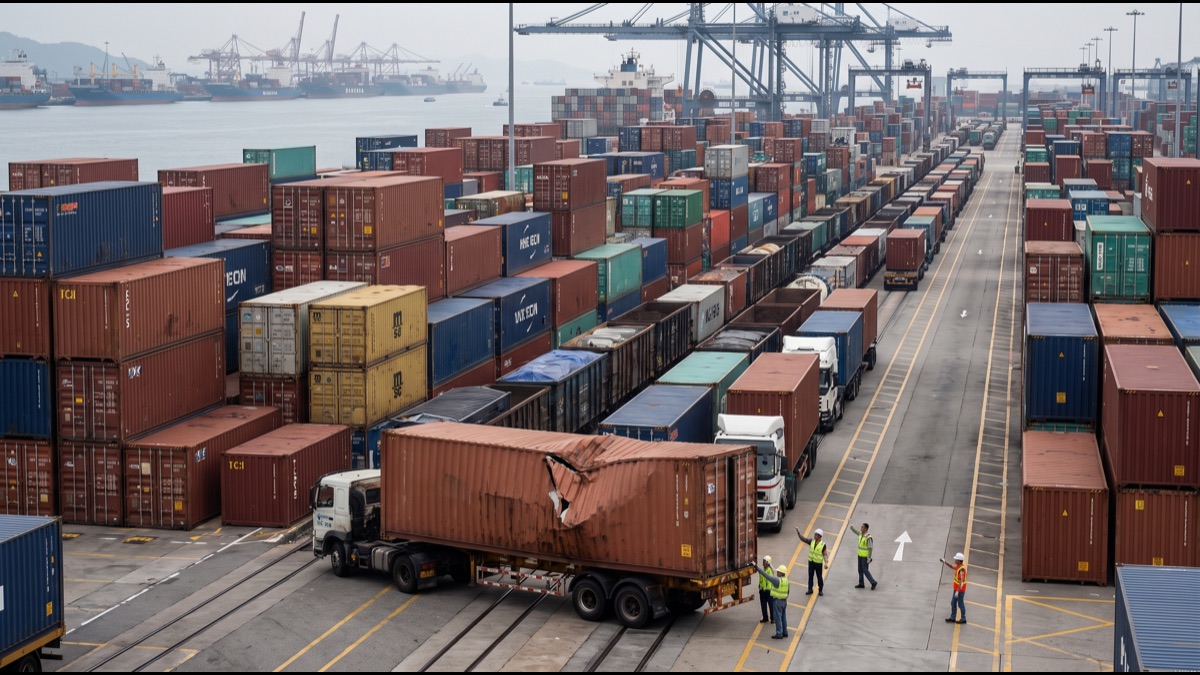
For decades, global supply chains operated so reliably that almost nobody outside logistics gave them a moment's thought. Goods appeared on shelves, components arrived at factories, and the enormously complex international machinery moving materials across the planet stayed comfortably invisible. That changed abruptly when shortages of everyday items made the phrase supply chain disruption a fixture of ordinary conversation.
What surprised many people was not that disruption occurred but how disproportionate the consequences were, with modest local problems producing shortages on the other side of the world months later. Understanding why requires looking at how these systems were deliberately designed, because the same choices that made them extraordinarily efficient also made them unusually vulnerable to exactly the kind of shock that eventually arrived.
What a Supply Chain Actually Is
A supply chain describes the full sequence of steps converting raw materials into a finished product delivered to a customer, encompassing extraction, processing, component manufacture, assembly, warehousing, distribution, and retail, each typically performed by different companies in different countries.
Modern products involve far more steps than most people imagine, since a single manufactured item may contain hundreds of components sourced from dozens of suppliers across many countries, each of those suppliers having their own upstream supply chains extending further back.
This depth means most companies have genuine visibility only into their immediate suppliers, with limited knowledge of who supplies those suppliers, which is precisely why disruptions frequently arrive unexpectedly from parts of the chain a company never knew it depended on.
Why Just-in-Time Became Standard
For much of the twentieth century, manufacturers held substantial inventories of components as protection against supply interruption, an approach providing security at the cost of capital tied up in stock, warehousing expense, and the risk of holding goods that became obsolete.
Just-in-time manufacturing inverted this, arranging for components to arrive precisely when needed rather than being stockpiled, which dramatically reduced working capital requirements and warehousing costs while also exposing quality problems faster.
The approach delivered genuine and substantial efficiency gains, spread from its origins in automotive manufacturing across essentially every industry, and became the default assumption in supply chain design rather than one option among several.
How Efficiency Created Fragility
The buffer inventory that just-in-time eliminated was performing a function beyond simply sitting idle, since it absorbed variation and gave the system time to respond when something went wrong somewhere upstream.
Removing that buffer meant disruptions propagated immediately rather than being absorbed, so a supplier problem that would once have gone unnoticed because two weeks of stock existed now halts production within days.
This is the central tradeoff underlying most supply chain fragility, since inventory is simultaneously a cost to be minimised and insurance against disruption, and decades of optimisation pushed consistently toward minimising the cost without pricing the insurance being given up.
Why Concentration Amplifies Risk
Efficiency pressures also drove concentration, since producing at enormous scale in a single location generally costs less than maintaining multiple smaller facilities, which gradually consolidated production of many components into a small number of sites.
This concentration is frequently invisible until something goes wrong, because many competing brands may source an identical component from the same single supplier, meaning apparent market diversity conceals a shared dependency.
When such a facility is disrupted, the effect is not limited to one company but hits every downstream customer simultaneously, which is why single-site disruptions have repeatedly produced shortages spanning entire industries.
The Bullwhip Effect
A well-documented phenomenon in supply chains is that small variations in consumer demand produce progressively larger swings further upstream, a pattern researchers describe as the bullwhip effect.
It arises because each participant orders based on what they observe from their immediate customer rather than actual end demand, and each adds a margin for safety, so a modest retail increase becomes a larger distributor order and a larger manufacturer order still.
The effect reverses just as violently, since when demand normalises the accumulated excess orders are cancelled, producing a collapse in upstream orders far exceeding the actual change in consumption and leaving suppliers with substantial unsold inventory.
How Panic Buying Interacts With This
Consumer panic buying illustrates the bullwhip effect operating at maximum intensity, since a sudden surge in purchasing empties shelves not because supply has genuinely failed but because weeks of normal demand compressed into days.
Retail systems are designed around predictable replenishment rates, so even a modest sustained increase can outpace restocking, and empty shelves then themselves signal scarcity to other shoppers, producing further buying in a self-reinforcing loop.
The shortage in these cases is genuinely one of logistics rather than of underlying supply, which is why such episodes typically resolve within weeks once buying normalises and the accumulated household stockpiles are gradually consumed.
Why Shipping Container Logistics Matter So Much
Containerisation transformed global trade by standardising how goods move, allowing a sealed box to transfer between ship, train, and truck without unpacking, which collapsed handling costs and made distant manufacturing economically viable.
Because containers must physically return to be reused, imbalanced trade flows create positional problems, with empty containers accumulating where imports exceed exports while shortages develop in exporting regions.
This positioning problem intensifies dramatically during disruption, since delays cause containers to sit stationary rather than circulating, effectively removing capacity from the system even though the physical containers still exist somewhere.
How Port Congestion Cascades
Ports operate near capacity under normal conditions because underused capacity is expensive, which means they have limited ability to absorb surges and instead accumulate queues when arrivals exceed processing rates.
Congestion becomes self-reinforcing because delayed ships miss their scheduled return, disrupting subsequent voyages, while containers waiting for collection occupy yard space that incoming vessels need, gradually reducing throughput further.
Recovery is slow because clearing accumulated backlog requires processing above normal rates for an extended period, and any additional disruption during recovery pushes the system back, which is why congestion episodes have historically persisted for many months.
Why Chokepoints Create Systemic Risk
Global shipping depends heavily on a small number of narrow passages that dramatically shorten routes, and because alternatives add substantial time and fuel cost, an extraordinary volume of trade funnels through very limited geography.
Blockage at such a point does not merely delay vessels currently there but disrupts scheduling across entire networks, since ships and containers are committed to sequences of voyages that all shift when one leg is interrupted.
These chokepoints also concentrate geopolitical risk, since regional conflict or political disruption affecting a single passage can force rerouting that adds weeks to transit times across a substantial share of global trade.
What Semiconductor Shortages Revealed
The shortage of semiconductors that disrupted automotive and electronics production illustrated several dynamics at once, beginning when vehicle manufacturers cancelled chip orders anticipating reduced demand, freeing capacity that chip makers promptly reallocated to consumer electronics.
When vehicle demand recovered faster than expected, manufacturers found capacity committed elsewhere, and because semiconductor fabrication involves lead times measured in months and facilities costing billions, capacity could not be expanded quickly in response.
The episode demonstrated how a demand forecasting error in one industry propagated into a shortage in another, and how capital intensity in upstream production creates rigidity that makes rapid adjustment genuinely impossible regardless of price signals.
Why Substitution Is Harder Than It Looks
An intuitive response to shortage is switching suppliers, but this is frequently impractical because components are designed into products with specific tolerances, certifications, and interfaces that alternatives may not match.
Regulated industries face additional barriers, since changing a supplier for a pharmaceutical ingredient or aerospace component may require regulatory approval taking months or years, making rapid substitution legally impossible even when technically feasible.
Qualifying a new supplier involves auditing, sample testing, and production validation that takes considerable time under normal circumstances, which means the alternative sourcing that looks obvious in hindsight was rarely available on the timescale the disruption demanded.
How Companies Have Responded
Disruption prompted widespread reassessment, with many firms increasing inventory buffers, deliberately accepting higher carrying costs in exchange for resilience, a reversal of decades of optimisation in the opposite direction.
Dual sourcing has expanded, with companies qualifying multiple suppliers for critical components even where a single supplier would be cheaper, accepting higher unit costs as insurance against dependency.
Mapping deeper into the supply chain has also become a priority, since many firms discovered during disruption that they could not identify their own indirect dependencies, making it impossible to assess exposure until problems had already materialised.
Why Reshoring Is Not a Simple Solution
Moving production closer to end markets is frequently proposed as a solution, and it genuinely reduces exposure to long-distance shipping disruption and geopolitical risk affecting distant suppliers.
The difficulty is that manufacturing capability is not simply relocated, since it depends on accumulated workforce skills, supplier ecosystems, and specialised infrastructure that developed over decades and cannot be recreated quickly elsewhere.
Reshoring also frequently raises costs substantially, and while resilience has genuine value, that value competes against price pressure in markets where consumers have consistently demonstrated strong preference for lower prices over supply security.
What Governments Have Started Doing
Several governments have moved from treating supply chains as purely commercial matters toward viewing certain categories as strategic, particularly semiconductors, pharmaceuticals, and critical minerals where dependency creates national vulnerability.
Interventions have included subsidies for domestic production capacity, stockpiling requirements, and restrictions on foreign ownership of strategically significant facilities, representing a substantial shift from prior policy emphasising efficiency.
These interventions carry their own costs and risks, since subsidised capacity may prove uncompetitive without continued support, and reciprocal measures by other countries can fragment global markets in ways that reduce overall efficiency for everyone.
What Genuine Resilience Would Require
Supply chain researchers generally argue that resilience requires visibility, meaning knowing dependencies several tiers deep, since exposure cannot be managed if it cannot be identified in the first place.
It also requires deliberately maintaining slack, whether as inventory, alternative suppliers, or spare capacity, all of which cost money continuously while delivering benefit only occasionally, which makes them perennially vulnerable to cost-cutting.
The underlying difficulty is that resilience investments are paid for constantly and rewarded rarely, and the interval between major disruptions is long enough that the memory motivating investment tends to fade before the next one arrives.
How Labour Shortages Compound Physical Bottlenecks
Supply chain discussion tends to focus on ships, containers, and factories, but every physical link depends on people, and shortages of truck drivers, warehouse staff, dock workers, and customs handlers have repeatedly proven as binding a constraint as any shortage of equipment or capacity.
Driver shortages have been particularly consequential because road transport connects almost every other mode, meaning goods can arrive by sea entirely on schedule and still sit at a port for weeks because insufficient drivers exist to move containers inland to distribution centres.
These shortages are structurally difficult to resolve quickly since roles requiring licensing, security clearance, or specialised training cannot be filled on demand, and the demographics of several of these workforces skew older, meaning retirement continues reducing capacity even as demand for it grows.
Why Weather and Climate Increasingly Matter
Physical infrastructure supporting global trade is genuinely exposed to weather, with ports closing during storms, rail lines washing out during floods, and inland waterways becoming unnavigable during drought when water levels fall below the depth loaded barges require.
Drought affecting canal systems that depend on freshwater to operate locks has demonstrated this vulnerability clearly, since reduced water availability forces restrictions on the number and draft of vessels permitted through, creating queues and pushing traffic onto substantially longer alternative routes.
Because climate projections indicate increasing frequency of extreme weather, supply chain planners have begun treating climate exposure as a routine element of network design rather than an occasional disruption, assessing which nodes and routes face rising physical risk over the operational lifetime of infrastructure investments.
What Cyber Vulnerability Has Added
As logistics has digitised, the systems coordinating cargo movement have become attractive targets, and attacks on shipping companies, port operators, and logistics providers have repeatedly halted physical operations despite leaving every ship, crane, and container entirely intact.
The damage occurs because modern terminals cannot function without knowing which container sits where and which is destined for whom, so losing access to that data effectively paralyses a facility even though nothing physical has been touched at all.
This has driven substantial investment in system resilience and in maintaining functional manual fallback procedures, though the growing interconnection between systems belonging to different companies means a compromise at one participant can propagate consequences well beyond the organisation actually attacked.
How Inventory Decisions Shape Inflation
Supply disruption feeds into consumer prices through a mechanism that is genuinely straightforward, since goods that are scarce relative to demand command higher prices, and elevated shipping and input costs are eventually passed along to buyers.
The timing is heavily lagged, because contracts fix prices for defined periods and firms frequently absorb initial cost increases before raising prices, meaning the inflationary effect of a disruption typically appears months after the disruption itself has been reported and largely forgotten.
The reversal is similarly lagged and frequently incomplete, since prices tend to fall more slowly than they rose once conditions normalise, a well-documented asymmetry that contributes to public frustration when disruption ends but the elevated prices it produced do not fully recede.
Why Small Businesses Absorb Disruption Worst
Large buyers generally weather supply disruption considerably better than small ones, because scale confers priority with suppliers, the financial capacity to hold larger buffer inventories, and the leverage to secure allocation when a supplier is rationing constrained output among competing customers.
Smaller firms frequently find themselves at the back of allocation queues precisely when supply tightens, and they typically lack the working capital to stockpile in advance or to absorb the higher spot-market prices that become the only route to securing scarce inputs quickly.
This dynamic means disruption tends to accelerate market concentration, since periods of scarcity systematically disadvantage smaller participants and occasionally eliminate them entirely, leaving the sector more concentrated afterward and therefore, by the logic described throughout this piece, somewhat more fragile than before.
What Better Forecasting Can and Cannot Fix
Considerable investment has gone into improving demand forecasting on the reasoning that better prediction would reduce the ordering distortions driving the bullwhip effect, and sharing genuine end-demand data across supply chain participants does measurably dampen amplification.
The limits are genuine, however, since forecasting cannot anticipate events that are inherently unpredictable, and the disruptions producing the most severe consequences have generally been precisely those nobody modelled because they fell outside the range of historical experience the forecasts were built from.
This suggests forecasting and resilience address genuinely different problems rather than being substitutes, since better prediction reduces the ordinary variation a system must absorb while resilience determines whether it survives the extraordinary events that prediction was never going to catch in the first place.
Supply chains break in ways that seem disproportionate because they were deliberately engineered to have almost no slack. Just-in-time delivery removed the buffer inventory that once absorbed shocks, concentration of production into fewer larger facilities removed geographic redundancy, and neither cost was visible while conditions stayed stable. The amplifying mechanisms then do the rest. The bullwhip effect turns modest demand changes into violent upstream swings because each participant orders from what they see rather than actual consumption. Port congestion is self-reinforcing because delays consume the very capacity needed to clear them. Substitution that looks obvious afterward is frequently blocked by certification timelines measured in months. None of this was irrational: the efficiency gains were real and enormous. The mistake was treating inventory purely as a cost to minimise rather than also as insurance whose premium had simply stopped being priced.
Sources
- Wikipedia — overview of supply chain structure, management, and disruption
- World Trade Organization — global trade data and analysis of supply chain disruption
- OECD — economic research on supply chain resilience and policy responses
- International Monetary Fund — analysis of supply disruption effects on inflation and growth
- United Nations Conference on Trade and Development — shipping, containerisation, and maritime trade statistics
FAQ
Why do small disruptions cause such large shortages?
Just-in-time systems removed the buffer inventory that once absorbed variation, so problems propagate immediately rather than being cushioned, and the bullwhip effect amplifies them further upstream.
What is the bullwhip effect?
Small changes in consumer demand produce progressively larger order swings upstream, because each participant orders based on their immediate customer rather than actual end demand and adds a safety margin.
Why can't companies just switch suppliers during a shortage?
Components are designed in with specific tolerances and certifications, and qualifying a new supplier involves auditing and validation that takes months — sometimes requiring regulatory approval.
Why does port congestion take so long to clear?
It is self-reinforcing: delayed ships disrupt later voyages while waiting containers occupy yard space, reducing throughput, so clearing backlog requires sustained above-normal processing.
Would moving production closer to home fix the problem?
It reduces some risks but is not simple, since manufacturing depends on accumulated workforce skills and supplier ecosystems built over decades, and it generally raises costs substantially.
About the Author
We reference Wikipedia, World Trade Organization, OECD, International Monetary Fund, and United Nations Conference on Trade and Development to explain the background and current understanding of this topic.
Loved This Article?
Share it on WhatsApp → Share it on WhatsApp
Get more guides in your inbox — Subscribe to our newsletter for weekly surprising stories from Egypt, Saudi Arabia, Dubai, and beyond.