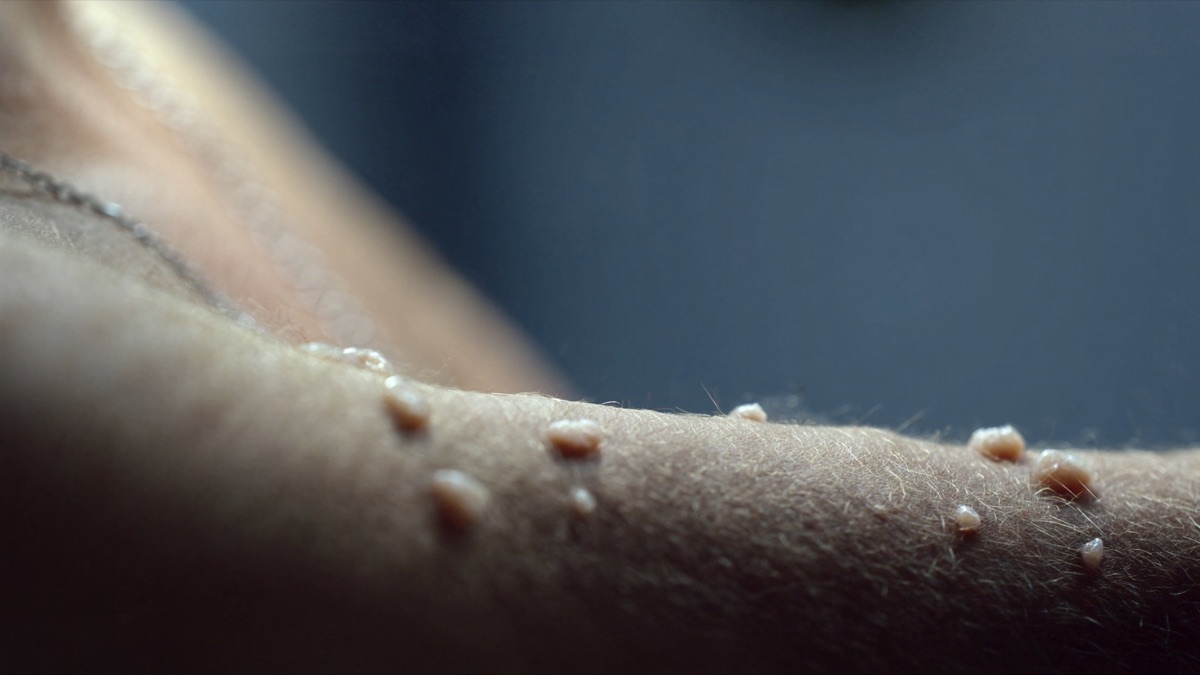
That sudden prickle of raised bumps racing across your arms during a cold gust, a scary movie scene, or a powerful piece of music is called piloerection, commonly known as goosebumps, and it is one of the clearest surviving pieces of evidence that the human body still runs some genuinely ancient software. The reflex itself is simple and fast, but the reasons your nervous system still bothers running it — despite humans having lost almost all the body hair the reflex originally evolved to move — reveal a lot about how evolution tends to leave old wiring in place long after its original purpose has faded.
The tiny muscle behind every goosebump
Each hair follicle on your body, however fine or thick the hair growing from it, is attached to a microscopic band of smooth muscle called the arrector pili muscle, which runs at a slight angle from the follicle up to just beneath the skin's surface. When this muscle contracts, it does two things simultaneously: it tugs the hair follicle more upright, making the hair stand more vertically than it normally sits, and it pulls the skin around the follicle's base inward and upward slightly, creating the small raised bump you can see and feel. Multiply this by the roughly five million hair follicles covering most of the human body, and a strong emotional or thermal trigger can visibly texture large areas of skin within seconds.
The arrector pili muscle is not under conscious voluntary control the way your bicep or hand muscles are; it is controlled entirely by the sympathetic nervous system, the same branch of the autonomic nervous system responsible for the broader 'fight or flight' response. This is why you cannot simply decide to get goosebumps on command the way you can decide to clench a fist, and why goosebumps so often accompany other classic sympathetic nervous system signals like a racing heart, dilated pupils, or a sudden chill, all triggered by the same underlying surge of the hormone norepinephrine acting on smooth muscle throughout the body.
The original job: trapping warm air
In mammals with a substantial coat of fur, raising the individual hairs via arrector pili contraction serves a very practical thermoregulatory purpose: it increases the layer of air trapped between the hairs and the skin, and trapped air is an excellent insulator, meaning a fluffed-up coat holds body heat far more effectively than a flat, sleek one. This is the same physical principle behind why a down jacket keeps you warm — the loft, or fluffiness, of the material traps insulating air, not the material's own thickness — and it is why you can watch a cat or dog visibly puff up its fur on a cold day, or why birds fluff their feathers using an analogous muscular mechanism to stay warm in winter.
Human ancestors, before losing most of their body hair somewhere over the past one to two million years of evolution, would have relied on exactly this same mechanism, and the reflex simply never got fully deleted from the genetic and neurological blueprint even after it lost most of its practical thermal benefit. Humans retain roughly the same density of hair follicles as other primates of comparable body size; what changed dramatically is that most human body hair became fine, short, and nearly colorless (called vellus hair) rather than the thick, pigmented hair (terminal hair) that would actually trap a meaningful layer of warming air when raised.
The intimidation function: looking bigger and scarier
Beyond warmth, piloerection serves a second well-documented function across the animal kingdom: making an animal appear larger and more threatening to a potential predator or rival. A frightened or aggressive cat arching its back with fur standing fully on end is a familiar example — the fluffed fur can make the animal's visible silhouette dramatically larger within a fraction of a second, a fast, low-cost bluff that may be enough to deter an attacker without any actual physical confrontation. Porcupines, various primates, and many other mammals use a similar fear- or aggression-triggered fluffing response for essentially the same intimidation purpose.
This defensive-bluff explanation is the leading theory for why goosebumps in humans are so reliably triggered by fear and strong negative emotion even today — a sudden fright, a jump scare in a film, or a genuinely threatening situation can produce a wave of goosebumps across the arms, neck, and scalp almost instantly, activating a reflex that, in a furrier ancestor, would have made them look larger and more formidable to whatever just startled them, even though in modern hairless humans the visible size effect is essentially zero.
Why music and emotion trigger them too
One of the more puzzling aspects of goosebumps is that they are reliably triggered not just by cold or fear but by powerful positive emotional experiences that have nothing to do with temperature or danger: a swelling orchestral crescendo, an unexpectedly moving moment in a film, a chill-inducing vocal performance, or even recalling a deeply meaningful memory. Researchers studying this phenomenon, sometimes called frisson, have found it activates the same sympathetic nervous system pathway and the same arrector pili reflex as fear-based goosebumps, suggesting the brain's threat- and arousal-detection circuitry doesn't cleanly separate 'this is dangerous' from 'this is overwhelming and significant' at the level where the goosebump reflex gets triggered.
Brain imaging studies of people experiencing music-induced chills show activation in reward-processing brain regions, including the same dopamine pathways activated by food, sex, and other biologically rewarding experiences, suggesting that emotionally powerful music may be triggering an evolutionarily ancient arousal and reward circuit that goosebumps happen to be wired into as a side effect, even though the music itself poses no actual threat and offers no direct survival benefit — an example of a very old reflex system getting repurposed, largely by accident, for a distinctly modern human experience.
Why not everyone gets goosebumps equally often
There is measurable individual variation in how easily and how often people experience piloerection, and research into personality traits has found a genuine correlation between how readily someone gets music- or emotion-induced goosebumps and certain personality dimensions, particularly the trait of 'openness to experience' in the widely used Big Five personality model. People who score higher on openness — often associated with stronger imaginative engagement, aesthetic sensitivity, and emotional responsiveness to art — tend to report frisson-triggered goosebumps more frequently and more intensely than people who score lower on that trait, though the underlying neurological mechanism connecting personality structure to the strength of an autonomic reflex is still an active area of research.
Some medical conditions and medications can also blunt or exaggerate the goosebump reflex by directly affecting sympathetic nervous system signaling; certain nerve-related conditions can reduce or eliminate the ability to form goosebumps in affected areas of skin, which physicians occasionally use as a diagnostic clue when assessing nerve damage, since an area of skin that no longer produces piloerection in response to cold or a startling stimulus may indicate localized disruption of the sympathetic nerve fibers serving that region.
Goosebumps in animals without visible fur
Even hairless or nearly hairless mammals often retain a functioning arrector pili reflex, despite having essentially no coat left to fluff, because the same underlying muscle and nerve wiring is present at each remaining hair follicle regardless of how fine or sparse the hair itself has become. This is precisely the situation in humans, whose vellus body hair is far too fine and short to trap meaningful insulating air even when fully raised, meaning the visible bump is essentially the only surviving functional trace of a reflex that once served a real physical purpose.
Elephants, which have only sparse, coarse hair rather than a true fur coat, and naked mole rats, which have almost no hair at all, both retain some degree of arrector pili muscle activity at their remaining follicles, further supporting the idea that the reflex arc tends to persist across evolutionary time even after the specific physical outcome it once reliably produced — a warming, insulating, or intimidating fluffed coat — has become largely or entirely irrelevant to the animal's actual survival.
Can you consciously control goosebumps?
Because the arrector pili muscles are controlled by the involuntary autonomic nervous system rather than the voluntary somatic nervous system that operates your skeletal muscles, most people cannot deliberately trigger goosebumps through direct conscious effort the way they can flex an arm muscle. However, some individuals report being able to indirectly induce goosebumps by deliberately recalling a specific emotionally powerful memory, mentally replaying a piece of music known to reliably produce frisson, or intentionally inducing a mild fear or awe response — an indirect route that works by triggering the same underlying emotional and sympathetic nervous system pathway rather than bypassing it.
A small subset of the population reports being able to trigger goosebumps at will with no clear emotional or physical stimulus at all, a somewhat rare and poorly understood ability that some researchers speculate may reflect unusually direct or well-practiced access to emotional memory recall, though rigorous scientific study of this specific voluntary-goosebump ability remains limited and it is not yet clear whether it represents a genuinely distinct neurological trait or simply a strong, well-trained version of the memory-triggered pathway available to most people to a lesser degree.
The vestigial-reflex debate among evolutionary biologists
Goosebumps are frequently cited in biology education as a textbook example of a vestigial reflex — a leftover behavior or structure that made functional sense in an ancestral species but provides little to no benefit in the descendant species that still exhibits it, similar to the appendix or the ability to move one's ears voluntarily, which some people retain and most do not. Some evolutionary biologists push back gently on the word 'vestigial' in this specific case, however, pointing out that the frisson-related emotional and social bonding functions of goosebumps — potentially reinforcing memory formation around emotionally significant events, or serving as a visible, shared physiological signal during group emotional experiences like live music — might represent a genuine, if modest, ongoing functional role rather than pure evolutionary leftover baggage.
This distinction matters less for everyday understanding than it might seem: whether or not goosebumps carry any small residual survival or social benefit in modern humans, the underlying mechanism — the arrector pili muscle, the sympathetic nervous system trigger, and the ancestral fur-fluffing purpose it originally evolved to serve — is well understood and well documented, making goosebumps one of the more accessible, visible windows into how the human nervous system still carries clear architectural traces of a furrier evolutionary past.
Goosebumps as a clinical and forensic clue
Physicians occasionally use the presence, absence, or pattern of goosebumps as a minor diagnostic signal in specific clinical contexts: in cases of suspected spinal cord injury, testing whether piloerection occurs normally above and below a suspected injury level can help localize where sympathetic nerve signaling has been disrupted, since the reflex requires an intact pathway from the brain's temperature- and emotion-processing centers down through the spinal cord to the peripheral nerves controlling each arrector pili muscle. Opioid withdrawal is another well-known clinical context in which goosebumps play a diagnostic role — the vivid, sometimes almost painful piloerection experienced during withdrawal is common enough that the phrase 'cold turkey' is widely believed to derive from the cold, bumpy appearance of a withdrawing patient's skin, closely resembling the skin of a plucked turkey.
In forensic and legal medicine, the presence or timing of goosebumps on a body has occasionally been discussed as one small, imperfect data point among many when investigators attempt to reconstruct circumstances around a death, though experts are generally cautious about how much weight to place on such a variable, rapidly fading physiological signal compared to more reliable and durable forensic indicators available through standard post-mortem examination.
Sources
- NCBI/PubMed Central — research on frisson, music-induced chills, and personality correlates
- Encyclopaedia Britannica — background on piloerection physiology and evolutionary origin
- Cleveland Clinic — clinical overview of the arrector pili reflex and related conditions
FAQ
Is piloerection unique to mammals?
The specific arrector pili muscle mechanism is a mammalian feature tied to hair follicles, but birds achieve a broadly similar fluffing effect using different muscles attached to their feathers, and both serve comparable warmth and size-display functions despite the different underlying anatomy.
Do goosebumps serve any purpose in modern humans at all?
The original thermoregulatory and intimidation functions are largely obsolete in hairless modern humans, though some researchers argue the emotional and social-bonding aspects tied to frisson may retain a modest functional role, making goosebumps a partially, rather than purely, vestigial reflex.
Can extreme cold cause goosebumps even without an emotional trigger?
Yes, cold-triggered piloerection is a purely thermoregulatory reflex distinct from emotion-triggered frisson, both routed through the same sympathetic nervous system pathway and the same arrector pili muscles, but activated by different sensory inputs — skin temperature receptors in one case, emotional processing centers in the other.
Why do some people get goosebumps from a certain song every single time they hear it?
Repeated frisson responses to a specific piece of music are thought to be reinforced by strong emotional memory associations formed the first few times the music was heard, meaning the brain has effectively learned to treat that specific musical passage as an emotionally significant trigger.
Do animals other than mammals and birds get goosebumps?
No — piloerection specifically requires hair or feather follicles with an attached muscle, structures that do not exist in reptiles, amphibians, fish, or invertebrates, so the phenomenon as commonly understood is limited to mammals and the feather-based equivalent found in birds.
Can medication suppress the goosebump reflex?
Yes, certain medications that block sympathetic nervous system signaling, including some blood pressure medications, can reduce or eliminate the ability to develop goosebumps as a side effect, since the reflex depends entirely on normal sympathetic nerve activity reaching the arrector pili muscles.
Is there a medical term doctors actually use instead of goosebumps?
Yes, the clinical term is piloerection, sometimes also called cutis anserina in more formal medical writing, both referring to the same reflex contraction of the arrector pili muscles at the base of hair follicles.
Do goosebumps happen more on some parts of the body than others?
Areas with a higher density of hair follicles and more developed arrector pili muscles, such as the forearms, upper arms, and back of the neck, tend to show more visible and noticeable goosebumps than areas with sparser hair growth, even though the underlying reflex is triggered simultaneously across the whole body.
Do goosebumps appear in human infants the same way they do in adults?
Yes, the arrector pili reflex is present and functional from birth, since the underlying nerve and muscle structures develop prenatally, though researchers have limited ability to study emotion-triggered frisson specifically in infants given the difficulty of confirming the subjective emotional experience behind an observed physical response that young.
About the Author
We reference Wikipedia and other authoritative sources to explain the background and current understanding of this topic.
Loved This Article?
Share it on WhatsApp → Share it on WhatsApp
Get more guides in your inbox — Subscribe to our newsletter for weekly surprising stories from Egypt, Saudi Arabia, Dubai, and beyond.