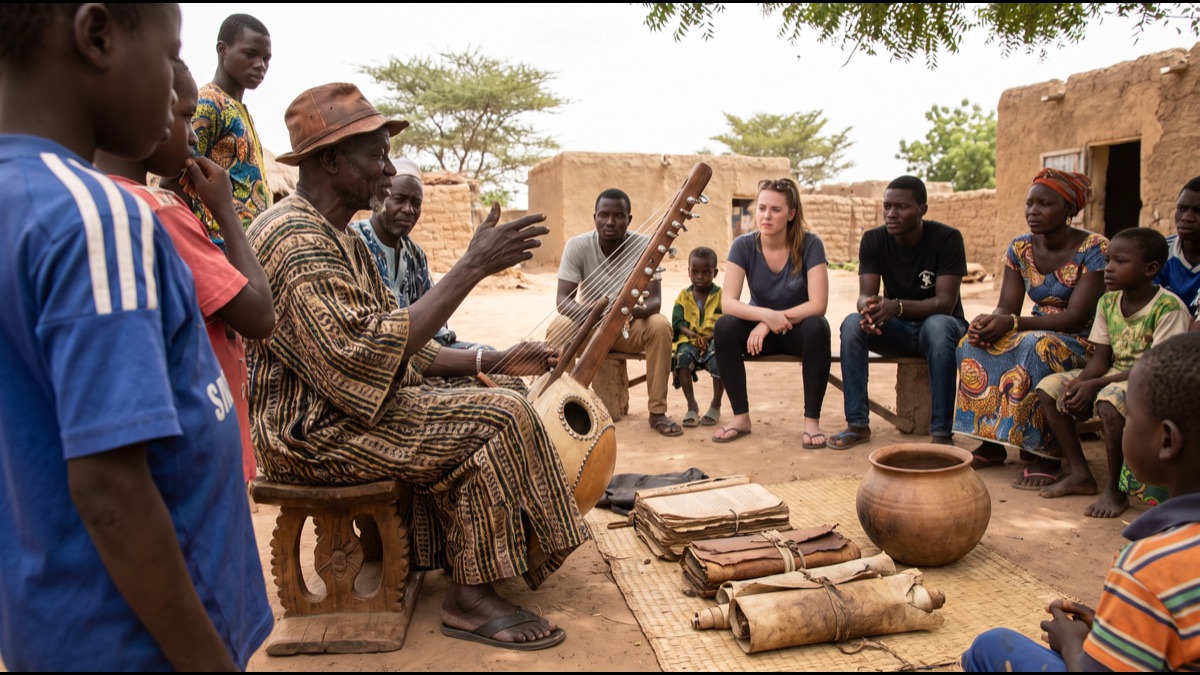
Long before West Africa had a single written archive, it had something arguably more resilient: a caste of professional memory-keepers whose entire life's work was to hold history inside their own minds. Known across the Mande-speaking world as griots, jeliw, or jaliw, these hereditary oral historians memorized centuries of genealogy, political history, praise poetry, and moral instruction, then transmitted it forward, performance by performance, generation by generation, with a precision that early European visitors frequently found difficult to believe.
Understanding the griot tradition means setting aside the assumption that a library needs shelves and paper to be real. For hundreds of years across what is now Mali, Senegal, Guinea, Gambia, and Burkina Faso, the most authoritative record of a kingdom's founding, a ruling family's lineage, or a battle's outcome did not sit in an archive. It sat in the trained memory of a specific person, from a specific family, who had spent a lifetime being prepared for exactly that responsibility.
A Caste Whose Job Was Memory Itself
Griots belong to a distinct hereditary social category within traditional Mande society, historically endogamous, meaning griots generally married within griot families, and occupationally specialized, meaning the role of preserving and performing history was not open to just anyone who showed talent or interest. You were typically born a griot, or you were not one at all.
This hereditary structure sits within a broader traditional caste system common across much of West Africa, which also included distinct hereditary categories for blacksmiths, leatherworkers, and free-born nobility and farmers. Griots occupied a genuinely peculiar social position within this structure: simultaneously essential and somewhat set apart, respected for their knowledge and skill while also viewed with a degree of social distance by the noble families whose histories they preserved.
The specialization was total. A griot family's entire multi-generational purpose was accurate, reliable transmission of history and genealogy, functioning collectively as something closer to a distributed, redundant archive than any single individual memory could achieve alone, since multiple griot lineages independently preserved overlapping accounts that could be cross-checked against one another.
Where the Griot Tradition Comes From
The griot tradition's precise origins are difficult to date with certainty, since by definition the earliest griots left no independent written record of their own beginnings, but oral tradition and available historical evidence place the tradition's clear establishment at least as early as the founding of the Mali Empire in the 13th century, and quite plausibly considerably earlier among predecessor Mande-speaking communities.
The tradition's geographic core sits within the historically Mande-speaking regions of West Africa, though griot-like hereditary oral-historian roles, under different local names, extended into neighboring Wolof, Fulani, and other West African cultural traditions as well, each adapting the core function of hereditary memory-keeping to their own social structure.
What makes the Mande griot tradition particularly well documented relative to comparable oral traditions elsewhere in the world is the sheer scale and formality of the institution: entire specific families, identifiable by surname, have functioned as griots for the same noble patron lineages across many consecutive centuries, a continuity that gives historians an unusually long and traceable oral record to work with.
Griots and the Rise of the Mali Empire
The most famous single piece of griot-transmitted oral history is the Epic of Sundiata, recounting the life of Sundiata Keita, the 13th-century founder of the Mali Empire. This epic survives today specifically because griot families preserved and performed it across roughly eight hundred years, and it remains one of the primary sources historians use to reconstruct the empire's founding.
Sundiata's own griot, a figure named Balla Fasseke in the tradition, is himself remembered as a central character within the epic, illustrating how deeply intertwined the griot's role was with the political history he preserved. Griots were not neutral outside observers recording events from a distance; they were embedded participants in the courts whose histories they carried forward.
This embeddedness gave griots genuine political significance well beyond simple record-keeping. A ruling family's legitimacy rested partly on its griot's public recitation of a lineage connecting the current ruler back to celebrated ancestors, meaning the griot functioned as something close to a living certificate of dynastic legitimacy, publicly renewed at ceremonies, coronations, and major state occasions.
How Training Began Almost at Birth
Becoming a fully accomplished griot required a training process that typically began in early childhood and continued for decades, under the direct instruction of a parent or senior relative already established within the family's griot lineage. A child born into a griot family would begin absorbing genealogies, historical narratives, and musical technique essentially as soon as they were old enough to listen and imitate.
The training emphasized precise verbatim reproduction of certain fixed elements, particularly core genealogical sequences and specific praise formulas, combined with considerable improvisational skill in weaving those fixed elements into a compelling live performance tailored to a specific patron, occasion, and audience. A skilled griot was therefore both a rigorous rote memorizer and a genuinely creative performer simultaneously.
Mastery was understood as a lifelong pursuit rather than something achieved at a fixed age. A griot in their sixties or seventies, having absorbed decades of additional performances, corrections, and refinements from elder griots throughout their own career, was generally regarded as considerably more authoritative than a talented younger griot still early in their own training.
What Griots Actually Recited
Griot performance repertoire extended well beyond simple genealogy recitation. Genealogies themselves, connecting a current patron back through named ancestors across many generations, formed a core and highly valued category, since establishing legitimate descent mattered enormously for political and social standing throughout the region.
Extended historical epics, of which the Epic of Sundiata is the best known internationally, preserved detailed narrative accounts of major political events, wars, and the deeds of celebrated historical figures, functioning as a region's primary transmitted historical record in the absence of comparable indigenous written chronicles.
Praise songs, composed and performed for a specific living patron, celebrated that patron's ancestry, deeds, and status, and functioned as an important form of social and political currency; a patron's public standing was measurably enhanced by prominent, skillfully performed praise from a respected griot, giving griots genuine soft power within courtly and social life well beyond their role as historians.
The Kora and the Musical Side of the Role
Music was never incidental to the griot tradition but structurally central to it. The kora, a distinctive 21-string bridge-harp built from a halved and dried calabash gourd covered with cow skin, is the instrument most closely associated with Mande griots internationally, though griot musical practice also commonly includes the balafon, a wooden xylophone, and the ngoni, a smaller plucked lute-like instrument considered an ancestor of the banjo.
Learning an instrument, typically inherited within the same family lineage alongside the oral repertoire itself, was treated as inseparable from learning the historical and genealogical content a griot would eventually perform, since the two were woven together in actual performance rather than delivered as separate spoken and musical components.
This musical dimension gives the griot tradition a continuing and increasingly visible modern legacy: numerous contemporary West African and West African-diaspora musicians trace direct family lineage to traditional griot families, and griot musical technique has demonstrably influenced broader West African popular music styles that have in turn shaped genres well beyond the region itself.
Griots as Diplomats and Political Advisors
Beyond preserving history and performing praise, griots frequently occupied genuinely functional political roles within traditional courts, serving as advisors, intermediaries, and sometimes formal diplomatic envoys precisely because their deep knowledge of regional genealogy and history made them uniquely equipped to navigate sensitive interpersonal and inter-lineage negotiations.
A griot's detailed knowledge of which families were historically allied, which held old grievances, and which specific ancestral connections might be diplomatically invoked in a delicate negotiation made griots valuable behind-the-scenes political operators, not merely performers brought out for ceremonial occasions.
This political dimension of the role meant that a ruler's personal griot was often among the most trusted and consistently present figures at court, present not just for formal recitations but for genuine ongoing counsel, a relationship of trust built and maintained across an entire multi-generational family partnership between the ruling lineage and their attached griot lineage.
How Reliable Is Oral Transmission Across Centuries
A natural and important question historians ask of any oral tradition is how accurately information actually survives transmission across many generations of purely spoken performance, without the fixed anchor of a written original text to check later versions against. Griot oral history is not immune to this general challenge.
Comparative scholarly analysis, cross-referencing griot accounts from different lineages performing about the same historical events, alongside available external written sources including Arabic-language chronicles from North African and West African Islamic scholars who documented some of the same history independently, generally finds griot accounts reliably accurate regarding major dynastic sequences and significant political events.
Scholars do note that finer details, particularly ones bearing on the relative prestige of a currently living patron family, can shift somewhat across generations in ways that subtly flatter the current patron, a limitation historians address by deliberately cross-referencing multiple independent griot lineages recounting the same underlying history rather than relying on any single family's version in isolation.
Why Griots Were Both Honored and Feared
The griot's social position carried a genuinely dual character that can seem contradictory to outside observers. Griots were indispensable and honored, essential to legitimizing rulers and preserving irreplaceable historical knowledge, yet simultaneously held at a degree of social distance within the broader caste hierarchy, occupying a status the anthropological literature sometimes describes as respected but not fully socially equal to free-born nobility.
Part of this complex standing stemmed directly from the sheer power griots held over reputation itself. A griot skilled in praise song was equally capable, in principle, of composing pointed, socially devastating satirical verse about a patron who had offended or failed to adequately compensate them, giving griots a form of reputational leverage that could inspire genuine wariness alongside genuine respect.
This dual reputation as both honored keeper of a family's legacy and potential source of public embarrassment if mishandled meant patron families generally worked hard to maintain a strong, well-compensated, mutually respectful relationship with their attached griot lineage across generations, recognizing that the relationship ran in both directions.
Colonialism and the Written-Word Challenge
European colonial administration across West Africa, beginning in earnest in the late 19th century, brought a written, bureaucratic administrative culture that frequently regarded oral tradition as inherently less credible or authoritative than written documentation, a bias that created real practical and reputational pressure on the griot tradition and on oral history generally.
Colonial-era ethnographers and administrators nonetheless increasingly recognized griots as an essential and irreplaceable primary source for regional history precisely because so little of it had ever been recorded in writing by anyone else, and much of the documented history of pre-colonial West African states that exists in academic literature today derives substantially from careful transcription and cross-referencing of griot testimony.
This colonial-era engagement, while extractive and imperfect in many respects, ultimately helped preserve a written record of griot testimony that supplements the ongoing living oral tradition, giving contemporary historians a somewhat unusual combination of both an active living oral tradition and a substantial archive of earlier transcribed griot accounts to compare against one another.
Griots in the Present Day
Griot families remain genuinely active across Mali, Senegal, Gambia, Guinea, and Burkina Faso today, with the tradition adapting rather than disappearing. Some griots continue in largely traditional roles, performing at weddings, naming ceremonies, and other significant community events much as their ancestors did.
Others have adapted the tradition into contemporary recorded music, and several internationally recognized West African musicians trace direct descent from established griot lineages, carrying elements of griot vocal style, instrumentation, and praise-singing structure into globally distributed popular music while often explicitly identifying their own family's griot heritage as central to their artistic identity.
The griot tradition today stands as a rare living example of an oral historical institution that has functioned continuously, in recognizable form, for roughly eight centuries, offering a genuine counterpoint to the common assumption that reliable long-term historical preservation requires writing. It required, instead, an extraordinarily disciplined institutional commitment to memory, performance, and generational transmission — and it worked.
Contemporary griot families also increasingly engage with digital preservation, recording performances on audio and video and archiving them alongside the oral tradition itself, a hybrid approach that griot communities have generally embraced pragmatically rather than viewing digital and oral transmission as somehow in competition with one another. A recorded performance supplements rather than replaces the living relationship between a griot and the patron family they serve, and most griot families continue prioritizing direct oral transmission to the next generation as the tradition's true backbone.
Researchers studying comparable oral-history institutions elsewhere in the world, from Polynesian navigator-historians to Vedic Sanskrit reciters trained in exact verbatim preservation across millennia, frequently cite the West African griot tradition as one of the best-documented and most institutionally sophisticated examples of a society deliberately building durable, checkable, cross-referenced historical memory entirely without reliance on writing, a genuine achievement worth taking seriously on its own terms rather than treating as a mere precursor to literacy.
Sources
- Wikipedia — overview of griot history, social role, and regional variation
- Encyclopaedia Britannica — background on West African oral history and the Mali Empire
- UNESCO — documentation on West African intangible cultural heritage and oral tradition
- Smithsonian Institution — musical and cultural context for kora, balafon, and griot performance
FAQ
What is a griot?
A griot, also called a jeli or jali in Mande languages, is a hereditary West African oral historian, musician, and genealogist responsible for preserving and reciting a community's history, lineage, and praise songs.
Is griot status inherited or chosen?
It is almost always inherited, passed down within specific endogamous families as part of a broader traditional caste system, with training beginning in early childhood under a parent or senior relative.
How accurate is griot-transmitted oral history?
Scholars find griot accounts reliably accurate on major dynastic and political events but note that details can shift over generations to flatter a current patron, a limitation historians correct for by cross-referencing multiple griot lineages and outside sources.
What instrument is most associated with griots?
The kora, a 21-string bridge-harp made from a halved calabash gourd, is the instrument most closely associated with Mande griots, though griot musical traditions also include the balafon and ngoni.
Do griots still exist today?
Yes, griot families remain active across Mali, Senegal, Gambia, Guinea, and Burkina Faso, with some members adapting the tradition into contemporary recorded music while others continue more traditional oral and ceremonial roles.
About the Author
We reference Wikipedia, Encyclopaedia Britannica, UNESCO, and the Smithsonian Institution to explain the background and current understanding of this topic.
Loved This Article?
Share it on WhatsApp → Share it on WhatsApp
Get more guides in your inbox — Subscribe to our newsletter for weekly surprising stories from Egypt, Saudi Arabia, Dubai, and beyond.