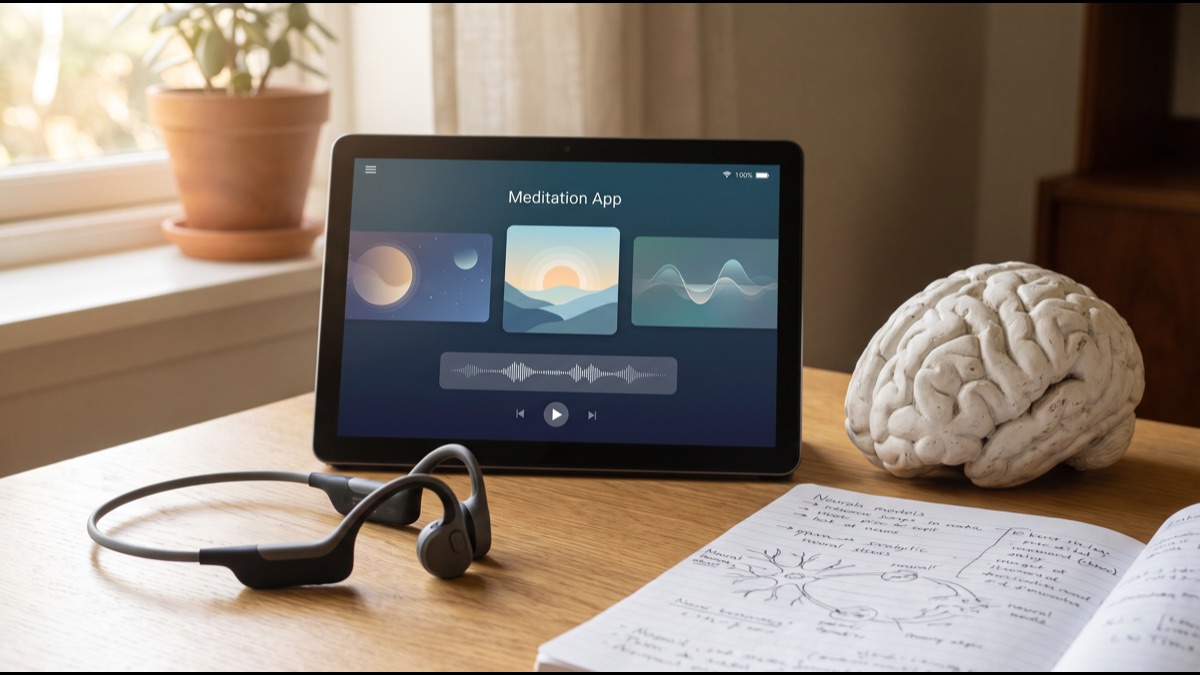
Meditation apps have turned a centuries-old contemplative practice into a five-minute daily habit tracked with streaks and push notifications. The pitch is simple: a calmer, more focused mind in the time it takes to drink a coffee, delivered through a phone screen rather than a monastery.
What actually happens inside the brain during and after that five minutes is a genuinely active area of neuroscience research, and the honest answer sits somewhere between the breathless marketing claims and the dismissive skepticism the wellness industry often attracts. Some effects are real and measurable; others are smaller, slower to appear, or simply less certain than either camp tends to admit.
What Meditation Apps Actually Promise
The major meditation apps generally promise some combination of reduced stress, improved focus, better sleep, and greater emotional regulation, typically achievable through short daily guided sessions ranging from three to twenty minutes. Marketing copy frequently cites neuroscience in general terms, referencing brain changes without always specifying which studies, doses, or populations those changes were observed in.
This vagueness is not necessarily dishonest, since summarizing a genuinely complex and still-developing research literature for a general audience is difficult, but it does mean the specific, testable claims worth examining are usually more modest than the overall impression the marketing creates.
What Brain Imaging Can and Cannot Show
Functional MRI and structural MRI studies of meditators have found differences in brain activity and, in some cases, measurable differences in gray matter density in regions associated with attention, interoception, and emotional processing, comparing experienced meditators to non-meditators or comparing brain scans before and after a training program.
These findings are genuine, but imaging research on meditation shares limitations common across neuroscience: sample sizes are often small, experienced meditators who volunteer for studies may differ from the general population in ways unrelated to meditation itself, and a difference observed in a scanner does not automatically translate into a meaningful difference in daily functioning.
Structural changes reported in some studies, often in regions like the hippocampus or prefrontal cortex, are generally small in absolute terms and observed after weeks to months of consistent practice, not after a handful of app sessions, a distinction the popular framing of this research frequently loses.
It is also worth noting that MRI research generally measures correlation rather than proving causation on its own; a properly randomized trial that assigns some participants to meditation and others to a comparable control activity, then scans both groups afterward, provides considerably stronger evidence than simply comparing people who already chose to meditate against those who did not, and the strongest studies in this field increasingly use that randomized design.
What Happens to the Default Mode Network
A frequently cited finding involves the default mode network, a set of interconnected brain regions active during mind-wandering, self-referential thought, and rumination, which tends to quiet down during focused meditation compared with an undirected resting state.
Because excessive activity in this network has been associated with rumination and some aspects of depression and anxiety, researchers have proposed that meditation's ability to dampen it may partly explain reported improvements in mood and reduced dwelling on negative thoughts, though this remains a proposed mechanism rather than a fully settled explanation.
Longer-term practitioners in some studies show altered default mode network connectivity even outside of active meditation, suggesting a possible lasting shift in baseline mental activity, though again this evidence comes primarily from experienced, often long-term meditators rather than casual app users.
Some researchers caution against treating default mode network suppression as straightforwardly good, since mind-wandering and self-referential thought also support creativity, autobiographical memory, and future planning, meaning the goal of meditation training is more accurately described as gaining voluntary control over when that network is active rather than permanently silencing it.
How Meditation Appears to Affect the Amygdala
The amygdala, a brain structure central to processing threat and fear, has shown reduced reactivity to stressful stimuli in several studies following meditation training, alongside reports of reduced self-reported stress and anxiety in the same participants.
This pattern is consistent with the idea that meditation practice may help recalibrate the brain's threat-detection system to be somewhat less reactive to non-dangerous stressors, a mechanism that would plausibly explain some of the stress-reduction benefits commonly reported by regular practitioners.
As with other imaging findings, the size of the effect and how long it persists after practice stops vary across studies, and most of this research involves structured programs of eight weeks or more rather than sporadic short sessions of the kind many app users actually complete.
What Changes in the Prefrontal Cortex
The prefrontal cortex, heavily involved in attention, planning, and regulating emotional responses generated elsewhere in the brain, shows increased activity and, in some structural studies, increased thickness in experienced meditators compared with non-meditators.
Stronger prefrontal engagement alongside reduced amygdala reactivity is often interpreted together as evidence for improved top-down emotional regulation, meaning the brain's more deliberative regions gain greater influence over its faster, more automatic threat responses.
This combination is a genuinely plausible neural explanation for why regular meditators frequently report feeling less overwhelmed by stressful situations, though establishing it as a proven causal mechanism, rather than a correlated pattern, requires the kind of large longitudinal studies that remain relatively rare in this field.
Why Dose and Duration Matter More Than Marketing Suggests
Most of the clinical and neuroimaging research showing meaningful effects involves structured programs, commonly modeled on Mindfulness-Based Stress Reduction, delivering 20 to 45 minutes of practice daily for eight weeks or more, considerably more time than the typical app session and considerably more consistency than most app users actually maintain.
App usage data consistently shows steep drop-off after the first few weeks, meaning the population actually completing enough practice to resemble the dose used in supportive research is a fairly small subset of total app users, which matters enormously when interpreting how representative published benefits are of a typical user's actual experience.
This does not mean shorter or less consistent practice provides no benefit, but the evidence for meaningful measurable effects becomes considerably thinner as session length and consistency drop below what controlled studies have actually tested.
Some apps have responded to this gap between real-world usage and research protocols by introducing longer structured courses spanning several weeks rather than isolated standalone sessions, an attempt to nudge typical usage patterns closer to the dose that supportive research actually evaluated, though whether most users complete these longer programs any more reliably than shorter sessions remains an open question.
What Clinical Trials Actually Find for Stress and Anxiety
Randomized controlled trials of mindfulness-based programs generally find moderate reductions in self-reported stress, anxiety, and depressive symptoms compared with waitlist or no-treatment control groups, with effect sizes broadly comparable to some other established interventions for mild to moderate symptoms.
Comparisons against active control conditions, such as relaxation training or exercise, tend to narrow but not eliminate the advantage for mindfulness-based approaches, suggesting genuine specific benefit beyond simply taking structured time to relax, though the margin over other legitimate self-care activities is often smaller than popular coverage implies.
Trials specifically evaluating consumer meditation apps, rather than intensive in-person programs, are a newer and smaller body of research, generally finding modest but real benefits for stress and sleep, with results that vary considerably depending on how the app was used and for how long.
Why App-Guided Practice Differs From In-Person Instruction
In-person mindfulness courses typically include live instructor feedback, group accountability, and structured discussion of difficulties that arise during practice, none of which a standalone app can fully replicate, even with high-quality guided audio.
Some research directly comparing app-based and in-person delivery finds apps can produce meaningful benefits, particularly for people who would not otherwise access any structured practice at all, while also finding somewhat smaller average effects than intensive in-person programs with trained instructors.
For many users the more realistic comparison is not app versus in-person course but app versus no structured mindfulness practice at all, a comparison in which apps generally perform favorably despite their limitations relative to the gold-standard research protocols.
Cost and access also matter here in a way that is easy to overlook in a purely scientific comparison: an in-person eight-week course with a trained instructor is considerably more expensive and time-intensive than a monthly app subscription, and for many people the realistic choice is not between the two delivery methods but between an app and nothing at all.
How Gamification Affects Engagement, Not Necessarily Outcomes
Streaks, badges, and daily reminders reliably increase how often people open a meditation app and how many consecutive days they log a session, a genuine and measurable behavioral effect that app designers deliberately engineer using well-established principles from behavioral psychology.
Whether this increased engagement translates into the higher-dose, sustained practice associated with the clearest neuroscience and clinical findings is a separate and considerably less certain question, since a short session logged primarily to preserve a streak may differ meaningfully in quality and depth from a session undertaken with full attention.
This distinction matters because app companies naturally track and report engagement metrics far more readily than they track clinically meaningful outcomes, which can create a gap between how successful a product appears by its own usage data and how much genuine benefit its average user is actually experiencing.
Why Some People Have Negative Experiences With Meditation
A minority of meditators, documented in clinical literature, report increased anxiety, intrusive thoughts, dissociation, or in rare cases more severe psychological distress during or after meditation practice, an outcome that receives far less attention in consumer marketing than the benefits do.
Sitting with attention turned inward can surface difficult emotions or memories that were previously avoided through distraction, and for people with certain trauma histories or underlying psychiatric conditions, this can be genuinely destabilizing rather than calming, which is part of why some clinicians recommend caution or professional guidance in specific circumstances.
This does not mean meditation is broadly unsafe, since adverse effects appear to affect a minority of practitioners, but it is a genuine and probably underreported part of the overall picture that a purely positive marketing narrative tends to omit entirely.
Some app developers have begun adding screening questions or content warnings before intensive practices for this reason, and mental health professionals increasingly recommend that people with a history of psychosis, severe trauma, or dissociative conditions consult a clinician before beginning an unsupervised meditation program, rather than assuming any guided app is automatically safe for every user regardless of psychiatric history.
What Publication Bias Means for the Overall Evidence Base
Like many areas of psychological and behavioral research, studies finding positive effects for meditation are more likely to be published, cited, and covered by media than studies finding null or negative results, a well-documented pattern across science generally known as publication bias.
Meta-analyses that specifically attempt to account for this, by searching for unpublished trials and applying statistical corrections for likely missing null results, tend to find genuine but more modest average effects than the raw published literature alone would suggest, without eliminating the evidence for benefit entirely.
This means a fair reading of the field supports real, replicated effects for stress and some aspects of attention and emotional regulation, at a more modest average magnitude than headline coverage of individual studies commonly implies.
Expectation effects also deserve mention here, since simply believing a practice will help can itself produce measurable improvement in self-reported outcomes, a phenomenon well documented across medicine generally and not unique to meditation; well-designed trials attempt to account for this using active comparison conditions, but it remains a genuine confound worth keeping in mind when reading any single study in isolation.
What a Realistic Expectation Actually Looks Like
The most defensible summary of the current evidence is that guided meditation, delivered consistently and for a meaningful daily duration over a period of weeks rather than days, produces real, moderate, measurable benefits for self-reported stress, some markers of emotional regulation, and in some studies detectable changes in brain activity and structure.
What the evidence does not support is the stronger version of the marketing claim, that a few minutes of occasional app use produces dramatic or rapid brain transformation, since the research supporting the clearest neural findings generally involves considerably more consistent and sustained practice than most app users actually complete.
Meditation apps have made a genuinely evidence-based practice more accessible than it has ever been, and the honest case for using one rests on real, replicated, if modest, effects, rather than on the more dramatic neuroscience claims that sometimes accompany their marketing, which is a good enough case on its own without needing the exaggeration. For someone deciding whether it is worth the daily minutes, the more useful question is not whether meditation apps work in some abstract sense, but whether a person is likely to actually sustain the consistent practice the supportive evidence is based on, since the technology itself is only ever as effective as the habit it manages to support.
Sources
- Wikipedia — overview of mindfulness-based stress reduction and related research
- U.S. National Institute of Mental Health — research on mindfulness, stress, and mental health interventions
- National Center for Complementary and Integrative Health — evidence summaries on meditation research
- American Psychological Association — clinical research on mindfulness-based interventions
- UK National Health Service — public guidance on mindfulness and mental wellbeing
FAQ
Do meditation apps actually change brain structure, or just how you feel?
Some imaging studies detect small structural and functional changes in regions involved in attention and emotional regulation after sustained practice, but effect sizes are generally modest and findings are not fully consistent across studies.
How much daily meditation is needed to see a measurable effect?
Most controlled studies use programs of 10 to 30 minutes a day over 8 or more weeks, and effects reported from much shorter or less consistent app usage in the real world have not been studied nearly as thoroughly.
Is app-guided meditation as effective as an in-person course?
Direct head-to-head comparisons are limited, but the available evidence suggests apps can produce meaningful benefits for stress and attention, generally somewhat smaller than intensive in-person programs with a trained instructor.
Can meditation apps make anxiety worse for some people?
A minority of practitioners report increased anxiety, intrusive thoughts, or dissociation during or after meditation, an outcome documented in clinical literature and one reason some experts recommend caution for people with certain trauma histories.
Do the streaks and reminders in meditation apps actually help people stick with practice?
Engagement features measurably increase short-term app usage, but whether they translate into the sustained, high-dose practice associated with the clearest research findings is much less established.
About the Author
We reference Wikipedia, the U.S. National Institute of Mental Health, the National Center for Complementary and Integrative Health, the American Psychological Association, and the UK National Health Service to explain the background and current understanding of this topic.
Loved This Article?
Share it on WhatsApp → Share it on WhatsApp
Get more guides in your inbox — Subscribe to our newsletter for weekly surprising stories from Egypt, Saudi Arabia, Dubai, and beyond.