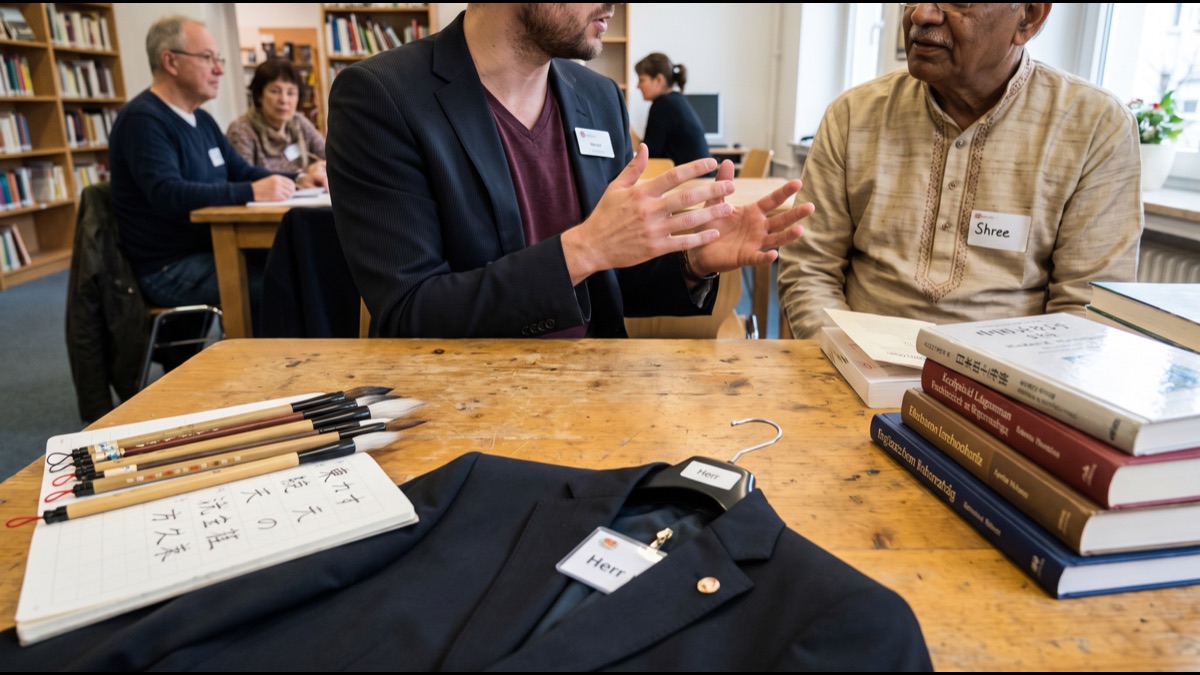
Address a Japanese colleague by their first name alone in a business meeting and you may unintentionally signal disrespect. Drop the honorific title before a Korean elder's name and the room may go quiet. Skip a formal title for someone senior in an Arabic-speaking workplace and you risk being read as careless rather than casual. None of these mistakes involve grammar in the way English speakers usually think of grammar. They involve honorifics, the small linguistic markers, titles, suffixes, and pronoun choices that encode who outranks whom, how much social distance is appropriate, and what kind of relationship two people actually have, and every language handles this differently enough that getting it wrong abroad is one of the most common and most quietly painful cross-cultural mistakes travelers and professionals make.
The Wrong Name Can Cost You a Relationship
Consider a foreign employee joining a company in Seoul who, following habits formed in a more informal workplace culture, begins addressing a senior manager by first name alone. To the employee, this might read as friendly directness. To colleagues raised within Korea's honorific system, it can register as a genuine breach of respect, the linguistic equivalent of skipping a greeting entirely.
This kind of mismatch happens constantly in an increasingly globalized workforce, and it rarely stems from malice. It stems from the fact that honorific systems are largely invisible to people raised outside them, precisely because a native speaker applies the correct form almost unconsciously, the way an English speaker automatically chooses "the" or "a" without consciously parsing grammatical rules.
Understanding why these systems exist, and how radically they differ across major world languages, is less about memorizing a list of polite words and more about understanding what honorifics are actually built to communicate in the first place: social structure, encoded directly into everyday speech.
What an Honorific Actually Encodes
At its core, an honorific is any linguistic device, a title, a suffix attached to a name, a specialized pronoun, or even an entirely different verb form, that signals the relative social position of the speaker and the person being addressed, along with the degree of formality or distance appropriate between them.
Linguists generally distinguish honorifics along a few key dimensions: relative social rank, such as age, seniority, or professional status, social distance, meaning how well the speakers know each other, and in-group versus out-group membership, meaning whether the person being addressed is part of the speaker's own family, company, or community.
Different languages weight these dimensions very differently. Some languages, like Japanese and Korean, encode all three dimensions deeply and pervasively throughout ordinary grammar, while others, like modern English, retain only faint traces of a system that was once considerably more elaborate.
Japan and the Grammar of Keigo
Japanese possesses one of the most extensively developed honorific systems among major world languages, known collectively as keigo, which is not a separate vocabulary layered on top of ordinary Japanese but a set of grammatical forms woven directly into verb conjugations, sentence structure, and vocabulary choice itself.
Keigo is generally divided into distinct categories: respectful language used to elevate the person being spoken about, humble language used to lower the speaker's own actions relative to the listener, and polite language used more generally to maintain formal distance, and a fluent speaker must choose the correct category based on the specific social relationship in play at that moment.
This system is taught explicitly and extensively in Japanese schools and corporate training programs precisely because mastering it takes years even for native speakers, and errors in keigo usage, particularly in professional or customer service contexts, are taken seriously enough that entire training industries exist around teaching it correctly to new employees.
Korea's Age-and-Rank Honorific System
Korean honorifics are built around a similarly intricate system, heavily influenced by Confucian social philosophy, in which age and hierarchical rank determine not just word choice but entire sentence endings, verb forms, and appropriate terms of address between virtually any two speakers.
Age in particular carries unusual social weight in Korean culture, to the point that it is common and socially expected for new acquaintances to establish each other's exact age relatively early in a relationship specifically in order to determine which honorific register to use going forward, a practice that can feel invasive to people from cultures where asking someone's age directly is considered impolite.
Korean also uses kinship-based honorific titles even between people who are not related by blood, such as calling an older woman a term equivalent to "older sister" or an older man a term equivalent to "older brother," extending family-style hierarchy and warmth into broader social and even commercial relationships.
Arabic Titles and the Weight of Formal Address
Arabic-speaking cultures maintain a rich system of honorific titles that draws on religious, professional, tribal, and educational status, with terms indicating respect for age, scholarly achievement, professional accomplishment, or social standing used prominently in everyday formal address.
Titles referencing educational or professional achievement, doctor, engineer, professor, are used with particular consistency and pride across much of the Arabic-speaking world, often retained in casual conversation long after the achievement itself, in a way that can feel more emphatic to outsiders than the equivalent titles function in many Western contexts.
Respect for age and family position also carries strong honorific weight, with kinship-style honorifics for elders and terms of respect for parents and grandparents used broadly even outside the immediate family, reflecting a cultural emphasis on family hierarchy and communal respect that extends outward into wider social interaction.
The European T-V Distinction
Many European languages retain what linguists call the T-V distinction, named after the Latin pronouns tu and vos, a grammatical split between an informal and a formal form of the word "you," used respectively for close relationships and for formal, distant, or hierarchical ones.
French, German, Spanish, and Russian, among many others, all maintain active T-V systems, and choosing the wrong form, using the informal pronoun with someone who expects formality, or maintaining excessive formality with someone who has signaled a wish to move to informal terms, carries real social weight and is a frequent source of visible discomfort in cross-cultural interactions.
The specific social rules governing when to switch from formal to informal address vary meaningfully by country and generation, with younger speakers in several European countries increasingly defaulting to informal address more quickly than older generations did, a shift that has itself become a subject of ongoing generational and cultural discussion.
Why English Feels "Honorific-Free" But Isn't Quite
Modern English is often described as having largely abandoned formal honorifics, having lost its own historical T-V distinction, the archaic "thou" was actually the informal form and "you" the formal one, centuries ago, leaving a single second-person pronoun used identically across every level of formality.
English nonetheless retains meaningful honorific-adjacent forms: titles like Mr., Ms., Dr., and Professor combined with a surname signal formality and respect, and the choice between using someone's title and surname versus their first name alone still carries real social information about the relationship between two speakers, even without dedicated grammatical machinery to enforce it.
This relative simplicity compared to languages like Japanese or Korean can make English speakers underestimate how much social information other languages pack into ordinary daily speech, sometimes leading to genuine surprise at how seriously honorific mistakes are taken in cultures where the system carries far more grammatical and social weight than English's comparatively minimal remnants.
South Asian Kinship Honorifics
Many South Asian languages and cultures extend kinship terms as honorifics well beyond biological family, using words equivalent to "older brother," "older sister," "uncle," or "auntie" to address strangers or acquaintances of an appropriate approximate age and gender, a practice that signals both respect and warmth simultaneously.
This system serves a somewhat different social function than the strictly hierarchical honorifics found in East Asian languages: it emphasizes social closeness and community belonging as much as it emphasizes relative rank, extending family-style warmth into interactions with shopkeepers, neighbors, or new acquaintances rather than purely marking status difference.
Visitors unfamiliar with this system sometimes find it initially confusing, since the kinship terms used carry no literal biological meaning in this context, but learning to use them appropriately is often considered an important marker of genuine cultural fluency and social integration rather than a merely optional politeness.
Professional Titles as a Global Honorific Layer
Beyond language-specific grammatical systems, professional and academic titles function as a near-universal honorific layer across cultures, with doctor, professor, engineer, and similar titles carrying social weight in nearly every language, though the intensity and consistency of their use varies considerably by culture.
Some cultures use professional titles almost exclusively in strictly formal settings, dropping them quickly once a working relationship becomes familiar, while others retain them consistently for years or even permanently, regardless of how close the personal relationship has become, reflecting differing cultural views on whether achieved status should continue to be marked explicitly in ordinary conversation.
This variation frequently causes cross-cultural confusion in international academic and business contexts, where a professional from a culture that drops titles quickly may unintentionally seem overly casual to a colleague from a culture that maintains them consistently, and vice versa.
Religious and Royal Honorifics
Religious contexts across many cultures maintain elaborate honorific systems for clergy, religious scholars, and figures of spiritual authority, systems that often predate and run parallel to secular honorific systems within the same language and culture, reflecting the deep historical entanglement between religious and social hierarchy.
Royal and aristocratic honorific systems, though diminished in most modern societies compared to historical practice, still persist in specific forms of address used for monarchs, nobility, and certain government officials in countries that retain these institutions, often preserving grammatical forms considered archaic in ordinary modern usage of the same language.
These specialized honorific registers illustrate a broader pattern: honorific systems tend to be conservative, preserving older forms of address for high-status or ceremonial contexts even as everyday informal language continues to evolve and simplify around them.
Why Getting an Honorific Wrong Feels So Personal
Sociolinguists studying politeness generally argue that honorific mistakes feel disproportionately personal, compared to other kinds of language errors like mispronunciation or grammar mistakes, because honorifics directly encode how one person is positioning another within a social hierarchy, rather than simply conveying neutral factual information.
A grammar mistake signals unfamiliarity with a language; an honorific mistake can be read, rightly or wrongly, as unfamiliarity with a relationship, or worse, as a subtle statement about how much respect the speaker believes the listener deserves, which is why honorific errors often produce a stronger emotional reaction than comparably minor grammatical slips.
This heightened sensitivity is precisely why native speakers of honorific-heavy languages generally extend considerable patience to visibly non-native speakers making these mistakes, correctly recognizing the error as a knowledge gap rather than a deliberate social slight, while still finding the mistake noticeable and worth correcting.
In-Group Versus Out-Group Marking
Many honorific systems, particularly in East Asian languages, encode not just individual social rank but group membership, shifting the honorific forms used depending on whether the person being discussed belongs to the speaker's own family, company, or team, or to an outside group.
This produces situations that can seem paradoxical to speakers of languages without this feature: a Japanese employee speaking to an outside client about their own company's president will typically use humble language about that president, even though the president outranks the employee, because relative to the external audience, both employee and president belong to the same in-group.
This in-group and out-group logic reveals that honorifics are not simply a fixed ranking of individuals but a relational system that shifts dynamically depending on who is speaking, who is being addressed, and who else is part of the conversation, a level of contextual complexity that makes these systems especially difficult for language learners to master.
Honorifics in the Digital and Workplace Era
Email, instant messaging, and workplace chat tools have introduced new friction points for honorific systems, since these formats often default to a casual register that can clash with cultural expectations around formal address, particularly in early professional relationships or communication with senior colleagues.
Some cultures have adapted relatively quickly, developing digital-specific conventions for maintaining appropriate honorific distance even in fast, informal-feeling chat formats, while others report more persistent friction, with older or more senior colleagues sometimes perceiving digital communication styles as insufficiently respectful regardless of their actual content.
This tension is an active and ongoing area of workplace communication research, since the informality that digital tools tend to encourage by design does not automatically map cleanly onto honorific expectations built for spoken, in-person interaction across a wide range of cultures.
Multinational Workplaces and Honorific Clashes
Multinational companies employing staff from honorific-heavy cultures alongside staff from more informal cultures frequently encounter friction around forms of address, with some employees feeling disrespected by casual first-name address while others feel uncomfortable or even alienated by what they perceive as excessive formality.
Some organizations have responded by developing explicit internal guidance around forms of address, particularly for multinational teams, aiming to reduce unintentional offense in either direction without forcing any single cultural norm onto the entire organization.
Cross-cultural management research generally recommends erring toward greater formality by default when uncertain, since excessive formality is typically read as merely overly cautious or unfamiliar with local customs, while excessive informality risks being read as genuinely disrespectful, an asymmetry that makes formality the safer default in unfamiliar cross-cultural situations.
Children Learning the System
Children raised within honorific-heavy languages typically begin acquiring the basic outlines of the system remarkably early, often before they fully understand the underlying social logic driving it, learning first through direct correction from parents and teachers and only gradually internalizing the broader social reasoning behind specific forms.
Full fluency in complex honorific systems like Japanese keigo or Korean age-based address is generally considered a skill that continues developing well into early adulthood, with even native speakers occasionally needing to consciously calculate the correct form in unfamiliar or ambiguous social situations rather than applying it purely automatically.
This extended acquisition timeline is itself evidence of how much social information these systems actually encode: a linguistic feature that takes native speakers decades to fully master is unlikely to be a simple matter of vocabulary, and is better understood as a genuinely complex social skill expressed through language.
Are Honorific Systems Simplifying Over Time?
Sociolinguists have documented gradual simplification in several honorific systems over recent decades, with younger speakers in a number of cultures reporting less strict adherence to traditional forms compared to older generations, a shift often attributed to increased social mobility, urbanization, and exposure to more informal international communication norms through media and travel.
This simplification trend is uneven and contested, however, with some linguists arguing that honorific systems are adapting and relocating to new contexts, such as workplace hierarchy, rather than genuinely disappearing, while others point to measurable declines in strict honorific usage among younger urban populations as evidence of a real, ongoing linguistic shift.
What seems clear across the available research is that even where honorific forms are simplifying, the underlying social need they serve, marking respect, distance, and relationship, does not disappear entirely; it tends to find new linguistic expression rather than vanishing outright, which suggests honorific systems in some form are likely to persist across most cultures for the foreseeable future, even as their specific grammatical machinery continues to evolve.
Practical Guidance for Cross-Cultural Address
For travelers and professionals navigating unfamiliar honorific systems, the most broadly useful strategy is to default to greater formality until explicitly invited to use a more casual register, since this error is consistently viewed more forgivingly across cultures than the reverse mistake of assumed familiarity.
Observing how local colleagues address each other, particularly across different apparent seniority levels, provides a faster and more reliable guide than relying purely on generic guidebooks, since actual local practice frequently reflects nuances that generic advice cannot fully capture.
Ultimately, honorific systems are not obstacles to communication so much as compressed maps of a society's social structure, encoding centuries of accumulated cultural logic about hierarchy, closeness, and respect into small linguistic choices made dozens of times a day. Learning to navigate them, even imperfectly, signals something that vocabulary and grammar alone cannot: a genuine effort to understand not just what people say to each other, but how they see each other, and that effort tends to be recognized and appreciated across nearly every culture that maintains such a system, regardless of how imperfectly a newcomer initially executes it.
Sources
- Linguistic Society of America — Research summaries on politeness theory and honorific systems.
- The Japan Foundation — Educational resources on keigo and Japanese sociolinguistics.
- Encyclopaedia Britannica — Reference background on honorific systems and forms of address across cultures.
- Cambridge University Press — Academic publishing on sociolinguistics and cross-cultural pragmatics.
- UNESCO — Resources on language, culture, and intangible cultural heritage.
FAQ
What exactly is an honorific?
An honorific is a title, suffix, or grammatical marker attached to a name or used in place of a name that signals respect, social distance, or the relative social position of the speaker and the person being addressed.
Why does Japanese have so many different honorifics?
Japanese grammar builds politeness and social hierarchy directly into verb forms and address terms through a system called keigo, reflecting a broader cultural emphasis on marking relative social position, age, and in-group versus out-group status in nearly every interaction.
Is it ever acceptable to use first names with older or senior people?
This varies enormously by culture and relationship: it is common and expected in many Western workplaces once a certain familiarity is established, while it can be read as disrespectful in cultures with strong honorific systems such as Korea, Japan, or many Arabic-speaking contexts unless explicitly invited.
What happens when honorific systems clash in multicultural workplaces?
Multicultural and multinational workplaces frequently see friction when employees from honorific-heavy cultures work alongside those from more informal cultures, and many companies have begun developing explicit norms or guidance to prevent unintentional offense in either direction.
Are English speakers really honorific-free?
English retains some honorific-like forms, including titles like Mr., Ms., Dr., and Professor, though English has lost the grammatical T-V distinction, the formal versus informal you, that many other European languages still actively use to mark social distance.
About the Author
We reference the Linguistic Society of America, The Japan Foundation, Encyclopaedia Britannica, Cambridge University Press, and UNESCO to explain the background and current understanding of this topic.
Loved This Article?
Share it on WhatsApp → Share it on WhatsApp
Get more guides in your inbox — Subscribe to our newsletter for weekly surprising stories from Egypt, Saudi Arabia, Dubai, and beyond.