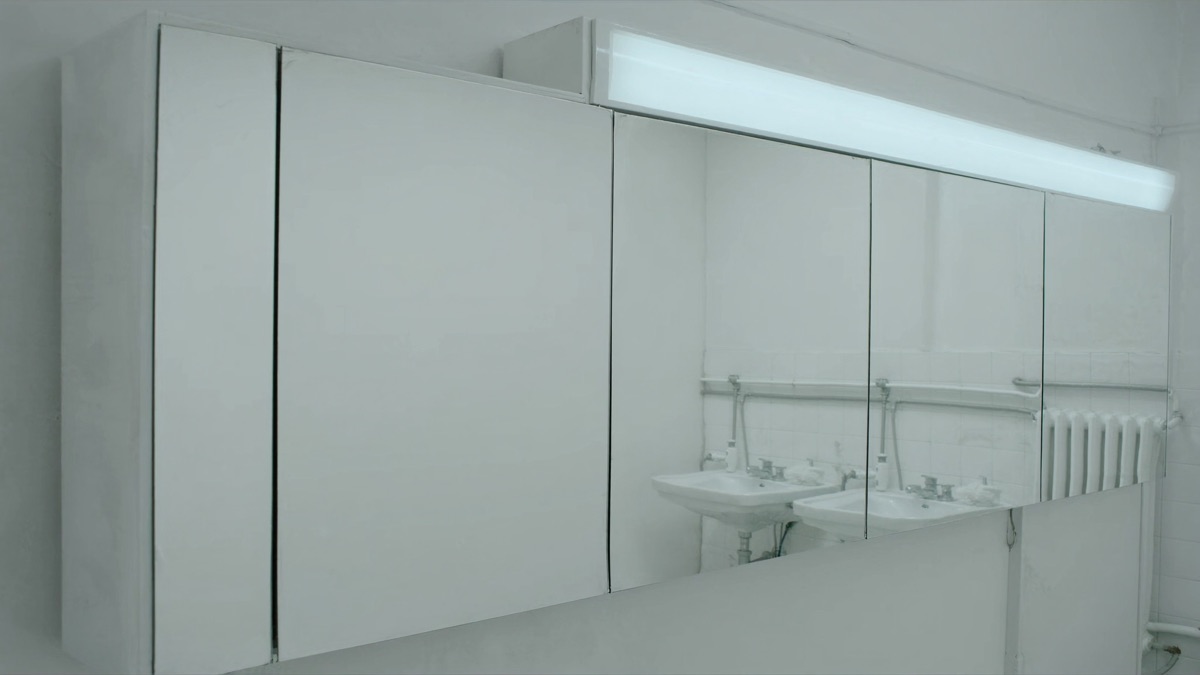
A household mirror works because a razor-thin layer of metal, usually aluminum or silver, sits behind a sheet of glass and reflects almost all the light that hits it at the same angle it arrived, a property physicists call specular reflection.
Why Glass Alone Does Not Make a Mirror
Plain glass reflects only a small fraction of light, typically around four percent at each surface, which is why a clean window barely shows a reflection in bright daylight and mostly lets light pass straight through instead.
To turn glass into a true mirror, manufacturers coat one side with a thin metallic layer that reflects the vast majority of incoming light, routinely above ninety percent for household mirrors and even higher for precision optical mirrors used in telescopes.
How the Reflective Coating Is Actually Applied
Most modern mirrors are made using a wet chemical process called silvering, where a silver nitrate solution is sprayed onto the back of a glass sheet and a chemical reaction deposits an extremely thin, even layer of metallic silver directly onto the glass.
That silver layer is then covered with a protective coat of copper and several layers of paint, which is why scratching the paint off the back of an old mirror eventually causes the silvering to tarnish and the reflection to develop dark spots.
The Law of Reflection That Makes Images Look Accurate
Every ray of light that strikes a flat mirror bounces off at exactly the same angle it arrived at, measured from an imaginary line perpendicular to the surface, a principle known as the law of reflection that has been understood since antiquity.
Because every point on your face sends out light in many directions, and the mirror reflects each of those rays at its own matching angle, your brain reconstructs a virtual image that appears to sit the same distance behind the mirror as you stand in front of it.
Why Mirrors Flip Left and Right but Not Up and Down
A mirror does not actually swap left and right at all; it reverses front and back, flipping whatever is closest to the mirror to appear farthest away, and it is the observer's own sense of orientation that interprets that front-back reversal as a left-right swap.
This becomes obvious with text: holding a printed word up to a mirror reverses each letter because the ink is on the side facing the mirror, but if you wrote the same word on a transparent sheet and viewed it from behind, no such reversal would occur.
Two-Way Mirrors Are Not Actually See-Through on One Side
A so-called two-way mirror is simply an ordinary mirror with a much thinner reflective coating than usual, one that reflects only about half the light hitting it and lets the other half pass through, rather than any special one-directional material.
The illusion that someone can see through it from only one direction depends entirely on lighting: the brightly lit room reflects enough light back to its occupants to see only their own reflection, while the dark room on the other side lets its dim light pass through the glass and become visible.
Curved Mirrors Bend the Rules on Purpose
Concave mirrors, curving inward like the inside of a bowl, can focus reflected light rays to a single point, which is why they are used in shaving mirrors and telescopes to magnify a close object or gather faint light from distant stars.
Convex mirrors, curving outward, spread reflected rays apart instead, producing a smaller image but covering a much wider field of view, which is exactly why they are mounted on the passenger side of cars and in shop security domes despite making objects look farther away than they really are.
Telescope Mirrors Demand Extraordinary Precision
A large astronomical telescope mirror must be ground and polished to an accuracy measured in nanometers, since even a tiny surface irregularity can blur or distort the extremely faint light gathered from objects millions of light-years away.
Because glass mirrors of that size are heavy and can sag under their own weight, engineers building today's largest telescopes often use segmented mirrors made of dozens of smaller hexagonal pieces, each individually adjusted by computer-controlled actuators many times per second to keep the combined surface perfectly aligned.
Why a Mirror Looks Slightly Different From a Direct View
The glass layer sitting in front of the reflective coating causes a very slight double reflection and a tiny amount of light scattering, which is part of why people often feel a mirror image looks subtly different from how they appear in photographs.
Psychologists also point out that people are simply far more used to seeing their own mirrored face than their true, unflipped face, so a photograph, which shows the true orientation, can look unexpectedly unfamiliar even though it is objectively more accurate.
Ancient Mirrors Were Made of Polished Metal, Not Glass
Long before silvered glass existed, people in ancient Egypt, China, and the Mediterranean world polished disks of bronze, copper, or obsidian to a high enough shine to produce a usable, if dim and often distorted, reflection.
Glass mirrors backed with metal only became widespread in Europe from the Renaissance onward, and Venetian glassmakers on the island of Murano became famous for producing unusually clear, flat mirror glass that was closely guarded as a valuable trade secret for generations.
How Smart Mirrors and Anti-Glare Coatings Work Today
Many modern bathroom and car mirrors add an anti-fog coating that either absorbs condensed water into a thin film instead of forming visible droplets, or uses a hydrophilic surface treatment that spreads moisture too evenly to scatter light and cloud the reflection.
Newer smart mirrors embed a thin, partially reflective screen behind the glass, using the same half-reflective principle as a two-way mirror to overlay digital information, like a weather forecast or a fitness display, directly on top of a person's own reflection.
The Night Setting on a Car Rear-View Mirror
Most car rear-view mirrors contain a wedge-shaped piece of glass, thicker at one edge than the other, with a small lever that tilts the whole mirror to switch between two internal reflective surfaces without the driver needing to touch the road-facing angle.
In day mode, the brighter front surface of the wedge dominates the reflection, but flipping the lever tilts the mirror so headlight glare from behind reflects off the dimmer back surface instead, cutting the intensity of following headlights to a fraction of their daytime brightness.
Why Makeup and Shaving Mirrors Magnify
A magnifying vanity mirror is simply a concave mirror with a shorter focal length than a flat mirror, curving inward enough that a face held close to it reflects an enlarged, upright virtual image rather than the true-to-size reflection a flat mirror produces.
Move too far from a strongly curved magnifying mirror, past its focal point, and the image flips upside down entirely, which is why these mirrors are only useful within a fairly narrow, close range and are usually mounted on an adjustable swing arm.
Infinity Mirrors Create the Illusion of Endless Depth
An infinity mirror places a two-way mirror in front of a fully reflective ordinary mirror with a ring of small lights sandwiched between them, so each reflection bounces back and forth repeatedly, each bounce slightly dimmer and appearing farther away than the last.
Because the light loses a little brightness at every bounce off the semi-reflective glass, the repeating reflections eventually fade into darkness rather than continuing forever, creating a convincing tunnel effect that is really just the same limited set of lights reflected dozens of times.
The Mirror Test and What It Reveals About Animal Cognition
Researchers use a mirror test to study self-awareness in animals, marking an animal with an odorless dot somewhere it cannot normally see and then observing whether it investigates the mark on its own body after glimpsing it in a mirror rather than reacting to the mirror as another animal.
Great apes, dolphins, elephants, and magpies have passed versions of this test, touching or investigating the mark on themselves, while many other species, including most monkeys, consistently treat their own mirror reflection as a rival or stranger rather than recognizing it as themselves.
Mirror Neurons Are Not Actually About Literal Mirrors
Despite the name, mirror neurons are brain cells that activate both when an animal performs an action and when it merely observes another individual performing that same action, a discovery made largely by accident in monkeys during unrelated motor-cortex research in the 1990s.
Scientists still debate exactly how large a role these neurons play in humans, but they are frequently discussed in relation to empathy, imitation learning, and understanding other people's intentions by mentally simulating their actions rather than through pure logical inference.
Periscopes and Submarines Rely on Angled Mirrors
A simple periscope uses two flat mirrors mounted parallel to each other at forty-five-degree angles inside a tube, so light entering the top mirror reflects downward to the bottom mirror and then straight out toward the viewer's eye, letting someone see over an obstacle or around a corner.
Modern submarine periscopes have largely replaced simple mirror arrangements with prism systems and digital camera masts for a clearer, more stable image, but the underlying optical principle, redirecting a line of sight through a sealed tube using reflective angled surfaces, remains conceptually the same.
Solar Power Plants Use Mirrors to Concentrate Sunlight
Concentrated solar power plants arrange thousands of large, computer-controlled mirrors called heliostats across an open field, each one continuously tilting throughout the day to track the sun and reflect its light onto a single fixed receiver tower.
The receiver at the top of the tower absorbs the combined reflected sunlight from every mirror at once, reaching temperatures high enough to boil water into steam and drive a turbine, generating electricity from concentrated light rather than photovoltaic cells.
Why Mirrors Feature So Heavily in Art, Architecture, and Superstition
Architects and interior designers use large mirrors to make small rooms feel more spacious by visually doubling the perceived depth of a space, a trick used since the mirrored halls of European palaces centuries ago to amplify the grandeur of a room using reflected candlelight.
Mirrors also carry deep superstition across many cultures, from the belief that breaking one brings seven years of bad luck to the practice of covering mirrors in a house of mourning, reflecting a long-standing folk association between a person's reflection and their soul or spirit.
Kaleidoscopes Use Mirrors to Multiply Simple Patterns
A kaleidoscope arranges two or three narrow mirrors at an angle inside a tube, so a handful of loose, colored beads or glass chips at one end gets reflected repeatedly into a symmetrical, multiplied pattern that appears to fill the entire viewing circle.
Turning the tube shuffles the beads and instantly reshuffles the entire reflected pattern, and because each mirror angle produces a mathematically different number of repeated segments, a kaleidoscope built with a sixty-degree mirror angle produces a six-fold symmetrical pattern rather than a random jumble.
Dental Mirrors Let Dentists See What They Cannot View Directly
A small angled dental mirror lets a dentist see the back and underside surfaces of teeth that are physically impossible to view directly with the naked eye from outside an open mouth, effectively extending their line of sight around a corner.
Some dental mirrors also include a built-in light source or a slight magnifying curve, combining the basic angled-reflection principle used in periscopes with extra optical power specifically suited to the tight, dim working space inside a patient's mouth.
Retail and Fashion Mirrors Are Often Deliberately Flattering
Some clothing store fitting-room mirrors use a very slight concave curve or an angled multi-panel arrangement specifically designed to make a customer's reflection look taller and slimmer than a perfectly flat mirror would show, a well-documented retail design trick.
Lighting placement matters just as much as the mirror's curvature, since overhead lighting tends to cast unflattering shadows while soft, evenly diffused side lighting near a mirror smooths out those same shadows, which is why store fitting rooms are lit very differently from a typical bathroom.
Sources
- Wikipedia — overview of mirror construction, silvering, and the physics of reflection
- Wikipedia — the physics of the law of reflection underlying how mirrors form images
- Encyclopedia Britannica — physics of mirror reflection and manufacturing
FAQ
Do mirrors actually flip left and right?
Not exactly; a mirror reverses front and back, and it is the viewer's own frame of reference that interprets that reversal as swapping left and right.
What material actually reflects the light in a mirror?
A thin metallic coating, usually silver or aluminum, applied to the back of a glass sheet, which reflects the vast majority of light that reaches it.
Why does plain glass barely show a reflection?
Untreated glass reflects only a small fraction of light at each surface, letting most of it pass through instead of bouncing back.
How do two-way mirrors actually work?
They use an unusually thin reflective coating that lets about half the light through, so a brightly lit room reflects back on itself while a dark room behind stays visible.
Why do convex mirrors make objects look farther away?
Convex mirrors spread reflected light rays outward across a wider field of view, which shrinks the apparent size of objects and makes distances harder to judge.
How precise do telescope mirrors need to be?
Extremely precise, often accurate to a few nanometers, since even tiny surface flaws can distort the faint light gathered from extremely distant objects.
Were early mirrors made of glass?
No; ancient civilizations polished metals like bronze and copper, or volcanic glass like obsidian, long before silvered glass mirrors became common.
Why can a mirror image look different from a photograph?
People are more used to seeing their own mirrored face than their true orientation, so an unflipped photograph can look subtly unfamiliar even though it is more accurate.
How does the night mode on a car mirror work?
A wedge-shaped mirror can be tilted to reflect headlight glare off a dimmer internal surface instead of the brighter one used during the day, cutting the intensity of following headlights.
Why do magnifying mirrors flip the image upside down at a distance?
A strongly curved concave mirror only produces an upright, enlarged image within its focal range; move past that point and the reflected image inverts entirely.
How does an infinity mirror create endless-looking depth?
Light bounces repeatedly between a two-way mirror and a fully reflective one, fading a little with each bounce until the repeating reflections disappear into darkness rather than continuing forever.
What does the mirror test measure in animals?
It checks whether an animal recognizes an odorless mark on its own body after seeing it in a mirror, which researchers treat as a sign of self-awareness in species that pass it.
Are mirror neurons about literal mirrors?
No; they are brain cells that fire both when performing an action and when watching someone else perform it, and the name is a metaphor rather than a description of an optical mirror.
How do periscopes use mirrors to see around corners?
Two flat mirrors angled at forty-five degrees inside a tube redirect a line of sight downward and then back out, letting a viewer see over an obstacle without exposing themselves.
How do concentrated solar power plants use mirrors?
Thousands of computer-controlled mirrors called heliostats track the sun and reflect its light onto a single receiver tower, generating enough heat to produce steam and drive a turbine.
Why do fitting-room mirrors sometimes make you look slimmer?
Some use a very slight concave curve or angled panels specifically designed to flatter the reflection, combined with soft, evenly diffused lighting that smooths out shadows.
About the Author
We reference Wikipedia and other authoritative sources to explain the background and current understanding of this topic.
Loved This Article?
Share it on WhatsApp → Share it on WhatsApp
Get more guides in your inbox — Subscribe to our newsletter for weekly surprising stories from Egypt, Saudi Arabia, Dubai, and beyond.