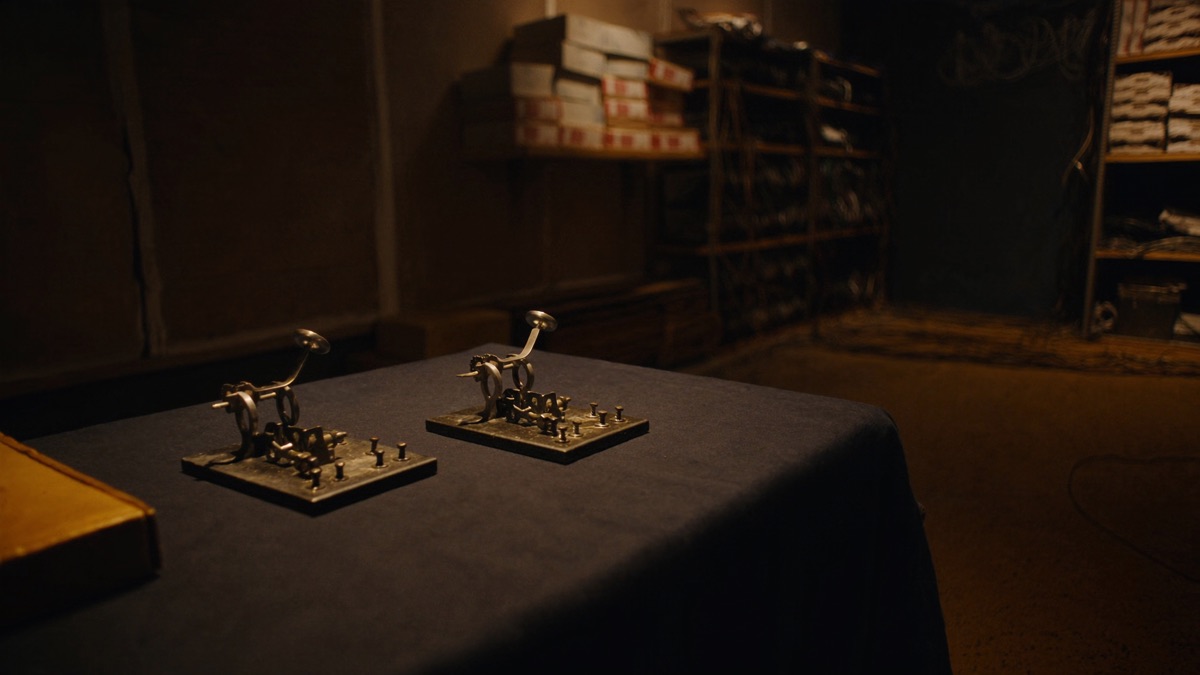
Morse code represents every letter, number, and punctuation mark using just two basic signal elements, a short pulse called a dot and a longer pulse called a dash, because early telegraph equipment could only reliably transmit a single on-off electrical circuit rather than the full range of tones or symbols a keyboard could produce. Reducing communication to timing differences in one simple signal made it possible to send messages over primitive wires and, later, radio, using equipment far simpler than anything capable of sending actual letter shapes.
Why Morse Code Uses Only Two Signal Types
A telegraph operator closes a switch to send electricity down a wire for a brief moment to create a dot, or for roughly three times as long to create a dash, and the receiving operator listens to a clicking sounder or reads marks on a paper tape to decode which pattern was sent.
This two-element system meant the entire alphabet, numerals, and common punctuation could be built from combinations of just dots, dashes, and the pauses between them, requiring no additional equipment beyond a simple switch and a length of wire.
How Samuel Morse and Alfred Vail Actually Designed the Code
Samuel Morse is credited as the code's namesake and the co-inventor of the electric telegraph system it ran on, but much of the actual code design, assigning specific dot-dash patterns to each letter, was worked out by his collaborator Alfred Vail.
Vail reportedly visited a local newspaper print shop to count how frequently each letter of the alphabet appeared in typeset text, then assigned the shortest, simplest codes to the most frequently used letters, a deliberate efficiency decision baked into the code's design from the start.
Why the Letter E Is Just a Single Dot
Because Vail's frequency analysis showed the letter E appears more often in English text than any other letter, he assigned it the absolute shortest possible code, a single dot, minimizing the time needed to transmit the single most common letter in the language.
By contrast, rarer letters like Q and Z received longer, more complex combinations of dots and dashes, since the time cost of a longer code mattered far less for letters that appeared infrequently in typical messages.
How Spacing Between Signals Actually Encodes Meaning
Morse code relies just as much on the length of silence between signals as it does on the dots and dashes themselves: a short pause separates the individual dots and dashes within one letter, a slightly longer pause separates complete letters, and an even longer pause separates whole words.
This timing-based structure means a skilled listener has to track not just the presence of a signal but its precise duration and the precise gaps around it, which is why Morse code proficiency takes real practice rather than simply memorizing which dots and dashes spell which letters.
Why International Morse Code Differs from the Original American Version
The Morse code widely used internationally today, including in amateur radio, is technically not the original code Vail designed, but a later revision called International Morse Code, standardized in the mid-1800s to simplify some of the more awkward original patterns for international telegraph use.
The original American Morse Code used variable-length dashes and internal spacing within some letters, distinctions that worked reasonably well over wired telegraph lines but proved harder to reliably transmit and receive over the radio equipment that later became the dominant medium for Morse communication.
How Morse Code Made the Transition from Wires to Radio Waves
When wireless radio telegraphy emerged in the early twentieth century, Morse code transferred naturally to the new medium because its dots and dashes could just as easily be represented by brief and longer bursts of a radio tone as by pulses of electricity down a wire.
This adaptability meant decades of accumulated telegraph infrastructure, trained operators, and code standards carried over directly into the radio era, giving Morse a substantial head start over any newly invented radio-specific signaling system might have had.
Why Ships at Sea Relied on Morse Code for So Long
Morse code radio transmissions could travel far greater distances with much less power than early voice radio, and could often still be understood through heavy static and interference that would make a spoken voice completely unintelligible, making it the preferred method for ship-to-shore distress communication for decades.
The distress signal SOS, chosen specifically because its pattern, three dots, three dashes, three dots, is simple, unmistakable, and easy to send even by an inexperienced or panicked operator, became internationally standardized specifically for maritime emergencies transmitted in Morse code.
How the Titanic Disaster Highlighted Both the Power and Limits of Morse Radio
The Titanic's wireless operators used Morse code distress calls to summon help after the ship struck an iceberg, and those transmissions are widely credited with enabling the rescue of hundreds of survivors who would otherwise have had no way to signal nearby ships in time.
The disaster also exposed serious gaps in the era's Morse radio practices, including some nearby ships whose wireless operators were off duty or asleep at the critical moment, findings that led directly to international regulations requiring round-the-clock radio watch on passenger vessels.
Why Learning Morse Code by Sound Works Better Than Memorizing Symbols
Experienced Morse operators do not consciously translate dots and dashes into letters the way a beginner reading a chart does; instead, they learn to recognize the rhythmic sound pattern of each letter as a single audible unit, similar to how a fluent reader recognizes whole words rather than sounding out individual letters.
This is why modern Morse code training methods emphasize listening practice from the very beginning rather than memorizing a chart of dot-dash patterns first, since operators who learn visually first often struggle later to convert that knowledge into real-time listening speed.
How Fast Can a Skilled Morse Operator Actually Communicate
Highly skilled operators can send and receive Morse code at rates upward of 40 words per minute, and competitive high-speed telegraphy events have recorded speeds well beyond that, figures that surprise people who assume Morse must be inherently slow because it lacks a full alphabet of distinct symbols.
At these speeds, individual dots and dashes blur together into a continuous, musical rhythm that only a trained ear can parse in real time, a skill that typically takes months or years of regular practice to develop reliably.
Why Amateur Radio Operators Still Use Morse Code Today
Despite being over 180 years old, Morse code remains popular among amateur radio hobbyists because it can be transmitted using extremely simple, low-power equipment and can often be understood through weak or noisy signals that would completely defeat voice communication.
Many amateur radio operators also describe an appreciation for the skill itself, treating Morse proficiency similarly to a musical instrument or a martial art, a discipline valued partly for its own difficulty and history rather than purely for practical necessity in an age of digital communication.
How Morse Code Requirements for Ham Radio Licenses Have Changed
For most of the twentieth century, obtaining an amateur radio license in many countries required passing a Morse code proficiency test, a requirement intended to ensure operators could use the mode reliably during emergencies when it might be the only communication method still working.
International regulators dropped the mandatory Morse requirement for amateur licenses in 2003, and many countries followed by removing it from their own licensing tests, though the code remains a popular optional skill many hams still choose to learn.
Why Morse Code Survived the Decline of Commercial Telegraphy
Commercial telegraph services largely disappeared through the late twentieth century as telephone networks, then digital communication, made point-to-point wired messaging obsolete for most practical business and personal use.
Morse code itself survived this decline not through commercial necessity but through niche communities, amateur radio, aviation navigation beacons, and military and maritime backup systems, that valued its unique combination of simplicity, reliability, and resistance to interference.
How Morse Code Is Used to Assist People with Disabilities
Because Morse code can be transmitted through any binary signal a person can reliably control, a single switch, a blink, a puff of breath, it has been adapted into assistive communication systems for people with severe physical disabilities who cannot speak or type conventionally.
Some assistive technology systems let a user spell out entire messages using only Morse-style long and short presses of a single button, which a computer then translates into text or synthesized speech, giving users with very limited motor control a genuinely usable communication channel.
Why Morse Code Signals Sometimes Appear in Popular Culture
Morse code occasionally appears in films, television, and music as a plot device or hidden message, partly because its visual and audible pattern is instantly recognizable even to audiences with no actual knowledge of the code, and partly because "tapping out a message" carries strong dramatic and historical resonance.
Musicians and artists have also embedded genuine Morse code messages into recordings and artwork as a kind of easter egg for attentive fans, relying on the code's durability as a cultural symbol of secret or urgent communication.
How Prosigns Extend Morse Code Beyond Letters and Numbers
Beyond the basic alphabet and numerals, Morse code includes special procedural signals called prosigns, short combined patterns representing operational instructions like "end of message" or "please stand by," that let operators manage the flow of a conversation without needing full words.
These prosigns function similarly to punctuation or control characters in written language, providing structure and turn-taking cues that keep a Morse conversation between two operators efficient and unambiguous even without any spoken words exchanged.
Why Morse Code Was Chosen for Early Deep-Space and Satellite Signals
Some of the earliest satellite transmissions, including the beeping signal from Sputnik, used simple repetitive tone patterns conceptually related to Morse-style signaling because such signals require minimal transmission power and can be detected and confirmed even with extremely weak, noisy reception.
This same principle, that simple binary-style signals survive weak and noisy channels better than complex ones, is why Morse-adjacent signaling concepts continued to influence early space communication design even as actual voice and digital data links became technically possible.
How Morse Code Compares to Modern Digital Encoding Concepts
Morse code is sometimes described by communication engineers as an early form of variable-length binary encoding, since it represents information using combinations of just two basic signal states, conceptually similar in structure, though far simpler, to how modern digital systems encode data as binary ones and zeros.
Vail's original decision to assign shorter codes to more frequently used letters also anticipated a core idea later formalized in modern data compression: assigning shorter representations to more common symbols and longer ones to rarer symbols to minimize the average length of transmitted data.
Why Learning Morse Code Remains a Popular Hobby Today
Beyond amateur radio, some hobbyists learn Morse code purely as a mental exercise or personal challenge, similar to learning a musical instrument or a new language, drawn by the sense of mastering a genuinely difficult skill with a long, storied history.
Online courses, smartphone apps, and dedicated practice communities have made learning Morse code more accessible than ever, letting new learners practice timing and rhythm recognition at their own pace without needing any actual radio equipment.
How Modern Emergency Systems Still Occasionally Rely on Morse-Style Signaling
While formal mandatory Morse requirements have been dropped from most professional and licensing contexts, some aviation navigation beacons still transmit their identifying call signs in Morse code, letting pilots confirm they are tuned to the correct beacon using equipment as simple as a basic radio receiver.
This lingering use reflects the same core advantage that kept Morse relevant for over a century: a signal simple enough to be generated, transmitted, and understood with minimal equipment remains valuable precisely because it has so few points of failure compared to more complex digital alternatives.
Why Morse Code Endures as a Symbol of Human Ingenuity in Communication
Nearly two centuries after its invention, Morse code remains a striking example of an elegant, minimal solution to a hard engineering problem, squeezing an entire alphabet's worth of information into combinations of a single simple signal and the silences around it.
Its continued use today, decades after it stopped being commercially necessary, speaks to how a genuinely well-designed system can outlive the specific technological constraints that originally shaped it, finding new relevance in hobbyist communities, accessibility tools, and niche technical applications long after its original purpose faded.
Sources
- Encyclopaedia Britannica — Morse Code
- American Radio Relay League — Morse Code
- History.com — Telegraph
FAQ
Why does Morse code use only dots and dashes instead of more complex symbols?
Early telegraph equipment could only reliably send a single on-off electrical signal, so reducing communication to timing differences in that one signal, dots and dashes, was the simplest way to transmit an entire alphabet.
Who actually designed the specific dot-dash patterns for each letter?
While Samuel Morse gave the code its name and co-invented the telegraph system, his collaborator Alfred Vail worked out most of the actual letter-to-pattern assignments.
Why is the letter E represented by just a single dot?
Vail analyzed letter frequency in typeset newspaper text and found E appeared most often, so he assigned it the shortest possible code to minimize transmission time for the most common letter.
How do operators know where one letter ends and another begins?
The length of silence matters as much as the signals themselves: a short pause separates dots and dashes within a letter, a longer pause separates letters, and an even longer pause separates words.
Is the Morse code used today the same as the original version Vail designed?
No; the internationally standardized version used today is a later revision called International Morse Code, created to simplify some of the original American Morse patterns for international telegraph use.
Why did Morse code transfer so easily from wired telegraphs to radio?
Its dots and dashes could be represented just as easily by brief and longer radio tone bursts as by electrical pulses on a wire, letting decades of telegraph infrastructure and training carry over directly.
Why was Morse code the preferred method for ship distress signals for so long?
Morse radio transmissions could travel farther on less power and remain understandable through heavy static that would make spoken voice unintelligible, making it ideal for emergency maritime communication.
Why was SOS chosen as the standard distress signal?
Its pattern of three dots, three dashes, three dots is simple, unmistakable, and easy to send correctly even by an inexperienced or panicked operator under pressure.
What did the Titanic disaster reveal about Morse radio practices?
While Morse distress calls helped rescue many survivors, the disaster also exposed gaps like nearby ships whose wireless operators were off duty, leading to regulations requiring round-the-clock radio watch on passenger ships.
Why is listening practice more effective than memorizing a Morse chart?
Experienced operators recognize each letter's rhythmic sound as a single audible unit rather than consciously translating symbols, similar to how fluent readers recognize whole words instead of sounding out letters.
How fast can skilled Morse operators actually communicate?
Highly skilled operators can exceed 40 words per minute, with competitive high-speed telegraphy events recording even faster speeds, figures that surprise people who assume Morse must be inherently slow.
Why do amateur radio operators still use Morse code today?
It can be transmitted with extremely simple, low-power equipment and often remains understandable through weak or noisy signals that would defeat voice communication entirely.
Is Morse code still required to get an amateur radio license?
No; international regulators dropped the mandatory Morse requirement in 2003, and most countries followed, though many hams still choose to learn it as an optional skill.
How did Morse code survive after commercial telegraph services disappeared?
It survived through niche communities like amateur radio, aviation navigation beacons, and military or maritime backup systems that valued its simplicity, reliability, and resistance to interference.
How is Morse code used to help people with disabilities communicate?
Because it can be sent through any binary signal a person can control, such as a single switch or blink, it has been adapted into assistive technology letting users with limited motor control spell out full messages.
What are Morse code prosigns used for?
Prosigns are special combined patterns representing procedural instructions like "end of message," letting operators manage conversation flow without needing full words, similar to punctuation.
Why did early satellites like Sputnik use simple tone signals similar to Morse concepts?
Simple, repetitive binary-style signals require minimal transmission power and remain detectable through extremely weak, noisy reception, an advantage that shaped early space communication design.
How does Morse code relate to modern digital data encoding?
It is considered an early form of variable-length binary encoding, and Vail's idea of assigning shorter codes to common letters anticipated a core principle later formalized in modern data compression.
Why do people still learn Morse code purely as a hobby today?
Many enjoy it as a mental exercise or personal challenge similar to learning a musical instrument, valuing the satisfaction of mastering a genuinely difficult skill with a long history.
Do any modern systems still rely on Morse code today?
Yes; some aviation navigation beacons still transmit identifying call signs in Morse code, letting pilots confirm the correct beacon using nothing more than a basic radio receiver.
About the Author
We reference Wikipedia and other authoritative sources to explain the background and current understanding of this topic.
Loved This Article?
Share it on WhatsApp → Share it on WhatsApp
Get more guides in your inbox — Subscribe to our newsletter for weekly surprising stories from Egypt, Saudi Arabia, Dubai, and beyond.