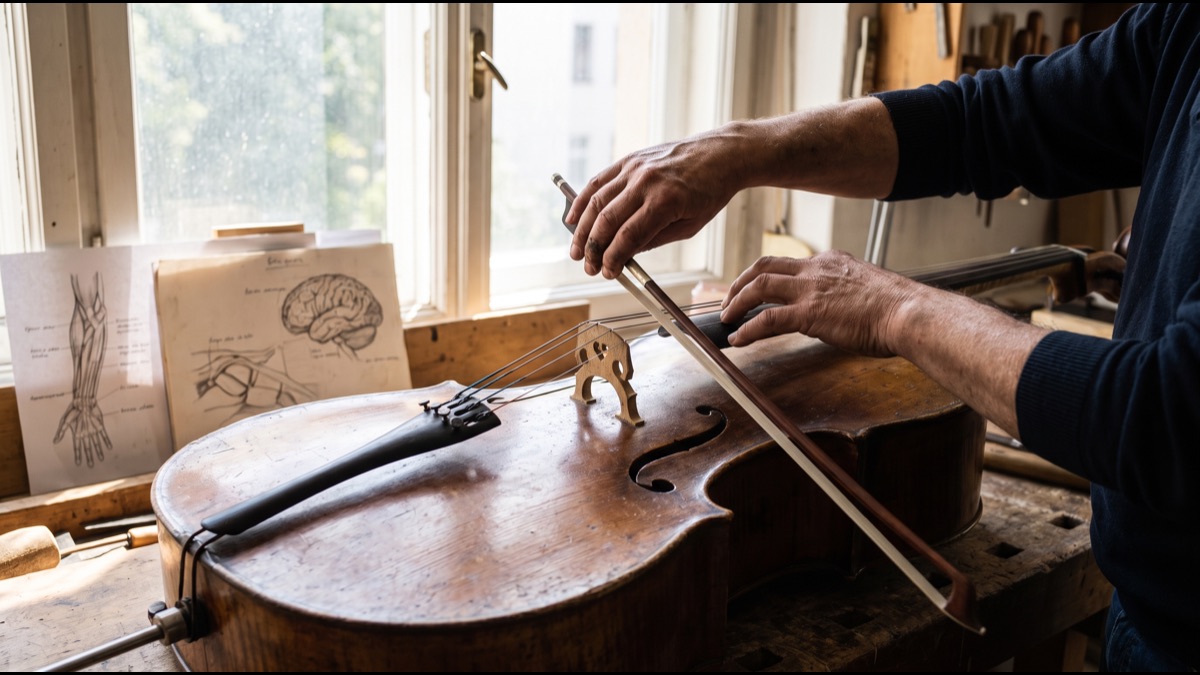
Ask a pianist to explain how their fingers know where to go and they will often struggle to answer, because the knowledge genuinely does not live in the part of the brain responsible for conscious explanation. What people casually call muscle memory is real, but the phrase itself is a slight misnomer, and understanding what is actually happening reveals a fascinating division of labor across the brain and spinal cord.
The muscles themselves do not store the choreography of a tennis serve or a typed sentence. They simply contract when instructed. The genuine memory lives upstream, in neural circuits that have been reshaped by repetition until a sequence that once required intense conscious effort can be executed almost instantly and with minimal attention.
Why "Muscle Memory" Is Actually a Misnomer
The term persists because it describes a real subjective experience: a well-practiced movement genuinely feels like it lives in the body rather than the mind. But neuroscientists classify this phenomenon as a form of procedural memory, a category distinct from the declarative memory used to recall facts and events, and procedural memory is stored almost entirely within the central nervous system rather than in muscle tissue.
This distinction matters because procedural and declarative memory rely on genuinely different brain structures and behave differently when damaged. Patients with severe amnesia who cannot form new declarative memories can often still learn new motor skills at a normal rate, improving session after session even though they have no conscious recollection of ever having practiced before.
That double dissociation, first documented rigorously in patients with hippocampal damage during the twentieth century, was one of the pieces of evidence that convinced researchers procedural learning uses an entirely separate memory system, one that does not require the hippocampus at all.
The Three Stages of Motor Learning
Researchers generally describe motor skill acquisition as passing through three overlapping stages. The first, often called the cognitive stage, is effortful and error-prone, requiring the learner to consciously think through each component of a movement, which is why a beginner driver must deliberately think about mirror checks, pedal pressure, and steering in a way an experienced driver never does.
The second, the associative stage, involves refining the movement and eliminating major errors as the brain begins linking the individual components into smoother sequences, gradually requiring less conscious monitoring as the pattern becomes more reliable.
The third, the autonomous stage, is where genuine "muscle memory" lives, in the everyday sense of the term. The skill becomes largely automatic, executable with minimal conscious attention, freeing up cognitive resources for other tasks, such as a skilled typist conducting a conversation while still producing accurate text.
How the Cerebellum Fine-Tunes Movement
The cerebellum, a densely packed structure at the back of the brain containing more individual neurons than the rest of the brain combined, plays a central role in refining movement timing and coordination. It continuously compares the movement that was intended against the movement that actually occurred, using sensory feedback from muscles and joints to detect even tiny discrepancies.
When a discrepancy is detected, the cerebellum adjusts the motor commands for the next attempt, a process that repeats across hundreds or thousands of repetitions until the error signal shrinks toward zero and the movement becomes reliably accurate without conscious correction.
Damage to the cerebellum characteristically produces movements that are correct in intention but poorly executed, overshooting targets, trembling during precise tasks, or losing the smooth timing that defines a well-learned skill, which illustrates just how much of the polish in a practiced movement depends specifically on this structure.
The Basal Ganglia and Automatic Habits
A separate set of structures deep in the brain called the basal ganglia handles a complementary function: converting a sequence of individual actions into a single automatic chunk that can be triggered as one unit rather than as separate deliberate steps.
This chunking process is why an experienced driver does not consciously plan "release clutch, then press accelerator, then check mirror" as three separate decisions, but instead executes an entire practiced sequence, like pulling out of a parking space, as one fluid unit triggered by a single intention.
The basal ganglia are also central to habit formation more broadly, and the same neural machinery that automates a tennis backhand automates far less desirable repeated behaviors, which is part of why breaking an ingrained habit is genuinely difficult even when a person consciously wants to stop.
What Actually Happens in Muscle Cells
While the choreography of a skill lives in the nervous system, physical training does produce real, measurable changes within muscle tissue itself, though these changes are about capacity rather than choreography. Repeated resistance training causes individual muscle fibers to grow larger, a process called hypertrophy, and increases the efficiency of the neuromuscular connections that deliver the nervous system's instructions to the muscle.
Training also improves what exercise physiologists call motor unit recruitment, the nervous system's ability to activate the right number and combination of muscle fibers for a given task, allowing a trained muscle to produce more coordinated force even before any change in raw muscle size becomes apparent.
None of this cellular adaptation constitutes the memory of the skill itself. A powerlifter with enormous muscle fibers still has to separately learn the technique of a clean and jerk; raw strength and coordinated skill are stored through entirely different biological mechanisms operating on different timescales.
Researchers studying elite athletes have also documented measurable changes in tendon stiffness and connective tissue that accompany years of specific training, changes that further separate physical capacity from skill retention. A gymnast's Achilles tendon, for instance, can develop mechanical properties tuned to repeated high-impact landings, a physical adaptation that persists independently of whether the specific choreography of a routine is remembered, and that itself takes months to partially reverse once training stops, on a timescale quite different from either neural skill memory or myonuclei retention.
Why Overlearned Skills Resist Forgetting
Skills practiced extensively over years, like riding a bicycle or swimming, become remarkably resistant to forgetting compared to skills practiced only briefly. The prevailing explanation is that heavy repetition shifts control of the skill deeper into subcortical structures, particularly the basal ganglia and cerebellum, which are more stable and less prone to interference from new learning than the cortical regions involved earlier in practice.
This is genuinely different from how declarative memories behave, since a fact learned once and never reviewed fades according to well-documented forgetting curves, while an overlearned motor skill can sit unused for decades and still be recovered with only a brief period of practice.
Researchers describe this durability as one of the most robust findings in the study of memory, and it explains the common observation that people who learned to swim or cycle as children rarely need extensive relearning as adults, even after decades without practicing at all.
The Myonuclei Discovery in Strength Training
A genuinely separate line of research has found that muscle cells themselves retain a form of physical trace from past training, distinct from anything happening in the nervous system. Skeletal muscle fibers are unusual in containing multiple nuclei, and intense strength training causes fibers to add additional nuclei as they grow.
When training stops and the muscle later shrinks through disuse, studies in animal models have found that many of these added nuclei persist for extended periods rather than being eliminated along with the reduced muscle mass, effectively leaving the fiber primed to regrow more quickly if training resumes later.
This finding, sometimes discussed under the informal label of cellular muscle memory, is a genuinely distinct phenomenon from the neural motor-skill memory described earlier in this article, involving actual physical retention within muscle tissue rather than a purely neural circuit, though research on how long this effect persists in humans specifically is still developing.
Why Skills Decay Slower Than They Were Learned
A consistent finding across motor learning research is that relearning a previously mastered but since-neglected skill takes measurably less time than the original learning did, even after a long gap without practice. This asymmetry, sometimes called savings, suggests the original neural changes are not fully erased by disuse but merely weakened.
Researchers studying savings have found measurable evidence of it even in cases where a person shows no conscious ability to perform the skill at all when tested cold, implying that some trace of the original learning persists below the threshold needed for immediate execution, only becoming apparent once practice resumes.
This partial persistence is part of why athletes returning from long injury layoffs, or musicians picking up an instrument after years away, typically describe technique returning faster than raw physical conditioning does, since the neural choreography was never fully lost even though the supporting fitness had to be rebuilt from a lower baseline.
Sleep's Role in Consolidating Motor Skills
Sleep plays a documented role in converting a freshly practiced motor skill into a more durable, stable form, a process researchers call consolidation. Studies comparing performance immediately after practice, before sleep, against performance the following day have repeatedly found measurable improvement attributable to sleep itself rather than additional practice.
This overnight improvement appears linked to specific patterns of brain activity during particular sleep stages, during which the brain appears to replay and reinforce the neural sequences activated during the day's practice, strengthening the relevant connections without any further physical repetition.
The practical implication, supported reasonably consistently across sports science and music pedagogy research, is that a night of adequate sleep genuinely functions as part of the learning process for a physical skill rather than merely a break from it, making sleep deprivation a real, measurable cost to skill acquisition.
Why Mental Practice Genuinely Helps
Vividly imagining the physical performance of a skill, without any actual movement, activates overlapping regions of the motor planning system compared with genuinely performing the movement, and a substantial body of research has found that structured mental practice measurably improves subsequent physical performance compared with no practice at all.
The effect is consistently smaller than physical practice and cannot fully substitute for it, since mental rehearsal provides no genuine sensory feedback about whether the movement actually succeeded, but it appears to meaningfully reinforce the planning and sequencing components of a skill even without physical execution.
This is part of why elite athletes in sports ranging from gymnastics to golf frequently incorporate structured visualization into training, and why rehabilitation programs for patients unable to physically move an injured limb sometimes include guided mental rehearsal as a genuine, evidence-supported component of recovery.
How Age Changes Motor Learning
Children and younger adults generally acquire new motor skills somewhat faster than older adults, though the difference is smaller and less consistent than popular belief suggests, and the capacity to learn genuinely new motor skills persists throughout life rather than disappearing after some fixed cutoff age.
What does change with age is often less about the learning capacity itself and more about processing speed, sensory acuity, and the accumulation of other health factors that indirectly affect motor performance, meaning an older adult given adequate practice time frequently reaches comparable proficiency to a younger learner, just via a somewhat different practice trajectory.
This is genuinely encouraging for adults taking up a new physical skill later in life, since the underlying neural mechanisms of procedural learning, the cerebellum's error-correction process and the basal ganglia's chunking of sequences, remain functional and responsive to practice well into older age in the absence of specific neurological disease.
Why Some Skills Interfere With Each Other
Practicing two similar but distinct motor skills in close succession can sometimes impair learning of both, a phenomenon researchers call motor interference. If the two skills share substantial overlap in the muscles and movement patterns involved but require conflicting timing or coordination, practicing one immediately after the other can degrade retention of the first.
This effect appears strongest when the second skill is practiced within a narrow window after the first, often within about an hour, suggesting the earlier skill's memory is still in a labile, easily disrupted state during that period before undergoing the stabilization that later practice and sleep provide.
Coaches and instructors who understand this effect often deliberately space practice of conflicting techniques further apart, or insert an unrelated activity or rest period between them, specifically to protect the consolidation window for the skill practiced first and avoid degrading it through premature interference.
What feels like a single seamless phenomenon called muscle memory is, on closer inspection, several distinct biological processes cooperating: cerebellar error-correction refining precision, basal ganglia chunking sequences into automatic habits, sleep-dependent consolidation stabilizing the day's practice, and in resistance training specifically, genuine physical retention within muscle cells themselves.
None of these systems live in the muscles in the way the popular phrase suggests, but together they explain why a skill built through years of deliberate practice can survive long periods of disuse and return with only a fraction of the original effort — the body genuinely does remember, just not quite where people assume it does.
Sources
- Wikipedia — overview of procedural memory and muscle memory research
- National Institutes of Health — research on motor learning and neuroplasticity
- Nature — peer-reviewed research on motor skill consolidation and myonuclei retention
- PubMed Central — published studies on cerebellar and basal ganglia function in motor learning
FAQ
Is muscle memory actually stored in the muscles?
Mostly no — the skill itself is encoded in the brain and spinal cord, though muscle cells do retain extra nuclei from past training that can speed up regaining lost strength, a genuinely separate phenomenon.
How long does it take to build muscle memory for a skill?
It varies enormously by task complexity, but consistent practice over weeks to months is typical for a skill to shift from effortful conscious control to fast automatic execution.
Can you lose muscle memory?
Fine motor skill memory degrades slowly and often partially returns faster than it was originally learned, because the underlying neural pathways are not fully erased, only weakened through disuse.
Why do old skills like riding a bicycle come back so quickly?
Highly overlearned skills recruit the basal ganglia and cerebellum so heavily that the pathway becomes resistant to forgetting, unlike skills that were only practiced briefly.
Does mental practice without physical movement help build muscle memory?
Yes to a meaningful degree — imagined movement activates overlapping motor planning regions of the brain, though it cannot fully substitute for physical repetition.
About the Author
We reference Wikipedia, National Institutes of Health, Nature, and PubMed Central to explain the background and current understanding of this topic.
Loved This Article?
Share it on WhatsApp → Share it on WhatsApp
Get more guides in your inbox — Subscribe to our newsletter for weekly surprising stories from Egypt, Saudi Arabia, Dubai, and beyond.