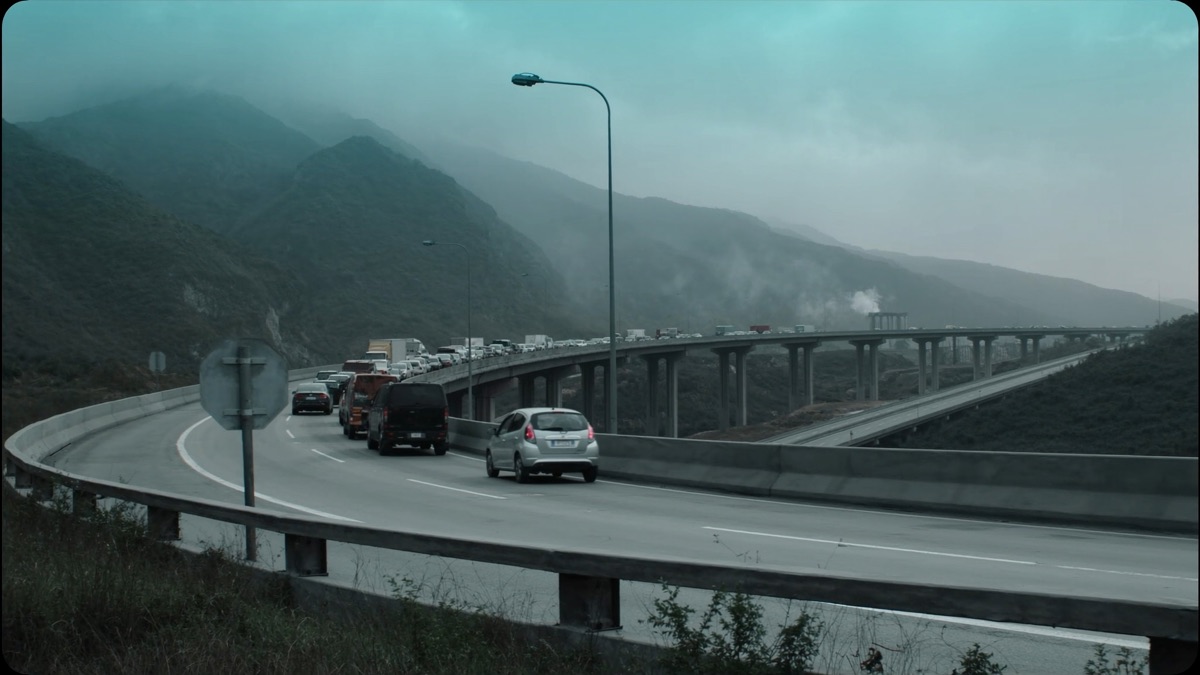
A Traffic Jam Doesn't Need a Cause to Exist
Most drivers assume every slowdown traces back to something concrete — an accident, a merging lane, a stalled car — but researchers have repeatedly demonstrated that dense highway traffic can grind to a complete stop with absolutely nothing blocking the road at all.
These are called phantom jams precisely because when drivers finally reach the front of the slowdown and expect to see wreckage or construction, they instead find open road and traffic that simply, mysteriously starts moving again.
One Small Brake Tap Is All It Takes to Start
In sufficiently dense traffic, a single driver tapping the brakes slightly harder than necessary — perhaps reacting to a truck changing lanes, or simply misjudging the gap ahead — forces the driver behind to brake somewhat harder still, just to maintain a safe following distance.
That second driver's slightly stronger reaction forces a third driver to brake harder yet again, and this small amplification repeating car after car is the entire seed from which a phantom jam grows, with no single driver doing anything unusually wrong.
Human Reaction Time Turns a Ripple Into a Wave
The average driver takes roughly 1 to 1.5 seconds to perceive a brake light ahead and respond by pressing their own brake, and that delay means each following driver reacts slightly later and often slightly more forcefully than the driver in front of them reacted.
Multiply that compounding overreaction across dozens of cars in close succession and what started as an imperceptible one-mile-per-hour slowdown at the front of the chain can escalate into cars braking to a full stop by the time the reaction reaches the back.
The Jam Physically Moves Backward Through the Traffic
Once the braking wave forms, it doesn't stay fixed at the location where the original small brake tap occurred — the wave propagates backward relative to the direction of travel, meaning the point of maximum slowdown continuously shifts to affect cars further and further behind the original trigger.
This backward propagation typically travels at around 20 kilometers per hour regardless of how fast traffic itself is moving, which is why a jam's front can be far behind where the original disturbance happened by the time a driver several minutes back finally hits the brakes.
Traffic Density Determines Whether a Ripple Dies Out or Grows
Below a critical density threshold, typically when cars are spaced with enough following distance to absorb small speed variations, a driver's minor brake tap simply dissipates as the cars behind smoothly adjust without needing to brake much at all.
Above that threshold, the same size of initial disturbance instead amplifies rather than dissipates, because there isn't enough following distance left to absorb the variation — traffic engineers call this the difference between stable and unstable flow, and it's the single biggest factor determining whether any given road will phantom-jam that day.
Highways Operate Dangerously Close to This Tipping Point by Design
Traffic planners generally want roads to carry as many vehicles as possible, which means highways are frequently operating right at or just below the critical density where flow transitions from stable to unstable — maximizing throughput but also maximizing vulnerability to phantom jam formation.
This is why phantom jams cluster heavily during rush hour rather than at moderate traffic volumes: at moderate density there's enough buffer for small disturbances to fade, but at rush-hour density the system sits right on the edge where any driver's momentary lapse can trigger a cascading wave.
Mathematicians Model This With the Same Equations as Fluid Dynamics
Traffic flow researchers borrow heavily from fluid dynamics, treating a stream of cars mathematically similar to water flowing through a pipe, where density, flow rate, and wave propagation follow comparable nonlinear equations even though cars are discrete objects driven by individual humans rather than a continuous fluid.
This modeling approach successfully predicts the exact conditions — density thresholds, following distances, reaction time ranges — under which small perturbations in traffic amplify into full stop-and-go waves, matching observed highway behavior closely enough that it's now standard in traffic engineering research.
A 2008 Experiment Proved Phantom Jams in a Closed Loop With No Merging Traffic
Japanese researchers demonstrated the phenomenon unambiguously by having a group of drivers circle a closed circular track at a constant target speed with no lane changes, merges, or external traffic allowed to interfere with the experiment at all.
Despite every driver trying to maintain even spacing and speed, a stop-and-go wave spontaneously formed and persisted around the loop purely from the accumulation of small human reaction-time variations, definitively proving that no external cause — no accident, no merge, no obstacle — is needed to generate the phenomenon.
Following Too Closely Isn't Aggressive Driving — It's the Root Mechanism
Tailgating is often framed purely as a safety or courtesy issue, but from a traffic-flow perspective it's the direct mechanical cause of jam amplification: shorter following distances leave less buffer space to absorb a leading car's speed change without braking hard in response.
A driver who deliberately maintains extra following distance effectively acts as a shock absorber for the traffic stream behind them, smoothing out the speed variation of the car ahead rather than passing an amplified version of it backward to the next driver.
Autonomous Vehicles Are Explicitly Being Designed to Dampen These Waves
Because self-driving systems can react to a lead vehicle's speed change in milliseconds rather than the roughly one second a human needs, and can maintain more mathematically consistent following distances than human drivers typically do, they have the theoretical potential to actively dampen rather than amplify traffic disturbances.
Real-world experiments placing even a small percentage of autonomous or semi-autonomous vehicles with adaptive cruise control into regular traffic have shown measurable reductions in stop-and-go wave severity, since these vehicles smooth out their own speed response instead of contributing to the amplification chain.
Merging Traffic Doesn't Cause Jams — It Just Provides a Convenient Trigger Point
On-ramps and lane merges are commonly blamed for creating slowdowns, and they do frequently correlate with jam locations, but the underlying reason is that merging simply forces a brief, sharp local increase in density and braking exactly at the point where the traffic system is already sitting closest to its unstable threshold.
Remove the merge entirely and sufficiently dense highway traffic can still spontaneously jam elsewhere along a completely uniform stretch of road, which is exactly what the closed-loop experiment demonstrated — merges are a common trigger, not the underlying cause.
Truck-Heavy Traffic Amplifies the Effect Further
Large trucks accelerate and decelerate more slowly than passenger cars due to their mass and engine characteristics, and drivers behind a truck often can't see far enough ahead past it to anticipate upcoming speed changes, both of which increase reaction delay and braking severity in ways that worsen wave amplification.
Traffic sections with a higher proportion of trucks statistically show more frequent and more severe phantom jams for exactly this combined reason, independent of the total number of vehicles on the road at any given moment.
Weather Doesn't Create New Jams So Much As Lower the Threshold for Them
Rain, fog, or reduced visibility don't introduce a fundamentally different jam mechanism, but they do make drivers react more cautiously and brake earlier and harder to the same size of disturbance, which effectively lowers the traffic density at which the system tips from stable into unstable flow.
This is why the same stretch of highway that flows smoothly at a given traffic volume on a clear day can phantom-jam at that identical volume once visibility drops or the road surface becomes wet, without any actual change in the number of cars present.
Variable Speed Limit Systems Try to Prevent the Tipping Point From Being Reached
Some highways now use overhead electronic signs that dynamically lower posted speed limits during high-density periods, a counterintuitive intervention that actually increases total traffic throughput by keeping vehicles moving at a slower but more stable, evenly-spaced speed rather than letting density creep toward the unstable threshold.
By smoothing speed variation across the entire stretch of road before a disturbance can amplify, these systems can prevent phantom jams from forming in the first place rather than trying to clear them once they've already started, and several countries have measured meaningful reductions in jam frequency after installing them.
A Jam Can Persist Long After the Triggering Density Has Dropped
Once a stop-and-go wave has fully formed, it can continue propagating backward and cycling through the traffic stream even after the road ahead has cleared and overall density has fallen back below the original unstable threshold, because the wave has essentially become a self-sustaining pattern independent of its original trigger.
This lag between cause and resolution is part of why drivers stuck in a phantom jam often can't understand why traffic remains stopped well after they can see open road not far ahead — the jam is a moving structural pattern in the traffic itself, not a fixed obstruction tied to a specific location.
Individual Driving Style Measurably Changes Jam Severity
Studies using instrumented vehicles inserted into real traffic have shown that a single driver deliberately maintaining smooth, gradual acceleration and braking, rather than reacting sharply to every small speed change ahead, can noticeably reduce the amplitude of a developing stop-and-go wave for the traffic behind them.
This finding has directly influenced eco-driving and traffic-calming public education campaigns, which frame smooth driving not just as fuel-efficient but as an active contribution to reducing congestion for every driver following behind, even though the smooth driver personally experiences no immediate benefit from their own restraint.
GPS Navigation Apps Can Unintentionally Worsen the Problem
When traffic apps detect a developing slowdown and reroute a large number of drivers onto an alternate road simultaneously, that sudden influx can push the alternate road's own density past its stability threshold, effectively exporting a phantom jam from one road to another rather than eliminating it.
Traffic engineers have specifically studied this side effect of mass real-time rerouting, since a solution that works well for a small number of individual drivers can create new instability when applied simultaneously at the scale modern navigation apps operate at.
Why You Can Never See the Cause From Inside the Jam
Because the wave propagates backward through the traffic while cars themselves continue moving forward relative to the road, a driver sitting inside a phantom jam is physically located far from wherever the original triggering brake tap actually happened minutes earlier — the cause has already moved on, structurally, by the time any given driver experiences the slowdown.
This spatial mismatch between cause and experienced effect is precisely why the phenomenon feels so mysterious to drivers stuck in it, even though traffic engineers can model and predict exactly when and where it will occur given density, speed, and following-distance data for a given road.
The Only True Fix Requires Changing the System, Not Individual Blame
Because phantom jams emerge from the aggregate mathematics of density and reaction time rather than from any single driver's mistake, punishing or blaming individual drivers for triggering one misunderstands the mechanism entirely — the same driver's identical brake tap would have caused no problem at all in less dense traffic.
Effective interventions instead target the system-level conditions: variable speed limits, increased following distance encouragement, adaptive cruise control adoption, and smarter rerouting algorithms all work by nudging the underlying density and reaction-time variables rather than trying to identify and penalize whichever driver happened to brake first.
Sources
- Wikipedia: Phantom traffic jam — Overview of stop-and-go wave formation without a discrete cause.
- Wikipedia: Traffic flow — Mathematical modeling of vehicle density, speed, and shockwave propagation.
- MIT News: The physics of traffic jams — MIT research news coverage of phantom traffic jam formation.
FAQ
Can a traffic jam form with no accident or obstacle at all?
Yes; researchers have demonstrated that dense traffic can spontaneously grind to a stop purely from small braking overreactions compounding between drivers, with no crash, merge, or blockage required.
What actually triggers a phantom traffic jam?
A single driver braking slightly harder than necessary forces the driver behind to brake harder still, and this small amplification repeating car after car is the entire seed a phantom jam grows from.
Why does the jam move backward relative to traffic direction?
The braking wave propagates backward at roughly 20 km/h regardless of overall traffic speed, continuously shifting the point of maximum slowdown to affect cars further behind the original trigger.
Does traffic density determine whether a jam forms?
Yes; below a critical density there's enough following distance to absorb small speed variations, but above it the same disturbance amplifies instead of dissipating, tipping flow from stable to unstable.
Was a phantom jam ever proven in a controlled experiment?
Yes; a 2008 experiment had drivers circle a closed track with no merges or obstacles, and a stop-and-go wave still formed spontaneously purely from human reaction-time variation.
Why do phantom jams happen mostly during rush hour?
Rush-hour traffic density sits right at the unstable threshold where highways are designed to maximize throughput, leaving little buffer for small disturbances to dissipate before they amplify.
Does following too closely actually cause worse jams?
Yes; shorter following distances leave less buffer to absorb a leading car's speed change without hard braking, directly amplifying the wave passed backward to following drivers.
Can self-driving cars reduce phantom traffic jams?
Yes; their faster reaction time and more consistent following distances let them dampen rather than amplify speed disturbances, and real-world tests show measurable improvement even with a small percentage of such vehicles.
Do highway merges actually cause traffic jams?
Merges are a common trigger because they briefly spike local density right where traffic is already near its unstable threshold, but they aren't the underlying cause — uniform stretches of road can jam too.
Why do trucks make phantom jams worse?
Trucks accelerate and decelerate more slowly, and cars behind them can't see far enough ahead to anticipate speed changes, both of which increase reaction delay and braking severity.
Why does rain make traffic jam more easily?
Rain doesn't create a new jam mechanism, but it makes drivers brake earlier and harder for the same disturbance, effectively lowering the density threshold at which flow becomes unstable.
How do variable speed limit signs prevent jams?
They dynamically lower speed limits during high-density periods, keeping traffic moving at a slower but more evenly-spaced pace that prevents density from reaching the unstable tipping point.
Can a jam persist after the road ahead has cleared?
Yes; once a stop-and-go wave forms it can keep propagating and cycling through traffic even after density has dropped, because it becomes a self-sustaining pattern independent of its original trigger.
Can one driver's smooth driving actually reduce congestion for others?
Yes; studies with instrumented vehicles show a single driver maintaining gradual acceleration and braking noticeably reduces the amplitude of a developing wave for traffic behind them.
Can navigation apps make traffic worse by rerouting drivers?
Yes; mass simultaneous rerouting onto an alternate road can push that road's density past its own stability threshold, effectively exporting the jam rather than eliminating it.
About the Author
We reference Wikipedia and other authoritative sources to explain the background and current understanding of this topic.
Loved This Article?
Share it on WhatsApp → Share it on WhatsApp
Get more guides in your inbox — Subscribe to our newsletter for weekly surprising stories from Egypt, Saudi Arabia, Dubai, and beyond.