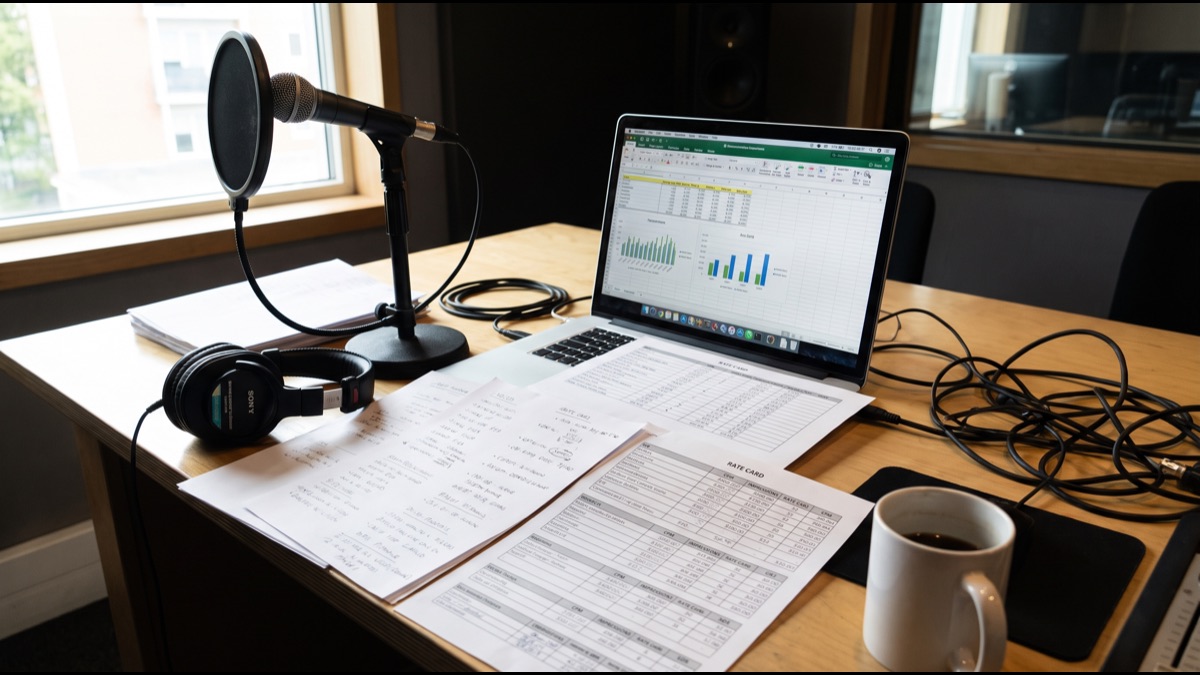
A single 60-second ad read on a mid-sized podcast can cost more per listener than a national television spot, and almost nobody outside the industry knows why. Podcast advertising runs on a pricing model borrowed from old-school radio and print, but the way that model actually gets applied, negotiated, and measured has turned into something far stranger and more fragmented than most advertisers expect when they first go looking for a rate card.
The unit everyone quotes is CPM, cost per mille, meaning the price an advertiser pays for every one thousand downloads an episode receives. It sounds simple on paper, and it is the number every media kit leads with, but CPM in podcasting hides an enormous amount of variation depending on who reads the ad, where in the episode it airs, how the download itself was actually counted, and whether the ad can ever be changed once it has shipped.
Unlike a banner ad that gets served fresh on every page load, or a pre-roll video ad that a platform can swap out in real time, a podcast ad is frequently recorded directly into the audio file itself, permanently, by the host, in the host's own voice. That single production choice explains most of what makes podcast ad pricing behave so differently from every other digital ad format advertisers are used to buying.
Understanding how the price actually gets set means separating several distinct questions that outsiders tend to collapse into one: how the CPM number is calculated, why it runs higher than comparable formats, why placement within an episode changes the price so much, why the underlying download count is such shaky ground to build a rate on, and how the industry has built workarounds, from affiliate codes to dynamic insertion technology, to patch the gaps that a simple download count leaves wide open.
How CPM Became the Core Unit of Podcast Ad Pricing
CPM stands for cost per mille, using the Latin word for thousand, and it means exactly what it says: the price an advertiser pays for every one thousand downloads of the episode carrying their ad. A show quoting a $20 CPM on a pre-roll spot and receiving 50,000 downloads for that episode would charge an advertiser roughly $1,000 for that single placement.
The model was inherited directly from radio and magazine advertising, where it made straightforward sense because audience measurement companies could plausibly estimate how many people actually saw or heard a given spot. Podcasting adopted the same unit largely because advertisers already understood it and because no better alternative had gained industry-wide traction by the time podcast advertising started attracting serious ad budgets.
What CPM does not capture, and what makes podcast pricing so much messier than the formula implies, is that a download is not a listen, a listen is not full attention, and full attention does not guarantee the ad message actually landed. Every one of those gaps gets priced into the number somewhat informally, through negotiation and reputation, rather than through anything the CPM figure itself can show.
Why Podcast CPMs Run Higher Than Display or Video Ads
Display banner CPMs on the open web frequently sit in the low single digits to low double digits of dollars, and even premium video pre-roll ads rarely clear $30 to $40 CPM outside of highly targeted campaigns. Podcast CPMs, by contrast, routinely run from $18 to $50 for host-read spots, and shows with devoted, high-income, or hard-to-reach audiences can command considerably more.
The core reason is trust transfer. A podcast host who has spent months or years building a direct, parasocial relationship with an audience carries a kind of credibility that a rotating banner ad or a skippable pre-roll simply cannot replicate, and advertisers are willing to pay a real premium to borrow that credibility rather than interrupt it.
Podcast audiences also tend to be unusually engaged relative to their size. Listeners actively choose an episode, often listen through headphones with full attention, and frequently finish entire episodes rather than skipping around, a completion pattern that display and even most video advertising cannot match. Advertisers pay more per listener because each of those listeners is statistically more likely to actually register the message.
Host-Read Ads vs. Programmatic Dynamic Insertion
Host-read ads are performed live by the podcast's own host, using a script or set of talking points the advertiser provides, then recorded directly into the master audio file alongside the rest of the episode. Because the host writes or adapts the language in their own voice, tone, and cadence, the ad frequently sounds less like an interruption and more like a recommendation from someone the listener already trusts.
Dynamically inserted, or programmatic, ads work completely differently. A pre-produced audio spot, often narrated by a professional voice actor rather than the host, gets stitched into the episode's audio stream at the moment of playback, using ad-insertion technology that can target the spot based on the listener's rough location, device, or even the specific episode being streamed.
The two models sit at genuinely different points on a trust-versus-scale tradeoff. Host-read ads command higher CPMs and stronger conversion but require the host's actual time and cooperation, capping how many advertisers a given show can realistically serve. Dynamic insertion scales to essentially unlimited advertisers and campaigns but sacrifices much of the intimacy that makes podcast advertising valuable in the first place.
Why a Baked-In Ad Can Never Really Be Swapped Out
A baked-in, host-read ad is recorded directly into the same audio file that contains the rest of the episode, meaning the ad and the content are physically fused together as a single continuous file the moment the episode is published and distributed to podcast apps.
Once that file has propagated out to Apple Podcasts, Spotify, and the dozens of other apps and directories that mirror podcast feeds, there is no practical way to reach back into every copy of that file and cut the ad out or swap in a different one. The episode a listener downloads next year, if they discover the show through its back catalog, contains the exact same ad it did on release day.
This permanence cuts both ways commercially. It means an advertiser's message can keep generating impressions and driving traffic for years after the campaign technically ended, which is part of why podcast ads are often priced to reflect long-tail value rather than only the download count in the first 30 or 60 days. It also means outdated promo codes, expired offers, and defunct company names sometimes live on indefinitely in old episodes, a known and generally accepted cost of the format.
Pre-Roll, Mid-Roll, and Post-Roll: Why Placement Changes the Price
Placement within an episode meaningfully changes what an advertiser is actually paying for, which is why rate cards almost always list separate CPMs for pre-roll, mid-roll, and post-roll spots rather than a single flat rate for the whole show.
Pre-roll ads run in the first minute or two, before the main content begins, and are heard by essentially every listener who presses play, but they also arrive before the listener has settled into the episode and can be the easiest spot to skip on platforms that allow scrubbing.
Mid-roll ads, placed somewhere in the middle of the episode once the listener is already engaged with the content, consistently command the highest CPMs of the three placements, frequently 20 to 40 percent above pre-roll rates, because listener drop-off by that point is lower and attention tends to be at its most settled.
Post-roll ads, running after the main content ends, reach only the smaller share of listeners who stay through the full episode, which is why they are priced the lowest of the three, but that smaller audience also skews toward the show's most loyal, highest-attention listeners, which some advertisers specifically value despite the reduced reach.
How Podcast Downloads Are Actually Counted
A podcast download is technically registered when a listener's app or device requests and pulls the audio file from a hosting server, not necessarily when a person actually presses play or listens to any of it. Hosting platforms like Libsyn, Megaphone, or Acast log each of these file requests and aggregate them into the download totals that appear on a show's media kit.
Because podcast apps frequently auto-download new episodes in the background the moment they are published, a download can be logged for a device that never actually plays the episode at all, inflating the raw number relative to genuine listenership in ways that vary considerably from app to app and depend heavily on each app's specific auto-download settings.
Most hosting platforms and industry measurement bodies have converged on counting a download only when a meaningful portion of the audio file, commonly defined as the first 60 seconds, has actually been requested and transferred, a partial safeguard against the crudest forms of inflation, though it still cannot confirm a human being was actually listening.
Why Download Numbers Are a Famously Unreliable Currency
The core problem with using downloads as a pricing currency is that the same underlying number can mean genuinely different things depending on the specific technical method used to count it, and for years there was no industry-wide standard forcing hosts to count consistently.
Bots, automated crawlers, corporate proxy servers that cache and redistribute a single download to many internal users, and podcast apps with aggressive background pre-fetching have all been documented inflating raw download counts well beyond genuine human listenership, sometimes significantly so for shows that have not implemented proper filtering.
This unreliability matters enormously to advertisers because CPM math only works if the denominator, the download count, is trustworthy. A show that quietly inflates its numbers, even unintentionally through sloppy technical filtering, is effectively overcharging every advertiser buying against that inflated figure, which is exactly the problem that pushed the industry toward third-party certification.
The IAB Certification Standard and What It Actually Fixes
The Interactive Advertising Bureau, the same trade body that sets standards across much of digital advertising, developed a specific podcast measurement standard defining precisely how a download should be counted, what counts as a valid request versus bot or prefetch traffic, and how hosting platforms should filter and report the resulting numbers.
Getting IAB certified requires a hosting platform to submit its measurement methodology and infrastructure to a third-party technical audit confirming it actually filters traffic the way the standard requires, rather than simply claiming compliance. Major hosts including Megaphone, Art19, and Acast have pursued and maintained this certification specifically because advertisers increasingly ask for it before committing significant ad spend.
Certification does not solve every measurement problem in podcasting, since it still relies on the download-request model rather than confirming actual listening, but it does meaningfully narrow the gap between what different hosting platforms report for functionally similar traffic, giving advertisers a more apples-to-apples basis for comparing shows before negotiating a rate.
Why Affiliate Codes and Promo Links Prove ROI That Downloads Cannot
Because downloads cannot prove a listener actually heard, remembered, or acted on an ad, the podcast industry leaned heavily on a much older direct-response advertising trick: the unique promo code or dedicated vanity URL that only that show's listeners would plausibly use.
When an advertiser gives a podcast host a code like SHOWNAME20 for a discount, or a URL like brand.com/showname, every redemption of that specific code can be traced directly back to that specific show, giving the advertiser a hard conversion number completely independent of how the download itself was counted or whether the listener actually finished the episode.
This tracking method has become so central to the industry that many advertisers now negotiate rates partly based on historical promo-code performance from a show's past campaigns rather than purely on its quoted CPM, effectively letting proven conversion data override a download count that everyone in the industry already knows is an imperfect proxy for actual audience size.
Why a Niche Show Can Charge More Per Listener Than a Broad One
A general-interest show with two million downloads per episode reaching an extremely broad, demographically undifferentiated audience often commands a lower CPM per listener than a niche show with twenty thousand downloads reaching, for example, working orthopedic surgeons, professional woodworkers, or venture capital associates.
Advertisers selling a specialized product or service are willing to pay considerably more per listener to reach an audience where a very high share of people are plausible customers, rather than paying a lower rate to reach a mass audience where only a small fraction has any relevant purchase intent at all.
This dynamic has made niche and hobbyist podcasts, in categories like finance, software development, parenting, or specific sports, disproportionately attractive to certain advertisers relative to their raw audience size, and has allowed some genuinely small shows to charge CPMs that would look absurd applied to a general entertainment podcast of the same download count.
The Rise of Podcast Ad Networks
Podcast ad networks emerged specifically to solve a matching problem: individual shows, especially mid-sized and smaller ones, struggled to find advertisers on their own, while advertisers struggled to efficiently buy space across dozens or hundreds of shows one negotiation at a time.
Networks like Midroll, AdvertiseCast, and later the in-house networks built by Spotify and iHeartMedia aggregate inventory across many shows, sell it to advertisers as a package, and take a commission, typically in the range of 20 to 30 percent of the ad revenue generated, in exchange for handling sales, contracts, and ad delivery on the individual show's behalf.
For many independent podcasters, joining a network trades away some percentage of revenue and some control over which specific brands appear on their show, in exchange for access to advertiser relationships and campaign volume that would be extremely difficult for an individual creator to build alone.
How Dynamic Ad Insertion Technology Actually Works
Dynamic ad insertion works by keeping the episode's core content and its advertising slots as technically separate elements until the exact moment a specific listener actually requests the file, rather than baking a single fixed ad permanently into the audio during production.
When a listener presses play, the hosting platform's server stitches together the episode audio with an ad selected in real time from whatever active campaigns are currently running, based on signals like the listener's approximate location, the app they are using, or which specific episode and publication date they are streaming.
This means the exact same episode can carry a completely different ad depending on when it is streamed and by whom, letting a show sell fresh inventory against its entire back catalog indefinitely, run limited-time campaigns with hard start and end dates, and rotate multiple advertisers through the same placement without ever re-recording anything.
What Actually Gets Negotiated When a Rate Gets Set
When a show and an advertiser actually sit down to agree on a number, the conversation rarely stops at the quoted CPM on a media kit. Both sides typically negotiate placement, ad length, whether the read will be host-read or produced, exclusivity within the show's category, and how performance will actually be measured and reported.
Larger advertisers frequently negotiate a hybrid deal combining a guaranteed baseline number of downloads, sometimes with a make-good clause if the show underdelivers against that guarantee, alongside performance incentives tied to promo-code redemptions or affiliate link conversions that reward the show for driving real, measurable results.
Smaller and mid-sized shows generally have less leverage to negotiate guarantees and instead compete primarily on audience specificity, host credibility, and demonstrated past conversion performance, which is exactly why a small, sharply focused show with a proven track record of driving sales can often out-earn a much larger, more generic one on a per-listener basis.
Sources
- Wikipedia — overview of podcast advertising formats and industry pricing conventions
- Interactive Advertising Bureau — technical standards for podcast download measurement and certification
- Edison Research — audience research and listening behavior data for podcast advertising
- Podnews — industry news and data on podcast advertising rates and ad-tech developments
FAQ
What does CPM actually mean in podcast advertising?
CPM stands for cost per mille, the price an advertiser pays for every one thousand downloads an episode receives, so a $20 CPM on 50,000 downloads works out to roughly $1,000 for that single ad placement.
Why are podcast CPMs higher than display ad CPMs?
Podcast audiences tend to be smaller but far more engaged, and host-read ads borrow the trust a listener already has in the host, which advertisers pay a real premium to access compared to an easily ignored banner or pre-roll.
What is the difference between a host-read ad and a dynamically inserted ad?
A host-read ad is recorded live by the host into the episode's permanent audio file, while a dynamically inserted ad is a separate pre-produced spot stitched into the stream at playback time and can be swapped or updated at any point.
Why can't a baked-in host-read ad be removed later?
Because it is physically part of the same audio file distributed to every podcast app and directory, and once that file has propagated out there is no practical way to reach into every copy and cut or replace the ad.
Why do mid-roll ads cost more than pre-roll or post-roll ads?
Mid-roll spots reach listeners after they are already engaged with the episode, when drop-off is lower and attention tends to be highest, which is why they typically command the highest CPMs of the three placement positions.
How do advertisers know a podcast ad actually worked?
Many rely on unique promo codes or dedicated vanity URLs tied specifically to that show, since redemptions of those codes can be traced directly back to the podcast independent of how the underlying download count was measured.
About the Author
We reference Wikipedia and other authoritative sources to explain the background and current understanding of this topic.
Loved This Article?
Share it on WhatsApp → Share it on WhatsApp
Get more guides in your inbox — Subscribe to our newsletter for weekly surprising stories from Egypt, Saudi Arabia, Dubai, and beyond.