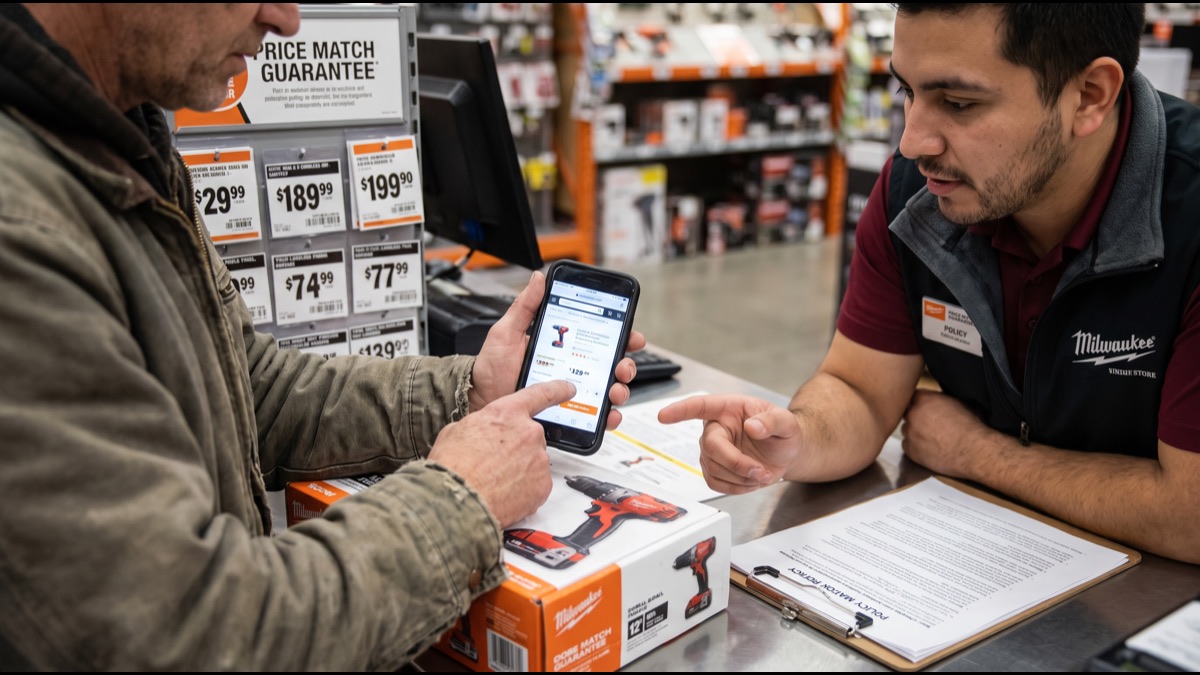
A price match guarantee sounds like an unconditional promise, that a retailer will simply match any lower price a customer finds, but the actual programs behind that marketing language are built around a dense set of exclusions and verification steps most shoppers never read. Understanding how these programs genuinely operate explains why a seemingly qualifying claim can still be denied, and what actually improves the odds of a successful one.
The gap between the confident headline promise and the restrictive fine print is not accidental; it reflects a genuine tension retailers must manage between appearing price-competitive to attract shoppers and protecting margin against the much larger volume of price-matching requests a truly unconditional policy would invite.
What a Price Match Guarantee Actually Promises
At its core, a price match guarantee commits a retailer to sell a specific item at a competitor's lower advertised price for that same item, provided the customer can demonstrate the competing price meets the program's specific eligibility conditions, which typically run several paragraphs longer than the headline promise itself suggests.
The promise generally applies only at the point of purchase or within a defined window afterward, rather than functioning as an ongoing commitment to continuously track and refund price differences for as long as a customer owns the item, a distinction that surprises shoppers who assume the guarantee behaves more like automatic price protection insurance.
Retailers frame these programs explicitly as marketing tools designed to remove price-comparison anxiety at the moment of purchase, encouraging a customer to buy immediately rather than continuing to shop around, which explains why the process is generally optimized for speed and simplicity at checkout rather than for handling claims submitted well after the fact.
Why Retailers Offer Them at All
Price match programs exist primarily to reduce a specific form of purchase hesitation, where a shopper standing in a store or browsing a website worries that a lower price might exist elsewhere and delays buying to search further, a hesitation retailers have found meaningfully reduces immediate conversion rates when left unaddressed.
By promising to match any lower price found, retailers remove the incentive to keep shopping around, since the guarantee theoretically ensures the customer never overpays regardless of where they ultimately decide to purchase, converting price anxiety from a reason to delay into a reason to buy immediately from the guaranteeing retailer.
The economics work in the retailer's favor precisely because actual successful price match claims remain a small fraction of total sales, meaning the marketing benefit of the confident promise, driving immediate purchases across the entire customer base, comfortably outweighs the modest cost of occasionally matching a genuinely qualifying lower price.
The Identical-Item Requirement
Nearly every price match program requires the competing offer to be for the exact identical item, meaning identical model number, color, size, configuration, and often identical bundled accessories or warranty terms, a bar considerably higher than most shoppers assume when they find what looks like a comparable product at a lower price elsewhere.
Retailers frequently sell functionally similar products under slightly different model numbers or with minor specification differences specifically negotiated with manufacturers, a practice within the electronics and appliance industries in particular that makes finding a truly identical match considerably harder than it initially appears, sometimes deliberately so.
This requirement is not merely bureaucratic caution; from the retailer's perspective, matching a price on a genuinely different product, even one that seems equivalent to an ordinary shopper, would effectively let a competitor's pricing strategy on an entirely separate item dictate the guaranteeing retailer's own margin on a product it may have negotiated very different supplier terms for.
Why Most Online Marketplaces Are Excluded
Price match programs almost universally exclude third-party marketplace sellers, auction sites, flash-sale platforms, and membership-based warehouse clubs, restricting eligible competitors to a specific list of named retailers selling directly at their own standard advertised prices rather than any price found anywhere online.
This exclusion exists because marketplace and auction prices are frequently set by individual sellers with radically different cost structures, sometimes including used, refurbished, or gray-market inventory not authorized by the original manufacturer, making them an unreliable and potentially manipulable reference point for a retailer's own pricing decisions.
Some price match policies further exclude prices found through coupon codes, cashback offers, credit card rewards, or limited-quantity doorbuster deals, treating only a competitor's plain, publicly advertised standard price as eligible, which filters out a considerable share of the lower prices shoppers actually encounter while comparison shopping online.
How In-Stock Rules Actually Apply
Most programs require the competing lower price to be for an item genuinely in stock and available for immediate purchase at the competitor, rather than a price advertised for a backordered, discontinued, or otherwise unavailable item, a rule intended to prevent customers from claiming a match based on a price that customer could not have actually paid anyway.
This requirement places a meaningful burden of proof on the customer, since demonstrating a competitor's current stock status at the moment of the claim, rather than simply screenshotting an advertised price, can require an additional verification step store staff must perform before approving any match, particularly for claims made in person at a physical counter.
Retailers occasionally interpret this rule aggressively, treating a competitor's listing as presumptively out of stock unless the customer can affirmatively demonstrate otherwise, a posture that shifts what should be a straightforward comparison into a more adversarial verification process for the shopper attempting the claim.
The Narrow Time Window Most Claims Miss
Post-purchase price match claims, sometimes called price adjustments, are almost universally subject to a short eligibility window, commonly somewhere between 7 and 30 days from the original purchase date, after which the retailer will not honor a price drop no matter how thoroughly documented the competing price actually is.
This window exists to bound the retailer's exposure, since an unlimited adjustment period would require indefinitely tracking every past sale against every subsequent price change across every competitor, an operationally unworkable commitment that would meaningfully undermine the predictability retailers need for inventory and margin planning.
Shoppers who miss this window entirely lose eligibility regardless of how clearly a lower price subsequently appeared, which is precisely why price match programs function far better as a pre-purchase decision tool, comparing prices before buying, than as a post-purchase safety net many shoppers mistakenly assume they can rely on indefinitely.
What Documentation Retailers Actually Require
Retailers typically require a clear, verifiable advertisement of the competing price, whether a printed circular, a website screenshot including a visible URL and date, or a physical in-store display, since an unverifiable verbal claim of having seen a lower price elsewhere is essentially never sufficient on its own.
Screenshots must generally show the exact product, the price, and evidence the page reflects current availability rather than an expired promotion, and many retailers explicitly reserve the right to independently verify the competing price themselves before approving a match, adding a further step beyond simply accepting whatever documentation the customer presents.
Customers who prepare this documentation in advance, before approaching a cashier or customer service representative, generally experience considerably faster approval than those attempting to search for evidence on their phone at the point of sale, since store staff are rarely willing to wait through an extended live search while a queue forms behind the customer.
How Staff Actually Verify a Claim
Front-line staff processing a price match request typically follow a specific internal checklist confirming the competing retailer is on the approved list, the item matches exactly, the price is current and verifiable, and the claim falls within any applicable time window, often using a dedicated internal tool or system prompt built specifically for this workflow.
Staff frequently have discretion to approve straightforward claims on the spot but are instructed to escalate ambiguous cases, such as a borderline product match or an unfamiliar competing retailer not clearly on the approved list, to a supervisor or manager, introducing a genuine element of individual judgment into what appears from the outside to be a purely mechanical policy.
This discretion means two customers presenting functionally similar claims at different stores, or even to different staff members at the same store, can genuinely receive different outcomes, a variability retailers generally tolerate as an acceptable cost of keeping the checkout-line verification process fast enough not to frustrate other waiting customers.
Why Some Claims Get Silently Discouraged
Consumer advocates and former retail employees have documented instances where store staff, whether through incentive structures discouraging discounts or simple unfamiliarity with the program's own rules, subtly discourage customers from pursuing eligible price match claims rather than actively processing them.
This friction is rarely an explicit corporate policy of denial; more often it reflects genuine staff uncertainty about a program's specific exclusions combined with a natural reluctance to spend the extra time a verification process requires during a busy shift, producing an inconsistent experience that varies considerably by individual employee and store location.
Persistent, polite customers who clearly present pre-gathered documentation and specifically reference the program's own stated terms tend to encounter considerably less friction than those making a vague verbal request, since a well-documented claim gives staff little discretionary room to deflect compared with an unsupported one.
The Difference Between Match and Beat Guarantees
A price match promises to reduce the retailer's own price to equal a verified competing price, while a considerably less common price beat guarantee promises to go further, typically undercutting the competing price by a small additional percentage, a stronger commercial promise generally reserved for retailers competing aggressively on price as a core brand identity.
Beat guarantees are structurally riskier for the retailer offering them and are correspondingly subject to even narrower eligibility rules and more rigorous verification requirements than a simple match program, since the retailer is effectively committing to operate at a small guaranteed margin disadvantage relative to whatever competitor price a customer successfully documents.
Shoppers occasionally confuse general marketing language about being the lowest-price option with a specific formal beat guarantee carrying enforceable terms, a distinction worth checking carefully since only the latter typically creates any concrete, claimable entitlement a customer can actually invoke at the point of sale.
How Store Brands and Clearance Items Are Treated
Exclusive store-brand or private-label products are almost universally excluded from price match eligibility entirely, since by definition no competing retailer sells the identical item, removing any possibility of a valid comparison regardless of how similar a competitor's own house-brand alternative might genuinely be in practice.
Clearance, closeout, and liquidation-priced items are typically excluded as well, on the reasoning that these represent temporary, store-specific inventory clearance decisions rather than the retailer's standard ongoing price for a product, meaning a customer cannot use a competitor's clearance price to obtain a matching discount on the guaranteeing retailer's regularly stocked inventory.
These exclusions substantially narrow the practical scope of most price match programs once applied together, since a meaningful share of the lowest prices shoppers actually encounter while comparison shopping fall into one of these excluded categories rather than representing a genuinely comparable standard advertised price eligible for matching.
What Happens After a Purchase Is Made
When a price drop is approved after purchase within the eligible window, retailers typically process the adjustment as either a partial refund to the original payment method or store credit, with the specific mechanism depending on the retailer's own policy and occasionally on how the customer originally paid for the item.
The adjustment is calculated purely on the price difference for the identical item, generally excluding any difference in shipping costs, taxes already collected at the original higher price, or bundled promotional offers the customer received at the time of the original purchase that the lower competing price did not include.
Processing times for approved adjustments vary considerably, from immediate register-based refunds for in-person claims to several business days for claims submitted through an online customer service channel, a delay that occasionally frustrates customers who expected the same immediacy as the original purchase transaction itself.
Whether Price Matching Is Actually Worth Pursuing
For a genuinely identical, in-stock item from an approved competitor found within the eligible time window, with clear documentation in hand, price matching is generally straightforward and worth pursuing, particularly for higher-value purchases where even a modest percentage difference translates into a meaningful dollar amount.
For smaller purchases, or cases involving marketplace sellers, clearance pricing, or borderline product matches, the time and friction required to document and pursue a claim frequently outweighs the modest savings available, making it a strategy best reserved for purchases where the underlying price gap is both clearly documentable and financially significant.
The most reliable approach is treating a price match guarantee as a pre-purchase comparison tool, gathering competing prices before buying and presenting them upfront at checkout, rather than as an open-ended post-purchase safety net, since the eligibility rules are considerably friendlier to a shopper who arrives prepared than to one attempting to reconstruct a claim after the fact.
How Price Match Culture Differs Across Retail Sectors
Consumer electronics and big-box general merchandise retailers have historically maintained the most visible and heavily marketed price match programs, largely because these categories feature highly comparable, easily specified products where a shopper can readily verify an exact match, unlike categories such as furniture or apparel where genuine product variation makes matching far harder to police.
Grocery retailers have increasingly adopted price matching in markets with intense local competition, though grocery programs typically apply a considerably stricter interpretation of identical items given the perishable, private-label-heavy nature of much grocery inventory, and often limit matching to a smaller list of named local competitors rather than any retailer nationally.
Travel and hospitality booking platforms occasionally offer their own version of price protection, though these programs function quite differently from retail price matching, generally comparing the platform's own price against itself over time rather than against a competing platform, reflecting the fundamentally different pricing structure of travel inventory.
What Regulators Say About Price Match Advertising
Consumer protection regulators in several countries have periodically scrutinized price match advertising for potentially misleading claims, particularly cases where a retailer's headline promise implies broader coverage than the actual program's exclusions permit, an area where regulatory guidance generally requires the material limitations to be disclosed reasonably clearly rather than buried exclusively in dense legal terms.
Enforcement actions in this area have historically focused less on the existence of exclusions themselves, which regulators generally accept as a legitimate business practice, and more on cases where a retailer's own staff or advertising actively suggested a match would be honored before later denying it on grounds not clearly disclosed anywhere the customer could reasonably have found them.
This regulatory backdrop gives shoppers a genuine avenue of recourse in cases of clearly deceptive practice, though the more common outcome for an ordinary declined claim is simply that the customer did not meet one of the program's disclosed conditions, a distinction worth keeping in mind before assuming a denial reflects bad faith rather than a genuinely unmet eligibility rule. Filing a complaint with a national consumer protection agency remains a reasonable last resort when a retailer's own advertising and staff conduct clearly contradict its published policy terms.
Sources
- Wikipedia — overview of price matching practices and retail history
- Federal Trade Commission — consumer protection guidance on advertised pricing practices
- Consumer Reports — practical guidance on price match policies and eligibility
- National Retail Federation — industry data on retail pricing strategy and promotions
- Better Business Bureau — consumer complaint patterns related to price match claims
FAQ
Do price match guarantees cover online marketplace sellers?
Almost never — most programs restrict eligible competitors to a specific list of retailers selling directly at their own advertised prices, excluding third-party marketplace and auction sellers.
How long do I have to request a price adjustment after buying?
Typically between 7 and 30 days, depending on the retailer; claims made after this window are generally not honored regardless of documentation.
Does a price match cover clearance or store-brand items?
Usually not — clearance, closeout, and exclusive store-brand products are almost universally excluded from price match eligibility.
What proof do I need to make a claim?
A clear, verifiable advertisement showing the exact item, price, and current availability, such as a screenshot with a visible URL and date, or a printed circular.
What's the difference between a price match and a price beat guarantee?
A match sets the retailer's price equal to a competitor's; a beat guarantee, less common, undercuts the competitor's price by an additional percentage.
About the Author
We reference Wikipedia, Federal Trade Commission, Consumer Reports, National Retail Federation, Better Business Bureau to explain the background and current understanding of this topic.
Loved This Article?
Share it on WhatsApp → Share it on WhatsApp
Get more guides in your inbox — Subscribe to our newsletter for weekly surprising stories from Egypt, Saudi Arabia, Dubai, and beyond.