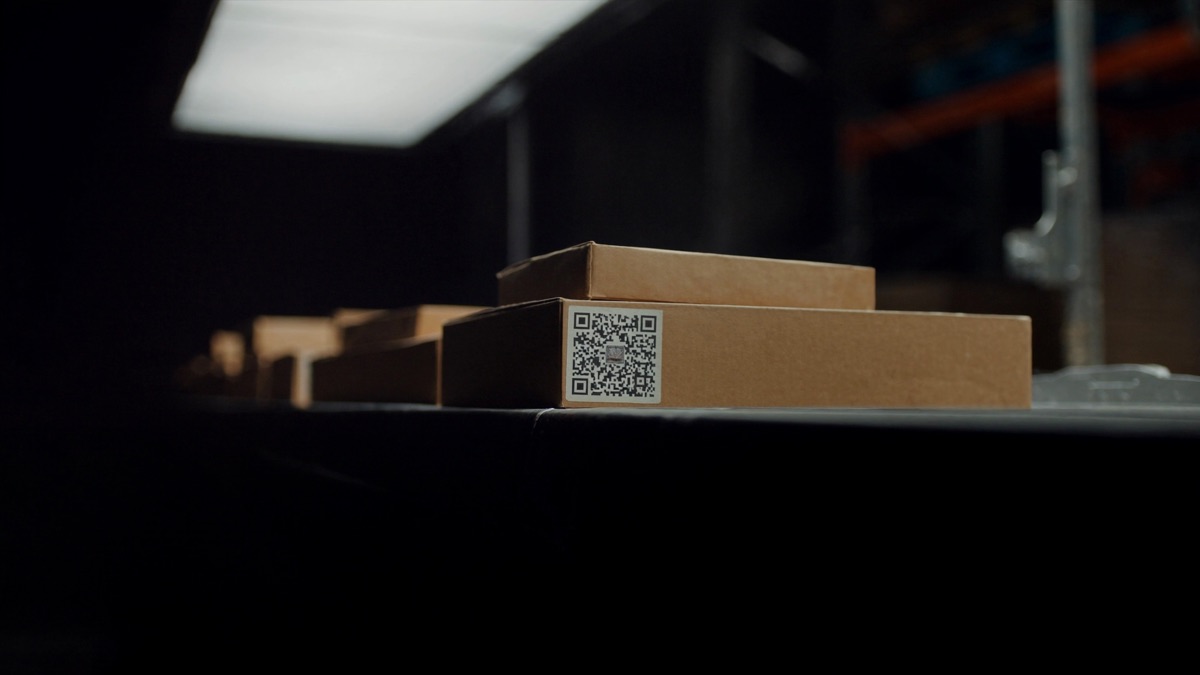
The square, pixelated pattern printed on menus, posters, and payment terminals looks like visual noise, but every module (each individual black or white square) is doing precise mathematical work. A QR code, short for Quick Response code, packs data, positioning information, and a substantial amount of built-in redundancy into a single grid using coding theory developed for deep-space communication, which is exactly why a QR code with a coffee stain across one corner or a company logo punched into its center often still scans instantly on the first try.
The three squares that tell a scanner which way is up
Look closely at any QR code and you will notice three larger square patterns positioned in three of the four corners — these are called finder patterns, and their job is purely geometric: they let a scanning camera or app instantly determine the code's orientation, size, and rotation angle, even if the code is photographed at an angle, upside down, or partially skewed. The distinctive ratio of black-white-black-white-black proportions within each finder pattern (1:1:3:1:1) is specifically chosen because this exact ratio is extremely unlikely to occur naturally elsewhere in the surrounding image, letting scanning software distinguish a genuine finder pattern from random background clutter with very high reliability.
A smaller fourth square, called the alignment pattern, appears near the fourth corner in larger QR codes (versions with more modules) and helps the scanner correct for any remaining image distortion or perspective warp after the three finder patterns have established the code's rough position, which is part of why QR codes remain scannable even when photographed from a noticeable angle rather than perfectly straight-on.
How black and white squares become actual data
Each individual module in the grid represents one binary bit: black typically means 1 and white means 0 (though this can be visually inverted in some designs, as long as the contrast between the two states remains clear enough for a scanner to distinguish them). These bits are grouped and interpreted according to a specific encoding mode declared near the start of the data stream, since QR codes can store several different kinds of data — numeric-only text, alphanumeric text, raw binary data, or Kanji/Kana characters for Japanese text — each of which uses a different, more space-efficient bit-packing scheme depending on the character set involved.
A format information area near the top-left finder pattern tells the scanner which error correction level and mask pattern the code uses, both of which must be known before the raw data bits can be correctly decoded. The mask pattern is a clever technical detail: the raw data bits are combined (XORed) with one of eight standard patterns before being placed into the grid, specifically chosen to avoid large solid blocks of same-colored modules or misleading patterns that could be confused with the finder patterns themselves, both of which would make the code harder for a scanner's image-processing algorithm to read reliably.
Reed-Solomon error correction: why damage barely matters
The single most important reason QR codes remain scannable even when partially obscured is Reed-Solomon error correction, a mathematical coding scheme originally developed in 1960 and used extensively in deep-space satellite communication, compact discs, and DVDs before being adopted for QR codes. Reed-Solomon codes add carefully calculated redundant data alongside the actual payload data, structured in such a way that a scanner can mathematically reconstruct the original data even if a meaningful percentage of the code's modules are missing, smudged, or misread, without needing to know in advance exactly which modules were damaged.
QR codes support four selectable error correction levels, commonly labeled L, M, Q, and H, which trade off data capacity for damage resilience: level L can recover the data with up to roughly 7 percent of the code damaged, while level H, the most robust setting, can recover data even with roughly 30 percent of the code damaged or obscured — which is precisely why businesses frequently embed a company logo directly in the center of a QR code, deliberately covering a chunk of the grid, and the code still scans perfectly as long as level H error correction was selected when the code was generated.
Why QR codes come in different sizes (versions)
QR codes are defined in 40 standardized sizes called versions, ranging from Version 1 (a compact 21×21 module grid holding a small amount of data) up to Version 40 (a dense 177×177 module grid capable of storing several thousand alphanumeric characters). The version used for any given QR code is automatically selected by the generating software based on how much data needs to be encoded and which error correction level was requested, since higher error correction levels consume more of the available grid space for redundancy data, sometimes forcing the generator to select a larger version than the raw data length alone would require.
This tradeoff explains a counterintuitive fact many people notice: a QR code encoding a short URL, protected by high (H-level) error correction, can sometimes appear visually more complex and dense than a QR code encoding a much longer block of text but protected by only low (L-level) error correction, because the extra redundancy data in the first case consumes grid space that would otherwise be available for a version-1 or version-2 minimal layout.
From a factory floor problem to a global standard
QR codes were invented in 1994 by Masahiro Hara and a team at Denso Wave, a Japanese automotive components subsidiary of Toyota, specifically to solve a factory logistics problem: traditional one-dimensional barcodes could only hold about 20 characters of data and had to be scanned individually and relatively precisely, which slowed down the tracking of the thousands of individual vehicle parts moving through Toyota's manufacturing and supply chain process. Hara's team was reportedly inspired partly by the black-and-white pattern of stones on a Go board while brainstorming a denser, faster-to-scan alternative pattern.
Denso Wave made a decision that proved crucial to the technology's later worldwide adoption: rather than tightly patenting and licensing the QR code format for exclusive profit, the company published the QR code specification openly and declared it would not exercise its patent rights against standard implementations of the technology, a choice that allowed the format to become an open ISO international standard (ISO/IEC 18004) and enabled free, unrestricted adoption by software developers, smartphone manufacturers, and businesses worldwide over the following decades — directly setting up the technology's explosive growth once smartphone cameras became powerful and common enough to scan them easily.
The 2020 mobile payment and menu boom
Although QR codes existed in relatively niche industrial and marketing use for over two decades, global adoption accelerated dramatically starting in 2020, driven substantially by contactless payment systems in several Asian markets that had already normalized QR-based mobile payment years earlier, and then by a sudden worldwide shift toward touchless restaurant menus, event check-ins, and payment terminals during the public health measures of that period, when physical menus and shared surfaces became a hygiene concern for many businesses.
This rapid adoption wave also drove meaningful technical improvements at the operating-system level: native camera apps on both major smartphone platforms added built-in QR code detection that no longer required downloading a separate dedicated scanning app, removing what had previously been a real adoption barrier — many earlier QR code marketing campaigns had failed specifically because customers were unwilling to install a special app just to scan one code, a friction point that essentially disappeared once scanning became a built-in camera feature on nearly all modern smartphones.
Dynamic QR codes and the tracking question
A meaningful distinction exists between static and dynamic QR codes that many casual users are unaware of: a static QR code has its actual destination data (a URL, text, or contact information) permanently and directly encoded into the grid pattern itself, meaning it can never be changed or updated after printing, while a dynamic QR code instead encodes a short redirect URL pointing to a server the code's creator controls, which can then forward the scanner to a different, updatable destination at any time, without needing to reprint or replace the physical code itself.
This redirect architecture is also what makes dynamic QR codes valuable for analytics and marketing purposes, since the intermediary redirect server can log every scan event, including approximate location, device type, and timestamp, information a purely static QR code cannot capture on its own since it involves no server round-trip at all. This tracking capability is generally considered a legitimate, disclosed marketing analytics practice similar to standard website visitor tracking, though security researchers have also documented cases of malicious actors printing fraudulent QR code stickers over legitimate ones (a technique sometimes called 'quishing,' a QR-code variant of phishing) to redirect unsuspecting scanners to fake payment or login pages instead.
Why QR codes can store far more than just a website link
While the overwhelming majority of QR codes encountered in daily life link to a website URL, the underlying format supports several other structured data types that many users never encounter directly: vCard-formatted contact information that automatically populates a new phone contact entry when scanned, Wi-Fi network credentials that let a phone join a network automatically without manually typing a password, calendar event details, and even SMS message templates that pre-fill a text message ready to send.
Some specialized applications embed genuinely large amounts of raw data directly into a QR code with no external server or redirect involved at all — certain vaccination or health certificate systems, for instance, encode a full cryptographically signed data payload directly into a single QR code, allowing a scanner to verify the certificate's authenticity offline without needing an active internet connection to check against a remote database, a meaningful advantage in settings with unreliable connectivity.
Micro QR codes and other variants you rarely notice
Beyond the standard QR code, Denso Wave and other standards bodies have developed several specialized variants for particular use cases: Micro QR codes use a simplified single finder pattern instead of three, making them smaller and suited to labeling tiny items like electronic components where space is extremely limited, while iQR codes support both square and rectangular shapes for situations where a standard square footprint does not fit the available labeling space, such as a narrow strip on a cylindrical product.
Frame QR and SQRC (Secure QR Code) are further specialized variants — the former reserves a defined empty region inside the code for a custom logo or image without interfering with error correction calculations, and the latter incorporates a restricted, semi-private data area readable only by specially authorized scanning software, used in some enterprise and government applications where a public scanner should read basic information while a proprietary system reads additional restricted data from the exact same printed code.
Sources
- Denso Wave (QR code inventor) — official history and technical background from the format's creator
- ISO/IEC 18004 — the international standard defining QR code structure and error correction
- US Federal Trade Commission — guidance on QR code security risks including quishing
FAQ
Can a QR code contain a virus that infects my phone just from scanning it?
No, a QR code itself cannot contain executable code or malware — it can only encode data such as a URL, and scanning it is no more dangerous than typing that same URL into a browser manually. The real risk is being redirected to a malicious website designed to steal information or trick you into downloading something harmful after scanning.
Why do some QR codes look more complex than others even when they seem to hold similar amounts of information?
Complexity depends on both the amount of data encoded and the chosen error correction level; a code using high (H-level) error correction devotes significantly more of its grid to redundant recovery data, making it visually denser than an equivalent code using low (L-level) correction, even if both encode the same underlying data.
Do QR codes expire?
A static QR code, with data directly encoded in the grid, never expires on its own. A dynamic QR code can effectively 'expire' if its creator deactivates the redirect server or lets a related hosting subscription lapse, since the code depends on that external server remaining active to function.
Can a damaged or torn QR code still be scanned?
Yes, depending on the error correction level used when it was generated; a code created with high (H-level) correction can typically still be read correctly even with up to roughly 30 percent of its area damaged, missing, or obscured, thanks to Reed-Solomon error correction mathematics.
Is it true QR codes were inspired by a board game?
According to Denso Wave's own account, inventor Masahiro Hara has cited the black-and-white stone pattern of the game Go as one source of inspiration while developing a denser, faster alternative to traditional barcodes in the early 1990s.
How much text can a single QR code actually hold?
At the maximum Version 40 size with the lowest error correction level, a QR code can hold up to about 4,296 alphanumeric characters or roughly 7,089 numeric-only digits, though most practical QR codes used for URLs and contact cards use far less capacity than this theoretical maximum.
Why did QR code popularity suddenly explode worldwide starting around 2020?
A combination of factors converged: smartphone cameras gained built-in native QR scanning without requiring a separate app, and a sudden global shift toward contactless menus, payments, and check-ins during that period made QR codes a practical, low-cost solution many businesses adopted almost simultaneously.
Can I create a QR code that only my own app can read, not a standard camera scanner?
Yes, developers can create custom QR-like formats or embed encrypted data that only a purpose-built app can properly decrypt and interpret, though the code would still be technically readable by a standard scanner as raw (likely meaningless-looking) encoded data unless it uses proprietary, non-standard encoding entirely.
Do all QR codes need an internet connection to be useful?
No — many QR code use cases, including Wi-Fi credential sharing, contact card information, and certain offline-verifiable certificate systems, encode all necessary data directly in the code itself and require no internet connection at all to be read and used.
Can two completely different-looking QR codes encode the exact same underlying data?
Yes, because the mask pattern applied during encoding and the exact error correction level chosen both affect the visual arrangement of modules, meaning the same underlying text or URL can produce visually distinct QR code patterns depending on which generator software and settings were used to create it.
Why do some QR codes use non-standard colors like blue or red instead of plain black and white?
As long as sufficient contrast remains between the light and dark modules for a scanner's image-processing algorithm to reliably distinguish them, colored QR codes will still scan correctly, which is why many brands print colored codes matching their visual identity rather than sticking to pure black and white.
About the Author
We reference Wikipedia and other authoritative sources to explain the background and current understanding of this topic.
Loved This Article?
Share it on WhatsApp → Share it on WhatsApp
Get more guides in your inbox — Subscribe to our newsletter for weekly surprising stories from Egypt, Saudi Arabia, Dubai, and beyond.