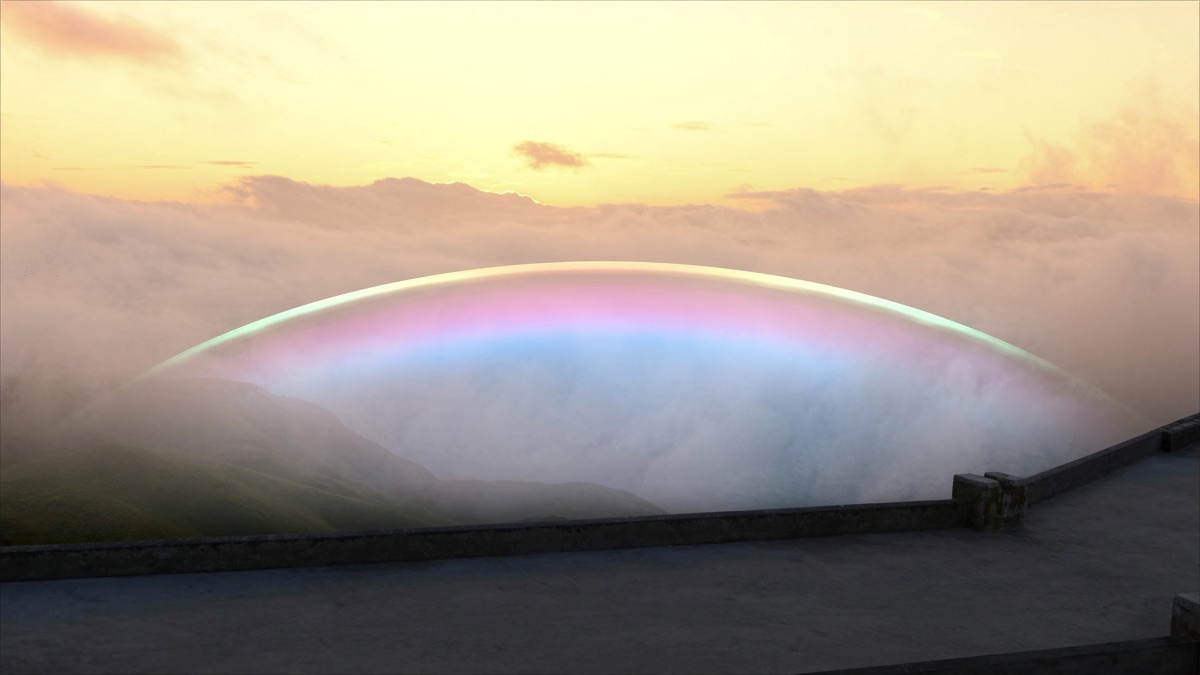
Every rainbow you have ever seen from the ground was really only half the story. The colored arc stretching across the sky is, geometrically, a full circle of light — it is only the presence of the ground beneath your feet that slices it in half and shows you an arc instead of a ring. Understanding why requires looking at the exact physics of how a single raindrop bends and splits sunlight, and why every observer on Earth is standing at the center of their own personal rainbow that no one else sees in quite the same place.
The antisolar point: your own private circle
A rainbow always forms in a circle centered on what is called the antisolar point — the spot directly opposite the sun from where you are standing, effectively the shadow of your own head projected onto the sky (or, if the sun is high, onto the ground far in the distance). Because this point is defined relative to your exact eye position, no two people ever see precisely the same rainbow; the person standing beside you is looking at a slightly different circle of raindrops, even though the two circles appear to overlap almost perfectly. This is also why a rainbow seems to move as you move — you are not chasing the same rainbow, you are generating a new one with every step, each one still centered on the point exactly opposite the sun from your current position.
The angular radius of that circle is fixed by physics at very close to 42 degrees for the outer, brighter primary bow, measured from the antisolar point outward. That number does not change with the size of the sun, the humidity, or the season; it comes directly from the refractive index of water and the geometry of light bouncing once inside a spherical raindrop. Because the angle is fixed, a rainbow's apparent size in the sky depends only on how high the sun is — the lower the sun sits near the horizon, the higher and larger the arc appears, which is why the most dramatic, tallest rainbows show up in the early morning or late afternoon, and why you essentially never see one at solar noon in most latitudes.
Why the ground cuts the circle into an arc
If you were floating in open sky with no horizon at all — in a hot air balloon at altitude, or looking down from an airplane window on the right side of the aircraft at the right angle — you would see the complete circular halo, sometimes called a glory-adjacent full-circle rainbow, glowing all the way around the antisolar point with the shadow of the plane sometimes visible right in its center. From ground level, however, the portion of that circle that would fall below the horizon has nothing to reflect off of: there are no illuminated raindrops down there catching the same sunlight at the same angle, because the ground itself blocks both the sunlight reaching that space and your line of sight into it. The lower the antisolar point sits (which happens when the sun is high), the more of the circle is chopped away, until at high solar angles the theoretical arc would dip almost entirely below the horizon and no rainbow is visible at all.
Pilots and mountaineers occasionally do see the complete ring precisely because they gain enough elevation to have raindrops (or, over clouds, tiny droplets) both above and below their horizontal line of sight simultaneously. From a commercial airliner cruising above a rain shower, passengers on the correct side of the plane can sometimes see a full glowing circle around the shadow of the aircraft on the cloud deck below — a striking demonstration that the arc shape most people know is purely an artifact of standing on solid ground, not a property of the rainbow itself.
How a single raindrop bends and splits light
Sunlight entering a spherical raindrop first refracts, or bends, as it crosses from air into water, because light travels slower in water and different wavelengths (colors) bend by very slightly different amounts — this is the same dispersion effect a glass prism uses. The light then travels to the back interior wall of the droplet, where a portion reflects internally rather than exiting, bouncing back roughly toward the direction it came from. As that reflected light exits the front of the raindrop, it refracts a second time, bending again and separating the colors even further apart from one another. The net result of these two refractions plus one internal reflection is that white sunlight enters a raindrop and exits as a fan of separated colors, red bending least and violet bending most.
Because every raindrop in the sky performs this exact same optical trick, what you actually see is not one drop's rainbow but millions of drops each contributing a single color to your eye, depending on their precise angular position relative to you and the sun. A drop positioned at almost exactly 42 degrees from your antisolar point sends red light to your eye; a drop at a very slightly smaller angle sends violet. Move your head, and an entirely different set of drops — now positioned at the correct angles — takes over the job of sending you red, then violet, then everything in between, which is why the rainbow appears to hang steady in the sky even though the actual water droplets producing the colors you see are constantly falling through and being replaced.
Why red is always on the outside
The order of colors in a primary rainbow is never random and never reversed under normal conditions: red sits on the outer edge of the arc and violet on the inner edge, with orange, yellow, green, and blue arranged between them in the familiar sequence. This ordering falls directly out of the physics of refraction — violet light bends more sharply than red light every time it crosses from air into water and back again, so the violet light emerging from a raindrop ends up concentrated at a slightly tighter angle (about 40 degrees) than the red light (about 42 degrees). Because your eye receives light from whichever drops happen to sit at the correct angle for each color, the outermost visible band, corresponding to the widest angle, is necessarily red, and the innermost band is violet.
This same logic explains the fainter secondary rainbow that sometimes appears as a second, dimmer arc outside the primary one, with its colors flipped — violet on the outside, red on the inside. The secondary bow forms from light that reflects twice inside the raindrop instead of once, which flips the color order and also spreads the light over a wider angle (about 51 degrees), making it noticeably dimmer because more of the original light energy is lost at each additional bounce. Between the two arcs, observers sometimes notice a visibly darker band of sky called Alexander's dark band, caused by the fact that almost no raindrops send light back to the eye at angles between the primary and secondary bow's ranges.
Why you need sun behind you and rain ahead
A rainbow can only appear when the sun is behind the observer and rain (or spray, or mist) is present in front of them, because the antisolar point — the center of the circle — must be visible, and that point is by definition directly opposite the sun. This is why rainbow-hunters instinctively know to check whether the sun is shining on their back before looking for a bow in a nearby rain shower, and why you never see a rainbow by looking toward the sun. It also explains why rainbows are common at sunrise and sunset near passing showers: with the sun low on one horizon, its antisolar point sits low on the opposite horizon too, putting the center of the potential rainbow circle right at a comfortable, easily visible height above the ground rather than buried near your feet or impossibly high overhead.
The same optics work with any suspended water droplets, not just falling rain — garden hoses, waterfalls, ocean spray, and even fine mist from a humidifier can all produce a visible rainbow if the droplets are the right size and the sun is positioned correctly relative to the observer. Very fine droplets, smaller than about 0.1 millimeters, tend to produce a washed-out, nearly white rainbow called a fogbow because the color separation becomes too subtle to distinguish, while larger raindrops of a millimeter or more produce the most vivid, saturated colors.
Double, triple, and even quadruple rainbows
Beyond the familiar primary and secondary bows, physicists have documented tertiary and even quaternary rainbows — formed by light bouncing three or four times inside a raindrop before exiting — though these are exceedingly faint and appear on the same side of the sky as the sun rather than opposite it, making them almost impossible to see against the sun's glare with the naked eye. The first confirmed photograph of a natural tertiary rainbow was not captured until 2011, despite centuries of rainbow observation, precisely because observers need to be looking in exactly the wrong direction (toward the sun) under exactly the right conditions of rain and clear sky simultaneously.
Supernumerary rainbows are a more commonly seen extra feature: faint additional bands of pastel pink, green, and purple sometimes visible just inside the primary bow's violet edge. These occur because of wave interference between light rays taking very slightly different paths through raindrops of a very uniform, narrow size range — an effect that classical ray-optics explanations of the primary and secondary bow cannot account for at all, and one that only made full physical sense once scientists treated light as a wave rather than a simple ray, a debate that occupied physicists including Descartes and Newton for generations.
Moonbows: the rainbow after dark
Rainbows are not exclusively a daytime phenomenon — a moonbow, sometimes called a lunar rainbow, forms through the identical optical process but using moonlight reflected from the sun instead of direct sunlight. Moonbows are dramatically fainter than solar rainbows because moonlight itself is only a small fraction as bright as direct sunlight, and the human eye's color receptors (cone cells) do not function well in such low light, which is why moonbows often appear silvery-white or very faintly colored to the naked eye even though long-exposure photography reveals the full spectrum of color is genuinely present.
Because moonbows require a bright, nearly full moon low in the sky opposite a rain shower — a fairly specific combination of conditions — they are considerably rarer than solar rainbows and are reliably observable at only a handful of locations worldwide with the right combination of waterfalls, mist, and clear night skies, such as Victoria Falls in Zambia and Cumberland Falls in Kentucky, both of which have built minor tourism attractions around predictable moonbow viewing nights tied to the lunar calendar.
Cultural meanings across history
Long before the physics of refraction was understood, rainbows carried enormous symbolic weight across cultures worldwide, almost always as a bridge or message between the earthly and the divine. In the biblical flood narrative, the rainbow is described as a covenant sign; in Norse mythology, the rainbow bridge Bifröst connects the realm of humans to the realm of the gods; and in many Indigenous Australian traditions, the Rainbow Serpent is a central creation figure associated with water sources and the shaping of the landscape itself.
The scientific explanation of the rainbow's colors and shape, first worked out with real rigor by Descartes and later refined by Newton's experiments with prisms in the 1660s, did little to diminish its cultural resonance — if anything, the discovery that white light secretly contains a full spectrum of color, made visible only when refracted correctly, added a new layer of wonder to a symbol humanity had already been contemplating for millennia. Modern rainbow flags used by movements from LGBTQ+ pride to peace organizations continue this long tradition of using the rainbow's full-spectrum inclusiveness as a visual shorthand for unity across difference.
Sources
- UK Met Office — explains rainbow formation, the 42-degree angle, and secondary bows
- Atmospheric Optics — detailed ray-tracing physics of primary and secondary rainbows
- NASA — background on moonbows and low-light color perception
FAQ
Why can I never actually reach a rainbow?
A rainbow is not a physical object sitting at a fixed location; it is an optical pattern created by light reaching your eye at specific angles from countless individual raindrops. As you walk toward where the rainbow appears to be, the raindrops responsible for that particular color pattern change continuously, and the rainbow — being purely a function of your viewing angle relative to the sun — effectively retreats with you at the same pace you approach it, forever out of reach.
Can two people ever see the exact same rainbow?
No. Because the rainbow's center point is defined relative to each individual observer's eye position, two people standing even a few feet apart are technically looking at two overlapping but distinct circles of raindrops. The rainbows look nearly identical because the angular geometry barely changes over a few feet of separation, but strictly speaking every observer sees their own private rainbow.
Why is the sky inside a rainbow noticeably brighter than outside it?
Raindrops send concentrated light back toward the observer at all angles smaller than the primary bow's 42 degrees, not just exactly at 42 degrees, which brightens the entire sky inside the arc. Above the 42-degree angle, comparatively little light reaches the observer's eye, which is why the sky outside a rainbow, and especially the dark band between a primary and secondary bow, looks noticeably dimmer by comparison.
Do rainbows ever appear at night without moonlight?
Extremely faint rainbows have occasionally been documented using strong artificial light sources such as stadium floodlights or aircraft searchlights shining through rain or spray, following the same optical principles, but these are rare, localized curiosities rather than a recognized natural phenomenon like the solar rainbow or moonbow.
Why do rainbows sometimes look almost white?
Fogbows, produced by very fine droplets smaller than about 0.1 millimeters (as found in fog or mist rather than rain), show very little color separation because such small droplets diffract light more than they refract and disperse it, blurring the color bands together into what appears as a broad, pale, nearly colorless arc.
Is it true no two rainbows in history have ever been identical?
In a strict physical sense, yes — the precise combination of sun angle, droplet size distribution, humidity, and observer position is different every time, making every individual rainbow event technically unique, even though the overall pattern of colors and the 42-degree geometry remain constant across all of them.
Why do rainbows appear more often after summer storms?
Rainbows require simultaneous sunshine and rain from the observer's viewpoint, a combination most common at the trailing edge of a passing shower or thunderstorm, when the rain cloud has moved on (or is moving away) while the sun re-emerges from behind it — a pattern that occurs frequently with the short, localized convective storms typical of summer weather.
Can a rainbow appear in a clear sky with no visible rain nearby?
Yes, if rain is falling from a cloud that is out of the observer's direct line of sight or too far away to be visually obvious, while sunlight still reaches the droplets from behind the observer — a fairly common scenario near the trailing edges of distant, visible-only-as-shadow rain shafts.
About the Author
We reference Wikipedia and other authoritative sources to explain the background and current understanding of this topic.
Loved This Article?
Share it on WhatsApp → Share it on WhatsApp
Get more guides in your inbox — Subscribe to our newsletter for weekly surprising stories from Egypt, Saudi Arabia, Dubai, and beyond.