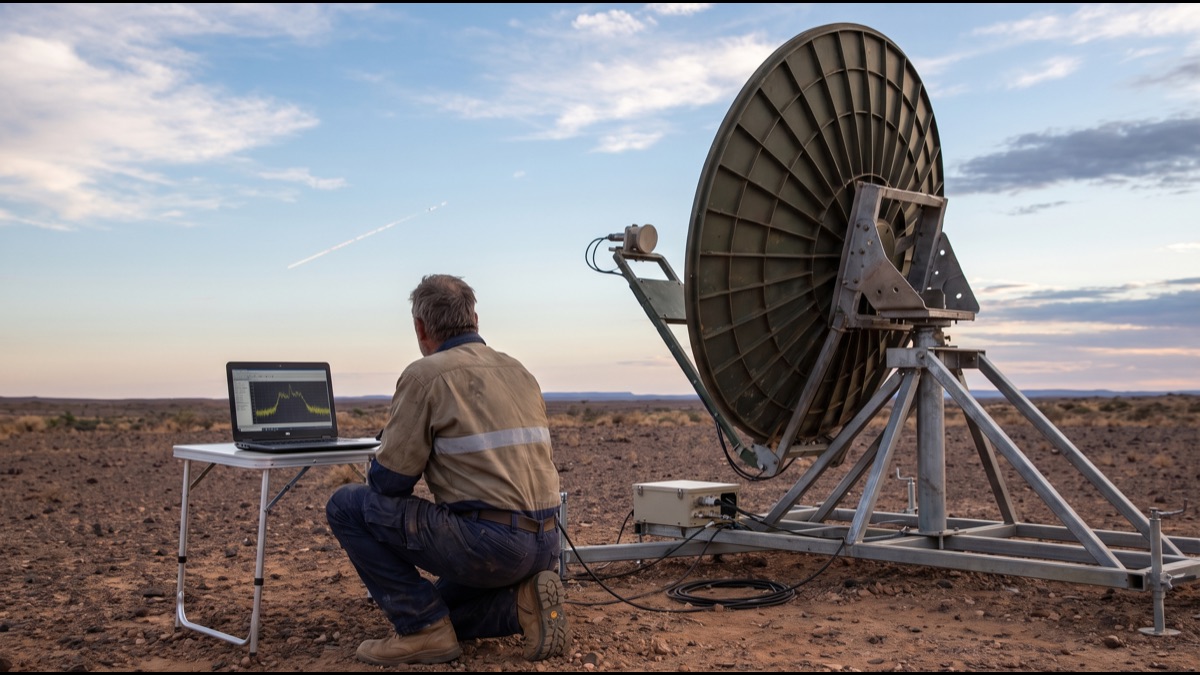
Traditional satellite internet, delivered through a handful of satellites parked in geostationary orbit roughly thirty-six thousand kilometres above the equator, has existed for decades, but it suffered from a fundamental physics problem that no amount of engineering could fully solve: the sheer distance the signal had to travel.
Why Satellite Internet Needed to Be Reinvented
A round trip to a satellite that far away and back takes a noticeable fraction of a second even at the speed of light, producing latency of around six hundred milliseconds or more, which made geostationary satellite internet frustrating for video calls, online gaming, and any interactive application, even though it could deliver reasonable download speeds for less time-sensitive uses.
The modern generation of satellite internet services solves this specific problem by abandoning geostationary orbit almost entirely in favour of a very different architecture: thousands of much smaller satellites flying in low Earth orbit, only a few hundred kilometres up, dramatically shortening the distance a signal must travel.
How Low Earth Orbit Constellations Actually Work
A low Earth orbit constellation consists of many satellites, sometimes numbering in the thousands, distributed across multiple orbital planes so that at any given moment several satellites are within reach of any point on the ground, unlike a single geostationary satellite that only serves a fixed patch of the planet.
Because these satellites orbit at low altitude, they move extremely quickly relative to the ground, circling the Earth roughly every ninety minutes rather than staying fixed above one location, meaning any individual satellite is only usable to a given ground terminal for a few minutes before it passes over the horizon.
This constant movement is precisely why the constellation needs so many satellites working together: as one satellite drops below the horizon from a user's perspective, the network must seamlessly hand the connection off to another satellite rising to take its place, ideally without the user noticing any interruption at all.
How the User Terminal Actually Connects
The dish or terminal a customer installs at home is considerably more sophisticated than older satellite dishes, because it must electronically steer its beam to track fast-moving satellites across the sky rather than staying pointed at one fixed spot the way a traditional satellite television dish does.
Most modern terminals use a flat phased-array antenna, which steers its beam electronically by adjusting the timing of signals across many small antenna elements rather than physically moving any part of the dish, allowing extremely rapid retargeting as satellites move overhead and get replaced by the next one in the handoff sequence.
This phased-array approach is also why these terminals require a genuinely unobstructed view of a wide swath of sky rather than a single fixed direction, since the terminal must be able to track and connect to satellites across a broad arc as they pass overhead throughout the day.
How Data Actually Travels From You to the Internet
When a user sends a request, such as loading a webpage, the signal travels from the ground terminal up to the nearest available satellite, and from there the path to reach the broader internet depends on the specific network's architecture, which generally falls into one of two approaches.
In the simpler approach, the satellite relays the signal directly back down to a ground station, sometimes called a gateway, that has its own high-capacity fibre connection to the internet, meaning the satellite essentially functions as a relay between the user's terminal and a nearby ground-based gateway station.
More advanced constellations increasingly use inter-satellite links, essentially laser communication between neighbouring satellites in orbit, allowing data to hop between multiple satellites in space before coming back down to a gateway, which becomes particularly valuable for serving remote areas far from any ground station, such as polar regions or areas over open ocean.
Why Latency Dropped So Dramatically
The latency improvement from moving to low orbit is substantial and directly explained by basic physics: a signal travelling to a satellite a few hundred kilometres away and back takes only a small fraction of the time required to reach a satellite tens of thousands of kilometres away in geostationary orbit.
Real-world latency for low-orbit satellite internet typically falls in a range comparable to many terrestrial broadband connections, low enough to support video calls and most online gaming reasonably well, a dramatic improvement over the older geostationary experience that made such interactive uses genuinely frustrating.
Latency can still vary meaningfully depending on how many satellite hops and ground-station relays a particular connection requires, how congested the local cell of satellite capacity is, and atmospheric or weather conditions, meaning the improvement over geostationary systems is substantial but not a complete elimination of the physical distance involved.
How Capacity Is Shared Among Users
Each satellite has a finite amount of bandwidth it can serve to users within its coverage footprint at any moment, meaning the actual speed an individual user experiences depends heavily on how many other users are simultaneously drawing on capacity from the same satellite and ground cell.
This is why satellite internet providers have generally had to manage capacity carefully in densely populated areas, sometimes introducing waitlists or capacity-based pricing in regions where demand threatens to exceed what the satellites overhead can comfortably serve without meaningfully degrading speeds for existing users.
The solution to this constraint is fundamentally the same one used by terrestrial mobile networks facing similar capacity limits: launching more satellites to increase overall network capacity, and in some designs, using more tightly focused spot beams that concentrate capacity on specific high-demand areas rather than spreading it evenly.
Why Weather Can Still Disrupt the Signal
Heavy rain, snow, and dense cloud cover can attenuate the radio frequencies used by satellite internet systems, a phenomenon commonly called rain fade, which can meaningfully degrade signal quality or, in severe cases, temporarily interrupt connectivity during intense storms.
Engineers mitigate this through several approaches, including operating with a power margin that accounts for expected signal loss during moderate weather, dynamically adjusting the modulation scheme used to encode data to favour reliability over raw speed during poor conditions, and in some networks, briefly rerouting a connection to a different satellite with a clearer path.
Despite these mitigations, users in regions with frequent severe weather should generally expect some degradation during the worst storms, a limitation shared to varying degrees by essentially all wireless technologies that rely on line-of-sight radio transmission through the atmosphere.
How Orbital Debris and Collision Avoidance Are Managed
Operating thousands of satellites in a relatively crowded orbital region raises genuine concerns about collision risk, both between satellites within the same constellation and with the growing amount of space debris and other operators' satellites sharing similar orbital altitudes.
Constellation operators generally use automated collision-avoidance systems that continuously track the predicted paths of nearby objects and autonomously execute small manoeuvres to maintain safe separation, a level of automation that has become necessary given the sheer number of objects that must be monitored simultaneously.
Satellites in these constellations are also typically designed with a limited operational lifespan and equipped with propulsion systems allowing controlled deorbiting at the end of their service life, intended to reduce the accumulation of long-lived debris compared with older satellites left to drift indefinitely after failure.
Why Ground Stations Matter as Much as the Satellites
The gateway ground stations that connect the satellite network to the broader terrestrial internet are a critical and sometimes underappreciated part of the system, since the fastest satellite constellation in the world is still limited by the capacity and geographic distribution of the ground infrastructure it ultimately depends on.
Operators generally need to negotiate landing rights and build physical infrastructure in many countries to serve users well within those regions, a process that involves regulatory approval, spectrum licensing, and often substantial construction investment, explaining why availability of these services has expanded gradually market by market rather than becoming instantly global.
In remote areas without any nearby ground station, inter-satellite laser links become essential, allowing a signal to be relayed in space to a satellite positioned closer to an available gateway rather than requiring a ground station literally underneath the coverage area.
How This Differs From Traditional Mobile Satellite Phones
Older satellite phone services, historically used for voice calls in genuinely remote locations, generally operated with much lower data capacity per user and were designed primarily for basic voice communication and short messaging rather than for anything resembling modern broadband internet use.
Modern low-orbit broadband constellations are architected specifically to deliver data speeds comparable to terrestrial home broadband, a fundamentally different design goal that required far more satellites, far more ground infrastructure, and considerably more sophisticated terminal hardware than older satellite phone networks ever needed.
Some providers do also offer basic satellite connectivity directly to ordinary mobile phones for emergency messaging in areas without any cellular coverage, a separate and more limited service built on similar underlying satellite infrastructure but delivering far less bandwidth than a dedicated home or business terminal.
Why Regulatory Spectrum Allocation Is So Contested
Satellite internet operators must be allocated specific radio frequency spectrum by national and international regulators, and because usable spectrum is a finite shared resource, allocation decisions frequently involve negotiation and sometimes dispute between different satellite operators and terrestrial wireless providers competing for overlapping frequency bands.
International coordination happens partly through bodies that manage shared global spectrum allocation, since satellites do not respect national borders in the way terrestrial infrastructure does, meaning a frequency conflict between operators in adjacent regions can require formal international coordination to resolve.
This regulatory dimension is one reason satellite internet services have rolled out unevenly across different countries, since operators must secure both spectrum rights and market access approval in each jurisdiction before legally offering service to consumers there.
How Reliability Compares to Fibre and Cable
Satellite internet remains generally less reliable in raw uptime terms than a well-maintained fibre connection, given its exposure to weather-related signal degradation and its dependence on a complex chain of satellite handoffs that simply does not exist for a physical cable running directly to a building.
For users in areas without any practical access to fibre, cable, or reliable mobile broadband, however, the comparison is less relevant than the simple fact that satellite internet may be the only option offering genuinely usable speeds at all, which is precisely the underserved market these networks were designed to address.
In areas where multiple options exist, satellite internet is generally positioned as a backup or a solution for genuinely remote locations rather than a direct competitor intended to displace fibre in already well-served urban and suburban areas.
What the Future of the Technology Looks Like
Successive generations of satellites in these constellations have generally added more onboard capacity, more inter-satellite laser links, and more sophisticated phased-array electronics, following a broader pattern of rapid iterative improvement enabled by manufacturing large numbers of relatively low-cost satellites rather than a small number of expensive, highly customised ones.
Terminal hardware has also become smaller, cheaper, and more power-efficient over successive product generations, gradually expanding the practical use cases from fixed home installations toward more portable and even vehicle-mounted or maritime and aviation applications requiring connectivity while genuinely on the move.
The long-term trajectory generally points toward satellite internet becoming a genuinely competitive option in more markets, particularly as launch costs continue falling and constellation capacity continues growing, though the fundamental physics of shared bandwidth per satellite means dense urban markets will likely continue to be served primarily by fibre and terrestrial wireless for the foreseeable future.
How Businesses and Aviation Use the Same Technology
Beyond home internet, the same low-orbit satellite infrastructure increasingly serves maritime shipping, commercial aviation, and remote industrial sites such as mining operations, all of which need reliable connectivity in locations where laying fibre or building cellular towers is impractical or prohibitively expensive.
Aviation terminals in particular required additional engineering work to handle the unique challenge of tracking fast-moving satellites from an aircraft that is itself moving at hundreds of kilometres per hour, compounding the tracking problem the ground terminal already has to solve for a stationary user.
These enterprise and mobility use cases have become a meaningful revenue stream for constellation operators alongside residential broadband, helping justify the enormous capital cost of building and continuously replenishing a constellation of thousands of satellites with limited operational lifespans.
The core achievement of modern satellite internet is not simply putting broadband in orbit, since that had already been done for decades, but rather solving the specific latency and capacity problems that made earlier geostationary satellite internet frustrating for interactive use, including video calls, gaming, and everyday web browsing that older systems could barely support. Moving to low Earth orbit, deploying thousands of satellites instead of a handful, and building genuinely sophisticated electronically steered ground terminals together turned satellite internet from a last-resort option into something approaching a genuine broadband alternative for underserved areas.
The technology still faces real constraints around shared capacity, weather sensitivity, and the substantial ground infrastructure and regulatory approval each new market requires, meaning it complements rather than replaces fibre and terrestrial wireless in already well-served areas while opening genuinely new connectivity options for remote and underserved regions worldwide.
Sources
- Wikipedia — overview of satellite internet architecture and history
- International Telecommunication Union — global spectrum coordination and satellite regulatory framework
- U.S. Federal Communications Commission — regulatory filings and spectrum allocation for satellite broadband
- European Space Agency — technical background on satellite constellation engineering
- NASA — orbital mechanics and space debris research
FAQ
Why is low-orbit satellite internet faster than older satellite internet?
It uses satellites only a few hundred kilometres up instead of tens of thousands, dramatically cutting the signal travel time and therefore the latency.
Does weather affect satellite internet?
Yes — heavy rain, snow, and dense cloud cover can attenuate the signal, a phenomenon called rain fade, though networks mitigate it with power margins and adaptive encoding.
How does the network avoid interruptions as satellites move overhead?
Ground terminals use electronically steered phased-array antennas that continuously hand the connection off from a satellite passing out of range to the next one rising into view.
Is satellite internet a replacement for fibre in cities?
Generally no — shared bandwidth per satellite means dense urban areas are usually still better served by fibre and terrestrial wireless, with satellite internet targeting remote and underserved regions.
How do satellites avoid colliding with each other?
Operators run automated collision-avoidance systems that track nearby objects and execute small manoeuvres to maintain safe separation, given the large number of satellites now in low orbit.
About the Author
We reference Wikipedia, International Telecommunication Union, U.S. Federal Communications Commission, European Space Agency, NASA to explain the background and current understanding of this topic.
Loved This Article?
Share it on WhatsApp → Share it on WhatsApp
Get more guides in your inbox — Subscribe to our newsletter for weekly surprising stories from Egypt, Saudi Arabia, Dubai, and beyond.