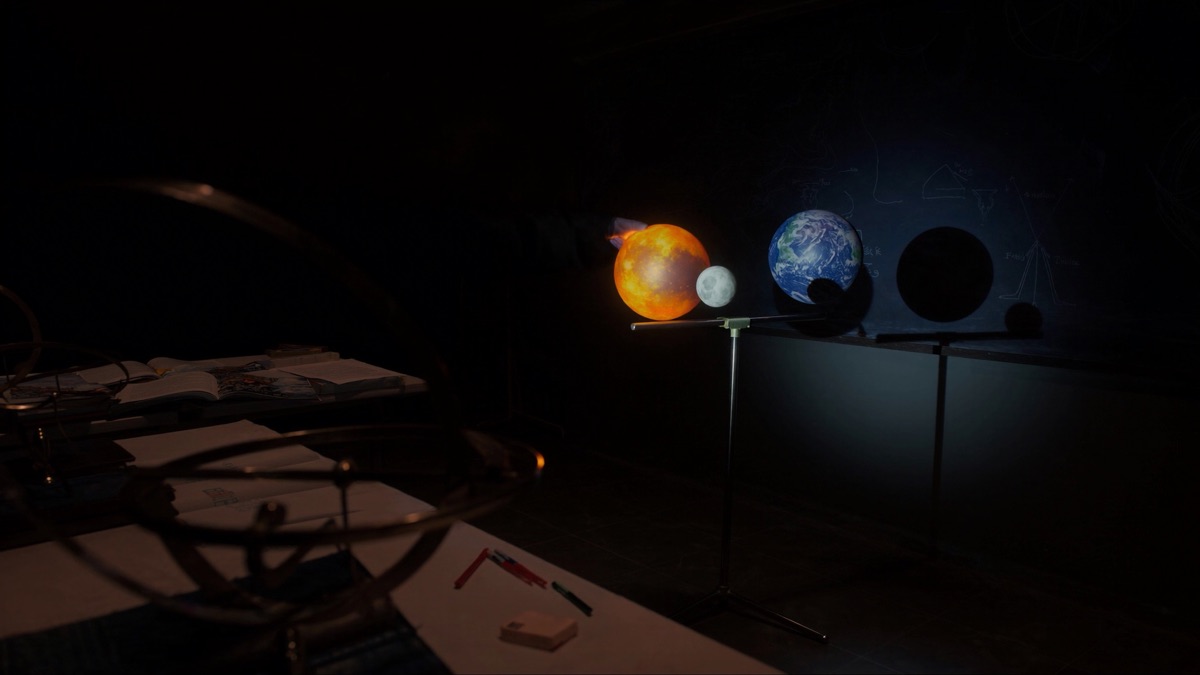
A total solar eclipse, the Moon fully blocking the Sun and turning day briefly into a strange twilight, depends on a geometric coincidence so precise it borders on improbable: the Sun's diameter is almost exactly 400 times the Moon's diameter, and the Sun also happens to sit almost exactly 400 times farther from Earth than the Moon does. That near-perfect ratio is why the Moon can appear to cover the Sun almost exactly, producing the brief, dramatic totality that draws eclipse chasers across the globe. Understanding the full mechanics behind that coincidence, and why it won't last forever, explains far more than most casual eclipse-day explanations ever cover.
The coincidence of apparent size that makes total eclipses possible
The Sun's actual diameter is roughly 1.39 million kilometers, while the Moon's diameter is only about 3,474 kilometers, a difference of almost exactly 400 times. If the Moon orbited at a random distance unrelated to this ratio, it would either look far too small to ever fully cover the Sun's disc, or far too large and never allow the delicate visual alignment eclipse chasers travel across continents to witness. Instead, the Moon orbits at an average distance of about 384,400 kilometers, and the Sun sits roughly 149.6 million kilometers away, a ratio that also lands almost exactly on 400.
Because apparent size in the sky depends on the ratio of actual size to distance, these two independent 400-to-1 ratios very nearly cancel out, giving the Sun and Moon almost identical apparent diameters as seen from Earth, roughly half a degree of arc each. This is purely coincidental in astronomical terms, no known physical law requires a planet's moon to match its star's apparent size this precisely, and no other moon in the solar system is known to produce anywhere near this exact a match with its parent star as seen from that moon's home planet.
Why an eclipse doesn't happen at every new moon
A solar eclipse can only occur during a new moon, the lunar phase when the Moon sits between Earth and the Sun, since that's the only configuration where the Moon's shadow can physically fall on Earth at all. Yet new moons occur roughly every 29.5 days, far more often than the handful of solar eclipses that actually happen each year, and the reason comes down to a second geometric detail beyond simple alignment: the Moon's orbital plane around Earth is tilted about 5 degrees relative to Earth's orbital plane around the Sun, called the ecliptic.
Because of that 5-degree tilt, during most new moons the Moon actually passes slightly above or slightly below the Sun as seen from Earth, missing the precise alignment needed to cast a shadow onto Earth's surface at all. A solar eclipse can only happen when a new moon occurs very close to one of two specific points where the Moon's tilted orbital path crosses Earth's orbital plane, points astronomers call the lunar nodes, which is why total solar eclipses at any given location on Earth remain a genuinely rare event despite new moons happening monthly.
Umbra, penumbra, and why totality only affects a narrow strip
The Moon's shadow, like any shadow cast by a roughly spherical object partially blocking a larger light source, actually consists of two distinct regions with very different effects on an observer standing inside them. The umbra is the shadow's fully dark inner cone, the region where the Moon completely blocks the Sun's disc from view, producing genuine totality, while the much larger penumbra surrounding it is a region of partial shadow where the Moon only partially blocks the Sun, producing the far more common partial eclipse experience.
Because the Moon is relatively small and Earth relatively large by comparison, the umbra's path across Earth's surface during a total eclipse is typically only 100 to 160 kilometers wide, a narrow strip called the path of totality that sweeps across a small fraction of the planet's surface over the roughly two to three hours it takes the Moon's shadow to cross Earth, meaning the overwhelming majority of Earth's population on any given eclipse day experiences at most a partial eclipse, or often no eclipse effect at all, depending entirely on how far they happen to live from that narrow path.
Why totality never lasts more than about 7.5 minutes
The absolute maximum possible duration of totality at any single point on Earth is roughly 7 minutes and 32 seconds, a theoretical ceiling set by the precise combination of the Moon's fastest possible apparent angular speed relative to the Sun and Earth's own rotation speed carrying an observer along with the shadow's movement, and most real total eclipses fall well short of that theoretical maximum, typically lasting only two to four minutes at any given location along the path.
That duration depends heavily on where the Moon happens to sit in its elliptical, not perfectly circular, orbit at the moment of eclipse: when the Moon is at or near perigee, its closest approach to Earth, it appears slightly larger in the sky and can more completely and more durably cover the Sun's disc, producing longer totality, while an eclipse occurring when the Moon sits closer to apogee, its farthest point, can actually fail to produce a total eclipse at all, resulting instead in the distinctly different ring-shaped annular eclipse discussed further below.
Annular eclipses: when the Moon is too far away to fully cover the Sun
Because the Moon's orbit around Earth is elliptical rather than a perfect circle, its distance from Earth varies noticeably over the course of each roughly 27-day orbit, ranging from about 356,500 kilometers at closest approach to about 406,700 kilometers at its farthest, a variation significant enough to change the Moon's apparent size in the sky by a measurable amount depending on where it sits in that orbit at any given moment.
When a new-moon eclipse alignment happens to occur while the Moon sits near the farther end of its orbital range, its apparent disc is slightly smaller than the Sun's, meaning even a perfectly centered alignment leaves a thin, bright ring of the Sun's surface visible around the Moon's silhouette rather than producing genuine total darkness, an event called an annular eclipse, sometimes nicknamed a ring of fire eclipse for the visible bright ring, which is astronomically a genuinely different phenomenon from a total eclipse rather than simply a weaker or shorter version of one.
Why the eclipse experience changes so dramatically minute by minute
As totality approaches, observers within the path typically notice a cascade of increasingly unusual effects in a short window: unusually sharp, wavy shadow patterns called shadow bands sometimes ripple faintly across flat, light-colored surfaces in the final seconds before totality, caused by Earth's turbulent atmosphere distorting the thin, crescent-shaped remaining sliver of sunlight in a way it doesn't distort a normal, larger solar disc.
In the final moments before full totality, the last visible sliver of the Sun's surface can appear to break into a string of brilliant points of light, called Baily's beads, caused by sunlight streaming through the Moon's uneven, mountainous limb, its edge as seen from Earth, before those beads collapse into one final intensely bright point that briefly resembles a glowing ring, called the diamond ring effect, immediately before true totality begins and darkness falls fully.
The corona: seeing the Sun's outer atmosphere with the naked eye
During the brief window of genuine totality, and only during that window, observers can safely view the Sun's corona, its faint, wispy outer atmosphere that extends millions of kilometers into space, without any special filtering equipment at all, because the Moon is at that moment blocking the intensely bright solar disc that would otherwise completely overwhelm the corona's much fainter light under normal daylight conditions.
The corona is genuinely difficult to study at any other time without highly specialized equipment, specifically a coronagraph, an instrument that artificially blocks the Sun's disc the way the Moon does naturally, which is exactly why professional solar astronomers have historically treated total eclipses as rare, irreplaceable natural research opportunities, traveling to remote eclipse paths specifically to gather corona data that ground-based equipment struggles to capture with comparable clarity outside of an actual eclipse.
Why it is never safe to look directly at a partial eclipse without protection
Even during a deep partial eclipse, with well over 90 percent of the Sun's disc covered by the Moon, the small remaining sliver of exposed solar surface still emits enough intense visible and invisible light to cause serious, sometimes permanent retinal damage if viewed directly without proper solar filtration, since the retina itself contains no pain receptors, meaning genuine eye damage can occur without any immediate sensation of pain that would otherwise warn a viewer to look away.
The only moment it is safe to view the Sun with the naked, unfiltered eye is during the brief window of genuine totality in a total eclipse, when the Moon has completely covered the Sun's bright disc, and observers must resume proper eye protection the instant totality ends and the first sliver of direct sunlight reappears, which is why certified eclipse glasses meeting the specific international ISO 12312-2 safety standard, not ordinary sunglasses regardless of how dark they appear, are the only equipment recommended for safely viewing any partial phase of an eclipse.
Why solar eclipses are gradually becoming rarer over cosmic time
The Moon is slowly spiraling away from Earth at a measured rate of roughly 3.8 centimeters per year, a gradual drift caused by tidal interactions between Earth's oceans and the Moon's gravity that very slowly transfers a small amount of Earth's rotational energy into the Moon's orbital energy, and scientists have measured this recession rate with remarkable precision using laser-reflecting panels astronauts left on the lunar surface during the Apollo missions.
As the Moon continues drifting outward over an astronomically long timescale, its apparent size in the sky will continue very gradually shrinking, and astronomers calculate that roughly 600 million years from now, the Moon will have moved far enough away that its apparent disc will no longer be large enough to fully cover the Sun's disc under any orbital configuration, meaning every solar eclipse from that point onward will be annular rather than total, permanently ending Earth's current era of total solar eclipses entirely.
Saros cycles: the ancient pattern that let astronomers predict eclipses
Ancient Babylonian astronomers, working with centuries of carefully recorded eclipse observations rather than any understanding of orbital mechanics as we know it today, identified a repeating pattern in eclipse timing now called the Saros cycle, a period of approximately 18 years, 11 days, and 8 hours after which the Sun, Moon, and Earth return to nearly, though not exactly, the same relative geometric alignment, producing a closely related eclipse.
Because a Saros cycle isn't a perfectly exact whole number of days, the extra 8 hours shifts each subsequent eclipse in the same series roughly a third of the way around the globe in longitude, meaning a specific Saros series of related eclipses gradually sweeps westward around Earth over multiple cycles spanning well over a thousand years total, a pattern modern astronomers still use as a useful organizational framework and rough predictive tool even though precise eclipse prediction today relies on far more detailed orbital mechanics calculations rather than the Saros pattern alone.
Why eclipse paths land in different places on Earth each time
Because Earth continues rotating beneath the Moon's shadow throughout each eclipse, and because the Moon's orbital plane, node positions, and Earth's own orbital position around the Sun all continuously shift relative to each other between eclipses, no two total solar eclipses trace the same path across Earth's surface, and a specific location on Earth typically waits an average of about 375 years between successive total eclipses passing directly overhead, though this average varies enormously by exact location since it depends on essentially random geometric chance rather than any predictable local pattern.
This is precisely why a total solar eclipse crossing a heavily populated region, as opposed to passing mostly over ocean or sparsely inhabited land, draws such enormous public and scientific attention when it happens; for most people on Earth, witnessing a total solar eclipse from their own home location without traveling specifically to intercept a path of totality is a once-in-a-lifetime event at best, and for many specific locations, an event separated by multiple human lifetimes entirely.
Lunar eclipses: the geometrically opposite but far more common event
A lunar eclipse, Earth's shadow falling on the Moon rather than the Moon's shadow falling on Earth, occurs during the opposite lunar phase, a full moon, and happens noticeably more often than solar eclipses as viewed from any single location, primarily because Earth's shadow is considerably larger than the Moon's, covering the entire visible lunar disc for observers across an entire hemisphere of Earth simultaneously rather than being confined to a narrow surface path only 100 to 160 kilometers wide.
This is also why lunar eclipses are dramatically safer and easier to observe than solar eclipses, requiring no special eye protection at all since observers are simply watching reflected sunlight dim and often turn a deep reddish color, caused by Earth's atmosphere bending red wavelengths of sunlight into the shadow the same way it produces red sunsets, rather than looking anywhere near the Sun's own intensely bright disc directly.
Sources
- NASA Eclipse Website (Goddard Space Flight Center) — Authoritative eclipse prediction data, Saros cycle tables, and eclipse science
- ISO 12312-2 International Safety Standard — The certified safety standard for solar eclipse viewing glasses
- timeanddate.com Eclipse Data — Detailed public eclipse path and local-visibility data referenced by astronomers
FAQ
Why does the Moon appear almost exactly the same size as the Sun in the sky?
A remarkable coincidence: the Sun is about 400 times wider than the Moon but also about 400 times farther away, so the two ratios very nearly cancel out, giving them almost identical apparent size as seen from Earth.
Why doesn't a solar eclipse happen at every new moon?
The Moon's orbit is tilted about 5 degrees relative to Earth's orbital plane, so during most new moons the Moon passes slightly above or below the Sun as seen from Earth. An eclipse can only happen when a new moon occurs very close to where the Moon's tilted path crosses Earth's orbital plane.
What is the difference between the umbra and the penumbra?
The umbra is the shadow's fully dark inner region, where the Moon completely blocks the Sun, producing totality. The much larger penumbra surrounding it is where the Moon only partially blocks the Sun, producing a partial eclipse.
Why does totality never last very long?
The theoretical maximum is about 7 minutes 32 seconds, set by the Moon's fastest possible apparent speed relative to the Sun combined with Earth's rotation. Most real total eclipses last only two to four minutes at any given location.
What is an annular eclipse and how is it different from a total eclipse?
It happens when the Moon is farther from Earth in its elliptical orbit and appears too small to fully cover the Sun, leaving a thin bright ring visible around the Moon's silhouette rather than producing full darkness. It's a genuinely different phenomenon, not a weaker total eclipse.
Is it ever safe to look directly at the Sun during an eclipse?
Only during the brief window of genuine totality in a total eclipse, when the Moon fully covers the Sun. At every other moment, including deep partial eclipses, certified ISO 12312-2 eclipse glasses are required to avoid serious retinal damage.
What is the Sun's corona and why can you only see it during an eclipse?
The corona is the Sun's faint outer atmosphere, normally invisible because the bright solar disc overwhelms it. During totality, the Moon blocks that disc, letting the much fainter corona become visible to the naked eye without special equipment.
Will solar eclipses eventually stop happening?
Total eclipses will, eventually. The Moon is drifting away from Earth about 3.8 centimeters per year, and in roughly 600 million years it will be too far away to ever fully cover the Sun, making every future eclipse annular rather than total.
What is a Saros cycle?
A roughly 18-year, 11-day, 8-hour period, identified by ancient Babylonian astronomers, after which the Sun, Moon, and Earth return to nearly the same relative alignment, producing a closely related eclipse. It remains a useful predictive framework today.
How often does a total solar eclipse pass over the same exact location?
On average, about every 375 years, though this varies enormously by location since it depends on essentially random geometric chance rather than a predictable local pattern.
Why are lunar eclipses more common and safer to watch than solar eclipses?
Earth's shadow is much larger than the Moon's, so a lunar eclipse is visible across an entire hemisphere at once rather than a narrow path. It's also safe to view directly since you're watching dimmed reflected sunlight, not the Sun's intense direct disc.
What causes the Moon to turn red during a total lunar eclipse?
Earth's atmosphere bends red wavelengths of sunlight into the shadow falling on the Moon, the same effect that produces red sunsets, giving the eclipsed Moon its characteristic reddish glow rather than going completely dark.
About the Author
We reference Wikipedia and other authoritative sources to explain the background and current understanding of this topic.
Loved This Article?
Share it on WhatsApp → Share it on WhatsApp
Get more guides in your inbox — Subscribe to our newsletter for weekly surprising stories from Egypt, Saudi Arabia, Dubai, and beyond.