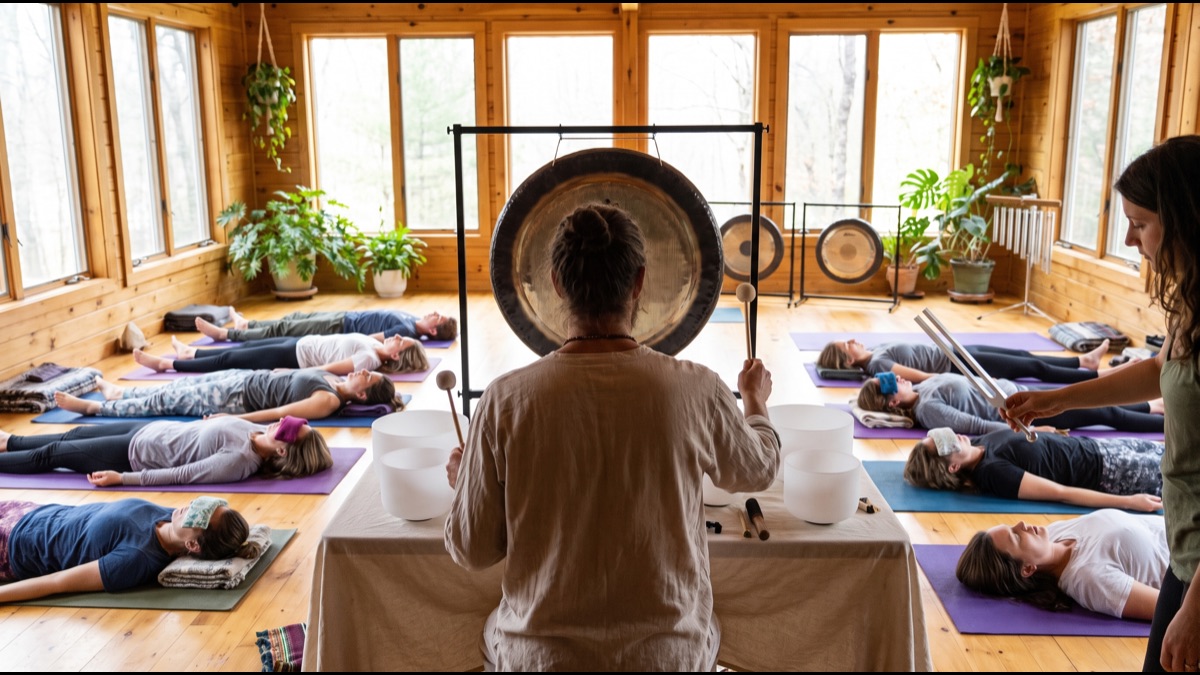
Lie down on a mat in a dim studio and a practitioner strikes a gong, sweeps a mallet around a circle of metal bowls, and the room fills with a wash of overlapping tones that seem to move through the body rather than simply arrive at the ears. Sound baths have become a fixture of wellness studios from Dubai to Los Angeles, promising deep relaxation, stress relief, and sometimes far more ambitious claims about healing at a cellular level.
Separating what is genuinely happening physiologically from what is marketing language borrowed from acoustics and physics requires looking closely at what instruments are actually used, what the body can measurably detect, and what the research literature on relaxation and sound actually supports rather than what practitioners sometimes assert.
What a Sound Bath Actually Involves
A typical sound bath gathers participants lying or sitting comfortably in a group setting while a practitioner plays a sequence of instruments for an extended, largely uninterrupted period, with little or no verbal instruction beyond an opening guided relaxation and closing return to alertness.
Unlike a musical performance built around melody and rhythm, sound baths favour sustained tones, slow builds, and long decays, deliberately avoiding the kind of structured, predictable musical patterns that keep a listener cognitively engaged, aiming instead for a state closer to passive, drifting attention.
Sessions are commonly offered in yoga studios, spas, and dedicated sound-healing centres, and have increasingly appeared as a standalone wellness offering rather than an adjunct to a yoga or meditation class, reflecting rising standalone demand for the format.
The Instruments Behind the Sound
Crystal and Himalayan metal singing bowls are the most recognisable instruments, producing a bowl-shaped resonance when struck or rubbed with a mallet around the rim, generating a fundamental tone along with a rich set of overtones that shift as the striking technique changes.
Gongs contribute the most physically forceful element of a typical session, capable of producing extremely low fundamental frequencies alongside chaotic, dense overtone clusters that some listeners describe as enveloping or disorienting in a way sharply different from a bowl's cleaner tone.
Tuning forks, chimes, rain sticks, and the human voice in the form of toning or chanting round out the typical instrument set, each contributing a distinct texture, with practitioners often layering several instruments to build and release intensity across the session.
What the Body Genuinely Experiences
Sound is mechanical energy, and at sufficient volume and proximity the ear is not the only organ detecting it; the skin, bones, and soft tissue of the body can register vibration directly, particularly from low-frequency sources like a large gong placed near the body or a bowl set directly on the torso.
This is a genuine, measurable physical phenomenon called somatic or tactile sound perception, distinct from ordinary hearing, and it plausibly contributes to the sensation participants describe as sound "moving through" the body rather than being simply heard.
Heart rate and breathing rate commonly slow during a session, consistent with what is observed during many calm, low-stimulation relaxation practices, though isolating how much of this response comes specifically from the sound itself versus the surrounding context of lying still in a dim, quiet room is genuinely difficult to establish.
The Relaxation Response Explanation
The most scientifically grounded explanation for sound bath benefits draws on the well-established relaxation response, a physiological state first characterised in the 1970s in which sustained, non-threatening, repetitive stimulation shifts the nervous system away from sympathetic arousal and toward parasympathetic dominance.
Under this framework, the specific instrument matters less than the overall structure of the experience: prolonged, undemanding sensory input in a safe, supported physical position reliably nudges most people toward reduced muscle tension, slower breathing, and a subjective sense of calm, regardless of whether the sound comes from a gong, ocean waves, or white noise.
This explanation is considerably more conservative than energy-healing framings, but it is also the one best supported by decades of research into meditation, biofeedback, and other relaxation techniques that share the same underlying mechanism without any of the more elaborate vibrational claims.
Why Low Frequencies Feel Like Physical Vibration
Human hearing perceives frequency as pitch, but very low frequencies, particularly below roughly 100 hertz, increasingly register as felt vibration rather than clearly pitched tone, a genuine acoustic and neurological phenomenon rather than a metaphor.
Large gongs and bass-heavy instruments produce substantial low-frequency energy capable of resonating within body cavities and being felt through a mat or the floor, which is precisely why sound bath practitioners often position gongs close to participants or use floor-transmitting platforms.
This physical resonance is real and measurable with standard acoustic equipment, but it is a mechanical phenomenon governed by ordinary physics, not evidence for the more specific claims sometimes made about frequencies correcting cellular dysfunction or clearing blocked energy.
What "Vibrational Frequency" Claims Actually Mean
Marketing language around sound healing frequently references specific frequencies said to correspond to particular organs, emotional states, or chakras, often citing numbers like 432 hertz as somehow more "natural" or healing than the standard 440 hertz tuning reference used in most modern music.
These specific frequency-to-outcome claims are not supported by peer-reviewed acoustics, physics, or medical research; the assignment of particular hertz values to particular healing effects traces to a mixture of numerology, misattributed historical claims, and marketing rather than any established biological mechanism.
This does not mean the instruments produce no real acoustic effect, only that the extremely specific correspondences claimed between exact frequencies and particular physiological or energetic outcomes go well beyond what current science can actually verify or explain.
The Evidence for Stress and Mood Benefits
Several small studies have measured self-reported stress, tension, and mood before and after sound bath sessions and found meaningful short-term improvements, with participants commonly reporting feeling calmer, less anxious, and more relaxed immediately following a session.
Some of this research has also measured physiological markers such as heart rate variability and blood pressure, generally finding shifts consistent with reduced physiological stress, broadly in line with what is observed after other passive relaxation interventions rather than uniquely attributable to sound.
These short-term findings are genuinely useful and consistent across a number of small studies, giving sound baths a reasonable evidence base as a relaxation practice, even though the mechanism driving the benefit likely overlaps heavily with general relaxation response effects rather than anything acoustically unique.
A handful of studies have also tracked participants over several sessions rather than a single visit, finding that regular attendance was associated with cumulative improvements in sleep quality and perceived stress comparable to what is reported in the literature on regular meditation practice, though again without the controlled comparison groups needed to rule out expectation and routine effects.
Where the Evidence Runs Thin
The research literature specific to sound baths remains genuinely limited in scale, with most studies involving small samples, no control group receiving a comparable non-sound relaxation intervention, and short follow-up periods that cannot speak to any lasting or cumulative benefit.
Claims that extend beyond mood and subjective stress, including assertions about pain relief, immune function, or cellular healing, are not well supported by the available evidence, and rigorous trials capable of separating a genuine sound-specific effect from ordinary relaxation and expectation effects are largely absent.
Placebo and expectation effects are a genuine confound in this research area specifically because the setting, ritual, and framing of a sound bath strongly cue relaxation regardless of the acoustic content, making it difficult to isolate what the sound itself is contributing versus the surrounding experience.
How Sound Baths Compare to Other Relaxation Practices
Compared with seated meditation, sound baths require less active mental effort from participants, since there is no instruction to maintain focus on breath or a mantra, which some people find considerably more accessible as an entry point into relaxation practice than traditional meditation.
Compared with guided progressive muscle relaxation or simple quiet rest, the acoustic layer adds a distinctive sensory anchor that many participants report helps prevent the mind from wandering toward stressful thoughts, functioning as a kind of passive attentional anchor rather than an active meditative technique.
None of this establishes sound baths as physiologically superior to these simpler, better-studied alternatives; the comparison is best understood as one of accessibility and personal preference rather than one practice being demonstrably more effective at producing relaxation than another.
Who Should Be Cautious
People with certain conditions affecting the inner ear, epilepsy triggered by rhythmic stimulation, or a history of trauma involving loud or unpredictable sound should discuss sound bath attendance with a healthcare provider, since the volume and duration of some sessions can genuinely be a poor fit.
Pregnant participants are sometimes advised to avoid direct contact with gongs or bowls placed on the abdomen, reflecting general caution around unstudied vibration exposure during pregnancy rather than any documented specific harm.
People with cochlear implants or certain hearing aids should check the device manufacturer's guidance before attending a session involving large gongs at close range, since some devices are sensitive to sustained low-frequency exposure in ways that ordinary hearing is not.
As with any wellness practice marketed with strong healing claims, treating a sound bath as a substitute for necessary medical treatment for a diagnosed condition is not supported by evidence and carries genuine risk if it delays appropriate care.
How the Wellness Industry Markets the Practice
Sound healing has grown into a genuine commercial category, with certification courses, branded instrument lines, and dedicated studios building a business around a practice that, at its evidentiary core, functions similarly to other well-established relaxation techniques.
The gap between the modest, well-supported claim (this helps many people relax) and the more expansive marketing claim (this heals at a cellular or energetic level) is where most of the legitimate scientific criticism of the industry concentrates, rather than in denying that participants often do feel genuinely calmer afterward.
Consumers are generally well served by seeking out practitioners who frame sessions honestly as relaxation practice rather than medical treatment, and by treating extraordinary specific healing claims with the same scepticism applied to any other unregulated wellness product.
What a First-Timer Should Expect
A first session typically begins with a short settling-in period, participants lying on mats or in chairs with blankets and eye coverings available, followed by 45 to 75 minutes of largely continuous instrument play with minimal verbal guidance beyond an opening and closing cue.
It is common to feel slightly disoriented or unusually tired immediately afterward, an experience some practitioners describe as a normal part of deep relaxation, though anyone with genuine dizziness or distress should simply leave the session rather than push through discomfort.
Arriving with reasonable, evidence-consistent expectations, wearing comfortable layered clothing since body temperature tends to drop during long periods of stillness, and bringing a light blanket if the studio does not provide one all make the physical experience considerably more comfortable regardless of what benefit a participant is hoping to get from it.
How the Practice Has Grown Across the Gulf
Sound healing has expanded rapidly across wellness centres in Dubai, Abu Dhabi, and Riyadh over the past several years, often positioned alongside more established offerings like yoga, float therapy, and spa treatments as part of a broader regional push into experiential wellness tourism and premium hospitality.
Several boutique studios in the UAE now offer sound bath sessions specifically framed around desert or beach settings, using the acoustics of open-air venues to create a different sensory experience from the enclosed, carpeted studios more typical of Western wellness centres, and marketing this as a distinctly regional take on the practice.
As with anywhere else, the same gap between well-supported relaxation benefits and more speculative healing claims applies to Gulf wellness offerings, and consumers evaluating a session marketed locally should apply the same scepticism toward extraordinary specific claims as they would anywhere in the world.
Approaching a sound bath as a structured relaxation practice with a reasonable, evidence-consistent expectation of reduced short-term stress, rather than as an alternative medical treatment, is the framing best supported by the current research and the one least likely to lead to disappointment or delayed necessary care. The genuine physics of vibration and the genuine psychology of the relaxation response are real; the more elaborate energetic claims layered on top by parts of the wellness industry are not, and separating the two is the difference between an evidence-informed practice and an oversold one.
Sources
- Wikipedia — overview of relaxation techniques and the relaxation response
- National Center for Complementary and Integrative Health (NCCIH) — evidence reviews of complementary and alternative wellness practices
- World Health Organization — general guidance on stress management and wellbeing
- Acoustical Society of America — background on acoustics and low-frequency sound perception
- American Psychological Association — research on stress physiology and relaxation interventions
FAQ
Is there real scientific evidence sound baths work?
There is reasonable evidence that sound baths can lower self-reported stress and improve mood in the short term, similar to other relaxation practices, but rigorous evidence for specific physiological healing claims is thin and much of the research uses small, uncontrolled samples.
Do singing bowls actually vibrate at healing frequencies?
Singing bowls produce measurable acoustic vibration and overtones, but claims about specific frequencies matching organs or chakras are not supported by physics or biology; the calming effect more plausibly comes from the relaxation response to sustained, predictable sound.
Can sound baths replace medical treatment?
No reputable practitioner or study supports using sound baths as a substitute for medical care; they are best understood as a relaxation and stress-reduction practice alongside, not instead of, conventional treatment.
Why do people feel vibrations during a sound bath?
Low-frequency sound genuinely produces mechanical vibration that can be felt through the mat or floor and via bone conduction, which is a real physical phenomenon distinct from the more speculative energetic claims sometimes attached to it.
How long does a typical sound bath session last?
Most public sound bath sessions run 45 to 75 minutes, often combined with guided relaxation or a short meditation before the instruments begin.
About the Author
We reference Wikipedia, the National Center for Complementary and Integrative Health, the World Health Organization, the Acoustical Society of America, and the American Psychological Association to explain the background and current understanding of this topic.
Loved This Article?
Share it on WhatsApp → Share it on WhatsApp
Get more guides in your inbox — Subscribe to our newsletter for weekly surprising stories from Egypt, Saudi Arabia, Dubai, and beyond.