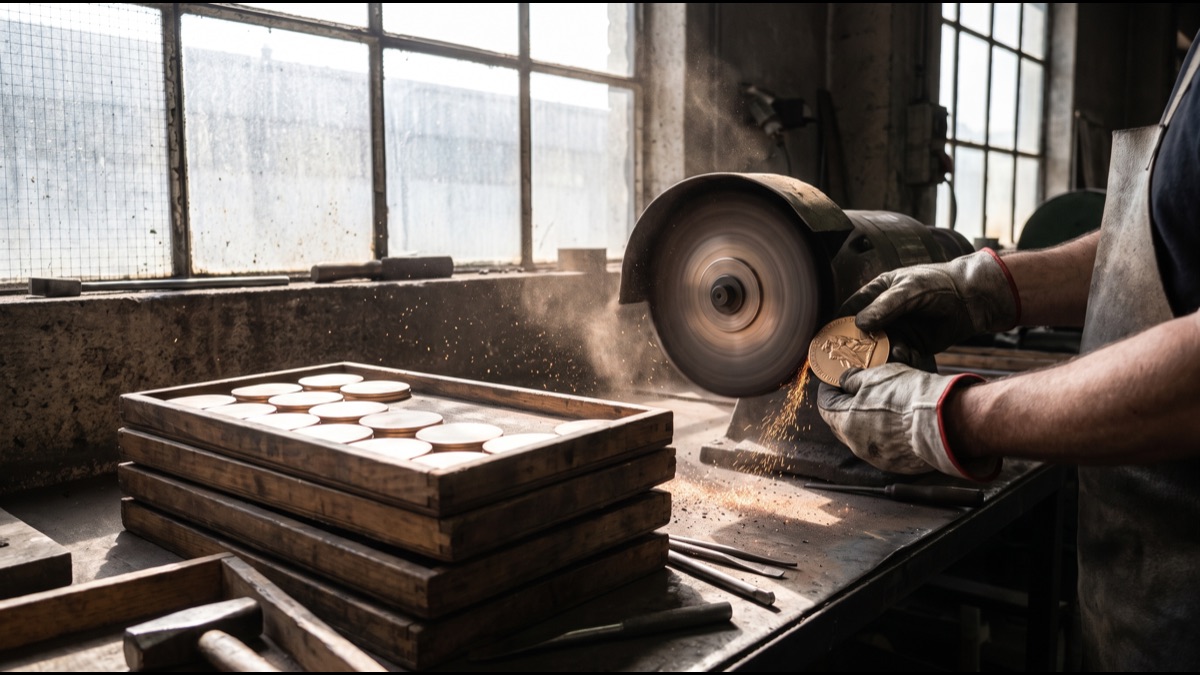
A medal ceremony lasts only a few minutes, but the object placed around an athlete's neck is the end product of a design, engineering, and manufacturing process that can take years and involves metallurgy, symbolism, and security measures most viewers never think about. The medal is not simply a trophy stamped out overnight; it is a carefully specified industrial object governed by rules, sourcing constraints, and design competitions that shape everything from its exact chemical composition to the ribbon it hangs from. Understanding how a medal actually comes into existence, from raw metal to the specific object handed to an athlete on a podium, reveals a surprisingly intricate story behind an object most people see for only a few seconds on television.
Why a 'Gold' Medal Is Mostly Not Gold at All
Olympic regulations have specified for over a century that the first-place medal must be made primarily of silver, plated with a minimum required quantity of pure gold, rather than being solid gold, a requirement rooted partly in the practical cost and weight of producing a solid gold medal at that size.
The governing specification typically requires the medal to be at least a set minimum weight of silver with a thin layer of gold, usually only a few grams, applied to the surface, meaning the visual gold finish is a plating rather than the bulk material of the object.
This has been true since long before modern cost-consciousness became a factor; solid gold at competition-medal size would be prohibitively heavy and expensive even for a well-funded organizing committee, which is why the silver-with-gold-plating approach has been standard practice for over a century.
How Silver and Bronze Medals Differ in Composition
The silver medal is generally made of the same base silver alloy as the gold medal, simply without the gold plating applied to the surface, which is why silver and gold medals of the same competition are often extremely close in underlying material composition and weight.
The bronze medal is typically made from a copper alloy, commonly a mix of copper with tin and zinc, a composition chosen partly for historical tradition and partly because bronze alloys are durable, relatively affordable, and take a fine, detailed die-stamped design well.
Because the underlying metal composition is specified by the organizing body's regulations rather than left entirely to the host committee's discretion, medal composition tends to be broadly consistent across different editions of a major recurring competition, even as the visual design changes substantially each time.
The Design Competition Behind a Medal's Appearance
Host committees for major events typically run a formal design competition, often involving professional designers or design agencies, sometimes combined with a public input process, to determine the medal's visual theme, which usually incorporates elements referencing the host country or city's culture, geography, or history.
This design brief has to satisfy technical manufacturing constraints alongside its symbolic goals, since a design with extremely fine detail or delicate raised elements can be difficult to strike cleanly and durably in metal, meaning the winning concept typically goes through several rounds of refinement with manufacturing engineers before finalization.
The reverse side of the medal, as opposed to the side carrying the event's standard required elements, is usually where a host committee has the most creative freedom, which is why medal reverses vary dramatically between different editions of the same competition even when the front-side format is largely fixed by governing regulations.
How a Medal Design Becomes a Physical Object
Once a design is finalized, engineers create a precise digital model of the medal's relief pattern, which is then used to manufacture a hardened steel die, essentially a metal stamp carved with the reverse of the design, capable of withstanding the enormous pressure required to strike thousands of medals without wearing down.
Producing this die is a specialized skill combining traditional engraving techniques with modern computer-aided manufacturing, since the die must capture fine design detail while also being engineered to survive repeated high-pressure strikes without the design degrading over the course of a full production run.
The actual striking process presses a blank metal disc between two dies, one for each face of the medal, under very high pressure, which forces the metal to flow into the fine details carved into the dies, a single powerful stamping action that produces the medal's final relief in a fraction of a second.
Why Medal Blanks Require Careful Metallurgical Preparation
Before striking, the metal blank must be carefully prepared through processes including alloying to precise specifications, casting into disc shapes, and annealing, a controlled heating and cooling process that makes the metal more malleable so it can be struck without cracking or producing an incomplete design.
Quality control at this stage is critical, since any inconsistency in the blank's thickness, alloy composition, or surface preparation can produce a flawed strike, either a medal with incomplete detail or one with internal stresses that could cause it to warp or crack after production.
Manufacturers producing medals for major international events typically work with tight tolerances specified by the organizing body, since medals are compared visually side by side on a podium and any noticeable inconsistency between individual medals would be immediately visible to a global broadcast audience.
The Electroplating Process That Puts the Gold on a Gold Medal
After the silver medal is struck, the required gold layer is typically applied through electroplating, a process that uses an electric current to deposit a thin, even layer of gold atoms onto the medal's surface from a gold-containing solution, rather than gold being mixed into the base metal itself.
This process must be tightly controlled to achieve an even coating across a surface with significant relief detail, since the raised and recessed areas of a struck design do not naturally plate evenly without careful control of current density and plating time across the medal's surface.
The plating thickness is specified by governing regulations as a minimum quantity, which manufacturers generally exceed somewhat to provide a margin of safety against uneven application, since a visible gap in the gold coating on a medal presented to a global audience would be a significant embarrassment for the organizing body.
Why the Ribbon Is a More Complicated Component Than It Looks
The ribbon attaching a medal is subject to its own design and manufacturing specification, often coordinated with the medal's visual theme and the broader visual identity of the event, and is typically produced in significant quantity well in advance since ribbons are far more likely to need replacement than the metal medal itself.
Some editions of major competitions have used ribbon materials incorporating recycled content or locally sourced textile production as part of a broader sustainability push, meaning the ribbon's supply chain can carry its own set of sourcing requirements distinct from those governing the metal components.
The clasp or attachment mechanism connecting ribbon to medal has to be engineered to hold securely through vigorous celebration, including athletes biting or holding the medal for photographs, a detail that seems minor but has practical failure-mode considerations in the manufacturing specification.
How Medal Security and Anti-Counterfeiting Measures Work
Because completed Olympic and similar major-event medals carry significant collector and resale value, organizing committees and manufacturers typically build in features intended to authenticate a genuine medal, which can include unique serialization, controlled production records tracking each individual medal, and sometimes subtle design elements not publicly disclosed.
Manufacturing facilities producing medals for major events generally operate under strict security protocols during the production run itself, since an unauthorized medal leaving the facility before the official ceremony would represent both a security failure and a potential embarrassment if it surfaced publicly ahead of the actual competition.
Post-event, organizing bodies and manufacturers have in various cases assisted in identifying counterfeit medals offered for sale by comparing weight, plating characteristics, and design details against production records, since the value of genuine medals has made counterfeiting an active concern for collectors and organizers alike.
What Happens to Medals That Are Lost, Stolen, or Damaged
Organizing bodies generally maintain a formal process allowing athletes to request a replacement medal in cases of genuine loss, theft, or damage, though this process typically requires documentation and is not treated as routine, both to preserve the object's significance and to prevent the process being used to obtain extra medals.
Some replacement requests stem from well-documented public incidents, such as medals damaged during celebrations or lost in transit, and organizing committees have in several known cases produced a replacement using the original production specifications and remaining die or digital design files where those records were preserved.
A minority of medals have also been intentionally sold by athletes, sometimes for cited charitable or personal financial reasons, at public auction, where a genuine, verifiable competition medal can command significant sums reflecting both the precious metal content and, more substantially, its documented historical and personal significance.
Why Different Competitions Follow Different Medal Rules Entirely
The specific composition, size, and design rules described above apply most directly to Olympic-style medals, but other major competitions, including various world championships and continental tournaments, set their own distinct specifications, meaning medal composition and design rules are not a single universal global standard.
Some competitions use trophies or other objects instead of, or alongside, medals for top honors, and some emphasize different materials entirely based on the sport's own traditions or the host organization's specific choices, meaning a viewer should not assume every awarded medal follows the same underlying manufacturing rules described here.
This variation is one reason medal specifications are typically detailed in each competition's own official regulations document rather than in any single global standard, and organizing committees for a new edition of a competition are generally required to have their proposed medal design and composition formally approved before manufacturing begins.
The Sourcing Question Behind the Raw Metal Itself
Where the silver, gold, and copper used in medal production actually comes from has become an increasingly public question in recent editions of major competitions, with several host committees specifically publicizing that metal was sourced from recycled electronic waste or other certified traceable sources as part of a broader sustainability commitment.
This sourcing shift reflects both genuine environmental considerations and a public relations opportunity, since a widely reported detail such as medals containing recycled metal from discarded electronics generates favorable coverage distinct from the medal's design itself.
Verifying these sourcing claims typically involves third-party certification of the recycling and refining chain, since simply asserting recycled content without an auditable supply chain would not satisfy the sustainability standards increasingly expected of major international event organizers.
How Long the Entire Process Actually Takes
The full process from initial design brief to finished, plated, ribbon-attached medal typically spans well over a year for a major international event, accounting for design competition, refinement, die manufacturing, metal sourcing and alloying, a full production run, quality control, and final assembly.
Manufacturers producing medals in the thousands for a large multi-sport event have to plan production well ahead of the competition itself, since any late design change or unexpected manufacturing defect discovered close to the event would leave little time for correction.
This lead time is one reason medal designs for a major upcoming competition are sometimes revealed publicly a year or more before the event itself, both as a promotional moment for the organizing committee and a practical reflection of how early in the production timeline the design is actually finalized.
Why the Number of Medals Produced Exceeds the Number of Athletes Who Win
A production run for a major multi-sport event has to account for team events, where every member of a winning team receives an individual medal, meaning the total medal count for a single event can range from one to dozens depending on whether it is an individual or team competition.
Manufacturers also produce a margin of spare medals beyond the calculated need, accounting for the possibility of manufacturing defects discovered during quality control, ties requiring an additional medal of the same rank, or late changes to results following official review or appeal.
This buffer production has to be accounted for early in the manufacturing schedule, since producing additional medals after the main run has concluded, particularly ones requiring gold electroplating, is far less efficient than including a reasonable margin within the original production batch.
How Testing and Prototyping Prevent Costly Manufacturing Mistakes
Before a full production run begins, manufacturers typically produce a small number of prototype medals using the finalized dies, allowing designers and organizing officials to physically inspect the medal's weight, finish, and design clarity before committing to the full order.
This prototyping stage is where subtle design problems are most commonly caught, such as a raised design element that looks correct in a digital rendering but does not strike cleanly in metal, or a color and finish combination that reads differently in physical metal than it did on screen.
Correcting a design flaw at the prototype stage is comparatively inexpensive; catching the same flaw only after a full production run has been struck and plated would mean scrapping and re-melting a significant quantity of precious and semi-precious metal, an outcome manufacturers and organizing committees work hard to avoid.
Why Some Editions of Major Competitions Have Faced Medal Manufacturing Controversies
Instances of medals tarnishing, chipping, or showing surface defects shortly after presentation have occurred in various editions of major competitions, sometimes drawing public attention when photographed by athletes and shared widely, prompting organizing committees to publicly explain the cause and, in some cases, offer replacements.
These incidents are usually traced to a specific manufacturing or plating issue, such as insufficient plating thickness, inadequate protective lacquer coating, or the medal's alloy reacting with environmental exposure such as saltwater or extended handling, rather than representing a fundamental problem with the underlying design.
Such incidents have led some organizing committees to adopt more rigorous accelerated aging and durability testing during the manufacturing approval process, deliberately exposing prototype medals to simulated years of handling and environmental exposure before finalizing the production specification.
What Role National Mints Play in Producing Official Medals
Many host countries award the medal production contract to their national mint, the same institution responsible for producing the country's coinage, since a national mint already possesses the industrial die-striking and precious-metal-handling infrastructure required for large-scale, high-precision medal production.
Using a national mint also carries a degree of national prestige and security assurance, since a mint accustomed to producing legal-tender currency already operates under strict chain-of-custody and anti-counterfeiting protocols directly transferable to medal production.
In cases where a national mint lacks sufficient capacity or specific technical capability for a particular design, organizing committees may contract a specialized private medal manufacturer instead, sometimes working alongside the national mint on different components of the same production run.
How Environmental and Ethical Sourcing Audits Actually Work in Practice
Verifying that metal used in medal production genuinely comes from certified recycled or ethically sourced material generally involves an independent auditor tracing the material through each stage of the supply chain, from the original waste or ore source through refining and alloying, and issuing a certification the organizing committee can cite publicly.
This auditing process has become more standardized in recent years as international bodies overseeing major sporting events have adopted explicit sustainability reporting requirements, meaning a sourcing claim in official promotional material is now generally expected to be backed by a specific, checkable certification rather than a general assertion.
Independent journalists and environmental organizations have in some cases separately investigated these sourcing claims, generally finding that headline claims about recycled content in medals are accurate at the level of the metal itself, though the broader supply chain feeding a large sporting event inevitably includes many components with less rigorously documented origins.
Why the Medal Case and Presentation Tray Are Part of the Same Production Effort
Alongside the medal itself, organizing committees typically commission a matching presentation case, tray, or box, often produced by a separate manufacturer specializing in packaging rather than metalwork, coordinated to match the same visual theme and timeline as the medal production run.
This case is not purely decorative; it is engineered to protect the medal during handling and storage, and its design has to account for the medal's exact dimensions and weight, meaning any late change to the medal's design can cascade into changes for the packaging supplier as well.
Athletes typically receive the medal in this case following the ceremony itself, since the medal presented on the podium is usually removed and securely stored between the ceremony and when the athlete formally receives the boxed medal along with any accompanying certificate or documentation.
How Digital Archiving of Medal Designs Supports Future Authentication
Organizing bodies and manufacturers typically retain detailed digital records of each medal edition's design, alloy specification, and production data long after the event concludes, both for historical archival purposes and to support any future authentication or replacement request from an athlete.
These archives have become increasingly valuable as collector interest in historic sports memorabilia has grown, since a documented, verifiable production record substantially increases both the authentication confidence and the market value of a medal later offered for sale or donated to a museum.
Some organizing bodies have partnered with museums or official heritage archives specifically to preserve prototype medals, dies, and design documentation as historical artifacts in their own right, distinct from the competition medals themselves that go on to athletes.
Why Athletes Are Instructed on How to Handle Medals During the Ceremony
Organizing committees typically brief medalists on ceremony logistics, including how the medal is presented and handed over, since a formal, coordinated presentation sequence has to work smoothly across dozens of ceremonies during a single major event with different medalists, languages, and cultural contexts each time.
This briefing occasionally addresses medal handling directly, such as advising against certain gestures with the medal that ceremony organizers consider inappropriate for the broadcast setting, reflecting that the ceremony itself, not just the object, is a carefully produced television and public-relations event.
The medal an athlete lifts on a podium is the visible final step of a long, exacting process spanning metallurgy, industrial engineering, design competition, and security protocol, all constrained by regulations that most viewers never encounter. A gold medal being mostly silver underneath is not a secret or a disappointment once the reasoning is understood — it reflects a century-old, sensible engineering compromise between symbolism, cost, and durability. From die-cutting and electroplating to ribbon attachment and anti-counterfeiting serialization, the object represents dozens of specialized skills converging on a single small item that will be handed to an athlete for a few seconds of ceremony and then kept, in most cases, for a lifetime.
Sources
- Wikipedia: Olympic medal — Background on Olympic medal composition regulations, design history, and manufacturing requirements.
- International Olympic Committee: Olympic Charter — Governing rules referenced for medal specification and competition regulation.
- Wikipedia: Electroplating — Technical background on the electroplating process used to apply gold to silver medal cores.
- Wikipedia: Bronze — Background on bronze alloy composition relevant to third-place medal manufacturing.
FAQ
Is an Olympic gold medal solid gold?
No. Regulations require it to be made primarily of silver with a required minimum quantity of pure gold, usually only a few grams, applied via electroplating to the surface. Solid gold at competition-medal size would be prohibitively heavy and expensive.
What is a bronze medal actually made of?
Bronze medals are typically made from a copper alloy, commonly combined with tin and zinc, chosen for durability, cost, and how well the alloy takes a fine, detailed die-stamped design.
How is the design on a medal actually created?
A digital design is translated into a hardened steel die, essentially a metal stamp carved with the design's relief pattern, which then strikes a prepared metal blank under very high pressure to produce the medal's final surface detail.
Can athletes get a replacement if they lose or damage their medal?
Generally yes, through a formal request process requiring documentation, though it is not treated as routine. Organizing bodies have produced replacements in verified cases using preserved production specifications and design files.
Where does the metal for medals actually come from?
It varies, but recent major competitions have increasingly sourced metal from certified recycled materials, including recycled electronic waste, as part of broader sustainability commitments, with third-party certification used to verify these sourcing claims.
About the Author
We reference Wikipedia: Olympic medal, International Olympic Committee: Olympic Charter, Wikipedia: Electroplating, and Wikipedia: Bronze to explain the background and current understanding of this topic.
Loved This Article?
Share it on WhatsApp → Share it on WhatsApp
Get more guides in your inbox — Subscribe to our newsletter for weekly surprising stories from Egypt, Saudi Arabia, Dubai, and beyond.