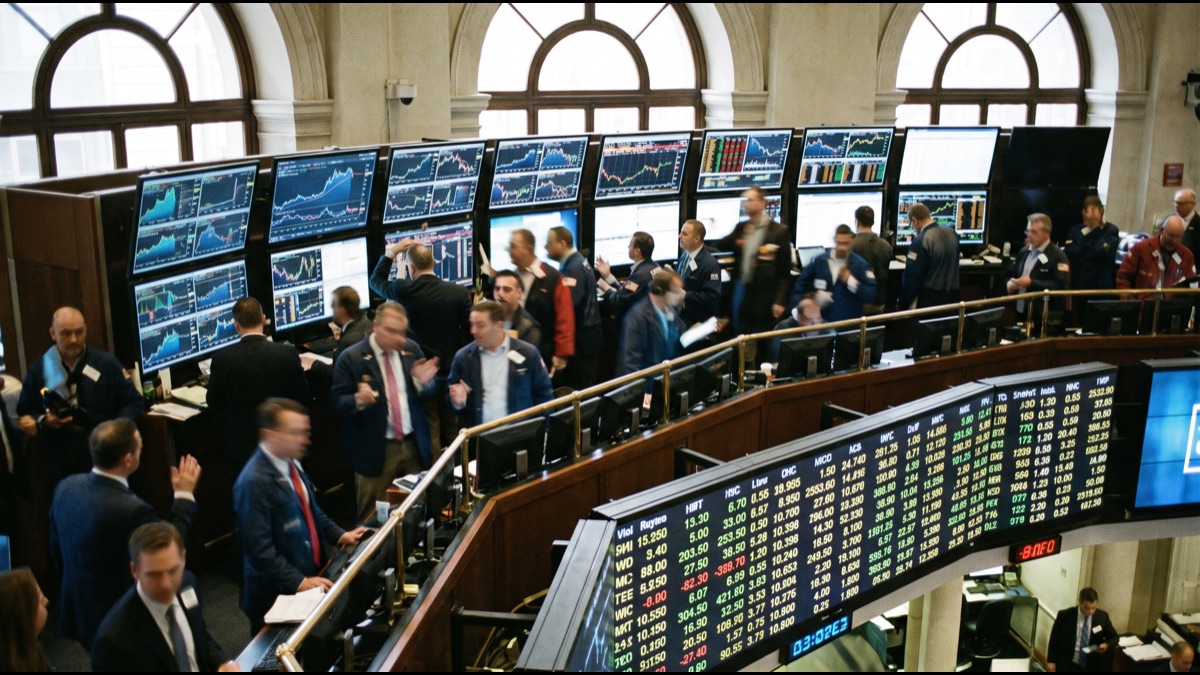
A stock market is an organized venue — almost entirely electronic today — where shares of publicly listed companies change hands. A share represents a small ownership stake in a company, entitling the holder to a proportional claim on its profits and, usually, a vote at shareholder meetings.
Prices move through continuous price discovery: buyers submit bids, sellers submit asks, and an exchange's matching engine pairs them the instant a bid meets an ask. When more people want to buy a stock than sell it, the price rises; when sellers outnumber buyers, it falls.
Buyers, Sellers, and Price Discovery
Primary vs. Secondary Markets
Companies first raise money by selling new shares directly to investors in an initial public offering, or IPO — this is the primary market. After that, the same shares trade endlessly between investors on the secondary market, and the company no longer receives money from those later trades directly.
Exchanges such as the New York Stock Exchange, Nasdaq, and Saudi Arabia's Tadawul enforce listing rules, disclosure requirements, and fixed trading hours that keep the process orderly and, in theory, transparent for every participant.
Sources
- Wikipedia — overview of stock market structure and history
- U.S. SEC Investor.gov — official guidance on how markets and exchanges function
- Saudi Exchange (Tadawul) — background on the Kingdom's primary stock exchange
FAQ
Do stock prices reflect a company's true value?
Not perfectly — prices reflect what investors currently believe a company is worth, blending fundamentals like earnings with sentiment, so prices can diverge from underlying value for extended periods.
What makes a stock price move minute to minute?
Order flow — the balance of buy and sell orders arriving at the exchange — combined with breaking news, earnings updates, and broader market sentiment.
Are all stock markets open at the same time?
No. Each exchange runs on its own local trading hours and calendar, so markets like Tadawul, the NYSE, and the Tokyo Stock Exchange open and close at different times, with only partial overlap.
About the Author
We reference Wikipedia, U.S. SEC Investor.gov, and Saudi Exchange (Tadawul) to explain the background and current understanding of this topic.
Loved This Article?
Share it on WhatsApp → Share it on WhatsApp
Get more guides in your inbox — Subscribe to our newsletter for weekly surprising stories from Egypt, Saudi Arabia, Dubai, and beyond.