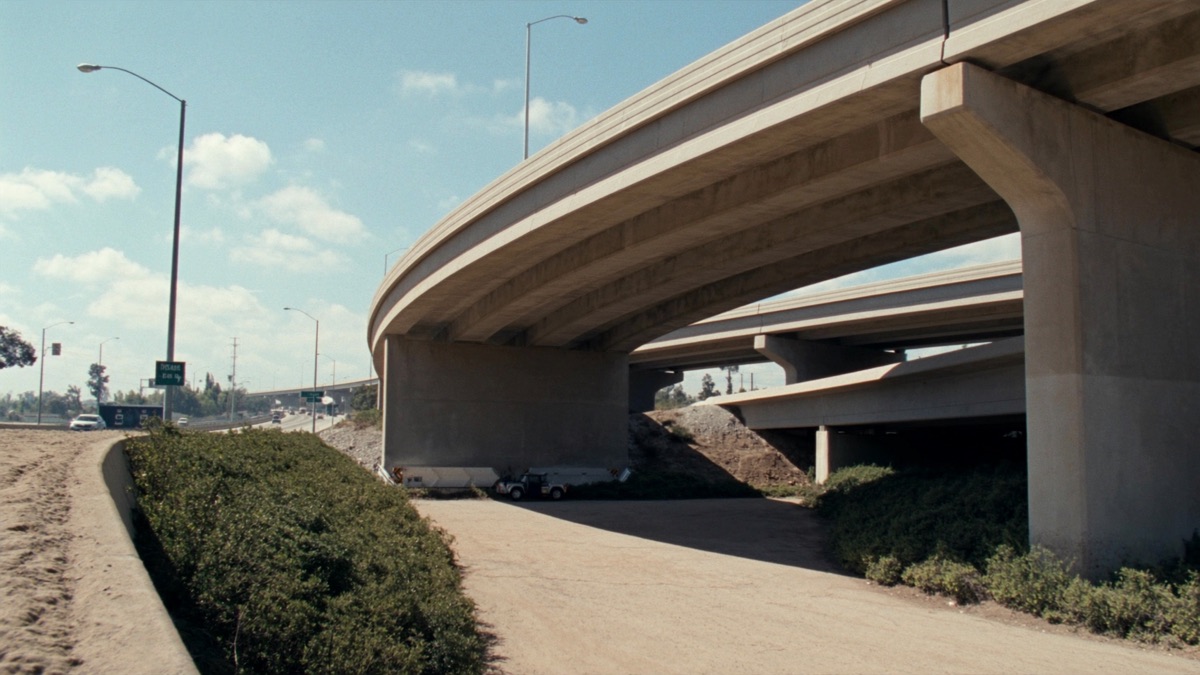
Suspension bridges carry their deck by hanging it from cables that drape between two tall towers, converting the deck's weight into pure tension the cables can handle far more efficiently than a beam or truss could span the same distance. This is why nearly every bridge spanning more than a kilometer over open water or a deep gorge is a suspension design rather than any other type.
Why Suspension Bridges Can Span Distances Other Bridges Cannot
A simple beam bridge resists load by bending, which puts the top of the beam in compression and the bottom in tension simultaneously, and the material needed to resist that bending grows very quickly as the span gets longer, making beams impractical past a few hundred meters.
A suspension bridge instead routes nearly all of the load into pure tension along its main cables, and steel is enormously strong in tension per unit of weight, which is exactly why suspension designs can leap spans that would require impossibly massive beams or trusses to achieve any other way.
How the Main Cables Actually Carry the Deck's Weight
The two main cables run from anchorages at each end of the bridge, up and over the tops of the towers, and down to the opposite anchorage, tracing a smooth curve called a catenary that naturally distributes tension evenly along the cable's length under a uniform load.
Vertical suspender cables, called hangers, drop down at regular intervals from the main cables to the deck below, transferring the deck's weight upward into the main cables, which then carry that combined load in tension all the way to the anchorages at either end.
What the Anchorages Actually Do
The anchorages are massive concrete or rock structures at each end of the bridge, built specifically to resist the enormous inward pull the main cables exert as they try to straighten under load, essentially acting as the fixed points the entire cable system pulls against.
Anchorage design varies with local geology — some bridges bolt directly into solid bedrock, while others rely on the sheer mass of a poured concrete block buried in the ground, but in both cases the anchorage must outweigh or out-resist the cable tension by a wide safety margin.
Why the Towers Are Built to Bend Slightly
The towers support the main cables at their highest point and carry that load down into the foundation as compression, but they are not rigid, fixed posts — most suspension bridge towers are designed to flex slightly at the top as the cables shift under changing traffic and wind loads.
This deliberate flexibility prevents the towers from cracking under the constant small movements a suspension system experiences daily, since a perfectly rigid tower would concentrate stress at its base every time the cable geometry shifted even slightly under load.
How Cable Spinning Actually Builds the Main Cables
Main suspension cables are not single massive ropes but bundles of thousands of individual, pencil-thin steel wires, spun in place high above the water or gorge by a traveling wheel that carries one wire back and forth between the anchorages thousands of times during construction.
Once spinning is complete, workers compact the bundle into a tight cylindrical shape and wrap it with additional wire for weatherproofing, producing a finished main cable that can be well over a meter in diameter despite starting as thousands of separate strands no thicker than a pencil.
Why the Deck Needs to Flex, Not Just Hang
A suspension bridge deck experiences constant small movement from traffic load, wind, and temperature change, and engineers deliberately design the deck and its connections to flex within a controlled range rather than trying to eliminate movement entirely, since a rigid structure would crack under stresses a flexible one simply absorbs.
Expansion joints at the towers and anchorages allow the deck to lengthen and shorten with temperature swings of tens of degrees across a year without buckling, a detail drivers rarely notice but that is essential to the bridge surviving decades of thermal cycling.
The Tacoma Narrows Collapse and What It Taught Engineers
The original Tacoma Narrows Bridge in Washington State collapsed dramatically in 1940, just months after opening, when moderate winds excited a twisting aerodynamic oscillation in its unusually narrow, solid-plate deck that grew larger and larger until the structure tore itself apart.
The collapse, captured on film and still studied in engineering courses today, permanently changed suspension bridge design by establishing wind-tunnel testing of deck cross-sections as standard practice and popularizing open-truss or box-girder decks that let wind pass through rather than pushing against a solid barrier.
How Modern Bridges Are Tested Against Wind Before Construction
Every major suspension bridge built since Tacoma Narrows undergoes extensive wind-tunnel testing using scale models of the actual deck cross-section, measuring how the shape responds to wind from every angle and at a wide range of speeds before a single cable is spun on the real structure.
Engineers specifically watch for aerodynamic flutter, the same self-reinforcing oscillation that destroyed Tacoma Narrows, and will redesign a deck's shape, add stabilizing vents, or adjust its stiffness until wind-tunnel data shows the design staying stable across every wind condition the bridge is likely to encounter over its service life.
Why Suspension Bridges Sway More Than People Expect
Suspension bridges are intentionally designed to sway and flex under wind and traffic load rather than resist it rigidly, and the amount of movement that feels alarming to a pedestrian crossing on foot is typically well within the structure's designed tolerance and poses no safety concern whatsoever.
Engineers calculate exactly how much a given design should move under specified wind speeds and traffic patterns during the design phase, and instruments installed on major bridges continuously monitor real-world movement against those predictions throughout the structure's operational life.
The Golden Gate Bridge's Engineering Legacy
The Golden Gate Bridge, completed in 1937, was for decades the longest suspension span in the world and remains one of the most studied examples of the design, notable for being built across a strait with powerful tidal currents, frequent fog, and significant seismic risk simultaneously.
Its chief engineer, Joseph Strauss, worked alongside other engineers including Charles Ellis and Leon Moisseiff to solve problems specific to the site, and the bridge has since undergone extensive seismic retrofitting to keep it safe as earthquake engineering standards advanced well beyond what was understood at the time of its original construction.
How Suspension Bridges Handle Earthquakes
Suspension bridges in earthquake-prone regions are retrofitted or originally designed with flexible joints, dampers, and reinforced towers specifically intended to absorb seismic energy rather than transmit it rigidly through the structure, since a suspension bridge's inherent flexibility actually helps it survive shaking that would crack a stiffer structure.
Engineers install devices called seismic dampers at key connection points that convert the kinetic energy of shaking into heat through controlled friction or fluid resistance, reducing the peak forces the bridge's cables and towers experience during a major earthquake.
Why Some of the Longest Spans Are in Japan and China
Japan and China have built several of the world's longest suspension bridge spans in recent decades, driven by geography that requires crossing wide straits and deep waterways between islands or around mountainous coastlines where alternative routes would be impractically long.
These projects pushed suspension bridge engineering forward significantly, particularly in seismic design and wind resistance, since many of these spans cross regions with both significant earthquake risk and powerful typhoon winds, requiring solutions more advanced than earlier generations of suspension bridges needed.
The Difference Between Suspension and Cable-Stayed Bridges
Cable-stayed bridges, often confused with suspension bridges, connect the deck directly to the towers with straight diagonal cables rather than hanging it from a curved main cable via vertical hangers, making cable-stayed designs generally more economical for medium spans but less efficient than true suspension bridges for the very longest crossings.
The visual difference is usually easy to spot once you know what to look for: suspension bridge cables form a smooth, continuous curve between towers, while cable-stayed bridge cables radiate outward from the tower in relatively straight lines directly to different points along the deck.
How Engineers Calculate the Right Cable Thickness
Determining main cable diameter requires calculating the total dead load of the deck, the expected live load from traffic, and additional dynamic loads from wind and seismic activity, then applying a substantial safety factor on top of the theoretical minimum strength needed, typically several times the maximum calculated load.
This conservative safety margin accounts for material imperfections, unexpected load combinations, and the difficulty of ever fully replacing a main cable once a bridge is in service, since main cable replacement is among the most complex and expensive maintenance operations possible on a major suspension structure.
Why Painting a Suspension Bridge Never Truly Ends
Steel suspension bridge components require continuous protection from corrosion, particularly in marine environments where salt air accelerates rust, which is why bridges like the Golden Gate Bridge maintain a permanent painting crew that works continuously along the structure, finishing one full cycle only to begin the next.
Modern protective coatings last considerably longer than older paint formulations, but the fundamental maintenance challenge remains unchanged: a suspension bridge is a massive steel structure permanently exposed to weather, and neglecting its protective coating for even a few years can allow corrosion to take hold in ways that are far more expensive to fix later.
How Traffic Load Is Distributed Across the Structure
When vehicles cross a suspension bridge, their combined weight transfers through the deck into the hangers, then into the main cables, and finally into the anchorages and towers, meaning every part of the load path must be engineered to handle not just the deck's own weight but the full range of traffic conditions the bridge will ever experience.
Engineers model worst-case scenarios like bumper-to-bumper traffic across the entire span combined with high wind, ensuring the structure retains an adequate safety margin even under combined loading conditions far more severe than typical daily use.
The Role of Tuned Mass Dampers in Modern Designs
Some modern suspension bridges incorporate large tuned mass dampers, heavy weights mounted on springs or hydraulic systems inside the deck or towers, engineered to oscillate out of phase with the bridge's natural sway and cancel out a portion of wind- or traffic-induced vibration before it becomes noticeable or problematic.
These systems work on the same physical principle used in tall skyscrapers to reduce sway in high wind, adapted to the specific vibration frequencies and structural characteristics of a suspension bridge's deck and towers.
Why Some Historic Suspension Bridges Still Use Wrought Iron
A handful of the oldest surviving suspension bridges, built in the 19th century before modern high-strength steel became widely available, still use their original wrought-iron chains or early steel cables, requiring specialized inspection and maintenance programs to keep century-old materials safely in service.
Preservation engineers working on these historic structures must balance maintaining original materials for heritage value against the practical need to ensure ongoing structural safety, sometimes reinforcing original components internally in ways invisible to visitors while keeping the bridge's historic appearance fully intact.
What Happens During a Full Suspension Bridge Inspection
Comprehensive suspension bridge inspections involve engineers physically climbing inside the main cables at designated inspection points, examining individual wire strands for corrosion or fatigue cracking, and using specialized robotic crawlers on some modern bridges to examine cable sections too difficult or dangerous for a human inspector to reach directly.
These inspections typically occur on multi-year cycles for different components, since a full cable inspection is far more labor-intensive than checking the deck surface or expansion joints, and any significant finding can trigger immediate load restrictions while engineers assess the full extent of the issue.
The Future of Suspension Bridge Materials and Design
Engineers are increasingly experimenting with carbon fiber composite cables as a potential future alternative to steel, offering comparable strength at a fraction of the weight, which could theoretically allow even longer spans than today's steel-cable suspension bridges can achieve, though cost and long-term durability data remain limiting factors for widespread adoption.
Advances in structural health monitoring, using networks of sensors embedded throughout a bridge to continuously track stress, vibration, and material condition in real time, are also changing how engineers maintain aging suspension bridges, catching developing problems earlier than periodic visual inspection alone ever could.
Sources
- Wikipedia — suspension bridge design and engineering
- Wikipedia — the 1940 Tacoma Narrows Bridge collapse
- Golden Gate Bridge, Highway and Transportation District — Golden Gate Bridge engineering history
FAQ
Why can suspension bridges span much longer distances than beam bridges?
They route nearly all load into pure tension along steel cables, and steel is extremely strong in tension per unit of weight, whereas beam bridges must resist bending, which requires disproportionately more material as span length grows.
What is the role of the anchorages at either end?
The anchorages are massive concrete or rock structures that resist the enormous inward pull the main cables exert as they try to straighten under load, acting as the fixed points the whole cable system pulls against.
Why do suspension bridge towers flex slightly instead of staying rigid?
Deliberate flexibility at the top of the towers prevents cracking from the constant small movements the cable system experiences daily; a perfectly rigid tower would concentrate stress at its base with every shift in cable geometry.
How are the massive main cables actually built?
They are spun in place from thousands of individual pencil-thin steel wires using a traveling wheel that carries one wire back and forth between anchorages thousands of times, then compacted and wrapped for weatherproofing.
What caused the original Tacoma Narrows Bridge to collapse?
Moderate winds excited a self-reinforcing twisting aerodynamic oscillation in its unusually narrow, solid-plate deck, which grew until the structure tore itself apart just months after opening in 1940.
How do engineers test bridge designs against wind today?
They use extensive wind-tunnel testing on scale models of the actual deck cross-section, watching specifically for aerodynamic flutter and redesigning the shape until the structure stays stable across all expected wind conditions.
Is it dangerous when a suspension bridge sways in the wind?
No; suspension bridges are intentionally designed to sway and flex within a calculated tolerance, and the movement pedestrians notice is typically well within the structure's designed safety margin.
How do suspension bridges survive earthquakes?
They use flexible joints, seismic dampers, and reinforced towers designed to absorb shaking energy rather than transmit it rigidly, and the bridge's inherent flexibility actually helps it survive shaking that could crack a stiffer structure.
What is the difference between a suspension bridge and a cable-stayed bridge?
A suspension bridge hangs its deck from a curved main cable via vertical hangers, while a cable-stayed bridge connects the deck directly to the towers with straight diagonal cables, making it more economical for medium spans.
How do engineers decide how thick the main cables need to be?
They calculate total dead load, expected traffic load, and dynamic wind and seismic loads, then apply a substantial safety factor, often several times the theoretical minimum strength required.
Why do bridges like the Golden Gate need constant painting?
Steel components require continuous protection from corrosion, especially in marine environments where salt air accelerates rust, so major bridges maintain permanent painting crews that finish one cycle only to start the next.
What do tuned mass dampers do on a suspension bridge?
They are heavy weights on springs or hydraulics engineered to oscillate out of phase with the bridge's natural sway, canceling out a portion of wind- or traffic-induced vibration before it becomes problematic.
How do engineers inspect the inside of a main cable?
They physically climb inside the cable at designated inspection points to examine individual wire strands for corrosion or fatigue, and some modern bridges use robotic crawlers to reach sections too difficult for a human inspector.
Could future suspension bridges use materials other than steel?
Engineers are experimenting with carbon fiber composite cables, which offer comparable strength at a fraction of the weight, though cost and long-term durability data still limit widespread adoption.
Why do expansion joints matter on a suspension bridge deck?
They allow the deck to lengthen and shorten with seasonal temperature swings of tens of degrees without buckling, a detail essential to surviving decades of thermal cycling.
About the Author
We reference Wikipedia and other authoritative sources to explain the background and current understanding of this topic.
Loved This Article?
Share it on WhatsApp → Share it on WhatsApp
Get more guides in your inbox — Subscribe to our newsletter for weekly surprising stories from Egypt, Saudi Arabia, Dubai, and beyond.