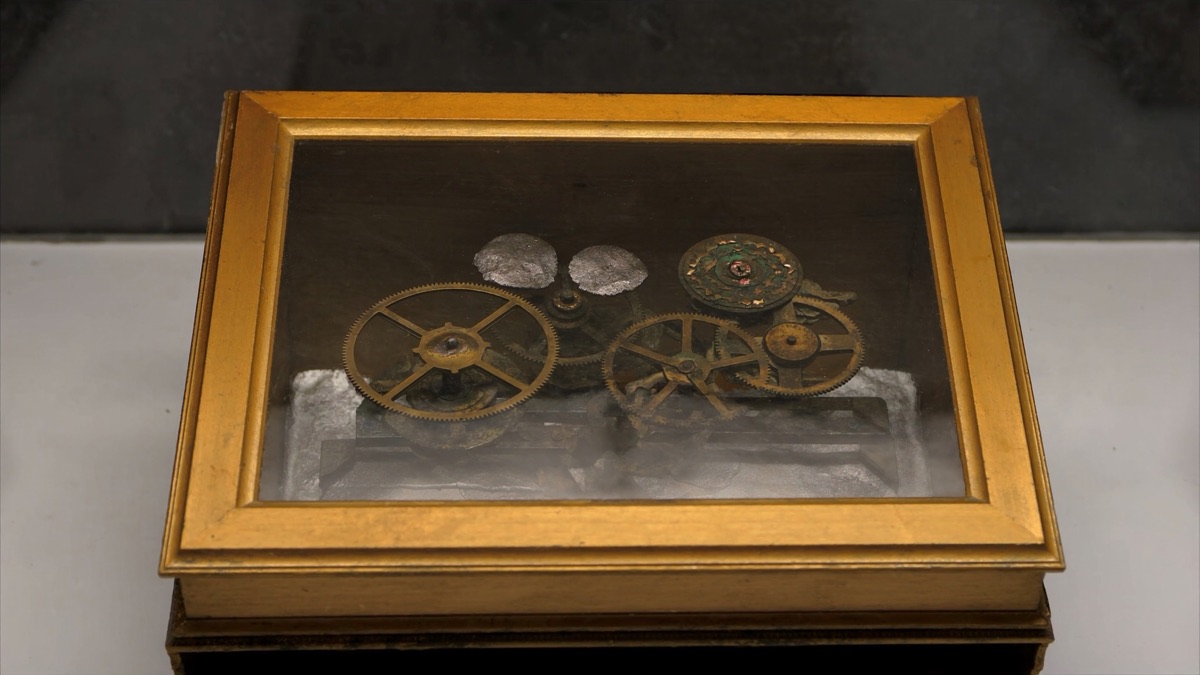
The Antikythera mechanism actually works as a hand-cranked mechanical computer that used dozens of precisely cut bronze gears to predict the positions of the sun, moon, and planets decades before the date it was set to. Recovered from a Roman-era shipwreck off a Greek island in 1901, it is roughly 2,000 years older than any other known device of comparable mechanical complexity.
A Shipwreck That Rewrote the History of Technology
Sponge divers discovered the wreck by accident while sheltering from a storm, and among the statues, coins, and pottery they recovered was an unremarkable, badly corroded lump of bronze that sat in a museum storeroom for months before anyone recognized it contained gear teeth.
For decades after its discovery, historians assumed something this mechanically sophisticated simply could not have existed in the ancient world, and it took X-ray and later 3D CT imaging technology, developed nearly a century after the wreck was found, to finally reveal the full internal gear structure hidden inside the corroded fragments.
What X-Ray Imaging Actually Revealed Inside the Corrosion
The mechanism survived only as 82 corroded bronze fragments, the largest barely the size of a hand, and centuries underwater had fused the gears together with calcified marine growth that made any direct physical examination destructive and unreliable.
High-resolution X-ray computed tomography, applied to the fragments starting in the early 2000s, let researchers see straight through the corrosion layers to count individual gear teeth and trace how each gear meshed with its neighbors without ever having to physically separate a single fused piece.
How Many Gears the Device Actually Contained
Researchers have identified at least 30 surviving bronze gears, and inscriptions and gear-ratio calculations suggest the complete original mechanism likely contained even more, arranged inside a wooden case roughly the size of a large book.
The smallest gears identified have teeth cut with a precision that seems remarkable for hand tools of the era, with tooth spacing consistent enough that researchers could confidently reconstruct the mathematical ratios the ancient makers intended between connected gears.
Tracking the Sun and Moon With a Single Front Dial
A single crank on the side of the device turned an internal drive gear that moved the entire gear train, and turning it forward or backward let the user set the mechanism to any specific date, past or future, within its calculated range.
The front dial displayed the position of the sun and moon against the zodiac using two years shown, letting a user read off where those bodies would appear in the sky for that specific date without any modern instruments or observation required.
The Ingenious Gear That Modeled the Moon's Uneven Speed
Ancient Greek astronomers already understood that the moon does not move across the sky at a perfectly constant speed, appearing to speed up and slow down slightly over its orbit due to its elliptical path around Earth.
The mechanism modeled this variation using a clever pin-and-slot gear arrangement, where one gear's pin rode inside a slot cut into a second, slightly offset gear, mechanically reproducing the moon's actual variable speed rather than assuming a simplified constant motion.
Predicting Eclipses Years Before They Happened
A separate spiral dial on the back of the device tracked what is now called the Saros cycle, an 18-year, 11-day pattern the Babylonians had discovered by which lunar and solar eclipses repeat in a predictable sequence.
Small inscribed glyphs along this spiral marked specific months when an eclipse was predicted, some even noting the expected time of day, letting the device forecast eclipse risk years into the future purely through mechanical calculation rather than fresh astronomical observation.
A Calendar Dial Built for the Olympic Games
One of the smaller dials tracked the four-year cycle of the ancient Panhellenic games, including the Olympics, letting the user identify which games year corresponded to any date the main mechanism was set to.
This inclusion strongly suggests the device was not built purely for elite astronomical research but also served a genuinely practical civic and social function, helping track a calendar cycle that mattered for travel and planning across the wider Greek world.
Why the Mechanism Uses a 19-Year Calendar Cycle
The main calendar dial follows the Metonic cycle, a 19-year pattern in which the phases of the moon repeat on nearly the same calendar dates, a relationship the Greek astronomer Meton had identified centuries before the device was built.
Building this cycle directly into the gearing let the mechanism reconcile the lunar month, which does not divide evenly into a solar year, with a workable civil calendar, solving a genuine practical problem every lunar-based calendar system in the ancient world had to address somehow.
Evidence for a Now-Lost Planetary Display
Inscriptions on the fragments reference the positions of Mars, Venus, and other visible planets, and gear-ratio evidence suggests a display for planetary motion once existed on the mechanism's missing front section, though the actual gears for it have never been recovered.
Researchers have proposed several competing reconstructions of exactly how a planetary display would have worked mechanically, since replicating the genuinely irregular apparent motion of planets, including their occasional backward loops, would have demanded significantly more complex gearing than the confirmed lunar and solar mechanisms.
The Inscriptions That Functioned as a User Manual
Thousands of tiny inscribed Greek letters, many barely visible to the naked eye, cover the inside and outside surfaces of the mechanism's plates, describing what each dial showed and in some cases how to interpret specific readings.
Modern imaging has recovered a large share of this inscribed text, and it functions essentially as an ancient user manual, giving researchers direct textual confirmation of features that gear analysis alone had already suggested but could not fully prove.
Who Actually Built It Remains Genuinely Unknown
No maker's signature or workshop mark survives on any recovered fragment, and while scholars have proposed links to astronomers such as Hipparchus, whose lunar theory the gearing closely matches, no direct evidence confirms a single specific inventor.
The device's construction style and the Greek dialect used in its inscriptions point toward the eastern Mediterranean, with the island of Rhodes, a known center of astronomical study in that era, frequently proposed as its likely origin, though this remains an educated inference rather than settled fact.
Dating the Device From the Ship That Carried It
The surrounding shipwreck contained coins, pottery, and other datable artifacts that place the vessel's sinking at roughly 70 to 60 BCE, giving researchers a firm latest possible date for when the mechanism was in active use.
Some scholars argue the mechanism itself was built a few decades earlier than the shipwreck based on the specific astronomical calculations embedded in its gearing, suggesting it may have already been a valuable older instrument being transported, rather than a brand-new device, when the ship went down.
Why This Level of Precision Gearing Then Disappeared
No other geared mechanism of remotely comparable complexity survives from the ancient world, and clockwork of similar sophistication does not reappear clearly in the historical record until European astronomical clocks roughly 1,400 years later.
Historians debate whether this reflects a genuine, near-total loss of the relevant technical knowledge during the intervening centuries, or simply that mechanisms this fragile, valuable, and rare almost never survived long enough to be found, meaning similar devices may simply not have left recoverable evidence behind.
How Modern Researchers Physically Reconstructed the Gear Train
Teams at institutions including University College London have built working physical and digital reconstructions of the full gear train, testing whether the proposed tooth counts and gear ratios actually produce astronomically accurate output when the mechanism is cranked through a full cycle.
These reconstructions serve as a genuine scientific test of competing theories about the missing sections, since a proposed gear arrangement that fails to reproduce known astronomical relationships when built and turned can be confidently ruled out rather than merely debated on paper.
The Manufacturing Precision That Still Impresses Engineers Today
Some of the mechanism's gears have teeth spaced barely a millimeter apart, cut with enough consistency that modern engineers examining the reconstructions have noted the manufacturing tolerance rivals what would later be expected of much later mechanical clockwork.
This precision implies the existence of specialized tools, likely including some form of dividing plate for marking equally spaced gear teeth, that have not themselves survived or been directly documented anywhere else in the surviving ancient record.
What the Device Reveals About Ancient Greek Astronomy
The mechanism's gearing embeds astronomical values, including the length of the lunar month, that closely match theoretical calculations attributed to Hipparchus and other Hellenistic astronomers, confirming those ancient calculations were accurate enough to be built directly into functioning mechanical hardware.
This gives historians physical, load-bearing evidence of how genuinely sophisticated Hellenistic mathematical astronomy had become, rather than relying solely on fragmentary surviving texts that describe theories without any surviving instrument to show they were actually put into practical use.
How the Device Traveled Through Museums and Research Teams
The fragments have resided at the National Archaeological Museum in Athens since shortly after their recovery, and international research collaborations have periodically gained access for new rounds of imaging as scanning technology improved across subsequent decades.
Each new generation of imaging technology, from early X-rays to modern high-resolution CT scanning, has extracted additional inscribed text and gear detail that earlier researchers using less capable equipment simply could not see, meaning the device continues to yield new findings even without any new physical fragments being recovered.
Comparing It to Later Astronomical Clockwork
Medieval and Renaissance astronomical clocks, built more than a thousand years later across Europe and the Islamic world, share the same fundamental engineering goal of using interlocking gears to model celestial motion, though none of their makers are known to have had any direct knowledge of the Antikythera mechanism itself.
This apparent independent reinvention of geared astronomical modeling suggests the underlying engineering idea was compelling enough to be arrived at more than once across history, even after the specific ancient Greek tradition that produced this particular device had been lost.
Why the Mechanism Continues to Attract New Research
Portions of the device, particularly the proposed planetary display and several minor dials, remain genuinely unresolved, and researchers continue publishing competing reconstructions as imaging techniques and mechanical analysis methods keep improving.
Its unmatched combination of mechanical complexity and historical age keeps it one of the most actively studied single artifacts in the history of science, cited constantly whenever historians discuss the actual limits of ancient technological capability.
Why the Wooden Case Barely Survived at All
The mechanism's original wooden housing, which likely carried external plates listing operating instructions, largely disintegrated in seawater over two millennia, leaving only faint impressions and a handful of surviving wood fragments fused to the bronze plates themselves.
Researchers have had to infer the case's original size and layout almost entirely from the shape of the surviving bronze plates and dial fragments, since so little direct physical evidence of the housing itself made it back to the surface intact.
What the Discovery Changed About How Historians View Ancient Technology
Before the mechanism's internal complexity was fully understood, most historians of technology assumed ancient Mediterranean engineering peaked with structures like aqueducts and monumental architecture rather than precision instrumentation.
The device forced a genuine reassessment of that assumption, showing that at least some ancient workshops could achieve a level of miniaturized mechanical precision previously assumed to be impossible before the medieval period, reshaping how museums and textbooks now frame the outer limits of ancient engineering.
Sources
- Wikipedia — overview of the Antikythera mechanism's discovery and function
- University College London Antikythera Research — modern reconstruction research
- National Archaeological Museum, Athens — custodian of the surviving fragments
FAQ
What did the Antikythera mechanism actually do?
It functioned as a hand-cranked mechanical calendar and predictor, using interlocking bronze gears to show the positions of the sun and moon, forecast eclipses, and track lunar and civic calendar cycles for any set date.
How was the mechanism discovered?
Sponge divers found it among statues, coins, and pottery in a Roman-era shipwreck off the Greek island of Antikythera in 1901, though its true mechanical complexity was not recognized until much later.
How many gears did the device actually contain?
Researchers have identified at least 30 surviving bronze gears, with inscriptions and gear-ratio evidence suggesting the complete original device likely had even more.
How did the mechanism model the eclipse cycle?
A spiral dial on the back tracked the 18-year, 11-day Saros cycle, with inscribed glyphs marking specific months when an eclipse was predicted, sometimes including the expected time of day.
Could the device account for the moon's changing speed?
Yes; a pin-and-slot gear mechanism mechanically reproduced the moon's actual variable orbital speed rather than assuming a simplified constant motion.
Who built the Antikythera mechanism?
No maker's signature survives, though scholars have proposed links to astronomers like Hipparchus and suggest the island of Rhodes as a likely origin, without direct confirming evidence.
How old is the Antikythera mechanism?
The shipwreck that carried it sank around 70 to 60 BCE, and some scholars believe the device itself was built a few decades earlier based on its embedded astronomical calculations.
Did the mechanism track anything other than the sun and moon?
Yes; it also tracked the four-year cycle of the ancient Panhellenic games including the Olympics, and inscriptions suggest a now-missing planetary display once existed.
How did researchers see inside the corroded fragments?
High-resolution X-ray computed tomography, developed decades after the discovery, let researchers see through corrosion layers to count gear teeth without physically separating the fragments.
Why did similarly complex geared devices disappear for over a thousand years?
Historians debate whether the relevant technical knowledge was largely lost, or whether such fragile, valuable mechanisms simply rarely survived long enough to be rediscovered.
What is the Metonic cycle and why does the mechanism use it?
It is a 19-year pattern in which lunar phases repeat on nearly the same calendar dates, and building it into the gearing let the device reconcile the lunar month with a workable civil calendar.
Have researchers built working replicas of the mechanism?
Yes; teams including one at University College London have built physical and digital reconstructions to test whether proposed gear arrangements actually produce astronomically accurate output when turned through a full cycle.
What do the inscriptions on the mechanism actually say?
Thousands of tiny inscribed Greek letters describe what each dial showed and how to interpret specific readings, functioning essentially as an ancient user manual for the device.
Is any part of the Antikythera mechanism still unexplained?
Yes; the proposed planetary display and several minor dials remain genuinely unresolved, and researchers continue publishing competing reconstructions as imaging and analysis methods improve.
Did the mechanism's wooden case survive?
Barely; the original wooden housing largely disintegrated in seawater over two millennia, leaving researchers to infer its size and layout mostly from the surviving bronze plates and dial fragments themselves.
How did the discovery change how historians view ancient technology?
It forced a reassessment of the assumption that ancient Mediterranean engineering peaked with monumental architecture, showing that at least some workshops could achieve miniaturized mechanical precision previously assumed impossible before the medieval period.
Why is the Antikythera mechanism sometimes called the first analog computer?
Because it performed a genuine calculation — converting an input date into astronomical output positions — through purely mechanical gear ratios rather than any form of digital processing, matching the basic definition of an analog computing device.
About the Author
We reference Wikipedia and other authoritative sources to explain the background and current understanding of this topic.
Loved This Article?
Share it on WhatsApp → Share it on WhatsApp
Get more guides in your inbox — Subscribe to our newsletter for weekly surprising stories from Egypt, Saudi Arabia, Dubai, and beyond.