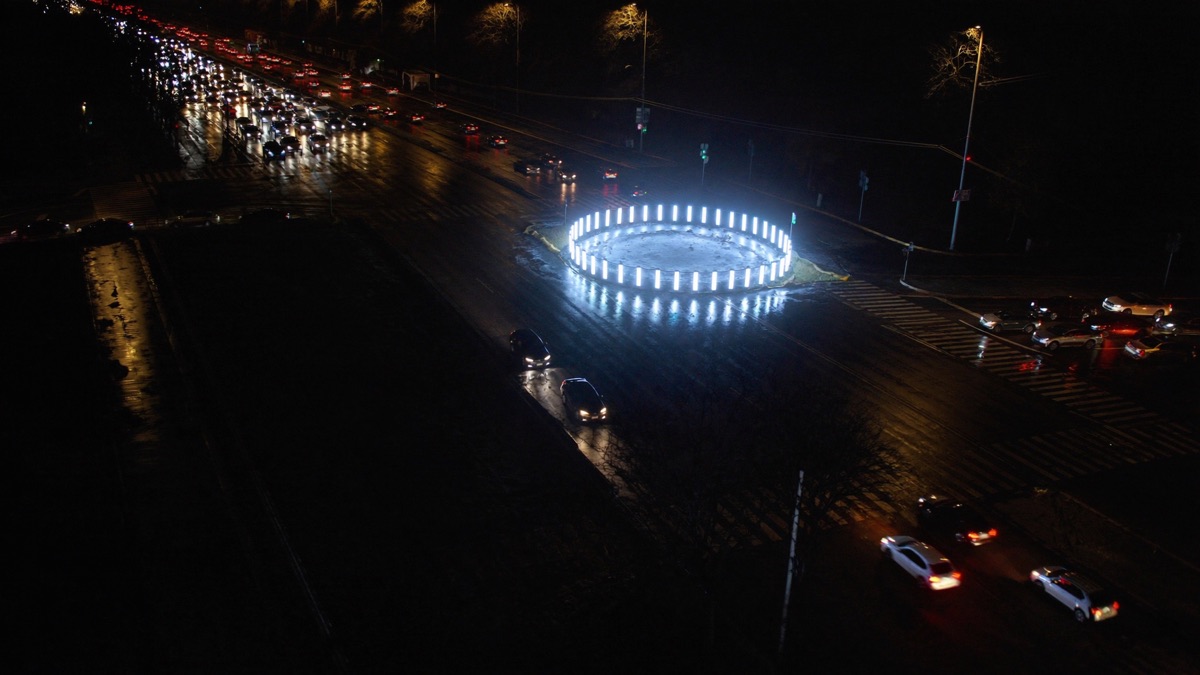
A traffic circle can feel counterintuitive the first time you drive one, no light telling you exactly when to go, other cars merging from multiple directions at once, and yet the engineering data is remarkably consistent across countries and decades: converting a standard signalized or stop-controlled intersection into a modern roundabout tends to produce a dramatic drop in serious and fatal crashes, even in cases where total collision counts don't fall by much at all. Understanding exactly why requires looking past the confusing merge and focusing on what a roundabout actually removes from an intersection's geometry.
The eight-conflict-point problem of a standard intersection
Traffic engineers analyze intersection safety partly through a concept called conflict points, specific locations where two vehicle paths can physically cross, merge, or diverge, each one representing a distinct opportunity for a collision. A standard four-way signalized intersection with left turns permitted has 32 vehicle-to-vehicle conflict points, a mix of crossing conflicts, where two paths intersect at an angle, merging conflicts, where paths join, and diverging conflicts, where paths split, and crossing conflicts specifically are the most dangerous category because they produce the T-bone and head-on collision angles most likely to cause serious injury or death.
A single-lane modern roundabout, by contrast, has only 8 total conflict points, and critically, none of them are crossing conflicts at all; every conflict point at a roundabout is a merging or diverging conflict, where vehicles are traveling in roughly the same direction at the point of interaction rather than at a perpendicular or head-on angle, which is the single biggest structural reason roundabout injury crashes tend to be so much less severe even when a collision does occur.
Why eliminating crossing conflicts matters more than reducing total crashes
A crossing collision, the classic T-bone crash at a traditional intersection, transfers a vehicle's kinetic energy directly into the side of another vehicle, the structurally weakest part of most cars and the part offering occupants the least crush-zone protection, which is exactly why side-impact crashes carry a disproportionately high rate of serious injury and fatality compared to their overall frequency. A head-on collision, similarly absent from roundabout geometry under normal operation, combines the closing speed of both vehicles into a single catastrophic impact.
Because a roundabout's circular geometry physically prevents vehicles from approaching each other at these dangerous angles, forcing all interactions into same-direction merging and diverging instead, roundabouts don't just reduce the total number of crashes somewhat, they specifically eliminate the crash types responsible for the overwhelming majority of intersection fatalities and severe injuries, which is why national road-safety research bodies consistently find fatal-crash reductions at converted intersections in the 70 to 90 percent range, a far larger effect than the reduction in total crash count alone would suggest.
Speed reduction is doing as much work as geometry
A roundabout's curved entry geometry physically forces drivers to slow down before entering, typically to somewhere between 25 and 35 kilometers per hour depending on the roundabout's specific radius, regardless of what speed a driver was traveling on the approaching road, because navigating the curve at higher speed becomes physically uncomfortable and risks losing control well before it becomes genuinely dangerous. This is a fundamentally different safety mechanism than a traffic signal, which relies entirely on driver compliance and can be run at a red light at full approach speed if a driver misjudges timing or deliberately runs it.
Crash-severity research consistently shows that the physical energy released in a collision scales roughly with the square of impact speed, meaning even a modest speed reduction from, say, 50 kilometers per hour down to 30, produces a much larger reduction in injury severity than the speed numbers alone might suggest, and because a roundabout's geometry enforces that slower speed mechanically rather than relying on a driver choosing to obey a posted limit or a red light, the safety benefit applies consistently to every vehicle passing through regardless of driver attentiveness or compliance.
What happens to pedestrians and cyclists at a roundabout
Pedestrian safety at roundabouts depends heavily on design details rather than being automatically safer by default: a well-designed modern roundabout places pedestrian crossings set back from the actual circulating roadway by roughly one car length, allowing a driver exiting the roundabout to fully complete their turn and straighten out before encountering the crossing, rather than having to simultaneously navigate a turn and watch for pedestrians at the same instant, which is a specific, well-documented safety improvement over crossings placed directly at an intersection's corner.
Cyclist safety is more design-dependent and more debated among engineers; a cyclist riding as a vehicle directly through a roundabout's circulating lane, matching car speed, generally experiences the same conflict-point and speed-reduction benefits drivers do, while a cyclist attempting to navigate a roundabout at pedestrian-like speed while mixed into vehicle traffic faces a genuinely more complex and researched risk profile, which is exactly why many modern roundabout designs, particularly in cycling-heavy regions of Northern Europe, incorporate a separate, physically distinct cycle path routed around the roundabout's outer edge rather than mixing cyclists directly into the vehicle circulating lane.
The yield-on-entry rule and why it eliminates all-way stop confusion
A modern roundabout operates on a single, consistent rule: vehicles entering must yield to traffic already circulating inside, full stop, no exceptions based on which direction arrived first or who was there longer, unlike an all-way stop intersection where right-of-way is determined by a sequence of arrival order that becomes genuinely ambiguous and disputed whenever two or more vehicles arrive at close to the same moment.
This single, unambiguous rule removes an entire category of driver decision-making error and hesitation-related crash risk, the awkward moment at a four-way stop where two drivers both begin moving simultaneously, unsure who has priority, or the split-second misjudgment at a signalized intersection about whether a yellow light leaves enough time to clear the intersection safely; a roundabout's circulating traffic simply always has priority, a rule simple enough that most drivers internalize it correctly on their very first encounter with an unfamiliar roundabout.
How multi-lane roundabouts change the safety calculation
Adding a second circulating lane to handle higher traffic volume reintroduces some crossing-conflict risk that single-lane roundabouts largely eliminate, specifically because a vehicle in the inner lane exiting the roundabout has to cross the path of a vehicle in the outer lane, and a vehicle entering from a multi-lane approach has to correctly judge which circulating lane to merge into, decisions that add genuine complexity and a documented, though still comparatively low, increase in certain crash types compared to single-lane roundabouts.
Traffic engineers address this specific multi-lane risk through detailed lane-marking design, dedicated turn-lane striping through the roundabout itself indicating which circulating lane a driver should use based on their intended exit, sometimes reinforced with overhead signage, specifically because research consistently finds that unclear or absent lane guidance at multi-lane roundabouts is the single largest driver-error contributor to the modestly elevated crash risk multi-lane designs carry relative to single-lane roundabouts.
Capacity and delay: the traffic-flow argument beyond pure safety
Beyond the safety case, roundabouts frequently outperform signalized intersections on pure traffic-flow efficiency at moderate traffic volumes, since a roundabout has no fixed signal cycle forcing vehicles to sit stopped at a red light even when the intersecting road has no traffic present at all, allowing continuous, self-metered flow that adjusts naturally to real-time traffic conditions rather than a pre-programmed or sensor-triggered timing cycle.
This efficiency advantage narrows and can reverse at very high traffic volumes, where a well-timed signal with dedicated turn phases can sometimes move more total vehicles through an intersection per hour than an equivalent roundabout, which is exactly why traffic engineers conducting an intersection redesign study specific projected volume, turning movement patterns, and pedestrian activity levels before recommending a roundabout conversion rather than treating it as a universally superior default choice for every intersection.
Why roundabout crashes that do happen tend to be minor
Because the crash types a roundabout doesn't eliminate, primarily rear-end collisions from a driver following too closely and sideswipe collisions from an improper lane change within the circulating roadway, both occur at the roundabout's inherently reduced operating speed and involve vehicles traveling in roughly the same direction rather than at a dangerous crossing angle, the injury severity of a typical roundabout crash, when one does occur, tends to be substantially lower than a comparable crash type at a traditional intersection.
This pattern shows up consistently in insurance claims data and crash-severity research: roundabout conversions often show little change, or even a slight increase, in total recorded collision count, largely driven by an uptick in minor fender-bender-type crashes during the adjustment period as drivers unfamiliar with the intersection learn the new merge pattern, while severe injury and fatal crash counts at the same locations drop sharply and durably, a pattern engineers specifically look for when evaluating whether a roundabout conversion delivered its intended safety benefit.
The driver adjustment period and why early crash data can mislead
Drivers accustomed to decades of stop-sign or signal-controlled intersections don't automatically know the correct yield behavior, lane positioning, or signaling etiquette at a roundabout the first time they encounter a newly converted one, and traffic-safety researchers consistently document an elevated rate of minor, low-severity incidents, mostly failure-to-yield near-misses and low-speed fender-benders, in the first several months after a roundabout opens, before gradually declining as the local driving population becomes familiar with the new intersection.
This adjustment-period effect is specifically why traffic engineers caution against evaluating a newly converted roundabout's safety performance based on its first few months of crash data alone, and why longer-term studies spanning one to several years after conversion, once the local driver population has adapted, are considered the more reliable measure of a roundabout's actual long-term safety impact compared to the intersection design it replaced.
Where roundabouts tend to work best, and where they struggle
Roundabouts generally perform best at intersections with moderate, relatively balanced traffic volumes from multiple approaches, locations with a documented history of severe crashes specifically related to crossing or head-on collision angles, and locations where sustained power outages would otherwise leave a signalized intersection with no traffic control at all, since a roundabout's yield-based operation requires no electricity to function correctly.
Roundabouts tend to work less well, or require significantly more careful design, at intersections with extremely high, heavily directional traffic volume that would overwhelm a roundabout's continuous-flow capacity during peak periods, locations with very high pedestrian volumes requiring frequent, high-priority crossings that a roundabout's continuous circulating traffic can complicate, and locations where drivers have limited experience with roundabouts at all, a cultural and habituation factor engineers in regions with few existing roundabouts have to weigh alongside the pure geometric safety case.
How roundabout design has evolved from early traffic circles
Early 20th-century traffic circles, sometimes called rotaries, were often large, high-speed designs that prioritized minimizing driver delay over safety, permitted merging without a clear yield rule, and in some historical designs actually gave priority to entering traffic over circulating traffic, the exact opposite of the modern yield-on-entry principle, a combination that produced notably worse safety outcomes than the intersections they replaced in several documented cases.
The modern roundabout, refined substantially through UK and later broader European traffic-engineering research starting in the 1960s, deliberately corrected these early design flaws: smaller radius forcing genuinely low entry speed, a strict and unambiguous yield-to-circulating-traffic rule, and carefully calculated entry and exit geometry, differences significant enough that traffic engineers treat early 20th-century traffic circles and modern roundabouts as genuinely distinct designs with substantially different safety profiles, not simply an older and newer name for the same intersection type.
How engineers actually measure whether a specific roundabout worked
Rather than relying on general research findings alone, transportation agencies typically conduct a formal before-and-after crash study for each individual roundabout conversion, comparing crash frequency and severity at that specific location across a multi-year period before construction against an equivalent multi-year period after, adjusted for changes in overall traffic volume to isolate the intersection design's specific effect from unrelated traffic growth or decline.
These location-specific studies consistently validate the broader research pattern, a modest or even flat change in total crash count paired with a sharp, statistically significant drop in severe-injury and fatal crashes, and are the primary evidence base transportation departments cite when recommending further roundabout conversions at other high-crash intersections within their jurisdiction, treating each converted intersection as both a safety improvement in itself and a data point reinforcing the broader engineering case for the design.
Sources
- Insurance Institute for Highway Safety (IIHS) — Peer-reviewed crash-severity research on roundabout conversions
- U.S. Federal Highway Administration — Official federal roundabout design and safety guidance
- U.S. Department of Transportation — National road-safety data on intersection crash outcomes
FAQ
Do roundabouts actually reduce the total number of crashes?
Sometimes only modestly, and occasionally total crash counts stay flat or even rise slightly, mostly from minor fender-benders during the driver adjustment period. The dramatic, consistent effect is on severe and fatal crashes, which typically drop 70 to 90 percent.
Why are roundabout crashes generally less severe than intersection crashes?
A roundabout's geometry eliminates crossing and head-on conflict angles entirely, replacing them with same-direction merging and diverging conflicts. Combined with mechanically enforced lower speeds, this removes the crash types responsible for most severe injuries and fatalities.
How many conflict points does a standard intersection have compared to a roundabout?
A typical four-way signalized intersection with permitted left turns has 32 vehicle conflict points, including dangerous crossing conflicts. A single-lane roundabout has only 8 conflict points, none of which are crossing conflicts.
Why do drivers have to slow down so much entering a roundabout?
The curved entry geometry physically forces lower speed, typically 25 to 35 km/h, because taking the curve faster becomes uncomfortable and risks losing control. Unlike a traffic light, this speed reduction doesn't depend on driver compliance.
Are multi-lane roundabouts less safe than single-lane ones?
They carry a documented, though still comparatively low, increase in certain crash types because a second lane reintroduces some crossing-conflict risk during exits. Clear lane-marking and signage significantly reduce this added risk.
Are roundabouts safe for pedestrians?
Design details matter significantly. Well-designed roundabouts set pedestrian crossings back roughly one car length from the circulating roadway, letting drivers complete their turn before encountering the crossing, a documented improvement over crossings placed at a standard intersection's corner.
How are cyclists supposed to navigate a roundabout?
A cyclist riding at vehicle speed through the circulating lane gets similar safety benefits to drivers. Slower cyclists mixed into traffic face more risk, which is why many modern designs, especially in Northern Europe, add a separate cycle path around the outer edge.
What is the basic right-of-way rule at a roundabout?
Vehicles entering must yield to traffic already circulating inside, without exception. This single, unambiguous rule removes the hesitation and arrival-order disputes common at all-way stop intersections.
Why do roundabouts sometimes show more crashes right after opening?
Drivers unfamiliar with the new merge pattern generate more minor, low-speed incidents during an adjustment period lasting several months. Longer-term studies, once local drivers adapt, show the durable safety benefit more accurately.
Do roundabouts work well at every intersection?
No. They perform best at moderate, balanced traffic volumes and locations with a history of crossing or head-on crashes. They struggle at extremely high directional volume or very high pedestrian crossing demand, where careful design or a signal may work better.
How is a modern roundabout different from an old-style traffic circle?
Early 20th-century traffic circles were often larger, faster, and sometimes gave entering traffic priority over circulating traffic, the opposite of today's rule. Modern roundabouts use smaller radii, strict yield-on-entry, and calculated geometry that produces substantially better safety outcomes.
Do roundabouts still work during a power outage?
Yes, and this is a specific advantage. Because a roundabout's yield-based operation requires no electricity or signal control, it continues functioning safely during outages that would leave a traffic light dark and an intersection without control.
About the Author
We reference Wikipedia and other authoritative sources to explain the background and current understanding of this topic.
Loved This Article?
Share it on WhatsApp → Share it on WhatsApp
Get more guides in your inbox — Subscribe to our newsletter for weekly surprising stories from Egypt, Saudi Arabia, Dubai, and beyond.