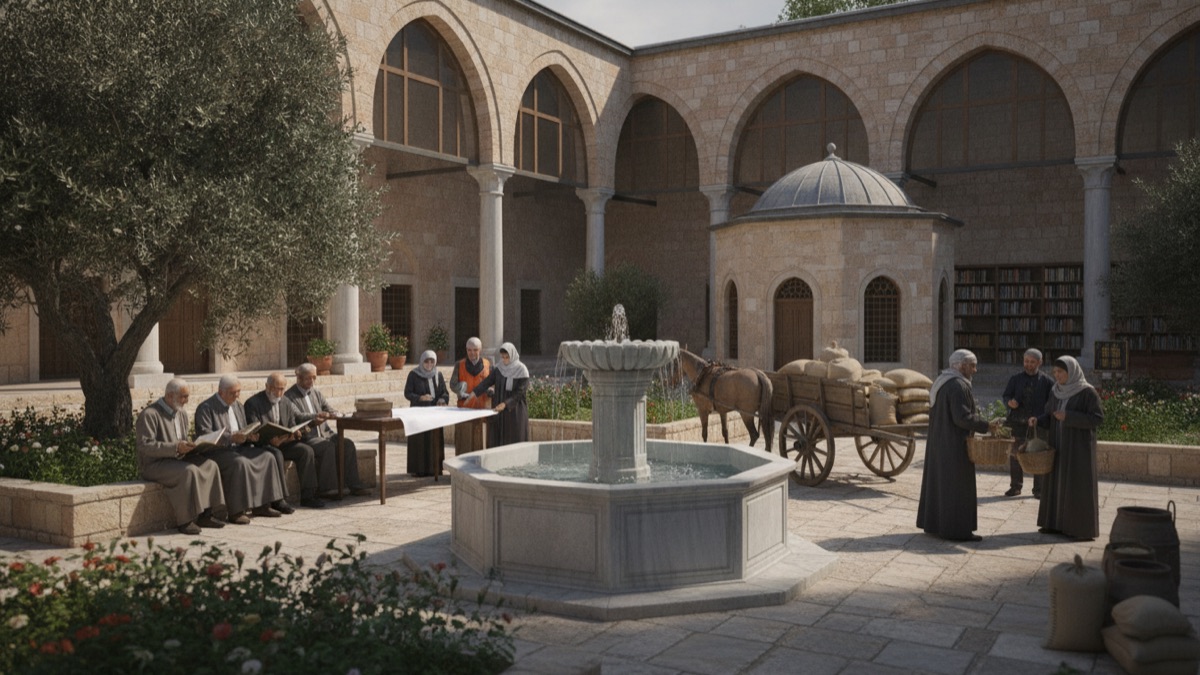
A public fountain in Cairo, a school in Damascus, a hospital in Ottoman Istanbul — many were never owned by the state or by any single family, but by God. That is the founding legal fiction behind waqf, an Islamic endowment structure that has quietly funded public infrastructure across the Muslim world for over a thousand years, and that still underpins a surprising share of religious, educational, and charitable property today.
Understanding how a waqf actually works — legally, financially, and administratively — explains a great deal about how public goods got built long before modern taxation and welfare states existed, and why the structure is now attracting renewed interest from Islamic finance and nonprofit-law specialists alike.
What a Waqf Actually Is, Legally
A waqf is the permanent dedication of an asset — most commonly land or a building, though it can also be cash or other property — to a charitable, religious, or public purpose, with the founder giving up ownership entirely. Once validly constituted, the asset is legally considered to belong to no one in the ordinary sense: not the founder, not the beneficiaries, and not the manager who administers it.
This detachment from ordinary ownership is the structure's defining legal feature. It is why a waqf property cannot generally be sold, inherited, gifted, or seized to satisfy the founder's debts once properly established, a permanence that made it an attractive vehicle for founders who wanted to guarantee an institution would outlive their own family's fortunes or political standing.
How a Waqf Actually Gets Established
Founding a waqf traditionally requires a clear declaration of intent, a specific identifiable asset, a defined charitable or religious purpose, and — critically — a set of instructions for how the asset is to be managed and its proceeds distributed. This declaration, historically recorded in a formal deed, functions similarly to a modern trust instrument or a nonprofit foundation's founding charter.
The founder appoints a manager, called a mutawalli or nazir depending on the region, who is responsible for administering the property according to the founder's stated conditions in perpetuity. The founder can name themselves as the first manager and specify how future managers should be selected, but they cannot retain ownership of the underlying asset once the waqf is validly constituted.
What the Difference Is Between a Charitable and a Family Waqf
Islamic legal tradition generally recognizes two broad categories. A charitable waqf, waqf khayri, dedicates its proceeds directly to a public or religious purpose — a mosque, a school, a hospital, the poor. A family waqf, waqf ahli or waqf dhurri, instead directs income to the founder's descendants for a specified period, often with the stipulation that the property eventually converts to charitable use once the family line specified in the deed ends.
Family waqfs served a practical legal function beyond charity: in jurisdictions with fixed Islamic inheritance shares, dedicating property to a family waqf allowed a founder some additional flexibility over how wealth passed to descendants, since waqf income distribution rules could differ from the standard inheritance formula. This use of family waqfs for estate planning purposes was historically significant and, in some periods and regions, controversial among jurists.
How Waqf Income Actually Gets Generated and Spent
A waqf does not simply hold an asset idle; it is typically structured to generate ongoing income that funds its stated purpose. A waqf might own agricultural land that is leased to tenant farmers, a row of shops whose rent supports a mosque, or a caravanserai charging merchants for lodging, with the resulting revenue directed according to the founder's original instructions.
This income-generating structure is why waqf endowments historically financed such a wide range of public infrastructure well beyond religious buildings alone: public drinking fountains, libraries, hospitals, soup kitchens, student housing, and road maintenance were all commonly waqf-funded across different periods and regions of the Islamic world, effectively functioning as a parallel, religiously-grounded public works system operating alongside or instead of state provision.
How Cash Waqfs Work Differently From Property Waqfs
While land and buildings were the traditional core of waqf endowments, cash waqfs — where the endowed asset is a sum of money rather than physical property — developed as a distinct and, in some periods, controversial variant, particularly prominent under the Ottoman Empire from roughly the fifteenth century onward.
A cash waqf typically operates by lending its principal out at a return, historically often structured to avoid interest in the conventional sense through profit-sharing or fee-based lending arrangements consistent with Islamic finance principles, with the resulting profit funding the waqf's charitable purpose while the principal itself remains intact and is never spent down.
This structure is functionally similar to a modern charitable endowment fund that spends only investment returns while preserving principal in perpetuity, and it is one of the clearest historical precedents cited by contemporary Islamic finance scholars developing modern waqf-based investment products.
How Waqf Administration Actually Gets Supervised
Because a waqf manager controls significant property and income without personally owning it, oversight has historically been essential to prevent mismanagement or outright diversion of funds for private benefit. Islamic courts historically served as the primary supervisory body, with judges empowered to review a mutawalli's conduct, remove a manager for breach of the founder's conditions, and resolve disputes over how proceeds should be allocated.
In many historical states, a dedicated waqf ministry or department eventually emerged to centralize this oversight function, registering endowments, auditing accounts, and in some periods directly appointing or approving managers — a shift from purely judicial supervision toward a more bureaucratic administrative model that persists in many countries today.
How Colonial-Era and Modern States Restructured Waqf Systems
The nineteenth and twentieth centuries brought significant disruption to traditional waqf administration across much of the Islamic world. Colonial administrations in several regions viewed the scale of waqf-held property, which in some cities amounted to a substantial share of all urban real estate, with suspicion, and introduced reforms that brought waqf assets under closer state control or, in some cases, converted them to state ownership outright.
Post-independence governments in many Muslim-majority countries continued and in some cases extended this centralization, establishing government ministries or authorities to directly manage waqf property rather than leaving administration to family-appointed or community-selected mutawallis, a shift that significantly changed the historically decentralized, civil-society character of the institution.
How Waqf Endowments Funded Education Historically
Some of the Islamic world's most significant historical centers of learning operated on waqf funding, including institutions in Fez, Cairo, and Baghdad whose teaching staff, student stipends, and physical maintenance were all financed by dedicated endowment income rather than tuition fees or direct state budgets. This funding model allowed for a degree of institutional independence from ruling authorities that direct state patronage did not always provide.
The madrasa system that spread across much of the medieval Islamic world was overwhelmingly waqf-financed, with individual endowments often specifying exactly how many students and teachers were to be supported, what subjects were to be taught, and even architectural requirements for the building itself, making the founding deed simultaneously a legal, financial, and educational-policy document.
Why Waqf Land Is Legally Complicated in Modern Property Markets
Because waqf property is, by design, extremely difficult to sell or convert to other uses, it creates distinctive challenges in modern urban land markets. City centers with historically dense waqf holdings can face genuine friction when redevelopment, infrastructure projects, or simple modernization would benefit from land assembly that waqf status effectively blocks.
Modern legal systems in various countries have developed specific mechanisms — including long-term leasing arrangements, land-swap provisions, and, in narrowly defined circumstances, judicially approved exchanges of one waqf property for another of equivalent value — to work around this rigidity without abandoning the underlying principle of permanence that defines the institution.
How Modern Islamic Finance Has Revived Interest in Waqf
Contemporary Islamic finance institutions have shown renewed interest in waqf structures over the past several decades, developing cash-waqf-based investment funds, waqf-linked sukuk (Islamic bonds), and corporate waqf models where a company dedicates a share of its equity or profits to a waqf-administered charitable purpose on an ongoing basis.
Several countries have introduced modern regulatory frameworks specifically enabling these structures, treating waqf less as a purely historical institution and more as a genuine alternative to conventional trust and foundation law for donors seeking a religiously grounded, legally permanent charitable vehicle, with growing interest from both individual donors and institutional development finance bodies.
How Waqf Compares to Western Trust and Foundation Law
Legal historians have long noted structural similarities between waqf and the Western trust, and some scholarship has argued for direct historical influence, particularly via contact during the Crusades and through Islamic Spain, though this claim remains genuinely contested among specialists and is not universally accepted.
Whatever the historical relationship, the functional similarities are real: both structures separate legal ownership from beneficial use, both can be structured to operate in perpetuity, and both rely on an appointed manager bound by the founder's original instructions and subject to external legal oversight, which is why comparative-law scholars frequently use waqf and trust side by side as parallel case studies in the study of non-ownership property structures.
What Challenges Modern Waqf Institutions Actually Face
Beyond the land-liquidity problem already discussed, modern waqf administration faces several recurring practical challenges: outdated or lost founding documentation that makes original founder intent difficult to verify centuries later, chronic underinvestment in aging waqf-held buildings whose rental income has not kept pace with maintenance costs, and, in some jurisdictions, ongoing tension between centralized state waqf authorities and communities who feel state administration has drifted from the founder's original charitable intent.
Digitization of waqf records, professional asset-management reforms, and renewed transparency requirements have been introduced in a number of countries specifically to address these issues, reflecting a broader global trend toward modernizing centuries-old charitable structures without abandoning their core legal character.
Why the Waqf Model Still Matters Today
The waqf's core insight — that dedicating an asset permanently outside ordinary ownership, with income directed by binding, enforceable instructions, can fund public goods reliably across generations without depending on any single ruler's goodwill or a state's annual budget cycle — remains as structurally relevant now as it was a thousand years ago, even as the institutions administering it have changed considerably.
From the fountains and schools of medieval Cairo to twenty-first-century cash-waqf investment funds, the underlying legal mechanism has proven remarkably durable, adapting to colonial disruption, nationalization, and now digital and financial modernization while preserving the one feature that made it useful in the first place: an asset that, once dedicated, genuinely cannot be taken back.
How Waqf Practices Differ Across the Muslim World
Although the underlying legal logic of waqf is broadly shared across Islamic jurisprudence, the practical administration of waqf property differs considerably from one country to another, reflecting each region's own legal history, colonial experience, and approach to religious-institution governance. In some countries, waqf assets are managed by a single centralized state ministry with detailed reporting requirements; in others, administration remains substantially decentralized, with individual mosques, family committees, or independent charitable boards retaining day-to-day control subject only to periodic oversight.
Gulf states with significant oil-era wealth have in some cases used modern waqf-style endowments to fund large public institutions — universities, hospitals, and research foundations — structured explicitly along classical waqf lines even when the underlying assets are financial rather than agricultural or urban real estate, illustrating how a centuries-old legal form has been adapted to entirely new categories of wealth. South and Southeast Asian countries with large Muslim populations, by contrast, often layer waqf regulation on top of colonial-era property law inherited from British or Dutch administration, producing hybrid systems that can differ significantly in practice from waqf regulation in the Arab world even while sharing the same core religious-legal foundation.
These regional differences matter practically for anyone studying or working with waqf institutions, since a legal mechanism or dispute-resolution process that applies cleanly in one jurisdiction may not transfer directly to another, and comparative scholars generally caution against treating waqf as a single uniform global institution rather than a shared legal principle expressed through many distinct national systems.
North African waqf administration has its own distinct trajectory, shaped heavily by twentieth-century nationalization waves that brought vast waqf property portfolios under direct ministry control in several countries, a pattern that differs sharply from the more devolved, community-managed waqf structures still common in parts of the Levant and the Gulf. This administrative divergence is not merely bureaucratic trivia — it directly affects how quickly a modern waqf-linked investment product can be approved, how transparent asset valuations are to the general public, and how much room individual founders retain to specify unusual or highly localized charitable purposes rather than having their intent absorbed into a generic state welfare budget.
Sources
- Wikipedia — overview of waqf history, legal structure, and regional variation
- Encyclopaedia Britannica — reference entry on waqf and Islamic charitable endowments
- Islamic Economics and Finance resources — academic literature on cash waqf and waqf-based finance
- World Bank — research on waqf and Islamic social finance in development contexts
- Oxford Islamic Studies Online — scholarly reference on Islamic law and endowment institutions
FAQ
Can a waqf property ever be sold?
Generally no — permanence is the defining feature, though modern legal systems allow narrow, judicially supervised exceptions such as exchanging one waqf property for another of equivalent value.
Who actually owns waqf property?
In the traditional legal fiction, no one does in the ordinary sense — the asset is considered dedicated to God, with a manager administering it on behalf of the stated charitable purpose.
What is the difference between a charitable and a family waqf?
A charitable waqf directs income to a public purpose immediately; a family waqf directs income to the founder's descendants first, often converting to charitable use once that family line ends.
Is waqf the same as a Western trust?
They are functionally similar — both separate legal ownership from beneficial use — but whether one directly influenced the other historically remains a genuinely contested question among legal historians.
Why did colonial and modern states restructure waqf systems?
Waqf property represented a large share of urban real estate in many cities, and governments introduced reforms bringing it under closer state administration, shifting it away from its historically decentralized character.
About the Author
We reference Wikipedia, Encyclopaedia Britannica, Islamic Economics and Finance resources, the World Bank, and Oxford Islamic Studies Online to explain the background and current understanding of this topic.
Loved This Article?
Share it on WhatsApp → Share it on WhatsApp
Get more guides in your inbox — Subscribe to our newsletter for weekly surprising stories from Egypt, Saudi Arabia, Dubai, and beyond.