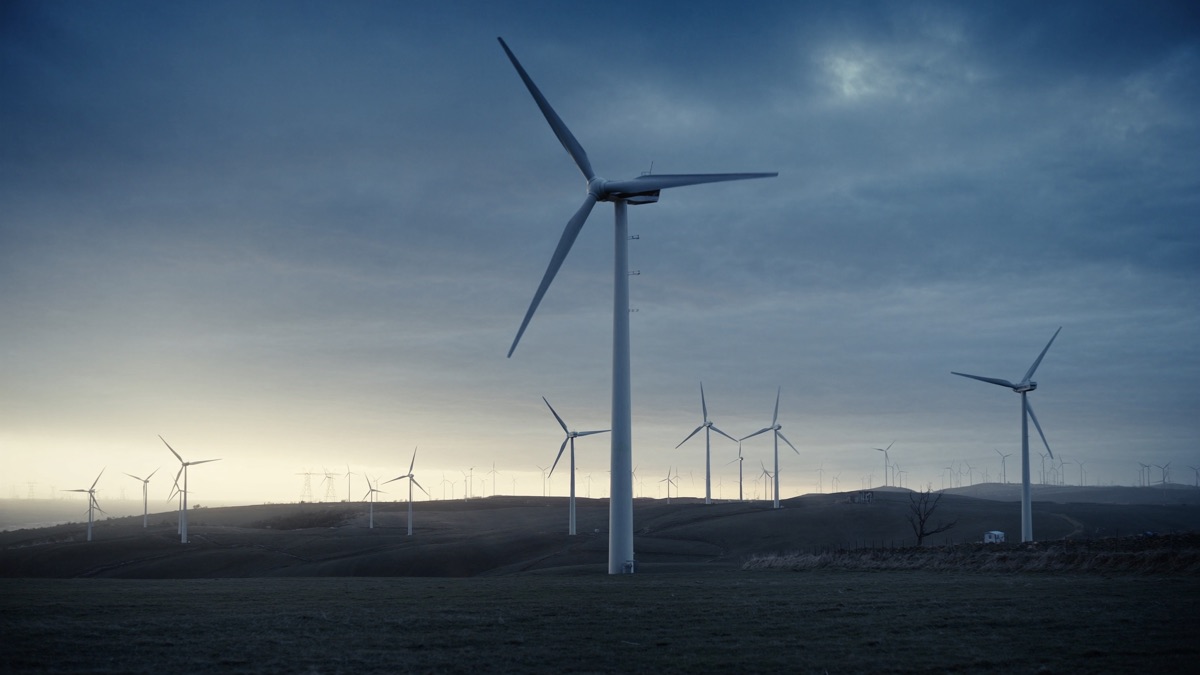
A wind turbine actually generates electricity by using its blades to capture the kinetic energy of moving air and convert it into mechanical rotation, which a generator then transforms into electrical current. The physics is conceptually similar to a hand-cranked generator, except the "hand" here is wind pressure acting continuously across enormous blade surfaces mounted dozens or even hundreds of meters above the ground.
Turning Moving Air Into Usable Electricity
Modern utility-scale turbines typically stand well over 100 meters tall at the hub, with blades stretching 60 meters or more each, because wind speed and consistency both increase significantly with height above ground-level obstacles like trees, buildings, and terrain friction.
A single large modern turbine can generate enough electricity to power several thousand homes over a year, though actual output varies constantly with wind conditions rather than running at a fixed, predictable rate the way a traditional power plant does.
Why Blade Shape Is Actually Airplane Wing Engineering
Turbine blades use an airfoil cross-section nearly identical in principle to an airplane wing, shaped so that air moving across the curved surface creates a pressure difference that generates lift rather than the drag a flat surface would produce.
Instead of using that lift to keep an aircraft airborne, turbine blade design channels the resulting aerodynamic force to spin the rotor around a fixed hub, converting what would be lift force in an airplane into rotational torque in a turbine.
The Gearbox That Speeds Up Slow Rotation
The rotor itself typically spins relatively slowly, often somewhere between 10 and 20 rotations per minute depending on wind conditions and turbine design, far too slow to efficiently drive a standard electrical generator on its own.
A gearbox inside the nacelle, the housing that sits atop the tower, steps that slow rotational speed up dramatically, often to somewhere around 1,000 to 1,800 rotations per minute, matching the speed range most generator designs need to produce grid-compatible electrical current efficiently.
Direct-Drive Turbines That Skip the Gearbox Entirely
Some modern turbine designs eliminate the mechanical gearbox entirely, instead using a specially designed generator that can produce usable electricity directly at the rotor's naturally slow rotation speed.
This direct-drive approach removes a historically failure-prone mechanical component, reducing maintenance needs and downtime risk, though it typically requires a larger, heavier, and more expensive generator to compensate for the lower input rotation speed it has to work with.
How the Nacelle Constantly Tracks Wind Direction
A yaw system inside the nacelle continuously rotates the entire turbine housing to keep the rotor facing directly into the prevailing wind, since a turbine angled even moderately off the wind direction captures significantly less usable energy.
Modern turbines use wind vanes and anemometers mounted on the nacelle itself, feeding real-time data to a control system that makes small, frequent yaw adjustments automatically, keeping the rotor properly aligned without requiring any human intervention during normal operation.
Why Blades Actually Pitch and Twist During Operation
Beyond simply yawing the whole nacelle, individual blades can also rotate along their own long axis, a movement called pitch control, adjusting the angle at which each blade meets the oncoming wind.
This pitch adjustment lets the turbine optimize energy capture at lower wind speeds while also deliberately reducing captured force during high winds, protecting the mechanical structure from damage that excessive rotational speed or force could otherwise cause.
What Happens When Wind Speeds Get Dangerously High
Every turbine has a specific cut-out wind speed, commonly somewhere around 25 meters per second, above which the control system automatically pitches the blades to a feathered position and applies mechanical brakes to stop rotation entirely.
This automatic shutdown protects the turbine's structural components, particularly the blades and drivetrain, from stresses that could otherwise cause catastrophic mechanical failure during severe storms, even though it means temporarily losing potential power generation during exactly the windiest conditions.
The Minimum Wind Speed a Turbine Actually Needs
Just as turbines have a maximum safe operating speed, they also have a cut-in speed, typically around 3 to 4 meters per second, below which there simply is not enough kinetic energy in the wind to overcome internal friction and turn the generator productively.
Between the cut-in and cut-out thresholds, a turbine's power output rises steeply with wind speed up to a rated wind speed, beyond which output plateaus at the generator's maximum rated capacity rather than continuing to climb indefinitely.
Why Onshore and Offshore Turbines Differ So Much
Offshore turbines are generally built significantly larger than onshore models, since ocean winds tend to be stronger and more consistent, and the enormous cost of installing offshore foundations and subsea cabling makes maximizing each individual turbine's output economically essential.
Offshore installations also avoid many of the visual and noise concerns that can limit onshore turbine siting near populated areas, though they face their own distinct engineering challenges around saltwater corrosion, marine foundation design, and the higher cost of offshore maintenance access.
How Turbines Get Built in Increasingly Remote Locations
Massive specialized cranes and heavy-haul transport vehicles move enormous tower sections, nacelles, and blades from manufacturing facilities to installation sites, often requiring purpose-built or significantly upgraded roads to accommodate components that can exceed 60 meters in a single piece.
Offshore turbine installation instead relies on purpose-built jack-up vessels, specialized ships with extendable legs that can raise themselves out of the water to create a stable working platform for the extremely precise crane work involved in assembling a turbine at sea.
The Power Curve That Defines a Turbine's Real-World Output
Every turbine model has a published power curve, a chart showing exactly how much electricity it produces at every wind speed between its cut-in and cut-out thresholds, letting developers accurately predict a specific site's likely energy output before ever building anything.
Because wind speed varies constantly throughout any given day and across seasons, actual annual output is calculated using a site's historical wind speed distribution combined with the turbine's power curve, rather than simply multiplying the turbine's maximum rated capacity by the total hours in a year.
Why Capacity Factor Matters More Than Rated Power
A turbine's capacity factor measures the percentage of its theoretical maximum possible output it actually achieves over a full year, accounting for periods of low wind, maintenance downtime, and time spent above the cut-out safety threshold.
Modern onshore wind farms in genuinely favorable locations often achieve capacity factors in the 35 to 45 percent range, while well-sited offshore installations frequently reach 45 to 55 percent or higher, a meaningful difference that significantly affects the economics of any specific project location.
How Wind Farms Coordinate Dozens of Turbines Together
Individual turbines within a wind farm are spaced deliberately far apart, often five to ten times a rotor's diameter, specifically to minimize wake turbulence, the disturbed, slower-moving air one turbine leaves behind that would otherwise reduce power output at neighboring turbines downwind.
A central control system continuously monitors output, wind conditions, and mechanical status across every turbine in the farm simultaneously, allowing operators to identify underperforming units or emerging maintenance issues well before they escalate into a costly full mechanical failure.
What Happens to the Electricity After It Leaves the Turbine
Electricity generated inside the nacelle first passes through a transformer, typically located at the base of the tower, that steps its voltage up to match the higher voltage used by the local electrical grid for efficient long-distance transmission.
From there, underground or overhead cables carry the power to a substation, where it can be further adjusted and integrated into the broader regional grid alongside electricity coming from other, entirely different generation sources like natural gas or solar.
The Intermittency Problem Grid Operators Actually Manage
Because wind speed is inherently variable and only partially predictable even with sophisticated forecasting, grid operators must maintain backup generation capacity or energy storage systems that can quickly compensate when wind output drops faster than anticipated.
Modern weather forecasting models have become substantially better at predicting wind generation output hours and even days in advance, letting grid operators plan backup capacity needs more precisely than the far less predictable intermittency management approaches used in wind power's early decades.
How Battery Storage Is Changing Wind's Reliability Profile
Large-scale battery storage systems increasingly paired with wind farms can absorb excess electricity generated during high-wind periods and discharge it later during low-wind periods or peak demand hours, smoothing out much of wind power's natural variability.
While battery costs have fallen substantially over the past decade, storage capacity large enough to cover extended multi-day low-wind periods remains expensive at scale, meaning most grids still rely on a diverse mix of generation sources rather than wind and storage alone.
Why Turbine Blades Are So Difficult to Recycle
Wind turbine blades are typically manufactured from composite materials, usually fiberglass or carbon fiber reinforced with resin, chosen specifically for their high strength-to-weight ratio, but that same composite structure makes the material extremely difficult to break down or recycle using conventional methods.
Retired blades have historically ended up in landfills in significant numbers, though newer recycling techniques, including specialized mechanical grinding processes and chemical methods that can separate resin from fiber, are increasingly being developed and deployed as the first generation of large turbines built decades ago reaches the end of its operational life.
The Typical Operational Lifespan of a Modern Turbine
Most modern wind turbines are designed and warrantied for an operational lifespan of roughly 20 to 25 years, after which components like blades, bearings, and gearboxes experience accumulated mechanical fatigue that makes continued safe operation progressively less economical.
Many wind farms extend this life through a process called repowering, replacing aging turbines with newer, more efficient, often significantly larger models on the same existing site, taking advantage of already-established grid connections, access roads, and confirmed favorable wind conditions.
How Wind Turbine Technology Has Changed Since the 1980s
Early commercial wind turbines from the 1980s typically generated well under 100 kilowatts each and stood only a few dozen meters tall, a tiny fraction of the multi-megawatt output and towering height of modern utility-scale machines.
Advances in blade aerodynamics, materials science, control software, and manufacturing scale have together driven a roughly hundredfold increase in typical turbine output over four decades, dramatically lowering the cost of wind-generated electricity per unit of energy produced along the way.
Why Wind Power Now Competes Directly on Cost
In many regions worldwide, new wind power installations now produce electricity at a cost per unit that is fully competitive with, or even cheaper than, new fossil fuel power plants, a dramatic shift from wind power's historical dependence on government subsidies to remain economically viable.
This cost decline, driven by the same technological and manufacturing scale improvements that increased turbine size and efficiency, is a primary reason wind power has grown from a marginal energy source to a mainstream component of electrical grids across dozens of countries within a relatively short span of decades.
How Turbine Noise Is Actually Controlled Near Communities
Modern turbine blade tips are engineered with serrated trailing edges and optimized aerodynamic profiles specifically to reduce the swishing noise generated as blades pass through the air, an issue that drew significant complaints from nearby residents in earlier turbine generations.
Regulatory noise limits in most jurisdictions require developers to model expected sound levels at the nearest residences before construction, and setback distances between turbines and homes are often calculated specifically to keep noise within those legally permitted thresholds under typical wind conditions.
Why Bird and Bat Collisions Remain an Active Engineering Concern
Wind farms can pose a collision risk to birds and bats, particularly at sites located along major migratory flyways, and this remains one of the most actively studied environmental trade-offs associated with wind power expansion.
Mitigation strategies now commonly include careful pre-construction siting studies to avoid the highest-risk migratory corridors, seasonal curtailment that temporarily shuts down turbines during peak migration periods, and ongoing research into ultrasonic deterrents and improved blade visibility markings to further reduce collision rates.
Sources
- U.S. Department of Energy — how wind turbines work
- Wikipedia — overview of wind turbine design and operation
- International Energy Agency — global wind power data and trends
FAQ
How does a wind turbine actually make electricity?
Blades shaped like airplane wings capture kinetic energy from moving air, spinning a rotor that drives a generator, either through a gearbox that speeds up rotation or a direct-drive system, to produce electrical current.
Why are modern wind turbines so tall?
Wind speed and consistency both increase significantly with height above ground-level obstacles like trees and buildings, so taller towers capture stronger, steadier wind.
What is a turbine's cut-in and cut-out speed?
Cut-in is the minimum wind speed, typically 3 to 4 meters per second, needed to generate power; cut-out, often around 25 meters per second, is the speed above which the turbine automatically shuts down to prevent damage.
Why do turbine blades pitch during operation?
Pitch control rotates each blade along its own axis to optimize energy capture at low wind speeds and reduce captured force during high winds to protect the structure.
What is capacity factor and why does it matter?
It measures the percentage of a turbine's theoretical maximum output actually achieved over a year; onshore farms often reach 35-45%, while offshore farms often reach 45-55% or higher.
Why are offshore wind turbines usually larger than onshore ones?
Ocean winds tend to be stronger and more consistent, and the high cost of offshore foundations and cabling makes maximizing each turbine's output economically essential.
How is wind's intermittency actually managed on the grid?
Grid operators maintain backup generation or storage capacity and rely on improved weather forecasting to predict wind output hours or days in advance.
Can battery storage fix wind power's variability?
It helps significantly by absorbing excess output during high-wind periods and discharging it later, but storage large enough for extended multi-day low-wind periods remains expensive at scale.
Why are wind turbine blades hard to recycle?
They are made from composite materials like fiberglass or carbon fiber reinforced with resin, chosen for strength-to-weight ratio, but that structure resists conventional recycling methods.
How long do wind turbines typically last?
Most are designed for a 20 to 25 year operational lifespan, after which accumulated mechanical fatigue makes continued operation progressively less economical.
What is repowering a wind farm?
It means replacing aging turbines with newer, more efficient, often larger models on the same site, reusing existing grid connections and confirmed favorable wind conditions.
Has wind power become cost-competitive with fossil fuels?
Yes; in many regions new wind installations now produce electricity at a cost per unit that is competitive with, or cheaper than, new fossil fuel power plants.
Why are turbines within a wind farm spaced far apart?
Spacing, often five to ten times a rotor's diameter, minimizes wake turbulence, the disturbed slower air one turbine leaves behind that would otherwise reduce output at neighboring turbines downwind.
How has turbine technology changed since the 1980s?
Early turbines generated well under 100 kilowatts each; advances in aerodynamics, materials, and manufacturing scale have driven roughly a hundredfold increase in typical output over four decades.
About the Author
We reference Wikipedia and other authoritative sources to explain the background and current understanding of this topic.
Loved This Article?
Share it on WhatsApp → Share it on WhatsApp
Get more guides in your inbox — Subscribe to our newsletter for weekly surprising stories from Egypt, Saudi Arabia, Dubai, and beyond.