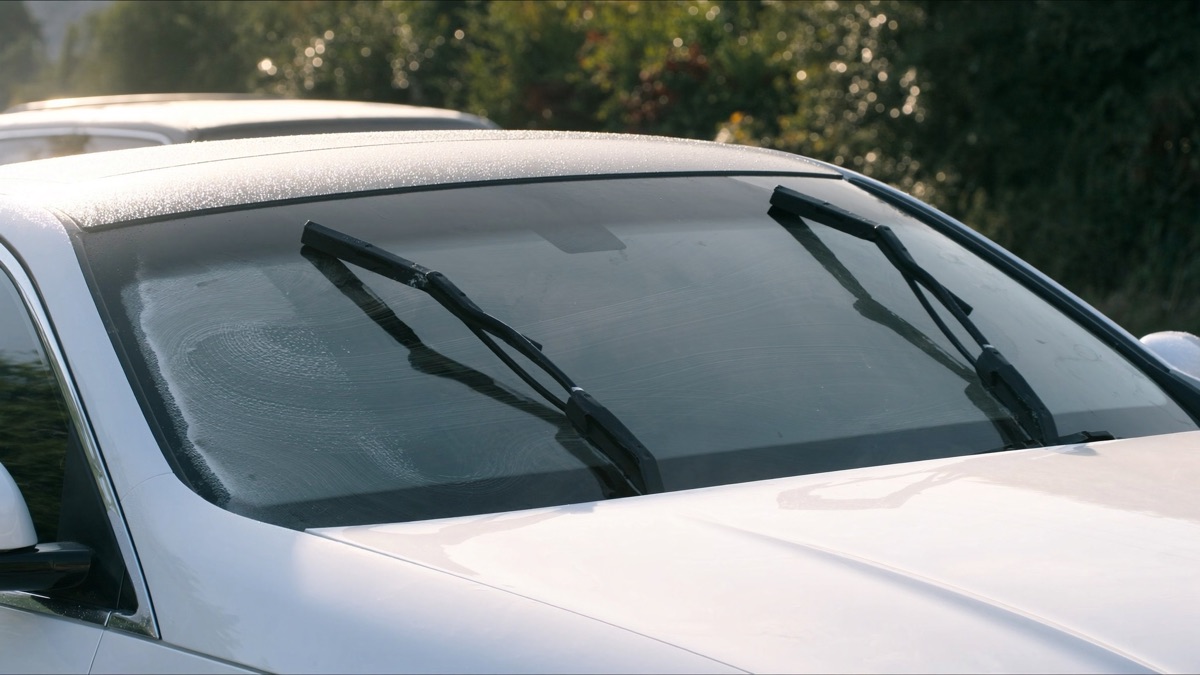
The Blade Doesn't Scrape — It Rides a Thin Water Film
A windshield wiper blade is not designed to drag directly against bare glass. As it moves, it pushes most of the rainwater into a rolling bead ahead of the rubber edge while a microscopically thin film of water remains trapped between the blade's leading edge and the glass surface, and that film is what the blade actually glides on rather than glass itself.
This hydroplaning-style contact is why a worn or torn blade suddenly starts squeaking and streaking: once the rubber edge loses its precise, sharp lip, it can no longer maintain that even film, so it begins making direct, uneven contact with the glass instead, which is both noisier and more likely to leave residue behind.
The Hidden Steel Spring Inside Every Blade
Windshields are curved, but a wiper blade is a straight rubber strip, so on its own the blade would only touch the glass at its center and lift away at both ends. To solve this, most blades hide one or two thin flexible steel strips, called spring backing or a flex spine, running the length of the rubber.
That embedded steel is pre-tensioned to bow the opposite direction from the glass's curve, so when the assembly presses down, the spring's tension fights back evenly and forces the entire rubber edge into constant contact with the curved windshield from end to end, rather than only in the middle.
Why the Blade Angle Flips at the Top of Every Stroke
Look closely at a moving wiper and you'll notice the rubber edge leans slightly in the direction of travel rather than standing straight up — this small forward lean, called rake angle, is what lets the thin edge dig into the water layer and squeegee it aside instead of just pushing a wave of water in front of itself.
Because the wiper reverses direction at each end of its sweep, the entire blade assembly has to flip its lean the opposite way at every stroke reversal; this flip is engineered into the rubber's cross-section itself, which is intentionally asymmetric so it snaps into the correct lean automatically rather than needing a separate mechanical part to force it.
The Linkage That Turns One Motor Into Two Synced Arms
A single electric wiper motor drives both the driver-side and passenger-side arms, and it does so through a mechanical linkage system: the motor spins a small crank, which pushes and pulls connecting rods that convert that rotary motion into the back-and-forth sweeping motion at each wiper pivot.
This linkage is precisely geometrically tuned so both blades stay in sync without ever colliding, even though they sweep overlapping areas of glass at slightly different arc lengths — a small manufacturing or wear-related slack in this linkage is usually what causes wipers to visibly drift out of alignment with each other over a car's lifetime.
Intermittent Mode Uses a Tiny Timer Circuit, Not a Slower Motor
The intermittent wiper setting does not run the motor more slowly; the motor itself always spins at the same speed whenever it's engaged. Instead, a small electronic timer circuit repeatedly switches the motor on for one full sweep cycle, then cuts power and lets the blades rest in the parked position for a set pause.
Turning the intermittent dial changes only the length of that pause between sweeps, typically from around one second up to twenty seconds or more, which is why intermittent wipers always look like they're making the exact same speed of stroke no matter what interval you select.
Rain-Sensing Wipers Read Light, Not Water Directly
Automatic rain-sensing wipers use a small optical sensor mounted against the inside of the windshield, usually near the rearview mirror, that shines infrared light at an angle into the glass and measures how much of that light reflects back to a photodetector.
Dry glass reflects the infrared light almost completely back to the sensor, but when raindrops sit on the outside surface they scatter and absorb some of that light instead of reflecting it cleanly, so the sensor detects a drop in returned light intensity and triggers a wipe — meaning the system technically measures optical disruption, not moisture, which is also why frost, dirt, or a cracked windshield can trigger false wipes.
Why Wiper Fluid Isn't Just Water
Washer fluid combines a detergent surfactant with methanol or ethylene glycol and water. The surfactant breaks the surface tension of oily road film, bug residue, and grime so a much smaller volume of liquid can lift contaminants off the glass rather than just pushing a thin film of water over them.
The alcohol component serves two separate jobs: it lowers the fluid's freezing point so the reservoir and lines don't crack in cold weather, and it also evaporates faster than plain water, which helps the glass dry to a streak-free finish instead of leaving watermarks behind after each wipe.
The Parking Position Is a Deliberate Mechanical Stop
Wipers always come to rest at the bottom of the windshield rather than stopping wherever the driver releases the switch, because the wiper motor includes a small internal cam switch that keeps supplying power to the motor even after the main control is turned off, until the blades physically reach the parked position.
Only once a mechanical lobe on that cam completes its rotation and trips the switch does the circuit actually cut power, which is why you can flip your wipers off mid-sweep and still watch them finish the stroke and settle neatly at the bottom edge of the glass every time.
Why Winter Blades Look and Behave Differently
Standard wiper blades expose their internal spring backing through open slots along the rubber spine, which works fine in normal conditions but lets snow and slush pack into those gaps and freeze solid, warping the blade's shape and destroying its even pressure against the glass.
Winter-specific blades enclose the entire spring mechanism inside a sealed rubber boot, so ice and compacted snow simply can't get into the moving joints; this added rubber does make winter blades noticeably heavier and stiffer, which is why they're generally not recommended for warm-weather use.
Chattering Is a Resonance Problem, Not Just Wear
That rapid juddering, skipping sound wipers sometimes make on a nearly dry windshield is a vibration phenomenon called chatter, caused by the flexible rubber edge briefly sticking to the glass through friction, then releasing suddenly as the spring tension overcomes that stick — a stick-slip cycle that repeats itself many times per second.
Chatter tends to appear specifically at low blade speed, on a nearly dry surface, or with a blade whose rubber has hardened and lost flexibility with age, since fresh, supple rubber can absorb small stick-slip vibrations that a stiffened edge instead transmits as an audible judder.
Rear Wipers Usually Skip a Design Feature Front Ones Need
Rear windshields are typically flatter and less steeply raked than front windshields, and rear wiper motors run through a simpler, single-arc linkage since there's only one blade to synchronize rather than two — this is one reason rear wiper systems are mechanically less complex overall.
Rear wipers also tend to use a smaller, single-lobe blade design without the same dual-spring backing found on longer front blades, because the flatter rear glass curve needs far less spring tension to maintain even contact across the shorter sweep.
Why Some Blades Squeak Even When New
New wiper rubber sometimes ships with a light manufacturing residue or release agent left over from the molding process, and until that residue wears off during the first several uses, it can interfere with the smooth glide-on-water-film mechanism and produce an audible squeak that has nothing to do with damage or defect.
A similarly common cause is a thin coating of silicone-based glass treatment or wax on the windshield itself, which changes how water beads and sheets across the surface; wiper manufacturers generally recommend cleaning the glass with a dedicated glass cleaner before judging whether a new blade is genuinely faulty.
The Physics Behind Streak-Free Versus Streaky Wipes
A streak is left behind whenever the blade's leading edge fails to maintain full, even contact across its entire width during a stroke — even a gap as small as a fraction of a millimeter lets a thin ribbon of water slip past untouched, which then dries into a visible mineral or residue line.
Because the steel spring backing is what enforces that even contact, any permanent bend, kink, or corrosion in the spring — often from being left frozen to the glass overnight, or from a careless scraping attempt — can create a streak that reappears in exactly the same spot on every single pass, no matter how new the rubber itself is.
Why Manufacturers Recommend Replacing Blades Roughly Yearly
Wiper rubber is a specific synthetic compound engineered to stay flexible and maintain a razor-sharp squeegee edge, but continuous exposure to UV radiation, ozone, and temperature swings gradually oxidizes and hardens that rubber, a process that happens even on a car that's rarely driven or wiped.
Once the rubber's edge microscopically rounds off from this hardening, no amount of cleaning restores its original sharp geometry, which is why manufacturers generally recommend replacement on a roughly six-to-twelve-month cycle regardless of how many miles the wipers have actually swept.
Beam Blades Versus Traditional Frame Blades
Older-style wiper blades use a visible external metal frame with several small pivoting joints — called a bridge or claw structure — that distributes pressure onto the rubber at a handful of discrete points along its length rather than continuously.
Modern beam-style blades eliminate that external frame entirely, instead embedding the curved spring directly inside a single continuous rubber housing; this spreads pressure far more evenly across the whole blade, resists ice buildup better since there are no small exposed joints to freeze, and is now the dominant design on new vehicles.
What Actually Happens When You Run Wipers on Dry Glass
Running wipers across bone-dry glass removes the protective water film the blade relies on to glide, so the rubber edge makes direct, high-friction contact with the glass surface instead, generating far more heat and mechanical stress on both the rubber and the glass than a wet wipe ever produces.
This is why doing it occasionally causes little harm, but frequent dry wiping — especially to clear dust or light debris rather than rain — measurably accelerates rubber wear and can, over enough repetitions, leave faint but permanent micro-scratches in the glass from trapped grit being dragged across the surface.
Why the Motor Sits Buried Under the Cowl, Not the Hood
The wiper motor and its linkage assembly are almost always mounted low, in the sealed cowl area between the base of the windshield and the hood, rather than higher up near the dashboard — a placement chosen partly to keep the motor's weight low and partly to shield the electrical components from direct sun and rain exposure.
That cowl cavity also happens to be a common spot for leaves and debris to accumulate, and a clogged cowl can trap water against the motor housing; manufacturers generally design a drain channel into this area specifically so pooled water has somewhere to escape rather than sitting against sensitive electrical connections.
The Overload Clutch That Protects the Motor From Ice
If a wiper blade is frozen solid to the glass and someone switches the wipers on, the motor would otherwise stall against that resistance and risk burning out its windings from the sudden current spike — a failure mode expensive enough that most wiper motors include a small mechanical overload clutch.
This clutch is designed to slip internally once resistance crosses a set threshold, letting the motor's output shaft spin freely without actually moving the frozen blade, which sacrifices a bit of wear on the clutch itself in exchange for protecting the far more expensive motor windings from an ice-jam failure.
Wiper Speed Settings Change Voltage, Not Gearing
Most wiper motors don't contain multiple physical gear ratios to produce their low, high, and intermittent speeds; instead, the motor is wound with a second internal winding tap that, when engaged, effectively changes how much electrical resistance the current experiences, altering the motor's rotational speed directly.
This is a deliberately simple, low-part-count approach — fewer moving mechanical parts means fewer things that can wear out or fail, which is one reason a basic wiper motor assembly can often run for a vehicle's entire service life without ever needing internal repair.
Sources
- Wikipedia: Windscreen wiper — Overview of wiper mechanisms, blade construction, and history.
- Wikipedia: Mary Anderson — Background on the inventor credited with the first practical manual wiper design.
- Britannica: Windshield wiper — Encyclopedia overview of windshield wiper invention and mechanism.
FAQ
Do wiper blades actually touch bare glass while wiping?
Mostly not; the blade rides on a microscopically thin film of water it leaves behind, which is why worn blades that can no longer maintain that film start squeaking and dragging.
Why does a wiper blade bend to match a curved windshield?
A thin steel spring strip embedded inside the rubber is pre-tensioned to bow opposite the glass's curve, forcing even contact across the whole blade rather than just the center.
Does intermittent wiper mode actually run the motor slower?
No; the motor always spins at the same speed. A timer circuit switches it on for one full sweep, then pauses power for a set interval you control with the dial.
How do rain-sensing wipers know it's raining?
An infrared sensor near the mirror measures how much light reflects off the inside of the glass; raindrops on the outside scatter that light, and the drop in reflected signal triggers a wipe.
Why isn't washer fluid just water?
It adds a surfactant to cut oily road grime and an alcohol component that lowers the freezing point and speeds evaporation for a streak-free dry.
Why do wipers always stop at the bottom of the windshield?
An internal cam switch inside the motor keeps power flowing until the blades physically reach the parked position, even if you turn the switch off mid-stroke.
What causes that rapid chattering sound wipers sometimes make?
A stick-slip vibration where the rubber edge briefly sticks to the glass through friction, then releases as spring tension overcomes it, repeating many times per second.
Why are winter wiper blades bulkier than regular ones?
They enclose the entire spring mechanism in a sealed rubber boot so snow and slush can't pack into the joints and freeze, which adds weight and stiffness.
Is it bad to run wipers on completely dry glass?
Occasionally it's harmless, but frequent dry wiping removes the protective water film, increasing friction and, over time, can leave faint scratches from trapped grit.
Why do new wiper blades sometimes squeak right out of the box?
Manufacturing residue on new rubber can interfere with smooth gliding until it wears off after several uses; a silicone-based glass coating can cause the same issue.
What's the real difference between beam blades and old frame blades?
Frame blades use an external metal bridge pressing at a few discrete points; beam blades embed the spring in one continuous rubber housing for more even pressure and less ice buildup.
Why do both wiper arms move in sync from a single motor?
A mechanical linkage of connecting rods converts one motor's rotary motion into synchronized back-and-forth sweeps at both pivots, geometrically tuned to avoid collision.
How often should wiper blades really be replaced?
Roughly every six to twelve months, since UV and ozone exposure harden the rubber's edge geometry over time regardless of mileage driven.
Why do rear windshield wipers look mechanically simpler?
Rear glass is flatter and less curved than the front, so rear systems need a simpler single-arc linkage and less spring tension in the blade.
Can a streak reappear in the exact same spot every wipe?
Yes — a permanent bend or corrosion in the internal spring backing, often from being frozen to the glass, creates a consistent gap that the same spot on every pass.
About the Author
We reference Wikipedia and other authoritative sources to explain the background and current understanding of this topic.
Loved This Article?
Share it on WhatsApp → Share it on WhatsApp
Get more guides in your inbox — Subscribe to our newsletter for weekly surprising stories from Egypt, Saudi Arabia, Dubai, and beyond.