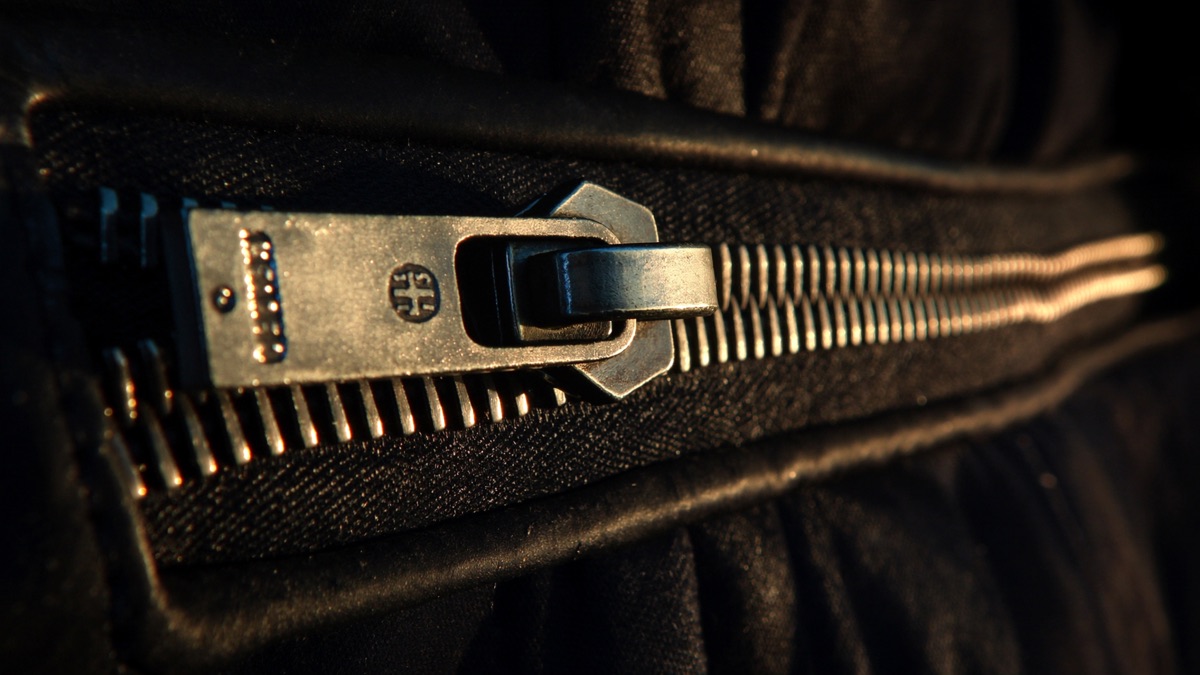
A zipper looks almost too simple to fail, two rows of small teeth pulled together by a sliding tab, and yet the actual mechanism hiding inside that small metal or plastic slider is a precisely engineered piece of geometry solving a genuinely tricky problem: how do you create a fastener that resists being pulled apart sideways with real force, while still opening instantly and smoothly when pulled the intended way. Understanding the geometry inside that sliding tab, and why zippers occasionally jam or split, reveals a surprisingly elegant piece of everyday mechanical engineering most people never look closely at.
The Y-shaped channel inside the slider that does all the real work
The visible zipper teeth themselves don't lock together through any mechanism built into the teeth alone; the actual interlocking happens inside the small sliding piece, the slider, which contains an internal channel shaped roughly like the letter Y when viewed in cross-section, with the two arms of the Y guiding the two separate rows of teeth in from either side as the slider moves along the track, and the single stem of the Y guiding the now-interlocked single row of teeth out the other end.
As the slider moves in the closing direction, that Y-shaped channel physically funnels each tooth on the left row and its corresponding tooth on the right row into precise alignment, then forces them to mesh together at exactly the correct depth and angle before they exit the channel already locked, meaning the slider isn't simply guiding pre-locked teeth together, it's actively performing the mechanical work of interlocking each tooth pair in sequence as it travels along the track.
Why individual teeth are actually offset, not identical mirror images
Each individual zipper tooth is shaped with a small forward-projecting hook on one side and a matching recessed cavity on the other, and critically, the teeth on the left row and right row are manufactured as offset mirror images of each other rather than identical shapes, meaning when the slider forces them together, the hook of each tooth from one row slots precisely into the cavity of the corresponding tooth from the opposite row, creating a genuine mechanical interlock rather than the two rows simply touching or overlapping.
This offset hook-and-cavity geometry, rather than a simpler flat or straight-edged tooth design, is specifically what allows a closed zipper to resist being pulled apart sideways, perpendicular to the direction the slider travels, with substantial force: each interlocked tooth pair physically braces against its neighbor's hook shape, distributing sideways pulling force across the entire engaged tooth row rather than concentrating it on any single point that could fail easily.
Why a zipper closes and opens through the exact same mechanism in reverse
Moving the slider in the opposite, opening direction reverses the entire process happening inside the Y-shaped channel: rather than merging two separate rows into one interlocked row, the channel's geometry now forces the single interlocked row of teeth apart, physically prying each tooth's hook back out of its neighbor's cavity one pair at a time as the slider travels, splitting the previously locked row back into two separate free rows on either side.
This is precisely why a zipper only ever opens or closes progressively from whichever end the slider currently sits at, rather than the entire length releasing or engaging simultaneously; the mechanical interlocking and de-interlocking process happens strictly one tooth pair at a time inside that small moving channel, meaning the total time and force required to open or close a zipper scales directly with how many individual teeth the slider has to process along its full travel path.
The pull tab's pivot design and why it prevents accidental opening
The small metal or plastic pull tab attached to the slider is deliberately designed to pivot freely rather than staying rigidly fixed in one position, and that pivoting freedom serves a specific mechanical purpose: it lets the wearer pull the slider in the correct direction of travel along the zipper track from a range of different hand angles without needing to apply force at one exact, awkward angle every time.
This pivot design also plays a role in preventing accidental opening under normal wear: because the slider mechanically locks the two tooth rows together internally through the Y-channel geometry rather than relying on the pull tab's position or orientation to maintain closure, simply bumping or brushing against a closed zipper's pull tab from any angle doesn't transmit meaningful force to the actual interlocked teeth, which is why a properly closed zipper stays closed through normal daily movement and only opens when someone deliberately applies pulling force to the slider itself along the track.
Why zippers jam, and it's almost always a specific, identifiable cause
The overwhelming majority of zipper jams trace back to a small foreign object, a loose thread, a piece of fabric, or debris, becoming physically caught inside the slider's internal Y-shaped channel at the exact moment it's trying to funnel teeth into alignment, which mechanically blocks the precise geometric path the teeth need to follow to interlock or separate correctly, causing the slider to bind and stop moving rather than simply skipping over the obstruction.
A second common jam cause is a slightly bent or damaged individual tooth, since even one tooth that's been crushed, bent sideways, or knocked out of its precise original alignment disrupts the exact geometric fit the Y-channel depends on for every tooth pair that follows it in sequence, which is why a jam frequently occurs at the exact same specific point along a particular zipper repeatedly, rather than at a random location each time, once a specific tooth has been damaged.
Metal versus plastic coil versus molded plastic: three genuinely different tooth designs
Traditional metal zippers use individual teeth stamped from sheet metal, typically brass, aluminum, or nickel-plated steel, and then crimped individually onto the fabric tape, a design that offers high durability and a distinctive visual and tactile quality but adds meaningful weight and cost compared to plastic alternatives, which is why metal zippers remain common on premium denim, outerwear, and leather goods specifically for their combined durability and aesthetic appeal.
Plastic coil zippers, sometimes called nylon coil zippers, use a continuous spiral coil of molded plastic monofilament rather than individual discrete teeth, sewn directly onto the fabric tape in a coiled pattern, offering greater flexibility and a lighter weight than metal or molded-tooth designs, while molded plastic tooth zippers, sometimes called vislon zippers, use individually molded plastic teeth injected directly onto the tape in a fixed, wider-spaced pattern, offering higher strength than coil designs and commonly used on heavier outerwear, jackets, and sleeping bags where the zipper needs to withstand significant pulling force.
Why a zipper occasionally splits apart entirely rather than just jamming
A full zipper split, where the two rows of teeth separate entirely below the slider rather than the slider simply jamming in place, typically occurs when lateral, sideways force applied to the fabric on either side of a closed zipper exceeds what the interlocked tooth geometry can mechanically withstand, most commonly from significant strain or stretching of the surrounding fabric itself rather than any defect in the zipper mechanism specifically.
This is exactly why zipper failures under heavy strain tend to occur at the bottom of the zipper track first, at the fixed bottom stop that anchors the two tape sides together, rather than partway up the middle of an otherwise intact closed run, since that bottom anchor point experiences the full accumulated sideways tension transmitted through the entire connected tooth row above it, making it the structurally weakest point in the entire closed zipper assembly under significant lateral strain.
The zipper pull's locking mechanism and how it prevents accidental drift
Many modern slider designs incorporate a small spring-loaded locking pin or tab built into the slider body itself, sometimes called an auto-lock slider, which mechanically engages with small notches along the zipper track whenever the pull tab is released and hangs in its natural resting position, physically preventing the slider from drifting open or closed under gravity, vibration, or light incidental contact without deliberate pulling force applied.
This locking mechanism only disengages when the pull tab is lifted upright away from its natural resting position before pulling, which is exactly why some zippers feel like they require an extra small lifting motion before they'll actually slide, a deliberate design feature rather than a malfunction, specifically intended to prevent exactly the kind of accidental gradual opening that a purely frictional, non-locking slider design would be more prone to over repeated normal use.
Why zipper size numbers actually refer to a specific physical measurement
Zipper manufacturers use a standardized numbering system, commonly numbers like 3, 5, 8, or 10, that refers specifically to the width in millimeters of the interlocked tooth row when the zipper is fully closed, a measurement industry professionals call the zipper's gauge, meaning a size 5 zipper measures roughly 5 millimeters across its closed, interlocked tooth chain, a standardized specification that lets manufacturers reliably match an appropriately sized, appropriately strong zipper to a specific garment or product application.
Larger gauge numbers generally correspond to physically larger individual teeth capable of withstanding proportionally greater pulling force before failing, which is why heavy-duty applications like tents, luggage, and industrial equipment covers commonly use larger gauge zippers, sometimes numbered 10 or higher, while lightweight garments like fine dresses or delicate fashion items commonly use much smaller gauge zippers, sometimes numbered 3 or smaller, chosen specifically to minimize visible bulk and weight where high pulling-force resistance isn't a practical requirement.
The invention history behind a design that took decades to get right
The zipper's conceptual predecessor, a clasp-locker patented in 1893 by Whitcomb Judson, used a system of hooks and eyes rather than the interlocking-tooth geometry modern zippers rely on, and proved notoriously unreliable in practical use, prone to frequent jamming and accidental opening, a reputation that meaningfully slowed the fastener's commercial adoption for the following two decades despite genuine ongoing engineering effort to improve it.
The modern interlocking-tooth design still used essentially unchanged today was developed by Gideon Sundback, a Swedish-American engineer, who patented the significantly improved hook-and-cavity tooth geometry described above in 1917, a design reliable enough to finally gain widespread commercial and later military adoption, and it was specifically the B.F. Goodrich company's marketing department that coined the now-universal name zipper in 1923 while promoting the fastener on a line of rubber galoshes, based directly on the distinctive zipping sound the newly reliable mechanism made when opened or closed quickly.
Why waterproof zippers use an entirely different sealing approach
A standard interlocking-tooth zipper, regardless of tooth material, inherently leaves small gaps between individual interlocked teeth that water can pass through under any meaningful pressure, which is why genuinely waterproof zippers used on outdoor gear, drysuits, and marine equipment take a fundamentally different engineering approach rather than simply making a standard zipper design more tightly fitted.
Most waterproof zippers use a continuous, unbroken strip of molded, flexible plastic or rubber-coated fabric on each side rather than discrete interlocking teeth at all, fused together under pressure and heat by the slider rather than mechanically interlocked, a sealing mechanism closer in principle to a resealable plastic food-storage bag than to a traditional toothed zipper, which is exactly why genuinely waterproof zippers typically feel noticeably stiffer and require more deliberate pulling force to operate than an ordinary garment zipper.
Why a zipper's slider, not the teeth, is usually the first part to wear out
Across a zipper's normal service life, the metal or plastic teeth themselves rarely wear out through simple repeated use, since each individual tooth experiences relatively brief, low-friction contact during each single open or close cycle, but the slider's internal Y-shaped channel undergoes continuous friction and mechanical stress against the teeth passing through it thousands of times over the zipper's lifetime, gradually wearing the channel's precise internal geometry slightly out of its original tight tolerance.
This gradual internal wear inside the slider, rather than damage to the teeth themselves, is the primary reason an aging zipper eventually starts to feel loose, gap slightly after closing, or fail to fully interlock the teeth even though the teeth themselves remain physically undamaged and correctly shaped, which is exactly why replacing just the slider component alone, without needing to replace the entire zipper tape and tooth row, is a genuinely viable and common repair for an otherwise structurally sound zipper that has simply developed a worn slider.
Sources
- YKK Corporation — The world's largest zipper manufacturer, technical documentation on tooth geometry and gauge standards
- U.S. Patent and Trademark Office — Historical patent records for Whitcomb Judson's and Gideon Sundback's original fastener designs
- Smithsonian Institution — Historical documentation on the invention and commercial adoption of the modern zipper
FAQ
Do zipper teeth actually connect directly to each other?
Not on their own. The interlocking happens inside the slider's internal Y-shaped channel, which funnels the two tooth rows together and forces each tooth's hook into its neighbor's cavity as the slider moves, actively performing the mechanical interlocking rather than simply guiding pre-connected teeth.
Why are left-row and right-row zipper teeth not identical shapes?
They're manufactured as offset mirror images, each with a hook on one side and a cavity on the other, so that when the slider forces them together, each tooth's hook slots precisely into the corresponding tooth's cavity, creating a genuine mechanical interlock.
What usually causes a zipper to jam?
Most jams come from a small foreign object, a loose thread or fabric piece, caught inside the slider's channel exactly where it's trying to align teeth. A bent or damaged individual tooth is the second most common cause, often jamming at the same spot repeatedly.
What is the difference between metal, plastic coil, and molded plastic zippers?
Metal zippers use individually stamped teeth crimped onto fabric, offering durability and a premium look. Plastic coil zippers use a continuous molded spiral, offering flexibility and light weight. Molded plastic tooth zippers use individually molded teeth, offering higher strength for heavy outerwear.
Why does a zipper sometimes split apart entirely?
A full split usually happens when sideways strain on the surrounding fabric exceeds what the interlocked teeth can mechanically withstand, most often at the bottom stop, which absorbs the full accumulated tension from the entire tooth row above it.
What is an auto-lock slider?
It's a slider with a small spring-loaded pin that engages notches along the zipper track whenever the pull tab is released, mechanically preventing the slider from drifting open or closed without deliberate pulling force, and requiring the tab to be lifted before it will slide.
What do zipper gauge numbers like 5 or 10 actually mean?
The number refers to the width in millimeters of the closed, interlocked tooth row. Larger numbers mean larger, stronger teeth used for heavy-duty items like tents and luggage; smaller numbers mean finer, lighter zippers used on delicate garments.
Who actually invented the modern zipper?
Gideon Sundback, a Swedish-American engineer, patented the reliable interlocking hook-and-cavity tooth design in 1917. An earlier 1893 clasp-locker by Whitcomb Judson used hooks and eyes instead and proved notoriously unreliable.
Where does the word "zipper" actually come from?
B.F. Goodrich's marketing department coined the name in 1923 while promoting the fastener on rubber galoshes, based directly on the distinctive zipping sound the newly reliable mechanism made when opened or closed quickly.
How do waterproof zippers actually work differently from regular ones?
Regular interlocking teeth always leave small gaps water can pass through. Waterproof zippers instead use a continuous strip of molded, coated material fused together by the slider under heat and pressure, closer in principle to a resealable food-storage bag.
Why does the pull tab need to pivot?
The pivot lets you pull the slider along the track from a range of hand angles without needing exact alignment every time. It also means incidental bumps to the tab from any angle don't transmit meaningful force to the actual locked teeth underneath.
Why do zippers eventually feel loose even if the teeth look fine?
The slider's internal Y-channel undergoes continuous friction against the teeth over thousands of open-close cycles, gradually wearing its precise internal tolerance. Replacing just the worn slider, without replacing the whole zipper, often fixes it.
About the Author
We reference Wikipedia and other authoritative sources to explain the background and current understanding of this topic.
Loved This Article?
Share it on WhatsApp → Share it on WhatsApp
Get more guides in your inbox — Subscribe to our newsletter for weekly surprising stories from Egypt, Saudi Arabia, Dubai, and beyond.