Introduction
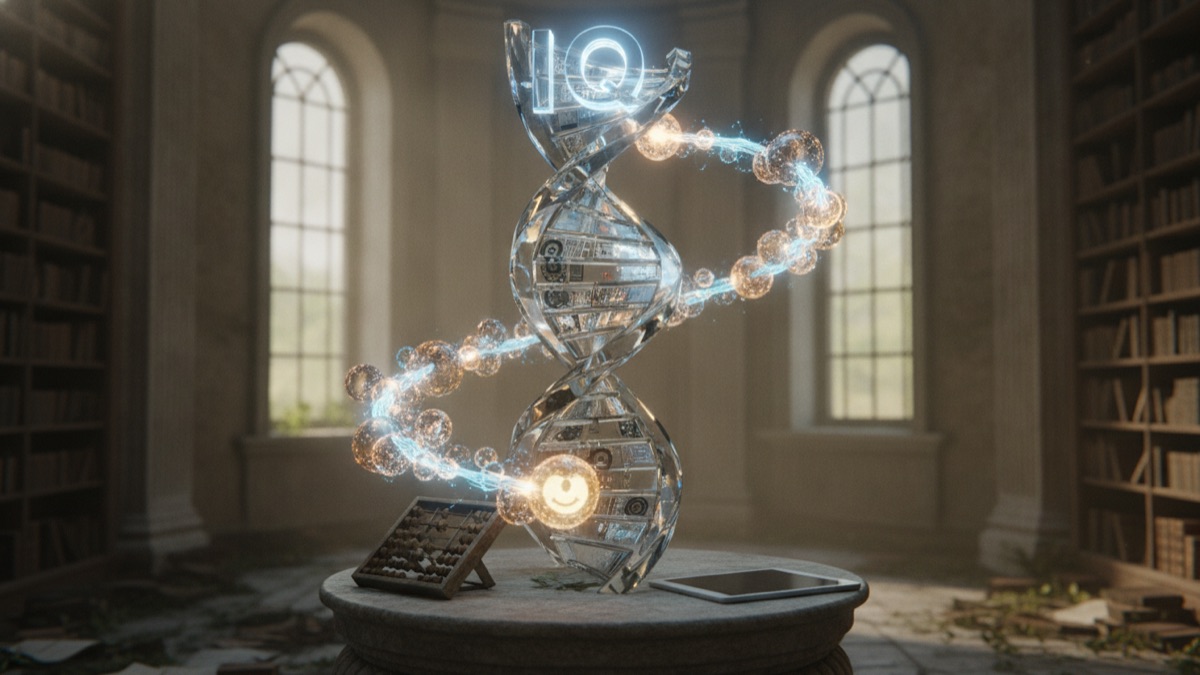
IQ (intelligence quotient) and EQ (emotional quotient, or emotional intelligence) are two of the most commonly referenced measures of human ability, yet they capture fundamentally different things. IQ measures cognitive abilities like logical reasoning, memory, and problem-solving, while EQ measures the ability to recognize, understand, and manage emotions, both your own and others'.
Both concepts have generated significant academic research and public debate, particularly around how much each actually predicts real-world success, and whether either can meaningfully change over a person's lifetime.
What IQ Actually Measures
IQ is measured through standardized tests, first developed in the early 20th century by psychologists including Alfred Binet, originally intended to identify students needing additional educational support. Modern IQ tests assess several distinct cognitive domains, including verbal comprehension, working memory, processing speed, and spatial/perceptual reasoning, combined into a single composite score.
IQ scores are standardized so that 100 represents the statistical average for the general population, with roughly two-thirds of people scoring between 85 and 115. Research shows IQ is a reasonably strong predictor of academic performance and, to a lesser extent, certain job performance outcomes, though its predictive power varies considerably by field and context.
What EQ Actually Measures
Emotional intelligence, popularized largely by psychologist Daniel Goleman's 1995 book of the same name, is generally broken into several components: self-awareness (recognizing your own emotions), self-regulation (managing emotional reactions), motivation, empathy (recognizing others' emotions), and social skills (managing relationships effectively).
Unlike IQ, EQ has no single universally standardized test; it's typically assessed through self-report questionnaires or, more rigorously, through 'ability-based' tests that present emotional scenarios and measure how accurately a person can identify or predict emotional responses, an approach considered more objective than pure self-assessment.
Which One Matters More for Success?
This is genuinely debated in the research literature. IQ remains one of the strongest single predictors of academic achievement and, in many studies, job performance, particularly in cognitively demanding roles. However, research on EQ suggests it plays a distinct and meaningful role in areas IQ doesn't capture well, including leadership effectiveness, workplace relationships, mental health, and conflict resolution.
Most researchers now generally agree the two are complementary rather than competing measures: high IQ can enable strong technical or analytical performance, while high EQ often determines how effectively someone can collaborate, lead, and navigate interpersonal dynamics required to actually apply that ability in real-world settings.
Can IQ and EQ Be Improved?
IQ is generally considered relatively stable across adulthood, though it is influenced by both genetics and environmental factors like education and nutrition during childhood development, and some specific cognitive skills measured within IQ tests can improve somewhat with practice and learning, even if the overall score tends to remain fairly consistent.
EQ is generally considered more malleable than IQ throughout life; skills like self-awareness, empathy, and emotional regulation can genuinely be developed through deliberate practice, therapy, coaching, and life experience, which is one reason emotional intelligence training has become common in corporate and educational settings.
Sources
- American Psychological Association — Research on intelligence testing and cognitive ability measurement
- Daniel Goleman — Original research and framework on emotional intelligence
- Encyclopaedia Britannica — History and methodology of IQ testing
FAQ
What does IQ actually measure?
IQ measures cognitive abilities including verbal comprehension, working memory, processing speed, and spatial reasoning, combined into a standardized score where 100 represents the statistical average.
What does EQ actually measure?
Emotional intelligence measures self-awareness, self-regulation, motivation, empathy, and social skills, generally assessed through self-report questionnaires or ability-based tests using emotional scenarios.
Which is a better predictor of success, IQ or EQ?
Research generally finds IQ a stronger predictor of academic and certain job performance, while EQ plays a distinct role in leadership, relationships, and mental health, making them complementary rather than competing measures.
Who popularized the concept of emotional intelligence?
Psychologist Daniel Goleman popularized the concept largely through his 1995 book Emotional Intelligence, building on earlier academic research into the construct.
Can you actually improve your EQ?
Yes. EQ is generally considered more malleable than IQ; skills like self-awareness, empathy, and emotional regulation can be developed through deliberate practice, therapy, coaching, and life experience.
About the Author
doyouknow.app Editorial Team — We reference academic psychology and testing research to clearly distinguish what IQ and EQ each measure.
Loved This Article?
Share it on WhatsApp → Share on WhatsApp
Get more guides in your inbox — Subscribe to our newsletter for weekly surprising stories from Egypt, Saudi Arabia, Dubai, and beyond.