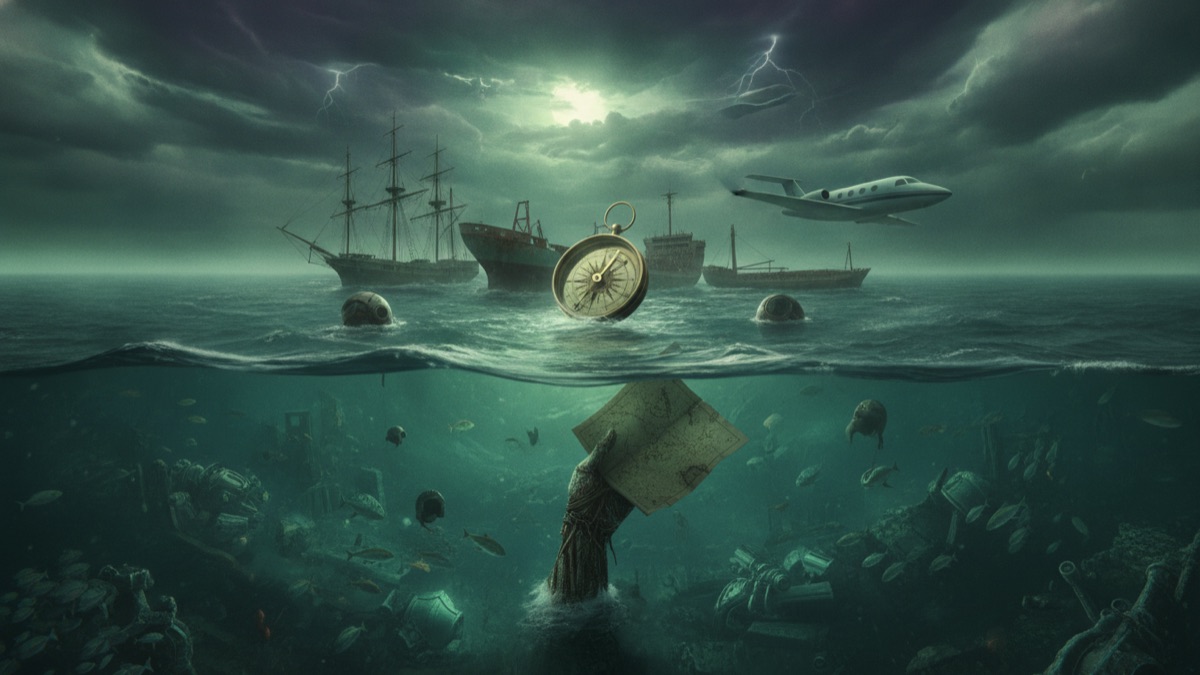
Somewhere in the stretch of Atlantic Ocean bounded by Miami, Bermuda, and Puerto Rico, a persistent story insists that ships and aircraft vanish at a rate no ordinary patch of sea should produce. The Bermuda Triangle has inspired documentaries, novels, and decades of anxious speculation about magnetic anomalies, sea monsters, and even extraterrestrial abduction, all built around a genuine list of real disappearances that happened to occur within a loosely defined triangular region of open water.
Separating the actual historical record from the mythology that grew around it requires looking closely at how the legend was assembled, which incidents actually anchor it, and what maritime statisticians and investigators have found when they examined the region's loss rate against comparably busy stretches of ocean elsewhere in the world.
What the Bermuda Triangle Actually Is
The Bermuda Triangle is not an officially recognized geographic or maritime designation. It is a popularly drawn triangle connecting Miami, Bermuda, and San Juan, Puerto Rico, enclosing roughly half a million square miles of the western Atlantic, though different authors have drawn its boundaries differently over the decades, sometimes stretching it considerably further to capture additional incidents that suited their narrative.
This lack of a fixed, agreed boundary is itself significant, because it means the very definition of the region has been flexible enough to absorb whichever disappearances a given writer wanted to include, while excluding losses that happened just outside whatever line was convenient for that particular telling of the story.
The area does happen to be one of the most heavily trafficked stretches of ocean and air on the planet, sitting directly across major shipping lanes between the Americas and Europe and beneath busy commercial and private aviation corridors, a fact that matters considerably when assessing whether its loss count is actually unusual.
How the Legend Actually Began
The idea of a specifically dangerous triangular zone did not exist as a popular concept until more than a decade after its most famous founding incident. Individual disappearances had been reported in newspapers over the years, but no writer had yet proposed that they formed a pattern worth naming and investigating as a single mysterious phenomenon.
The turning point came from magazine writers in the 1950s and 1960s who began noticing that several unrelated losses had occurred in roughly the same region and started grouping them together in feature articles, using increasingly dramatic language to suggest an underlying connection that the original incident reports themselves had never claimed.
The name itself, "Bermuda Triangle," was coined by a writer named Vincent Gaddis in a 1964 magazine article, and it was popularized further by a 1974 bestselling book that compiled dozens of incidents into a single narrative, cementing the triangle as a recognizable cultural concept rather than a loose collection of separately reported maritime and aviation losses.
The Flight 19 Disappearance That Started It
The incident most responsible for the legend's staying power is the disappearance of Flight 19, a group of five U.S. Navy Avenger torpedo bombers that vanished during a routine training exercise off the coast of Florida in December 1945, along with the rescue seaplane subsequently sent to search for them, which also vanished the same evening.
Fourteen crew members aboard the five bombers and thirteen more aboard the rescue plane were lost, and despite an extensive search covering hundreds of thousands of square miles of ocean and land, no wreckage, debris, or bodies from either the original flight or the rescue aircraft were ever conclusively recovered, which understandably left the incident feeling genuinely unresolved.
The completeness of the disappearance, combined with the fact that a rescue aircraft sent specifically to find the missing planes vanished as well, gave the story an unusually eerie quality that later writers found irresistible when constructing a narrative about a uniquely dangerous stretch of ocean.
What Investigators Actually Found About Flight 19
The official Navy investigation into Flight 19, conducted in the immediate aftermath, reached a considerably more mundane conclusion than the mystery narrative that developed later. The flight's commanding officer, Lieutenant Charles Taylor, was a relatively inexperienced pilot on this particular route who appears to have become disoriented and believed he was over the Florida Keys when the flight was actually much further north and east than he calculated.
Radio transmissions recorded before contact was lost show Taylor repeatedly rejecting a compass heading suggested by another pilot in the formation, insisting on his own incorrect position estimate, which led the flight further out to sea rather than back toward land as fuel ran low, a scenario consistent with a training flight running out of fuel over open ocean in deteriorating weather and ditching in rough seas at night.
The rescue seaplane's loss is separately explained by that aircraft type's known history of occasional in-flight fuel vapor explosions, an established mechanical hazard for that specific model rather than anything unique to the location, and a merchant ship in the area that night reported witnessing an explosion consistent with this timeline and position.
The USS Cyclops and Early Naval Losses
Predating Flight 19 by nearly three decades, the disappearance of the USS Cyclops, a U.S. Navy collier carrying more than three hundred crew and passengers, remains the single largest loss of life in Navy history not directly attributable to combat, having vanished sometime after departing Barbados in March 1918 without ever sending a distress signal.
No wreckage was found for decades, and the ship's loss became one of the earliest anchors for triangle mythology, though maritime historians point to several plausible explanations including a severely overloaded cargo hold of manganese ore, structural problems already documented in sister ships of the same design, and the possibility of a wartime storm or even enemy action given the ongoing First World War.
Two sister ships of nearly identical design were separately lost without a trace years later while carrying the same type of ore cargo, a pattern that strongly points toward a structural design flaw specific to that ship class rather than any location-based explanation, since the losses occurred in entirely different parts of the Atlantic.
How the Media Actually Built the Modern Myth
Beyond Gaddis's original article, the concept received its decisive cultural push from Charles Berlitz's 1974 book, which compiled a long list of incidents, presented them with dramatic framing suggesting an unexplained common cause, and became a massive bestseller that introduced the Bermuda Triangle to a global mainstream audience for the first time.
Subsequent researchers who fact-checked Berlitz's claims found numerous factual errors throughout the book, including incidents that occurred well outside the supposed triangle, ships whose sinkings were actually well documented and unmysterious, and at least one incident that appears not to have happened as described at all, findings that seriously undermined the book's credibility among careful researchers even as its popular influence continued growing.
Television documentaries throughout the following decades further entrenched the legend, frequently repeating Berlitz's uncorrected claims rather than the more thoroughly researched debunkings that had already been published, a pattern common to sensational topics where the exciting version of a story circulates far more widely than its careful correction.
What the Statistics Actually Show
Insurance industry data provides one of the more objective tests available, since insurers such as Lloyd's of London have no particular incentive to downplay genuine risk and every incentive to price policies accurately according to actual loss rates in any given region they insure.
Lloyd's has stated repeatedly that it does not charge higher premiums for vessels transiting the Bermuda Triangle compared with any other similarly trafficked stretch of ocean, a striking fact given that insurance pricing is precisely the kind of hard commercial decision that would reflect genuine elevated risk if such risk existed and could be measured.
The U.S. Coast Guard, which maintains extensive records of maritime search and rescue operations, has likewise stated that the number of incidents in the region is not significantly disproportionate to its heavy traffic volume and does not suggest any unusual or unexplained cause distinct from ordinary maritime and aviation hazards found throughout the world's oceans.
Why Ships and Planes Actually Get Lost There
The region genuinely does see a substantial number of maritime and aviation incidents, but researchers who have studied it point to entirely ordinary explanations that combine unusually severe local conditions with an unusually high volume of vessel and aircraft traffic passing through the area every single day of the year.
The Triangle sits along one of the busiest recreational boating corridors in the world, connecting Florida's coastline with the Bahamas and the Caribbean, and a large proportion of that traffic consists of small private vessels and aircraft operated by relatively inexperienced pilots and boaters, a demographic that statistically accounts for a disproportionate share of maritime and aviation accidents anywhere in the world.
When incident rates are normalized against actual traffic volume rather than simply counted in absolute terms, researchers have consistently found the region's loss rate to be unremarkable compared with other heavily trafficked coastal waters worldwide, a finding that undercuts the core premise that something location-specific is driving the disappearances.
The Role of the Gulf Stream
The Gulf Stream, a powerful and fast-moving current that runs directly through the Triangle region, is capable of quickly scattering wreckage and debris across a very wide area of ocean, and can also rapidly erase surface evidence of a sinking or crash by carrying it far from the actual incident location before search efforts even begin.
This current has genuinely contributed to the mystique of several incidents, since search teams looking for wreckage in the vicinity of a last known position may find nothing simply because the current has already carried debris dozens or even hundreds of miles away by the time a search actually gets underway, producing a genuinely empty-handed search result that feels more mysterious than it actually is.
The current's strength and unpredictability near the ocean floor's varied depth also makes wreckage recovery in parts of the region considerably more difficult than in calmer, shallower waters, meaning some losses that would eventually be explained elsewhere simply remain unresolved indefinitely due to practical recovery difficulty rather than genuine mystery.
Sudden Weather and Rogue Waves
The region is subject to rapidly forming tropical storms and squalls that can develop with comparatively little warning by the standards of mid-twentieth-century forecasting technology, catching vessels and small aircraft in conditions considerably more severe than what was reported when they departed, a genuine hazard independent of any specific location.
Rogue waves, unusually large waves that form unpredictably and can significantly exceed the height of surrounding sea conditions, have been documented in the wider Atlantic and are now understood by oceanographers to occur far more commonly than was believed decades ago, offering a plausible physical explanation for some sudden losses of vessels that seemed, at the time, to vanish without any weather explanation on record.
Modern satellite weather tracking has made this kind of rapid, poorly forecast severe weather considerably rarer as a cause of unexplained loss today than it was during the era when most of the Triangle's founding incidents occurred, which is itself a quiet piece of evidence pointing toward ordinary weather rather than anything more exotic.
Human Error and Navigation Challenges
Before satellite positioning systems became widely available, navigation across open ocean relied heavily on dead reckoning, a method of estimating position from known speed, heading, and elapsed time that compounds even small errors over distance, precisely the kind of error that appears to have contributed to Flight 19's disorientation.
The region's proximity to the magnetic-versus-true-north variation line, where a compass reading and an actual geographic bearing diverge by an unusually small margin compared with surrounding areas, has been proposed as a contributing factor in some historical navigation errors, since pilots and navigators of that earlier era sometimes failed to correctly account for the variation.
Contemporary GPS-based navigation has essentially eliminated this specific category of error for vessels and aircraft equipped with modern positioning systems, and disappearances of well-equipped, well-maintained craft in the region have become considerably rarer in recent decades as a direct consequence, a trend that itself argues against any exotic, non-navigational explanation.
The Methane Hydrate Theory
One more genuinely scientific hypothesis proposes that large releases of methane gas from hydrate deposits on the seafloor, which are known to exist in parts of the region, could theoretically reduce water density enough to cause a vessel to lose buoyancy and sink rapidly, and could separately ignite in the atmosphere in a way that might affect aircraft.
Laboratory experiments have demonstrated that sufficiently large methane releases can indeed reduce water density enough to sink scale-model vessels, lending the theory genuine scientific credibility as a physically possible mechanism, though researchers studying actual seafloor methane seep activity in the region have not found evidence of eruptions on a scale that would be required to sink a large real-world ship.
The theory remains an active area of legitimate geological research into seafloor methane hydrate stability generally, valuable in its own right for understanding ocean chemistry and climate science, even though its specific application to explaining Bermuda Triangle disappearances remains unproven and is treated by most researchers as one plausible but unconfirmed contributing factor at most.
Why the Legend Still Persists Today
Despite the accumulated weight of insurance data, Coast Guard statistics, and individually debunked incidents, the Bermuda Triangle remains one of the most recognizable pieces of modern folklore, a durability that says as much about how compelling mystery narratives are to a general audience as it does about the underlying incidents themselves.
Psychologists who study belief in such phenomena point to a well-documented human tendency to notice and remember confirming patterns while overlooking the far larger number of uneventful ship and aircraft crossings of the same waters that never make headlines precisely because nothing unusual happened to them at all.
The legend of the Bermuda Triangle endures not because the region is provably more dangerous than any comparable stretch of heavily trafficked ocean, but because a handful of genuinely unresolved historical disappearances, amplified by decades of sensational media coverage, proved more memorable and more emotionally satisfying than the more mundane statistical reality that careful investigators have repeatedly documented.
Other Incidents Often Cited in the Legend
Beyond Flight 19 and the USS Cyclops, triangle books typically list a longer roster of incidents, including the 1948 disappearance of the airliner Star Tiger and the 1949 disappearance of Star Ariel near Bermuda, both lost without a trace during otherwise routine commercial flights, leaving investigators of that era without a conclusive explanation given the far more limited search and rescue technology available compared with modern standards.
The 1968 loss of the submarine USS Scorpion is also frequently cited, though subsequent investigation clearly located its wreckage southwest of the Azores and linked its loss to a probable internal mechanical failure rather than anything unexplained, a typical outcome for how most incidents on triangle lists resolve once subjected to careful later technical investigation.
Researchers note that a considerable number of the incidents repeatedly listed in triangle books actually fall outside the traditionally drawn boundaries of the triangle itself, or occurred in weather conditions well documented in official records at the time, a pattern that reinforces the conclusion that the list's persuasive power comes from its sheer length rather than any genuinely documented connection between its individual entries.
What the Triangle Teaches About Critical Thinking
The Bermuda Triangle offers a genuinely useful case study in how a compelling narrative can outcompete careful statistical analysis in public awareness, since the individually debunked explanations for Flight 19, the Cyclops, and other incidents have been publicly available for decades yet remain far less well known than the original mysterious framing that made each story famous in the first place.
The pattern illustrates a broader principle relevant well beyond maritime history, namely that a list of dramatic anecdotes assembled without controlling for base rates, total traffic volume, or comparison regions can feel statistically compelling while being analytically meaningless, precisely the kind of reasoning error that careful investigators must correct for whenever a supposed pattern is proposed from a curated set of memorable incidents.
Understanding why the Bermuda Triangle legend persists despite the evidence against it therefore offers more than historical curiosity, providing a genuinely transferable lesson in evaluating any claim that a specific place, product, or practice is unusually dangerous or unusually effective based on a handful of vivid stories rather than a fair statistical comparison against a proper baseline.
Sources
- Wikipedia — overview of the legend, its history, and documented incidents
- U.S. Navy Naval History and Heritage Command — official records on Flight 19 and USS Cyclops
- United States Coast Guard — statements on search-and-rescue statistics for the region
- NOAA (National Oceanic and Atmospheric Administration) — oceanographic data on the Gulf Stream and Atlantic weather patterns
- Encyclopaedia Britannica — background on the Bermuda Triangle legend and its origins
FAQ
Is the Bermuda Triangle officially recognized as a dangerous zone?
No — it has no official geographic designation, and agencies including the U.S. Coast Guard and Lloyd's of London have stated its incident rate is not unusual for its traffic volume.
What actually happened to Flight 19?
The Navy's own investigation concluded the flight commander became disoriented, ran low on fuel over open ocean, and the formation likely ditched in rough seas at night; the rescue plane sent afterward is separately explained by that aircraft type's known fuel-vapor explosion risk.
Who coined the term 'Bermuda Triangle'?
Writer Vincent Gaddis first used the name in a 1964 magazine article; the concept was popularized further by Charles Berlitz's bestselling 1974 book.
Do insurance companies charge more for Bermuda Triangle crossings?
No — Lloyd's of London has stated it does not charge elevated premiums for the region, a strong indicator that actual risk data does not support the legend.
Is there any real scientific theory behind the disappearances?
The methane hydrate hypothesis is a genuine, physically plausible theory under study, though evidence for eruptions large enough to sink real ships has not been found in the region.
About the Author
We reference Wikipedia, U.S. Navy Naval History and Heritage Command, United States Coast Guard, NOAA (National Oceanic and Atmospheric Administration), Encyclopaedia Britannica to explain the background and current understanding of this topic.
Loved This Article?
Share it on WhatsApp → Share it on WhatsApp
Get more guides in your inbox — Subscribe to our newsletter for weekly surprising stories from Egypt, Saudi Arabia, Dubai, and beyond.