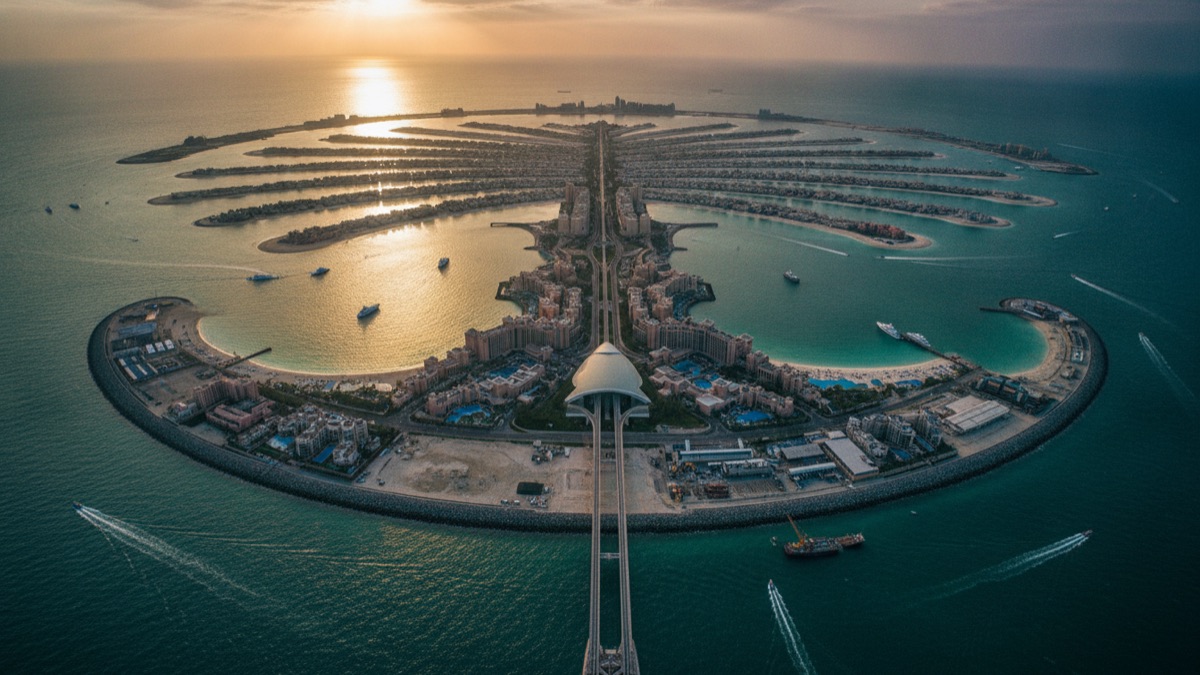
Palm Jumeirah: An Engineering Marvel
In 2001, Dubai had a problem. It was running out of coastline. So it decided to build more.
The solution was Palm Jumeirah — an artificial island shaped like a palm tree, pushed into the Persian Gulf. It's the world's largest artificial island. It added 78 kilometers of coastline to a city that desperately needed it. And it was built using nothing but sand, rock, and the sheer will to make the impossible happen. If you're curious about how was palm jumeirah built, the story is even wilder than the result.
The Vision: Why Build an Island?
Dubai's coastline was limited. The city wanted to become a global tourism and real estate destination. It needed beachfront property. But nature hadn't provided enough. So Nakheel, the government-owned developer, proposed something radical: build an island in the shape of a palm tree, complete with a frond-shaped breakwater.
The plan was ambitious to the point of absurdity. A 5-by-5 kilometer island. Seventeen fronds. A crescent-shaped breakwater. Hotels, villas, apartments, and marinas. All built from materials dredged from the sea floor. This was palm jumeirah history in the making — before the first grain of sand was moved.
Sheikh Mohammed bin Rashid Al Maktoum approved the plan. Construction began in 2001. The timeline was aggressive. The budget was massive. And the engineering challenges were unprecedented.
Palm Jumeirah Facts That'll Blow Your Mind
7 Million Tons of Rock
The breakwater alone required 7 million tons of rock. Workers placed these rocks on the seabed to create a protective wall around the island. The breakwater is 11 kilometers long. It protects the island from waves and currents. Without it, the entire structure would erode within years. The rocks came from quarries across the UAE. Trucks delivered them 24 hours a day for years.
94 Million Cubic Meters of Sand
The island itself is made of sand dredged from the Persian Gulf. Dredgers sucked sand from the seabed and sprayed it into the desired shape. The process is called "rainbowing" — the sand arcs through the air like a liquid rainbow before settling into place. Approximately 94 million cubic meters of sand were moved. That's enough to fill 37,000 Olympic swimming pools.
GPS Precision to the Centimeter
Building a palm-shaped island requires precision. The fronds must be evenly spaced. The crescent must be perfectly curved. Engineers used GPS-guided dredgers controlled by satellite positioning. The accuracy was within centimeters. This was the first time GPS technology was used at this scale for marine construction. It changed how coastal projects are built worldwide.
It Took 10 Years to Build
Construction started in 2001. The first residential units opened in 2006. The Atlantis, The Palm hotel opened in 2008. But full completion took a decade. The project involved 40,000 workers at its peak. It cost approximately $12 billion. That's a palm jumeirah facts figure that puts the scale in perspective — this wasn't just a real estate project. It was national infrastructure.
The Island Is Sinking — Slightly
Here's a fact that doesn't make the brochures. Studies suggest the island is settling at a rate of about 5 millimeters per year. That's not dramatic, but it's real. The sand compresses under the weight of buildings. Engineers anticipated this. The foundations of major structures were designed with settlement in mind. But it's a reminder that building on reclaimed land is never truly finished. The earth keeps moving.
The Engineering Challenges
Wave Action and Erosion
The Persian Gulf has strong currents and seasonal storms. Without protection, the island would wash away. The crescent breakwater absorbs wave energy. But designing it required extensive modeling. Engineers tested scale models in wave tanks. They simulated decades of storm conditions. The breakwater had to be thick enough to survive the worst-case scenario.
Soil Stability
Sand doesn't behave like solid ground. It compacts, shifts, and liquefies under stress. Buildings on the fronds needed special foundations. Many villas sit on shallow foundations with reinforced concrete slabs. The Atlantis hotel required deep pile foundations driven into the compacted sand. Each structure needed custom engineering based on its location and weight.
Water Circulation
The fronds create narrow channels. Without water circulation, these channels would become stagnant. Engineers designed the breakwater with two openings that allow tidal flow. The water exchanges naturally. This prevents pollution buildup and keeps the marine ecosystem alive. It's hidden infrastructure that makes the entire project sustainable.
Materials and Logistics
Getting 7 million tons of rock and 94 million cubic meters of sand to the right place requires extraordinary logistics. A fleet of dredgers worked around the clock. A dedicated rock-loading terminal handled breakwater materials. At peak construction, 200 trucks per day delivered rock to the marine loading point. The palm jumeirah engineering coordination was as impressive as the engineering itself.
What Palm Jumeirah Became
Hotels and Resorts
The Atlantis, The Palm opened in 2008 and became an instant icon. The Aquaventure waterpark is one of the largest in the world. The Lost Chambers aquarium holds 65,000 marine animals. The Pointe, a retail and dining complex, opened at the top of the island. The Palm Tower adds a St. Regis hotel and observation deck. New hotels keep opening. The island is now a full hospitality ecosystem.
Residential Villas and Apartments
The fronds are lined with private villas. The trunk has apartment towers. Thousands of people live on the island full-time. The properties are among the most expensive in Dubai. The views are spectacular. The lifestyle is unique. But residents deal with the practical realities of island living — traffic on the single bridge, limited grocery options, and the knowledge that the ground beneath them is reclaimed sand.
The Monorail
The Palm Jumeirah Monorail opened in 2009. It's the first monorail in the Middle East. It connects the Gateway Station at the trunk to Atlantis at the crescent. The ride offers spectacular views of the island's layout. It's a tourist experience as much as a transport system. The fact that Dubai built a monorail on an artificial island is peak Dubai.
The View from Space
Palm Jumeirah is visible from space with the naked eye. Astronauts on the International Space Station have photographed it repeatedly. The shape is unmistakable. That's a palm jumeirah facts that puts the scale in cosmic perspective. Humans altered the coastline so dramatically that it became a landmark visible from orbit.
The Impact on Dubai
Dubai palm island projects changed how the world sees the city. Before Palm Jumeirah, Dubai was a regional trading hub. After, it was a global brand. The island proved that Dubai could execute the impossible. It attracted international investment. It put Dubai on magazine covers and TV shows. It made Sheikh Mohammed's vision tangible.
The project also inspired other artificial islands. The World Islands, another Nakheel project, created a map of the world from 300 islands. Deira Islands and Palm Jebel Ali followed. Some succeeded. Some stalled. But Palm Jumeirah was the proof of concept that made everything else imaginable.
Sources
- Nakheel Official Website — Developer information and project specifications for Palm Jumeirah
- Emaar Properties — Real estate context and surrounding development information
- Dubai Tourism Official — Tourism board information and visitor guidance for Palm Jumeirah
- National Geographic — Palm Islands Engineering — Engineering coverage and environmental analysis
- Journal of Marine Science and Engineering — Academic papers on coastal engineering and artificial island settlement
- CNN — Dubai's Palm Islands — International news coverage and documentary features
FAQ
How was Palm Jumeirah built?
Palm Jumeirah was built using dredged sand from the Persian Gulf and 7 million tons of rock for the breakwater. GPS-guided dredgers sprayed 94 million cubic meters of sand into the palm shape. The crescent breakwater was built first, then the trunk and fronds. Construction took approximately 10 years from 2001 to 2011.
Is Palm Jumeirah sinking?
Studies indicate the island is settling at a rate of about 5 millimeters per year due to sand compression under the weight of buildings. This was anticipated by engineers. Major structures like the Atlantis hotel were built with deep pile foundations designed to accommodate settlement. The process is gradual and monitored.
How big is Palm Jumeirah?
Palm Jumeirah covers approximately 5 by 5 kilometers. It added 78 kilometers of coastline to Dubai. The island has 17 fronds, a trunk, and an 11-kilometer crescent-shaped breakwater. It's the world's largest artificial island and is visible from space.
How much did Palm Jumeirah cost to build?
The project cost approximately $12 billion. It involved 40,000 workers at peak construction. The scale required extraordinary logistics — 200 trucks per day delivering rock, fleets of dredgers working 24/7, and the first-ever GPS-guided marine construction at this scale.
Can you visit Palm Jumeirah as a tourist?
Yes. The Atlantis, The Palm and its Aquaventure waterpark are major tourist attractions. The Pointe offers dining and entertainment. The Palm Tower has an observation deck. The monorail provides scenic views. Many restaurants and beach clubs are open to visitors. You can also take boat tours around the island to see the shape from the water.
About the Author
[Author bio placeholder — add a short bio about the writer, their expertise in engineering, architecture, and Middle Eastern development, and a photo.]
Loved This Article?
Share it on WhatsApp → Share on WhatsApp
Get more engineering wonders in your inbox — Subscribe to our newsletter for weekly surprising stories about Dubai, Saudi Arabia, and beyond.