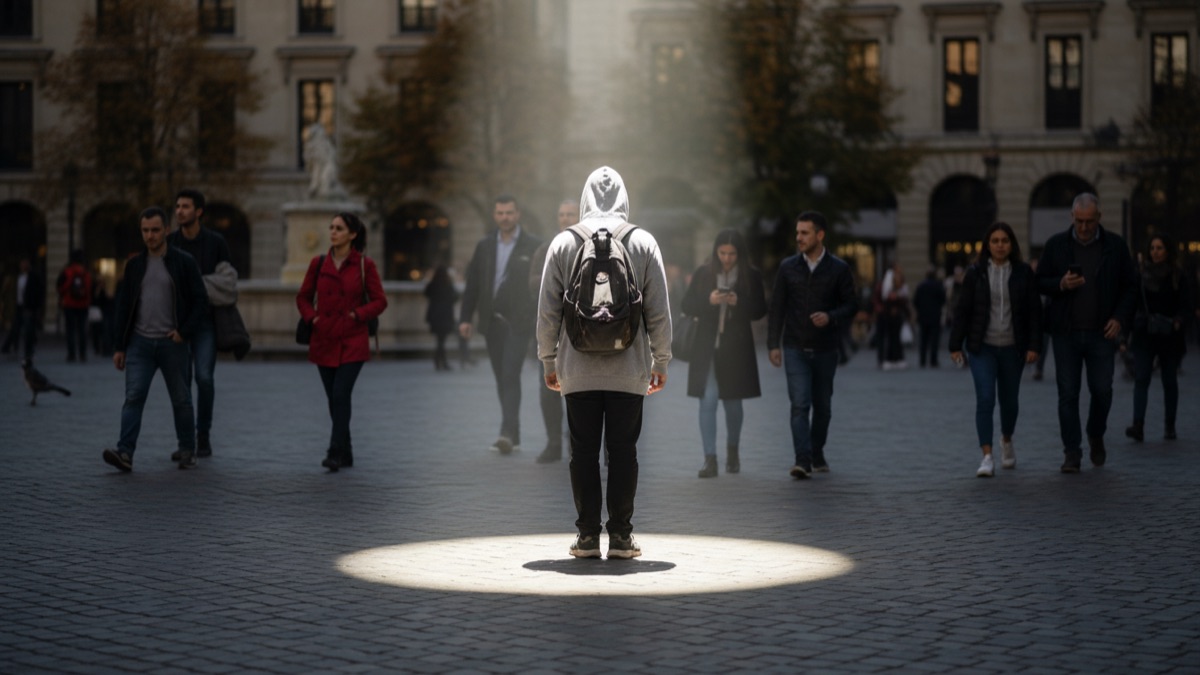
Psychologists Thomas Gilovich, Kenneth Savitsky, and Victoria Husted Medvec coined the term after a series of studies at Cornell University published around 2000. In one well-known experiment, students were asked to wear an embarrassing Barry Manilow t-shirt into a room of strangers, then guess how many people would remember it.
The students guessed that about half the room would notice and recall the shirt. In reality, only about a quarter did. That gap between predicted and actual attention is what the researchers named the spotlight effect: we consistently overestimate how much other people notice and remember about us.
The Cornell Study With the Embarrassing T-Shirt
Why Our Brains Overestimate Other People's Attention
The effect is explained partly by anchoring: we're intensely aware of our own appearance and mistakes because we can't stop noticing ourselves, and we insufficiently adjust that starting point downward when guessing what others are focused on. Everyone else is running the same self-focused loop, which is exactly why they aren't paying as much attention to you as you assume.
A related idea called the illusion of transparency describes a similar overestimation — the belief that our internal emotions, like nervousness, are more visible on our face than they really are. Both effects tend to shrink once someone deliberately imagines the situation from an outside observer's point of view instead of their own.
Sources
- American Psychological Association — research on self-focused cognitive biases
- Cornell University — origin of the spotlight effect studies
- Verywell Mind — explanation of the spotlight effect
FAQ
Does the spotlight effect fade as people get older?
It tends to soften with more social experience, but the underlying tendency to overestimate others' attention shows up across age groups in the original research.
Is the spotlight effect the same as social anxiety?
No, it's a normal cognitive bias everyone experiences to some degree, while social anxiety is a clinical condition involving persistent, disproportionate fear of judgment.
Can knowing about the spotlight effect actually reduce it?
Yes, studies suggest that consciously reminding yourself of the effect, or imagining the scene from an outsider's perspective, measurably lowers the anxiety it causes.
About the Author
We reference American Psychological Association, Cornell University, Verywell Mind to explain the background and current understanding of this topic.
Loved This Article?
Share it on WhatsApp → Share it on WhatsApp
Get more guides in your inbox — Subscribe to our newsletter for weekly surprising stories from Egypt, Saudi Arabia, Dubai, and beyond.