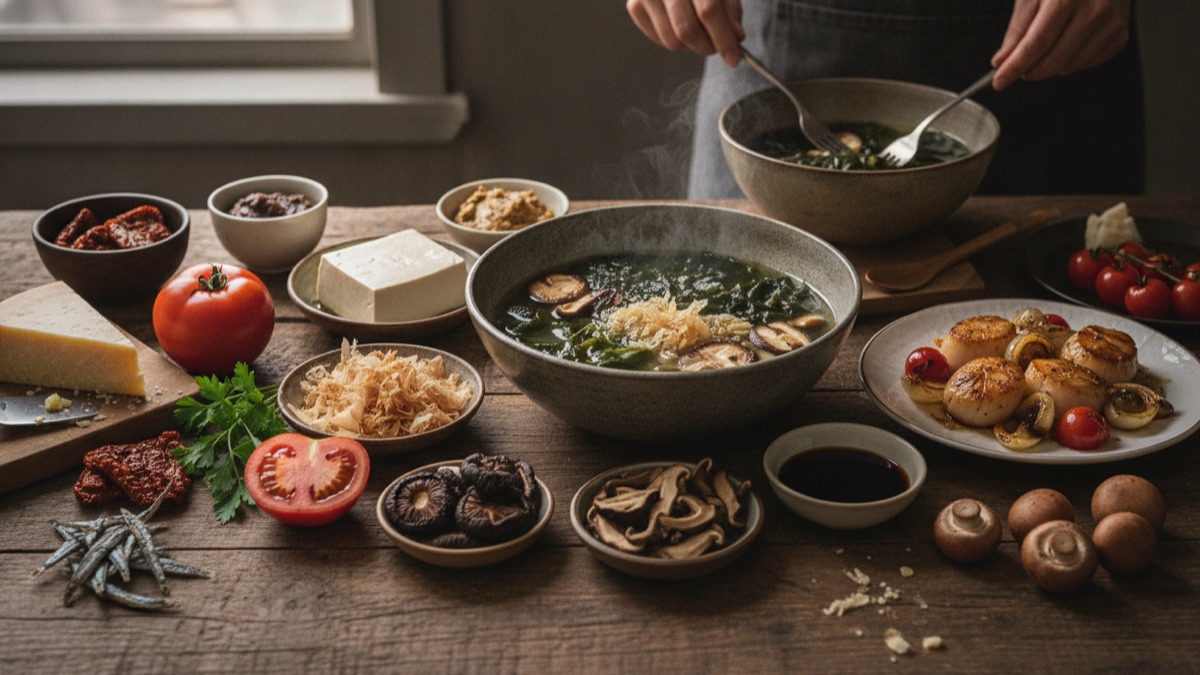
Umami is the savory, deeply satisfying taste identified alongside sweet, sour, salty, and bitter as one of the five basic tastes the human tongue can detect.
It was first identified in 1908 by Japanese chemist Kikunae Ikeda, who traced the flavor in kombu seaweed broth to glutamate, an amino acid.
Where Umami Comes From
Foods naturally rich in glutamate and related compounds — inosinate and guanylate — include aged cheese, cured meats, mushrooms, tomatoes, soy sauce, fish sauce, seaweed, and fermented products.
Cooking techniques like aging, curing, roasting, and fermenting all concentrate umami compounds, which is part of why slow-cooked broths and aged cheeses taste so rich.
How Scientists Confirmed It
For decades, umami was debated as a genuine distinct taste rather than just an enhancer of others.
That changed in 2000, when researchers identified specific glutamate taste receptors on the tongue, confirming it operates through its own dedicated sensory pathway, just like sweet or salty.
Sources
- Wikipedia — overview of umami taste and its discovery
- Encyclopaedia Britannica — background on the fifth basic taste
- Umami Information Center — historical accounts of Kikunae Ikeda's research
FAQ
Is MSG the same as umami?
Monosodium glutamate (MSG) is a purified form of glutamate, the compound that produces umami taste; it's added to intensify umami flavor and is recognized as safe by major food safety authorities despite past controversy.
Which foods have the strongest umami taste?
Aged parmesan cheese, dried shiitake mushrooms, soy sauce, fish sauce, and cured meats like prosciutto are among the most concentrated natural sources.
Can you taste umami on its own?
Yes — dedicated glutamate taste receptors were confirmed on the tongue in 2000, proving umami is a genuinely distinct basic taste rather than just a flavor enhancer.
About the Author
We reference Wikipedia and Encyclopaedia Britannica and the Umami Information Center to explain the background and current understanding of this topic.
Loved This Article?
Share it on WhatsApp → Share it on WhatsApp
Get more guides in your inbox — Subscribe to our newsletter for weekly surprising stories from Egypt, Saudi Arabia, Dubai, and beyond.