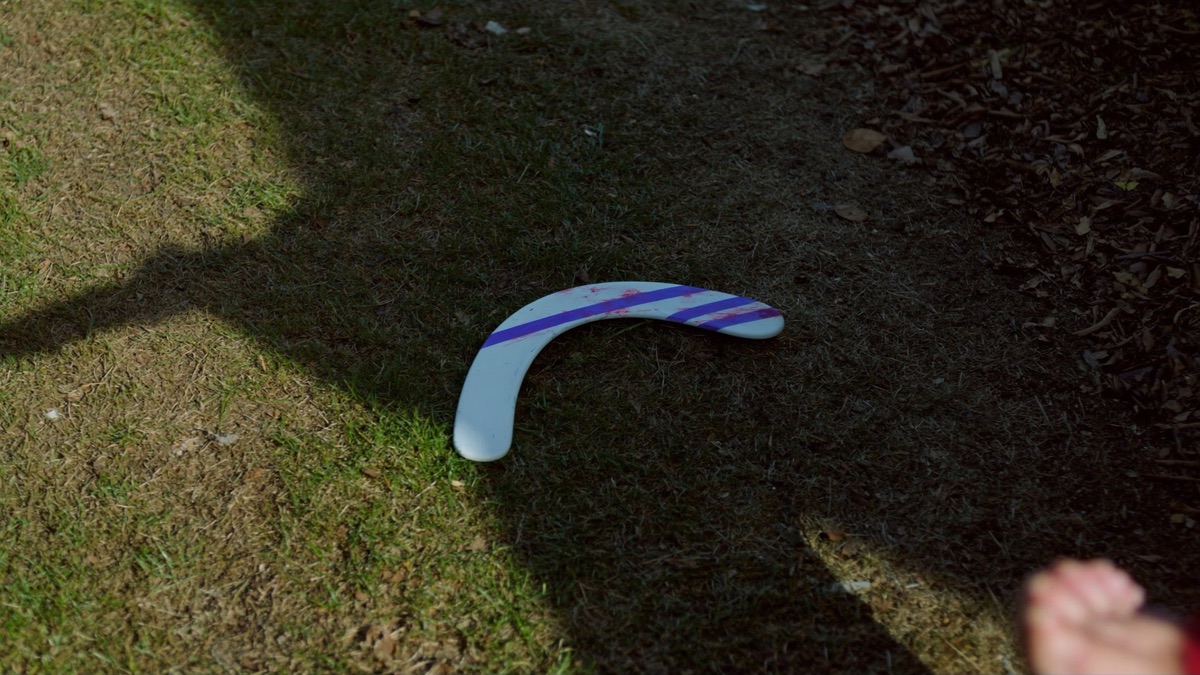
A returning boomerang is not a novelty toy defying physics; it is a precisely shaped spinning wing, and every part of its curved flight path, from the initial climb to the final circling return, follows directly from ordinary aerodynamic lift interacting with fast rotation. The same asymmetric lift that keeps a helicopter rotor blade or a thrown frisbee airborne is what steadily bends a boomerang's straight-line throw into a wide circle, and small differences in the angle, speed, and spin of the throw are what separate an expert's clean return from a beginner's boomerang that simply flies off in a straight line.
The Basic Shape: Why Every Returning Boomerang Is an Airfoil, Not a Flat Stick
A returning boomerang's arms are not flat pieces of wood; each arm is shaped as an airfoil, curved on the top surface and flatter on the bottom, exactly like an airplane wing, so that air flowing over the curved top surface travels faster and creates lower pressure than the air flowing along the flatter bottom, generating genuine aerodynamic lift.
This airfoil cross-section exists on both arms, and because the boomerang spins rapidly as it flies, both arms alternately act as tiny wings slicing through the air hundreds of times per second, meaning the whole object behaves less like a thrown stick and more like a miniature, fast-spinning rotor generating continuous lift throughout its flight.
How Gyroscopic Precession, Not Gravity Alone, Steers the Flight Path
A boomerang's most counterintuitive behavior comes from gyroscopic precession, the same physical principle that makes a spinning top or bicycle wheel respond to a tilting force by moving perpendicular to that force rather than in the direction the force was applied, roughly ninety degrees offset from what intuition would predict.
As a boomerang flies and its lower arm generates slightly more lift than its upper arm, that lift difference acts as a tilting force on the spinning disc, and precession converts that force into the boomerang gradually rotating its entire flight direction, which is precisely why the tool curves into an arc rather than simply flying straight and eventually dropping.
Why the Bottom Arm Generates More Lift Than the Top Arm
As a boomerang spins while also translating forward through the air, the arm sweeping through its lower position at any given instant moves faster relative to the surrounding air than the arm sweeping through the upper position, because the lower arm's rotational speed adds to the boomerang's forward speed while the upper arm's rotational speed partially subtracts from it.
Since aerodynamic lift increases with the square of airspeed, even a modest speed difference between the two arms produces a meaningfully larger lift force on the faster-moving lower arm, and this asymmetric lift is the initiating force that gyroscopic precession then converts into the boomerang's characteristic curving flight.
Why the Throwing Angle Is Nearly Vertical, Not Flat and Horizontal
A common beginner mistake is throwing a boomerang flat like a frisbee, but experienced throwers hold it nearly vertical, tilted only slightly off vertical toward the wind, because the entire physics of the return path assumes the spin axis points roughly upward and slightly toward the thrower, letting gyroscopic precession curve the flight into a horizontal circle back to the starting point.
If thrown flat, the same precession mechanics still apply, but the resulting curve bends the boomerang's path upward into the sky or downward into the ground rather than horizontally back toward the thrower, which is why proper throwing technique treats the vertical launch angle as just as important as the wrist snap that generates spin.
How Spin Rate Determines Whether a Throw Returns Cleanly or Falls Short
A boomerang typically needs to spin at several hundred rotations per minute to generate enough lift and gyroscopic stability to complete its curved flight path, and this spin comes almost entirely from a sharp snap of the wrist and fingers at the moment of release, not from the arm's overall throwing motion.
Too little spin means insufficient lift and precession force, causing the boomerang to fall short of a full circle and drop to the ground partway through its arc, while adequate spin combined with the correct launch angle and force lets the tool complete its full curving path and arrive back near the thrower's original position, typically after covering twenty to forty meters of flight.
Why Wind Direction and Speed Matter More Than Most Throwers Expect
Boomerang flight paths are highly sensitive to wind, and experienced throwers deliberately throw at an angle offset from directly into the wind, typically around thirty to forty-five degrees, rather than straight upwind, because the combination of the boomerang's own forward travel and the wind's push together determine the actual curving trajectory it follows.
A boomerang thrown directly into a strong headwind tends to curve too sharply and return short of the thrower, while one thrown with too much wind assistance can overshoot or curve unpredictably, which is why serious boomerang throwers check wind conditions carefully before adjusting their throwing angle for each specific throw.
Why Most Boomerangs Have Two or Three Arms Rather Than Just One
A two-arm boomerang is the traditional shape most people picture, but three-arm and even multi-blade designs exist and fly on the exact same aerodynamic and gyroscopic principles, since what actually matters for the physics is that each arm sweeps through the air as a lift-generating airfoil at a fast, consistent rotational speed, regardless of how many arms share that job.
More arms generally distribute lift generation across additional smaller wing surfaces, which can produce a smoother, more stable flight for less experienced throwers, while fewer, longer arms concentrate lift generation and typically require more spin and throwing skill to fly a clean, consistent return path.
How Boomerang Weight Distribution and Arm Angle Affect Stability
The angle between a boomerang's arms, typically somewhere between seventy and one hundred twenty degrees depending on design, along with careful weight balancing across the whole shape, determines how smoothly the object spins and how predictably it holds its flight path without wobbling or tumbling out of its intended curve.
Competition boomerangs are precisely engineered and often hand-tuned by adjusting small amounts of material at specific points, since even a slight asymmetry in weight or arm angle can throw off the delicate balance between lift, spin rate, and precession that a clean, tight return depends on, especially in the fast, close-range disciplines used in competitive throwing.
Why Modern Sport Boomerangs Look Nothing Like the Traditional Hunting Tool
Modern sport and competition boomerangs are made from lightweight composite materials like carbon fiber or high-density plastic rather than carved wood, and their shapes have been refined through wind-tunnel testing and computer modeling into bent, asymmetric forms optimized purely for return accuracy, hang time, or long-distance flight depending on the specific competition category.
This is a significant departure from traditional wooden hunting boomerangs used historically by Aboriginal Australians, most of which were actually non-returning weapons designed to fly in a relatively straight line for hunting purposes, with the returning variety representing a specialized subset developed and refined for different, more recreational purposes.
How Non-Returning Hunting Boomerangs Actually Worked as Weapons
Non-returning boomerangs, historically the more common type used across multiple continents including Australia, ancient Egypt, and parts of North America, were essentially heavy, aerodynamically stable throwing sticks that traveled in a relatively straight, flat trajectory with enough mass and velocity to injure or kill game at a distance, functioning more like a thrown club than a returning toy.
The same airfoil-shaped cross-section that gives a returning boomerang its lift also helps a non-returning throwing stick fly farther and more accurately than a plain straight branch would, by generating some lift that extends the weapon's effective range, even though these hunting sticks are deliberately shaped and weighted to avoid the tight curving return path.
How Boomerang Aerodynamics Directly Informed Helicopter Rotor Design
The asymmetric lift problem a boomerang solves through gyroscopic precession is remarkably similar to a challenge early helicopter engineers faced: a helicopter rotor blade advancing into the aircraft's forward motion generates more lift than the blade retreating on the opposite side, exactly the same lift imbalance that curves a boomerang's flight.
Helicopter designers solved this dissymmetry of lift using flapping hinges that let each blade pitch up and down as it rotates, compensating for the speed difference, a solution conceptually related to the same rotational aerodynamics that a boomerang exploits rather than fights, illustrating how understanding one spinning-wing problem illuminates a very different engineering challenge.
Why a Boomerang Thrown Too Hard or Too Soft Both Fail to Return
Throwing a boomerang with excessive force does not simply make it fly farther before returning; too much forward velocity relative to the spin rate disrupts the careful balance between forward travel and lift-driven curving, often causing the boomerang to fly in a much wider, flatter arc that overshoots the intended return point or fails to complete the circle at all.
Conversely, a throw with too little force and spin lacks the airspeed and gyroscopic stability needed to sustain lift throughout the full curved path, causing the boomerang to stall and drop early, which is why consistent, repeatable returns require throwers to find a specific, practiced combination of spin, angle, and forward force rather than simply throwing as hard as possible.
How Competitive Boomerang Throwing Turned Precise Physics Into a Sport
Competitive boomerang throwing includes disciplines like accuracy, where throwers score points based on how close the returning boomerang lands to a target center, and maximum time aloft, where the same physical principles are pushed to extremes through careful throw calibration to keep a boomerang airborne for as long as physically possible.
World championship-level accuracy throwers can consistently land returning boomerangs within a meter or less of dead center from throws covering dozens of meters, a level of precision that requires deeply internalized, almost instinctive control over spin rate, launch angle, and force, refined through the exact same aerodynamic principles described throughout this article.
Why Left-Handed and Right-Handed Boomerangs Are Genuinely Different Objects
A boomerang designed to be thrown with the right hand and curve to the left cannot simply be thrown left-handed to reverse its path, because the airfoil is shaped asymmetrically with a specific curved leading edge tuned to generate lift in one particular direction of spin, determined by which hand launches it.
A left-handed thrower using a right-handed boomerang will find it generates lift in the wrong orientation entirely, causing it to fly erratically or fail to curve back at all, which is why boomerang manufacturers produce distinct left-handed and right-handed models rather than a single universal design, unlike most other sporting equipment.
How the Boomerang Effect Became a Common Metaphor Beyond the Physical Object
The phrase boomerang effect entered everyday language to describe any action that unexpectedly returns to harm or affect its originator, a metaphor drawn directly from the physical object's defining trait of curving back toward the thrower rather than continuing in the direction it was launched.
This metaphorical usage appears widely in fields entirely unrelated to aerodynamics, from psychology, where it describes persuasion attempts that backfire and strengthen the opposing view, to economics and international trade, where tariffs or sanctions sometimes circle back to harm the country that imposed them.
How Beginners Can Diagnose a Boomerang That Won't Come Back
Experienced instructors teach a simple troubleshooting checklist for a boomerang that flies away without curving back: first check the throwing angle, since a throw held too flat sends the curve upward or downward instead of horizontally; then check spin, since a weak wrist snap produces too little rotation to sustain lift through the full path.
If angle and spin both seem correct, the remaining likely culprits are wind conditions, since throwing directly downwind or in gusty, unpredictable air disrupts the delicate balance the flight path depends on, or the boomerang itself being warped, damaged, or simply mismatched to the thrower's hand dominance.
Why Lift-to-Weight Ratio Determines How Long a Boomerang Stays Airborne
A boomerang's total time aloft depends fundamentally on the ratio between the lift its spinning arms generate and its overall weight, which is why maximum-time-aloft competition boomerangs are built extremely lightweight from materials like thin carbon fiber, maximizing lift relative to the minimal mass that lift has to support.
This same ratio explains why a heavier, more robust hunting-style boomerang, even a returning one, tends to fly a shorter, faster, more forceful path than a delicate competition model, since the added weight requires correspondingly more lift, and therefore more spin and speed, to achieve the same degree of curving flight.
How Boomerang-Like Throwing Sticks Independently Appeared Across Ancient Cultures
Archaeological evidence shows curved throwing sticks with boomerang-like aerodynamic properties were independently developed by multiple ancient cultures separated by vast distances, including a wooden example found in Tutankhamun's tomb in Egypt, artifacts from Native American tribes, and throwing sticks used historically in parts of India and Europe.
This independent, repeated invention across unrelated cultures suggests the curved throwing stick's aerodynamic advantages over a plain straight stick, extended range and improved accuracy from the added lift, were discoverable through practical trial and error by any society working with wood and hunting, without any single point of cultural transmission required.
Why Understanding Boomerang Physics Also Helps Explain Frisbee Flight
A thrown flying disc relies on the same core physics as a boomerang, gyroscopic stability from rapid spin combined with airfoil-shaped lift, though a standard frisbee is designed with symmetric lift distribution specifically to fly in a stable straight or gently curving line rather than looping back to the thrower.
Specialty flying discs designed to curve or return more dramatically deliberately introduce the same kind of asymmetric lift a boomerang exploits, confirming that boomerangs and frisbees sit on the same continuum of spinning-wing aerodynamics, differing mainly in how symmetrically or asymmetrically their lift is distributed across the rotating shape.
Sources
- Wikipedia — boomerang aerodynamics and history
- Wikipedia — gyroscopic precession mechanics
- Britannica — boomerang history and design overview
FAQ
Why does a spinning boomerang curve instead of flying straight?
Its lower arm generates more lift than its upper arm as it spins, and gyroscopic precession converts that lift imbalance into a steady curving of the flight path.
Why should a boomerang be thrown nearly vertically?
The return physics assumes a roughly upward-pointing spin axis; thrown flat, the same precession bends the flight up or down instead of horizontally back to the thrower.
What generates a boomerang's spin?
A sharp snap of the wrist and fingers at the moment of release, not the overall arm motion, provides nearly all of the spin needed for flight.
Do all boomerangs have two arms?
No; three-arm and multi-blade designs also exist and fly on the same principles, since what matters is each arm acting as a lift-generating airfoil while spinning.
Were most historical boomerangs actually returning ones?
No; most traditional boomerangs used for hunting across history were non-returning weapons designed to fly straight, with returning types being a specialized subset.
Why does wind direction matter for throwing a boomerang?
The boomerang's own travel and the wind's push combine to determine its curving path, so throwers angle their throw roughly thirty to forty-five degrees off the wind rather than straight into it.
What happens if a boomerang is thrown too hard?
Excessive forward speed relative to spin rate disrupts the lift-driven curving balance, often causing a wider, flatter arc that overshoots or fails to complete the return.
Is gyroscopic precession unique to boomerangs?
No; the same principle governs spinning tops and bicycle wheels, where a tilting force produces motion roughly ninety degrees offset from the direction it was applied.
Why does a boomerang's cross-section matter?
Each arm is shaped as an airfoil, curved on top and flatter below, exactly like an airplane wing, which is what allows it to generate real aerodynamic lift as it spins.
How does boomerang physics relate to helicopters?
Both face the same asymmetric lift problem between an advancing and retreating rotating blade; helicopters solve it with flapping hinges rather than precession.
What are modern sport boomerangs made from?
Lightweight composite materials like carbon fiber or high-density plastic, shaped through wind-tunnel testing rather than carved from wood like traditional versions.
How precise can competitive boomerang throwers be?
World-class accuracy throwers can consistently land returning boomerangs within a meter of dead center from throws covering dozens of meters.
Why does a boomerang thrown too softly fail to return?
Insufficient airspeed and gyroscopic stability cause it to stall and drop early, before it can complete the full curved path back to the thrower.
Does arm angle affect how a boomerang flies?
Yes; the angle between arms, typically seventy to one hundred twenty degrees, along with weight balance, determines spin smoothness and flight path predictability.
How far does a typical returning boomerang travel before coming back?
Most recreational throws cover roughly twenty to forty meters of curving flight before the boomerang arrives back near the thrower's original position.
Can a right-handed boomerang be thrown left-handed?
No; the airfoil is shaped asymmetrically for one specific spin direction, so a left-handed thrower needs a distinct left-handed model rather than reversing a right-handed one.
Where did the term boomerang effect come from?
It's a metaphor drawn directly from the object's defining trait of curving back toward the thrower, now used to describe any action that unexpectedly returns to affect its originator.
Is a frisbee governed by the same physics as a boomerang?
Yes, largely; both rely on gyroscopic stability from spin and airfoil lift, but a standard frisbee's symmetric lift keeps it flying straight rather than curving back.
About the Author
We reference Wikipedia and other authoritative sources to explain the background and current understanding of this topic.
Loved This Article?
Share it on WhatsApp → Share it on WhatsApp
Get more guides in your inbox — Subscribe to our newsletter for weekly surprising stories from Egypt, Saudi Arabia, Dubai, and beyond.