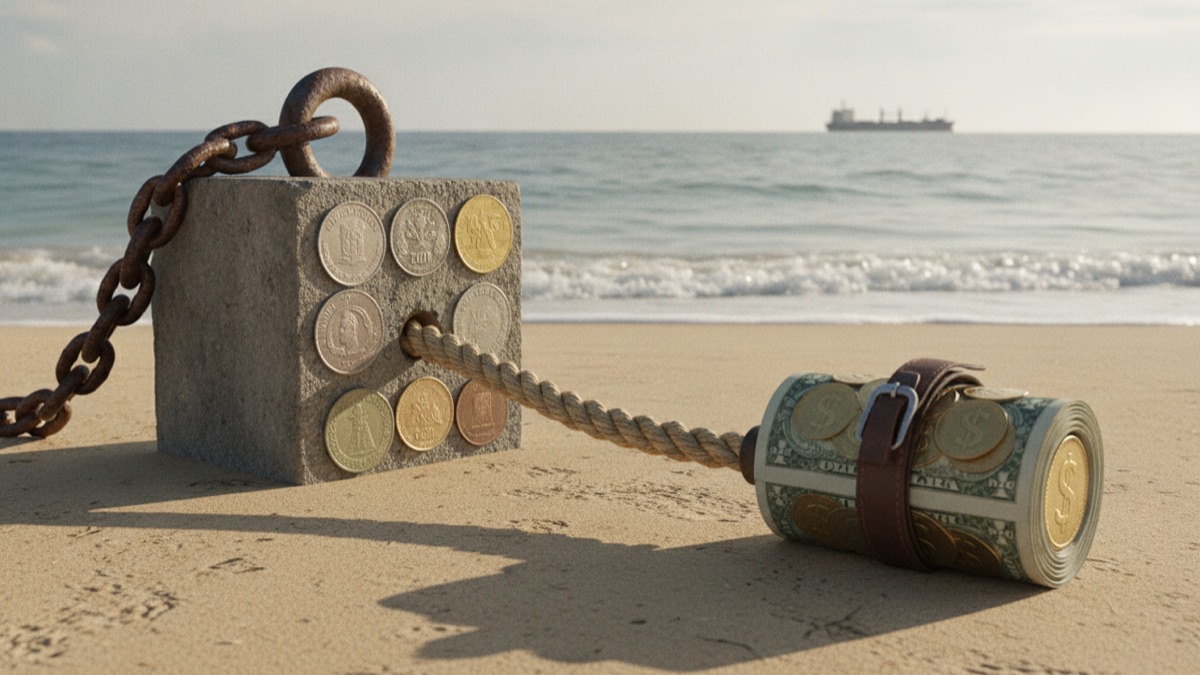
A currency peg is when a country's central bank fixes its exchange rate to another currency, most often the US dollar, instead of letting markets set the price freely. The Saudi riyal, the UAE dirham, and Hong Kong dollar are well-known examples.
Pegging removes exchange-rate uncertainty for trade and investment, which matters most for economies that sell a lot of a dollar-priced commodity like oil, or that rely heavily on foreign investment and want to signal monetary stability.
Trading Volatility for Predictability
The Cost of Defending a Peg
To hold a peg, a central bank must keep enough foreign currency reserves to buy or sell its own currency whenever market pressure pushes the exchange rate away from the target, which effectively hands control of domestic interest rates to the country whose currency is being tracked.
That trade-off is why pegs sometimes break under pressure — as happened to several currencies in the 1990s Asian financial crisis — when a country's reserves run low or investors doubt its ability to keep defending the fixed rate.
Sources
- Wikipedia — overview of fixed exchange rate systems
- International Monetary Fund — explainer on pegged exchange rates
- Federal Reserve Bank of St. Louis — comparison of fixed and floating exchange rate regimes
FAQ
Is the UAE dirham pegged to the US dollar?
Yes — the dirham has been pegged to the US dollar at a fixed rate since 1997, which the UAE Central Bank actively defends.
Can a country choose to stop pegging its currency?
Yes, this is called de-pegging or floating a currency, and countries sometimes do it gradually to avoid shocking markets.
Does pegging a currency prevent inflation?
Not on its own — a peg controls the exchange rate, but domestic inflation still depends on factors like government spending, wages, and import prices.
About the Author
We reference Wikipedia, International Monetary Fund, and Federal Reserve Bank of St. Louis to explain the background and current understanding of this topic.
Loved This Article?
Share it on WhatsApp → Share it on WhatsApp
Get more guides in your inbox — Subscribe to our newsletter for weekly surprising stories from Egypt, Saudi Arabia, Dubai, and beyond.